Resume Keywords: I've Read 1000s of Resumes, Here's My List of 25-30
Where to find your job posting's exact keywords, how many to use (25 to 30), where they go on your resume, and which ones are actually working in 2026.


Written by Dr. Priya Sharma
Career Development Expert & Resume Analyst
Updated August 2026
Reviewed by Sarah Chen
Is your resume ATS-friendly?
Drop your resume in and see which of these skills a scanner can actually read, and which ones the job you want is asking for that you have not listed.
PDF or DOCX. Max 2MB.
We never share your resume or use it to train a model.
In This Guide:
What are resume keywords?
Every posting has a shortlist of words the employer actually cares about, and your resume either has them or it doesn't. That's it. That's the whole game.
I've read thousands of resumes, and the ones that get callbacks aren't the best-written ones. They're the ones that happen to use the same words as the job ad.
Skills and tools
Naming a skill in your skills section
Customer database
CRM platforms
Software names, platforms, methods - Python, Salesforce, Excel, SEO, Scrum. These are the easiest keywords to spot because they're nouns you can point to.
They're also the first thing a recruiter scans for. If a posting says "CRM platforms" and your resume says "customer database," you've made someone guess.
Don't make them guess.
Job titles
Your past titles are keywords too, and so is the title you're applying for. If you managed a team but your old title was something vague like "coordinator," say what you actually did in the language the new posting uses.
Degrees, certifications and licences
Degree names, license numbers, certification titles - these belong under education and certifications, but they count as keywords wherever they sit on the page. How to write one so a scanner finds it is covered in spell out the acronym and the full term.
Industry terms and professional bodies
Every field has its own shorthand - case management, GAAP, HIPAA, membership in a trade body. These prove you've actually worked in the field, not just adjacent to it.
Leave them out and a qualified resume can read like a guess.
Action verbs that carry a keyword
Pairing a verb with a keyword in a bullet
Worked with databases
Optimized SQL queries
"Developed," "managed," "optimized" - on their own these verbs are empty. Paired with a keyword noun, they turn into a real accomplishment: "optimized SQL queries," not just "worked with databases."
Nouns vs verbs: which one gets matched
Here's the part most people get backwards. Applicant tracking software mostly hunts for nouns - the skill, the tool, the credential - not the verb sitting next to it.
The verb makes the sentence read well for a human; the noun is what gets you found.
So if you're only going to fix one thing, fix the nouns. Pull the exact ones from the posting, run them against your resume, and see what's missing - that's a five-minute check, and it's the difference between a resume that gets opened and one that doesn't.
Why do keywords decide whether anyone reads your resume?
Is your resume good enough?
Drop your resume in and see which of these skills a scanner can read, and which ones the job you want is asking for that you have not listed.
Upload your resumeFree. PDF or DOCX. We never share your resume or use it to train a model.
The software screens you before a person does
Before a hiring manager ever opens your resume, software has already read it.
Most companies getting hundreds of applications for a single role run every resume through an applicant tracking system first. That system doesn't decide anything - it ranks and sorts, and a recruiter then works down that list from the top.
Almost every resume still gets at least a brief look from a person, but where you sit in that order decides whether the look is a real read.
What the applicant tracking system counts
The system searches for the words the posting cares about, then ranks you by how often they show up and where.
A keyword sitting inside a real bullet counts for more than the same word sitting alone in a list. Context is what separates a match from a coincidence, which is why where you place them matters as much as which ones you pick.
What keyword stuffing does to you
I've seen resumes with the same word crammed into every section, hoping volume wins. It backfires - the system flags repetition that isn't backed by real experience, and a human reader spots it in seconds and stops trusting the rest of the page.
Why a qualified candidate still gets rejected
This is the part that stings: you can have the exact experience a job needs and still get filtered out, because you described it in your own words instead of the posting's. Run your resume against the actual job description - ResumeJudge will find what's missing and rewrite your resume to include it before you hit submit.
How do you find the right keywords for a job?
How do you find the right keywords for a job?

You don't need a course on this. You need the posting in front of you and twenty focused minutes.
Step 1: Pull them straight out of the posting
Start with the job description itself, especially the first paragraph or two. That's usually where the must-haves live, before the listing drifts into boilerplate about culture and benefits.
Circle every skill, tool, and qualification you see. Don't judge them yet, just collect them.
Step 2: Read five to ten postings for the same role
One posting tells you what one company wants. Ten tell you what the role actually is.
Pull up five to ten job ads for the title you're chasing and write down what keeps repeating. A term that shows up in six of ten postings isn't optional, it's the job.
Step 3: Check the company's own website for its wording
Companies have their own dialect. One calls it "customer success," another calls the same job "client experience."
A quick look at the company's careers page or about section tells you which words they reach for, and using their language back at them never hurts.
Step 4: Look at the level above yours for stretch skills
Pull up a posting one rung above the one you're applying for. You'll usually find two or three skills that show up there but not in your level's listings yet.
Those are worth having in your back pocket, even if you only mention them lightly, because they signal you're already thinking like the next role.
Step 5: Match your own experience to the list
Now go through your list and ask, honestly, which of these you can actually back up. This is where I see people either underclaim or overreach, and neither serves you.
If a keyword sits on your list but you can't point to a place you used it, it doesn't go on the resume. ResumeJudge checks your resume against the posting and rewrites it to include exactly what's missing, so you're not guessing.
Spell out the acronym and the full term
Writing a degree or certification
MFA
Master of Fine Arts (MFA)
Write "Master of Fine Arts" and "MFA." Write "Customer Relationship Management" and "CRM."
A scanner may only search for one form, and you don't get to pick which.
Match the posting's exact wording and tense
Matching the posting's exact term
Project management
Project manager
If the posting says "project manager," don't write "project management." If it says "managing projects," that verb form is what gets searched for.
Some systems still won't credit you for a close relative of the word, only the word itself - and you don't get to know which kind you're up against.
Free tools that pull keywords out of a posting
Paste the job text into a free word cloud generator and the terms that repeat most will jump out visually. It's a fast way to confirm what you already suspected from reading the posting twice.
Where do keywords go on your resume, and how many?
Where keywords go on the resume
| Section | What goes there | Example |
|---|---|---|
| Summary | Job title, company name | Senior Project Manager, applying to Acme |
| Skills section | Tools, software, certifications, grouped | Python, SQL, AWS |
| Work experience bullets | Keyword plus verb plus result | Led the migration to AWS |
| Education and certifications | Degree, major, licence, full name | PMP, Project Management Professional |
Every resume I look at has keywords somewhere. The question is whether they're in the right five places, or crammed into one and thin everywhere else.
The summary
Your job title and the company name you're applying to are the two most important keywords on the whole page, and they belong in your first two lines. Most people save their strongest language for later.
Put it up top instead.
The skills section
This is where the scanner looks hardest, because software and tools are easy to match exactly. Group them - languages together, platforms together, certifications together - rather than one long comma-separated line.
I've got a full breakdown of what actually counts as a keyword if you want the categories.
Work experience bullets
Using a keyword in a bullet, not alone in a list
AWS
Led the migration to AWS
A keyword sitting alone in a skills list proves nothing. The same keyword inside a bullet - "led the migration to AWS" instead of just "AWS" - proves you used it.
Pair an action verb with the keyword and a result every time you can. If you're not sure which of your bullets actually cover what a posting is asking for, running the resume against the job description in ResumeJudge will rewrite those bullets to close the gaps instead of you guessing.
Education and certifications
Applicant tracking systems weight your degree and field of study more than people expect, so state them plainly - degree type, major, and any license or certification by its full name. If a degree isn't finished, say so directly rather than leaving it vague.
How many keywords is too many
Somewhere around 25 to 30 keywords, spread across the whole resume, is the range I'd aim for. Fewer than that and you're probably missing obvious matches.
Repeating the same one over and over is keyword stuffing, and it counts against you.
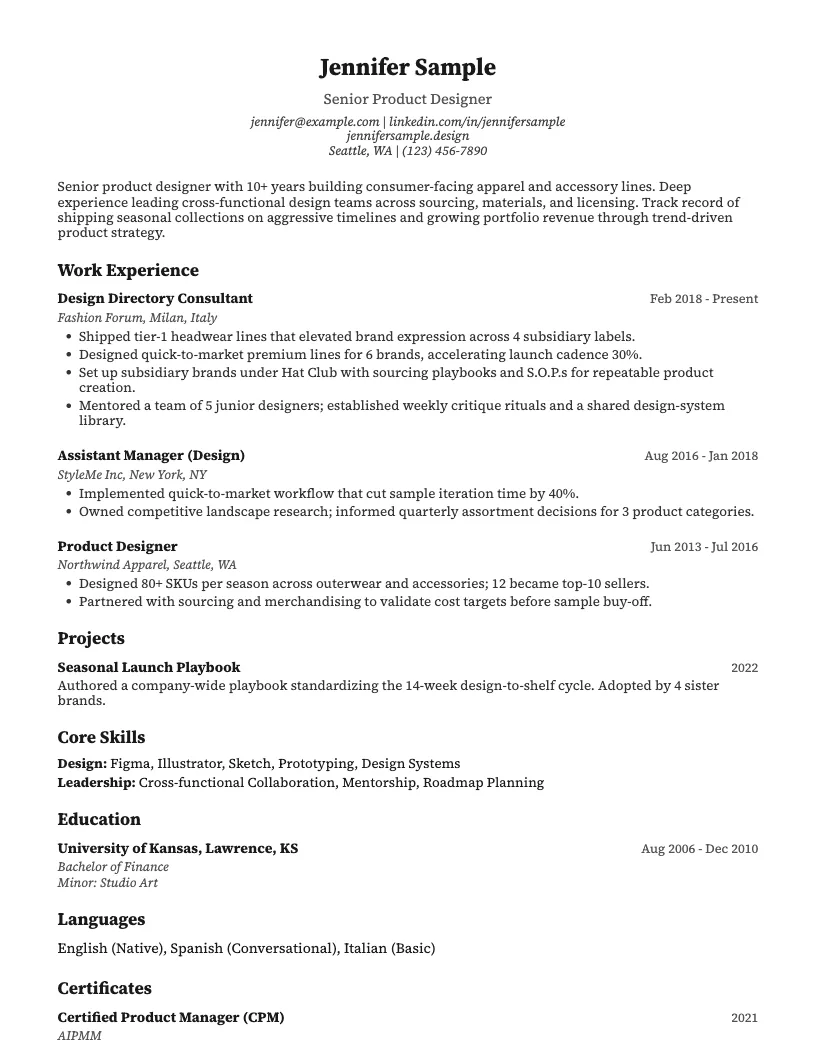
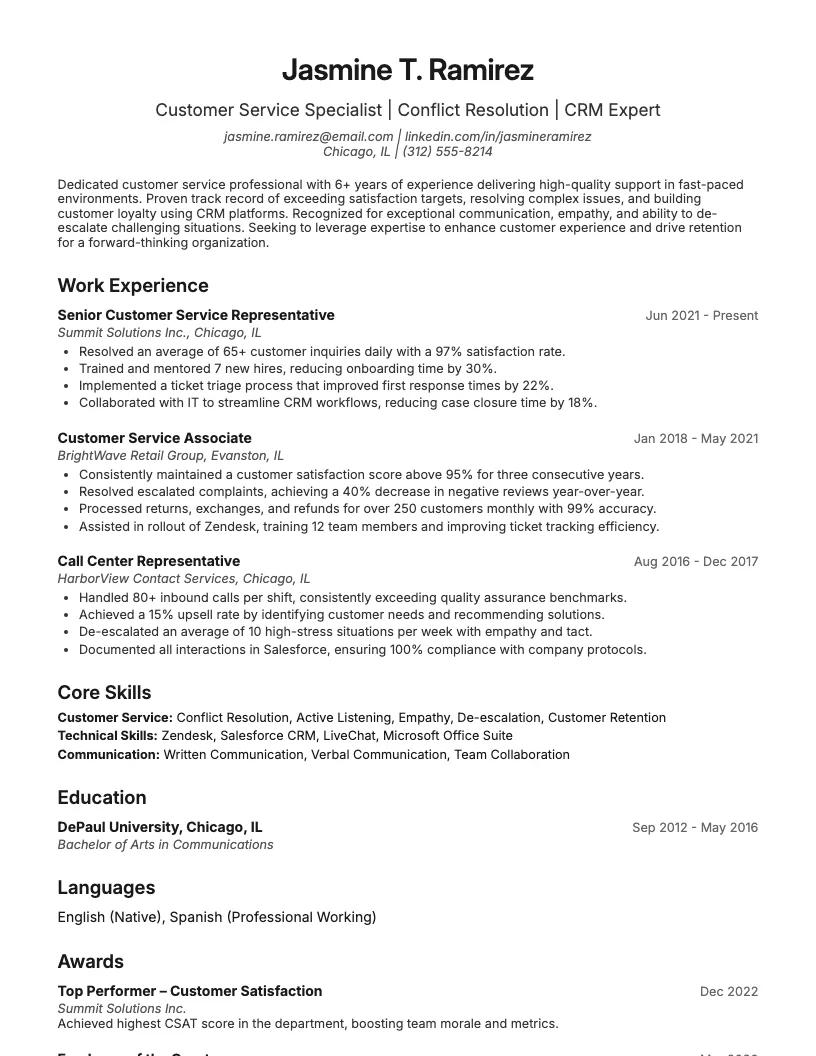
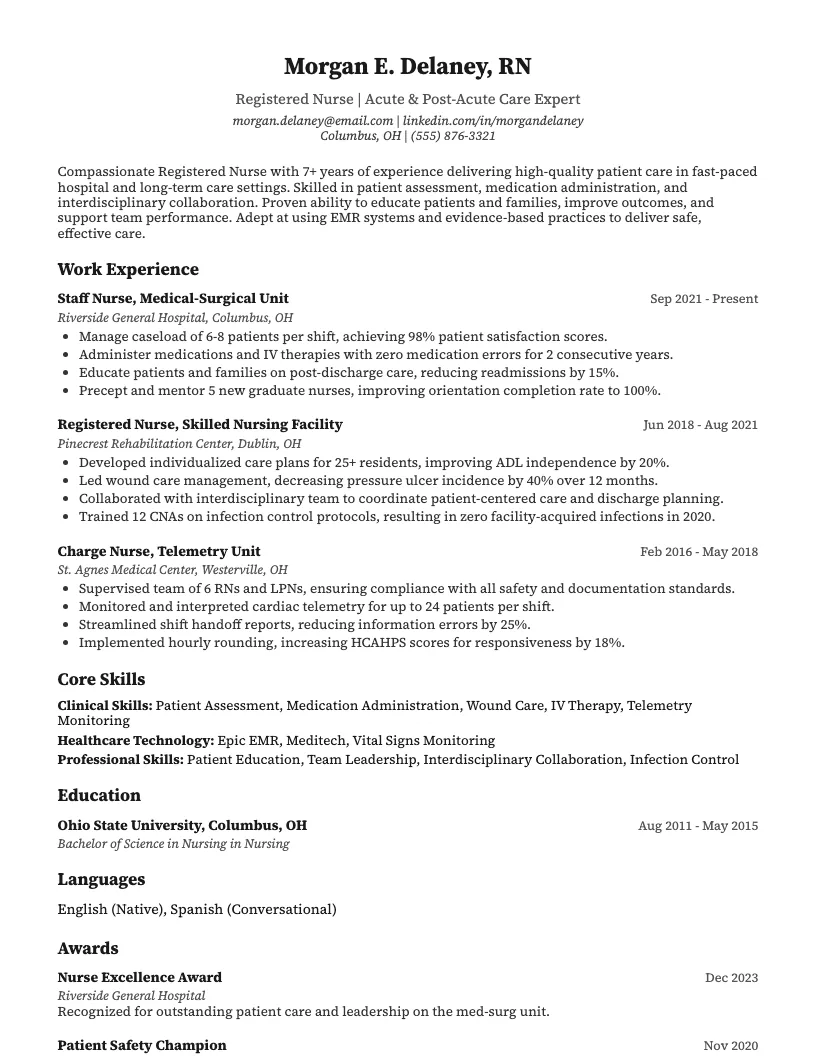
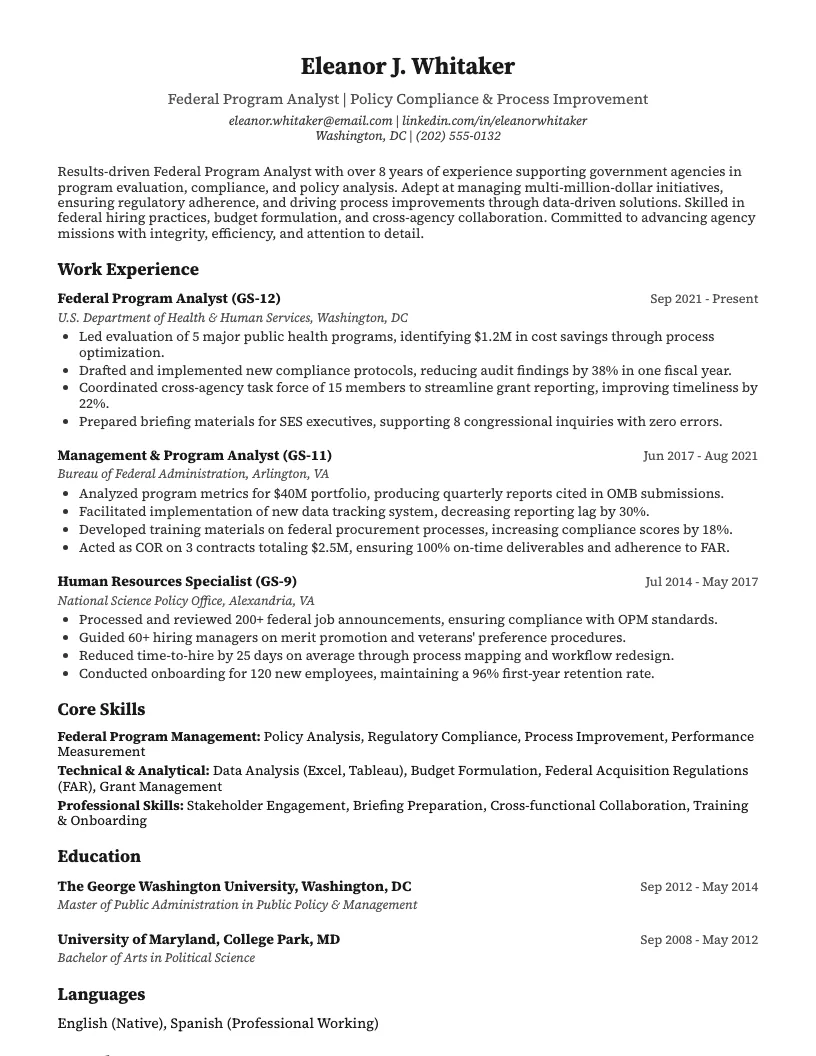
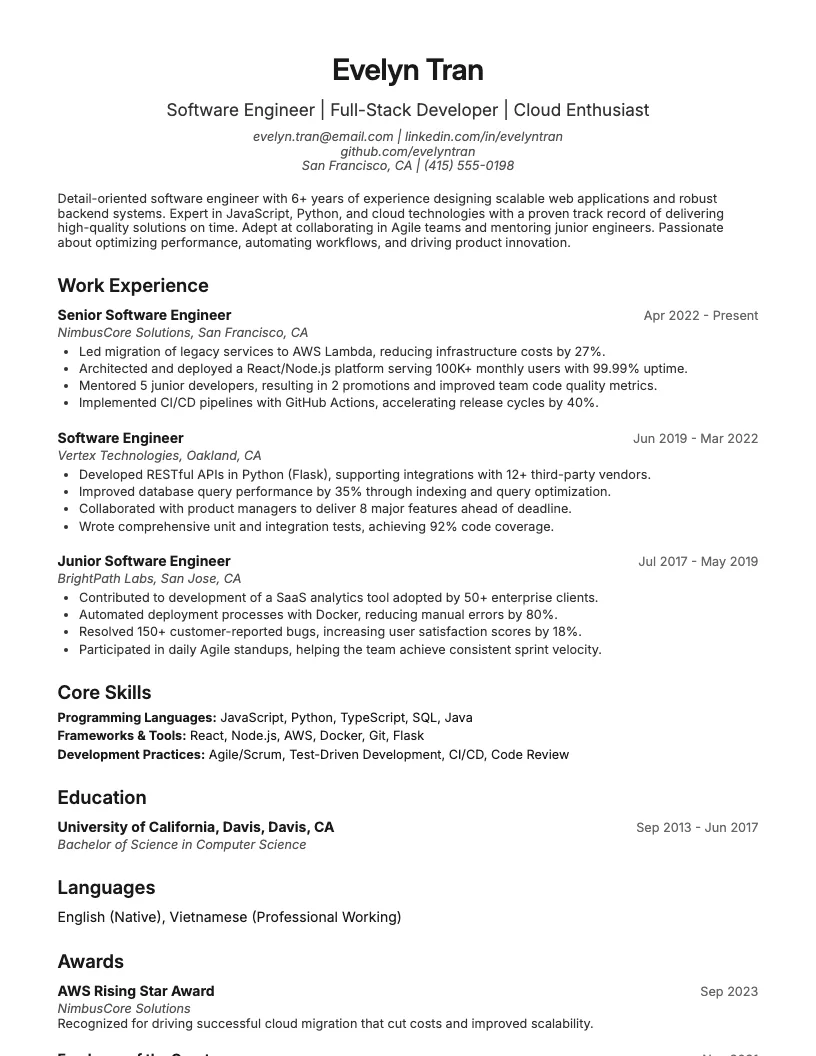
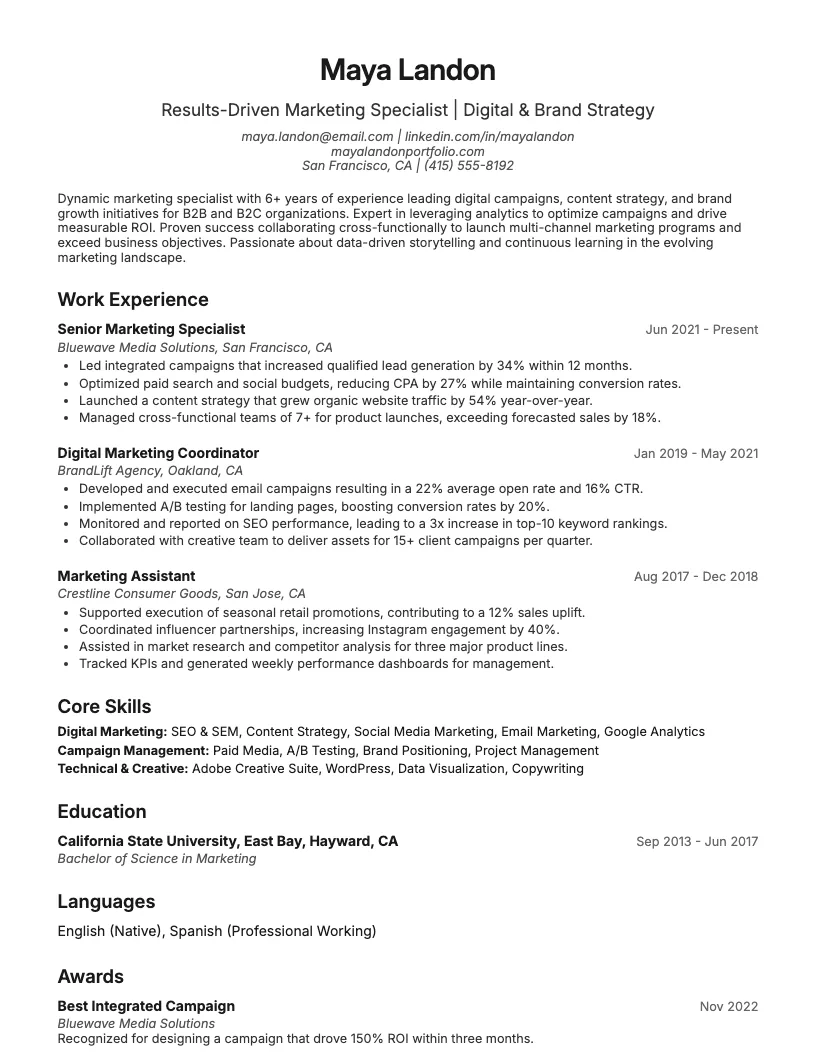
A full resume with its keywords marked
If you want to see this in practice: the job title and years of experience go in the summary, the tools go in skills, and the verbs-plus-outcomes go in the bullets - all pulling from the same posting, none of it repeated word for word. That's the pattern to copy, not any single resume's exact wording.
Keywords for a federal or USAJOBS resume
Federal listings spell out required qualifications in far more detail than a private-sector posting, and a USAJOBS resume needs to mirror that language closely, section by section. That's enough of a different animal that it gets its own page - worth a look if you're applying through USAJOBS.
Keywords in your cover letter
The same keywords that go on your resume belong in your cover letter too - you just get room to explain one or two of them properly instead of just naming them. I'd rather see one keyword backed by a real sentence than five dropped in with no context.
Which keywords are worth using in 2026?
Keyword categories worth using in 2026
| Category | Example keywords | Why it lands |
|---|---|---|
| Technical skills and software | Python, SQL, AWS, Salesforce | Named tools beat vague claims |
| Business and finance | Budget, forecasting, cost reduction | Measurable, a number sits behind it |
| Management and strategy | Strategic planning, risk management | Needs a scope attached to matter |
| Marketing and sales | SEO, pipeline, conversion | Pairs well with a hard metric |
| Operations and administration | Logistics, vendor management | Plain text an ATS matches easily |
| People and process | Coaching, stakeholder management | Works only next to a hard outcome |
I get this question more than almost any other: just give me the list. Fair enough.
Here's what's actually landing on resumes I'd call strong right now, sorted the way most postings sort them.
Technical skills and software
Named tools beat vague claims every time - 'Python,' 'SQL,' 'AWS,' 'Salesforce,' or whatever platform the job runs on, not 'proficient with software.' If you're not sure which ones a posting cares about, that's a straight lookup, not a guess - paste the job description into ResumeJudge and it'll add the skills you're missing straight into your resume.
Automation, data analysis, and cloud terms carry the most weight across roles right now, even outside IT.
Business and finance
Budget, forecasting, cash flow, cost reduction. These work because they're measurable - a hiring manager can picture the number behind them.
"Managed a $2M budget" does more than "financially responsible" ever will.
Management and strategy
Strategic planning, program management, risk management, business analysis. The trap here is using these words without a scope attached - how many people, how big a program, how much risk.
A keyword with no size behind it reads as filler to me nine times out of ten.
Marketing and sales
SEO, brand strategy, pipeline, conversion. Sales resumes get away with more numbers than any other category, and I always push people to use that - quota attainment, deal size, close rate.
If you're not naming a metric here you're leaving your strongest evidence on the table.
Operations and administration
Logistics, scheduling, inventory, vendor management, process improvement. These sound plain, which is exactly why they work - an applicant tracking system is matching text, not judging how impressive it sounds.
People and process
Leadership development, coaching, stakeholder management, cross-functional collaboration. Soft skills like these matter, but only when they sit next to a hard outcome - "coached a team of six to hit quarterly targets" does the job; "great with people" doesn't. This is the same trade-off covered in more depth over in the skills section.
Words that carried a resume in 2011-2019 and no longer do
"Team player," "hard worker," "detail-oriented," "go-getter," "results-driven," "synergy." I still see these constantly, and every one of them is a claim with nothing under it - no tool, no number, no scope an ATS can match against a posting.
If a word could describe literally any candidate for any job, it's not a keyword, it's noise. Swap it for the actual skill or result it was standing in for, and check the count against how many is too many before you call the list done.
Go deeper
ATS Resume Keywords: What Applicant Tracking Systems Look For
Learn what ATS resume keywords are, how an applicant tracking system searches for them, and the 6-step process to find, place, and count the right 10-30.
Read MoreFederal Resume Keywords (USAJOBS and Government Roles)
See the 14 keyword categories, word lists for 6 federal agencies, and the 27 action verbs reviewers score, plus exactly where each one goes on your resume.
Read MoreWhere to Put Keywords on Your Resume
Where keywords actually belong on a resume: the 7 spots that matter, how many times to repeat one, and how to work them into bullets instead of a bare list.
Read MoreSkills Keywords for Your Resume
What skills keywords are, 6 steps to find the ones your target job wants, keyword sets for 10 fields, and how to prove a skill instead of just listing it.
Read MoreSee these skills on a real resume
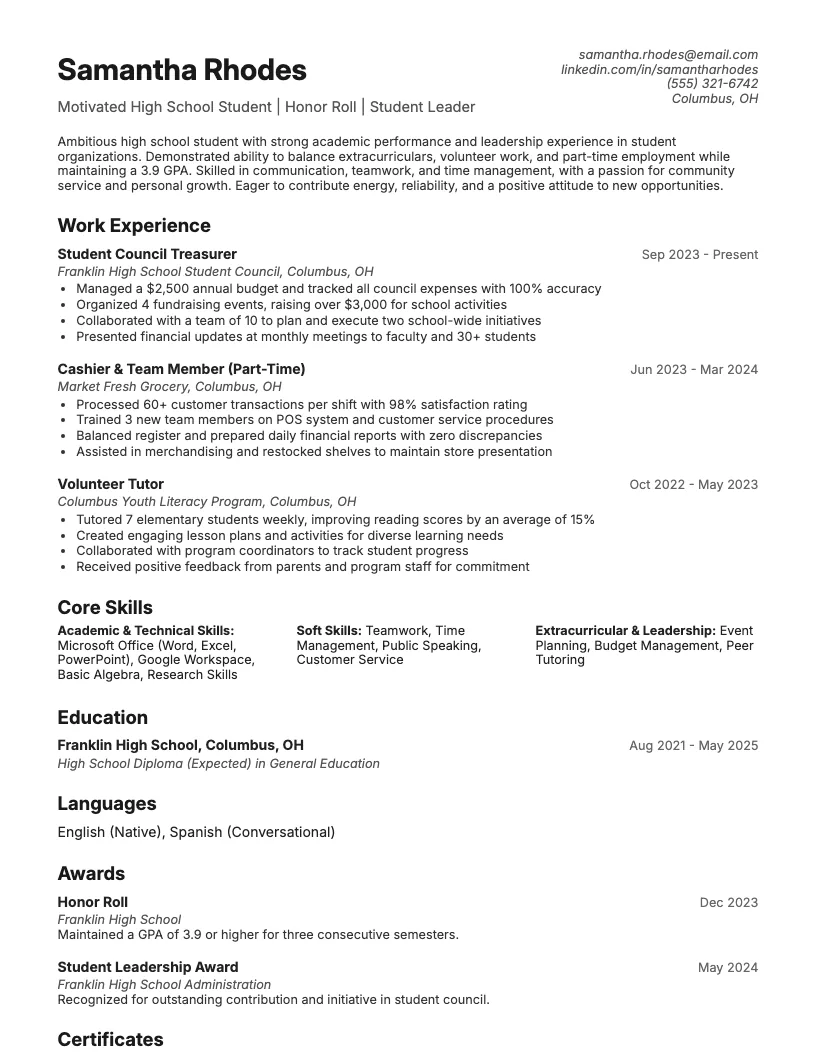
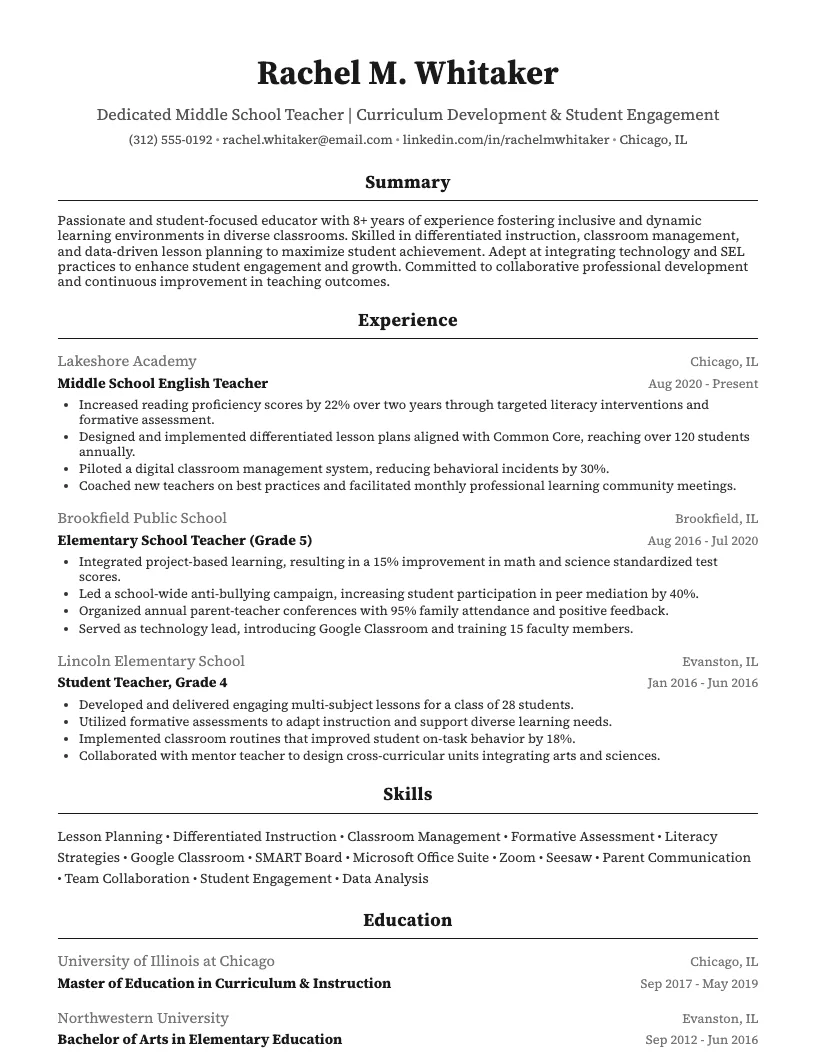
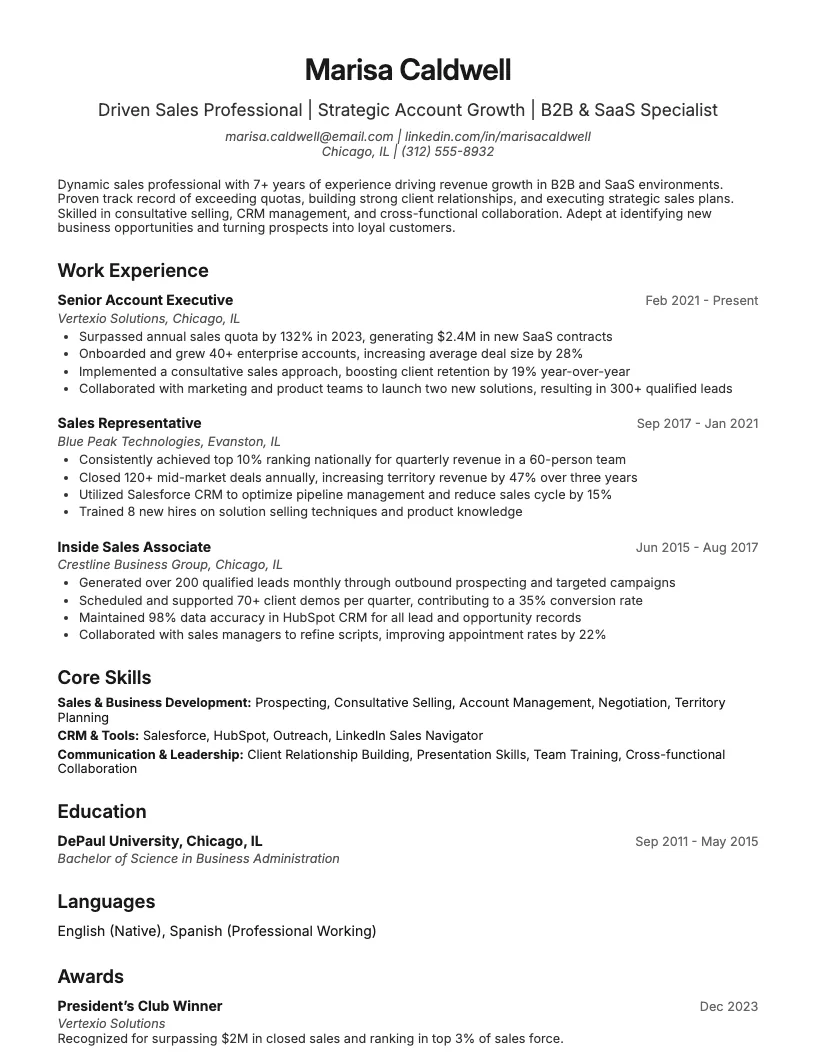
8 examplesStart from an example that already has them, and swap in your own.
Check your resume against the job you want
Scan your resume, see which skills and keywords the posting asks for that you are missing, and fix them before you apply.
Free to use • No credit card required