Nouns to Describe Yourself: 14 Words Plus 35 Verbs to Pair Them With
14 nouns and 35 verbs to describe yourself on a resume, the exact sentence pattern that turns either one into proof, and which ones to leave off entirely.


Written by Dr. Priya Sharma
Career Development Expert & Resume Analyst
Updated August 2026
Reviewed by Sarah Chen
Is your resume ATS-friendly?
Drop your resume in and see which of these skills a scanner can actually read, and which ones the job you want is asking for that you have not listed.
PDF or DOCX. Max 2MB.
We never share your resume or use it to train a model.
In This Guide:
What is a noun that describes yourself?
You've been asked to describe yourself in a word, or you're staring at the top of your resume trying to find one. That word is usually a noun.
A noun names what you are, not what you're like
"Organized" describes a trait. "Organizer" describes a role you've actually filled.
That difference matters more than people think. A noun puts you in a category a hiring manager already recognizes - mentor, analyst, communicator - and categories are easier to hire for than trait lists.
"Problem solver" vs "good at solving problems"
I've read thousands of resumes, and "good at solving problems" reads like a shrug. "Problem solver" reads like a job title.
Nine times out of ten, the noun version is shorter and stronger. Say the same thing with a verb sentence behind it and you've paired it with a real result.
Where a self-describing noun goes on a resume
It belongs in your summary line, not scattered through your bullets.
One or two nouns up top set the frame; the bullets below prove them with verbs and numbers.
When an adjective works better
Adjectives still have a place - modifying a noun you've already earned, like "detail-oriented analyst."
On their own, though, adjectives are cheap. Anyone can claim to be "hardworking."
Fewer people can back up "mentor" with a sentence about who they trained.
What nouns can you use to describe yourself professionally?
What nouns can you use to describe yourself professionally?

Here are the ones I actually see land, and what each one is doing on the page.
Problem solver
This is the most common one I see, and also the most common one done wrong.
On its own it's a claim, not evidence. Pair it with the moment you fixed something - a broken process, an angry customer, a missed deadline - and it stops being filler.
I go into the pairing pattern later on this page, but the short version: name the problem, name what you did, name what happened after.
Team player
Everyone writes this. Almost nobody backs it up.
The fix isn't to cut the noun, it's to attach it to something specific - a project with more than one department on it, a handoff you made work. If you're not sure whether "team player" is even a noun here, I cover that in the FAQ.
Self-starter
This one earns its place on a resume with no manager breathing over it - freelance work, a solo project, a first job where you had to figure things out. It's weak when you're describing a role that was heavily supervised.
Use it where it's true, not where it sounds good.
Strategic thinker
I'd save this for people with a few years in and a decision behind them - a plan you built, a tradeoff you weighed, a direction you set. On an entry-level resume it reads like it was copied from somewhere else, because it usually was.
Quick learner
Underrated. If you switched industries, picked up a tool nobody trained you on, or ramped up faster than expected, this noun is doing real work.
I show a full example of turning it into a sentence - "learned Tableau and rebuilt the weekly report in a month" - in the pairing section.
Multitasker
Honestly, I'd think twice before leading with this one. Hiring managers read "multitasker" as "can't finish one thing before starting another" almost as often as they read it as a compliment.
If what you mean is that you ran several accounts or projects at once, say that instead - it's the same claim with proof attached.
Critical thinker
Close cousin of "problem solver," and it suffers from the same issue - it's an unproven claim until you attach a decision to it. A version of this claim that actually works: you looked at data, weighed options, picked one, and it paid off.
That's a critical thinker. The noun by itself is not.
Mentor
Use this one when you trained, onboarded, or coached someone - even informally. I see people leave it off because they never had the word "manager" in their title, but you don't need a title to have mentored a coworker.
If you did it, claim it.
Communicator
Vague on its own, useful when it's tied to who you communicated with and why - clients, executives, a cross-functional group. "Strong communicator" with nothing after it is the kind of line I skim past on hundreds of resumes a month.
Organizer
This one's underused. If you ran a calendar, a budget, an event, or a rollout with a lot of moving parts, "organizer" earns its keep.
It pairs naturally with the organizing verbs later on this page - coordinated, scheduled, tracked.
Analyst
Only use this if you actually work with numbers or data - spreadsheets, reports, dashboards, trends. I've seen it slapped onto resumes for roles that never touched a dataset, and it doesn't survive a follow-up question in an interview.
Advocate
This works well for anyone whose job involves representing someone else's interests - a customer, a patient, a client, a cause. It's specific enough to mean something, which is more than most of this list can say.
Specialist
Good when you've gone deep in one lane - a tool, a process, a market - and you can name it. "Specialist" with no subject after it is just a title with no content.
"Payroll specialist" or "onboarding specialist" tells a hiring manager exactly what to expect from you.
Generalist
The opposite case, and it's a real strength for small teams or early-stage companies where one person wears several hats. I wouldn't lead with it for a role that wants deep expertise in one thing - save it for jobs where the posting itself asks for range.
Nine times out of ten, the noun that actually helps you is the one pulled straight from the job posting, not the one that sounds most impressive. If you're not sure which of these show up in a listing you're applying to, ResumeJudge will scan the posting and tell you exactly which ones it's asking for - and which ones your resume is currently missing.
What is a verb that describes yourself?
A verb names something you did
A verb on a resume names an action you took: coordinated, rebuilt, negotiated. It's the part of a bullet someone can check.
The case for why that carries more weight than naming what you are, and how the two go together in one sentence, is in How do you pair a noun with a verb in one sentence.
Past tense for old jobs, present for the current one
This trips people up more than it should. Anything in the past - a previous role, a finished project - gets past tense: managed, built, cut. Your current job gets present tense: manage, build, cut.
I see resumes every week with "manages a team of six" under a job from three years ago. It reads as a copy-paste error, because it usually is one.
Why a verb beats an adjective on a resume bullet
"Hardworking" and "dedicated" ask the reader to take your word for it. A verb doesn't ask - it shows. "Reduced onboarding time by 30%" doesn't need the word "dedicated" anywhere near it; the number does that job.
If you're not sure your bullets are landing, running the resume against the actual job posting will show you exactly which verbs and skills it's missing before a hiring manager ever sees it.
One verb per bullet
Cutting a stacked verb down to one
Responsible for managing and coordinating the onboarding process
Coordinated onboarding for six new hires each quarter
Nine times out of ten, when I see a bullet that opens with "responsible for managing and coordinating," the fix is picking one verb and cutting the rest. Two verbs stacked together usually means neither one is doing much work. Pick the one that names the pattern from How do you pair a noun with a verb in one sentence: verb, then what, then result.
What verbs can you use to describe yourself?
Verb categories and when to use them
| Category | Verbs | Use it for |
|---|---|---|
| Leading | led, directed, mentored, coached, supervised | Owning an outcome or growing someone |
| Building | built, designed, developed, launched, created | Making something from nothing |
| Fixing | resolved, streamlined, rebuilt, simplified, corrected | Repairing or improving what was broken |
| Numbers | increased, grew, doubled / reduced, cut, eliminated | A metric that moved, with a number attached |
| Organising | coordinated, scheduled, tracked, managed, planned | Admin and operations work |
| Persuading | negotiated, pitched, presented, advised, trained | Making a case or passing on knowledge |
Nine times out of ten, the resumes that read flat aren't missing skills - they're missing verbs. Pick one strong verb per line and the same experience suddenly reads like an achievement instead of a job description.
Verbs for leading people: led, directed, mentored, coached, supervised
Use "led" when you owned the outcome, "directed" when you set the strategy from above it, "supervised" when the job was making sure the work got done right. "Mentored" and "coached" are for one-on-one growth - a junior hire, a struggling teammate.
Don't reach for "led" if you were just the senior person in the room; hiring managers can tell the difference.
Verbs for building things: built, designed, developed, launched, created
"Built" and "developed" both work for something made from nothing, but "designed" implies you planned the thing before anyone touched it, and "launched" belongs at the end - the moment it went live. I've seen candidates use "created" for everything, which flattens a six-month project and a five-minute template into the same word.
Match the verb to the size of the thing.
Verbs for fixing things: resolved, streamlined, rebuilt, simplified, corrected
"Resolved" is for a specific problem with an end date. "Streamlined" and "simplified" are for something that kept working but was slow or messy - you took steps out.
"Rebuilt" means you started over. Pick whichever matches what you actually changed, not whichever sounds biggest.
Verbs for growing numbers: increased, grew, doubled, expanded, raised
These need a number right after them - "increased" with no percentage attached is a sentence half-finished. If you're not sure the number belongs before or after the verb, see where the number goes.
Verbs for cutting numbers: reduced, cut, lowered, eliminated, saved
"Eliminated" means the thing is gone entirely - a step, a cost, a manual process. "Reduced" and "lowered" mean it's smaller, not gone.
Don't say "eliminated" if you just made something faster; that's "streamlined" or "cut."
Verbs for organising: coordinated, scheduled, tracked, managed, planned
These are the workhorse verbs for admin and operations roles, and the mistake I see most often is stacking three of them in one bullet. "Coordinated and managed and tracked" tells me nothing - pick the one that names what you actually spent your time doing.
Verbs for persuading: negotiated, pitched, presented, advised, trained
"Negotiated" implies two sides and a deal at the end. "Pitched" is one-directional - you made the case, someone else decided.
"Advised" and "trained" both mean you passed on knowledge, but "trained" usually means it stuck as a formal process. If you're not sure which of these actually matches the posting you're applying to, ResumeJudge will pull the exact verbs and skills that job description asks for and show you what your resume is missing before you send it.
How do you pair a noun with a verb in one sentence?
Is your resume good enough?
Drop your resume in and see which of these skills a scanner can read, and which ones the job you want is asking for that you have not listed.
Upload your resumeFree. PDF or DOCX. We never share your resume or use it to train a model.
A noun on its own is a claim. A verb next to it is proof.
I've read enough resumes to know the pattern that works, so here it is.
The pattern: verb + what + result
Start with the verb, name the thing you touched, end with what happened because of it.
Drop any piece and the sentence goes soft - "resolved issues" tells me nothing without the issue and the outcome attached.
"Problem solver" turned into "resolved a supplier failure in 48 hours"
Turning 'problem solver' into a bullet
Was a problem solver on the team
Resolved a supplier failure in 48 hours
"Problem solver" is a label anyone can put on themselves.
"Resolved a supplier failure in 48 hours" is a sentence only someone who actually did it can write, and that's the difference a hiring manager is scanning for.
"Team player" turned into "coordinated three departments on a shared launch"
Turning 'team player' into a bullet
Team player who works well with others
Coordinated three departments on a shared launch
Same swap. "Team player" says nothing about what you did with the team.
"Coordinated three departments on a shared launch" says exactly what you did and how big the team was.
"Quick learner" turned into "learned Tableau and rebuilt the weekly report in a month"
Turning 'quick learner' into a bullet
Quick learner who picks up new skills fast
Learned Tableau and rebuilt the weekly report in a month
The weak version is a personality trait. The strong version names the tool, the task, and the deadline you hit.
That's what "quick" actually looks like on paper - a month, not a vague sense of speed.
Where the number goes
Put it at the end, next to the result, not buried in the middle of the sentence.
"48 hours," "three departments," "a month" - each one lands harder as the last thing the reader sees.
If you're not sure which of your old bullets still lean on a bare adjective instead of this pattern, that's the kind of gap ResumeJudge flags automatically - it scans your resume against a posting and tells you exactly where a claim needs a verb and a number behind it before you hit apply.
How do you describe yourself in a resume summary?
Your summary is three lines at the top of the page. It's also sitting right at the top of the page, so it's worth more thought than a noun buried in a bullet further down.
The noun goes in the first line
Open with what you are, not with "I am." Something like "Detail-oriented coordinator with three years in event logistics" beats "I am a hardworking person who wants to grow."
One tells them what to expect from the rest of the page. The other tells them nothing.
Example summary for a first job
"Organized and quick-learning marketing assistant with hands-on experience from two internships and a semester leading a student club's social accounts. Comfortable picking up new tools fast and delivering on tight deadlines."
Example summary for a mid-career move
"Analyst with five years turning messy sales data into decisions leadership actually acts on. Known for finding the number that changes the plan, not just the number that fills the slide."
Example summary for a career change
"Former operations manager now focused on UX research, bringing a decade of reading what people actually do versus what they say they'll do. Completed a research certification and led two independent usability studies this year."
Notice the career-change one leans harder on the noun and the credential, because there's no matching job title to lean on yet.
How many nouns is too many
One, maybe two. I've read summaries that open "Dynamic self-starter, team player, and results-driven problem solver" and by the third noun I've stopped believing any of them.
Pick the one word that's actually true of you and back it with a result in the next sentence. If you're not sure which noun the job wants, ResumeJudge will scan the summary against the posting and tell you if you're leading with the wrong one.
How do you say these out loud in an interview?
How do you say these out loud in an interview?
The nouns and verbs on your resume have to work out loud too. I've sat through interviews where someone's resume said "problem solver" and then they froze the second someone asked them to prove it.
Don't let that be you.
"Tell me about yourself" - noun first, then the verb sentence
Open with the noun that matches the job, then back it up with a verb sentence straight off your resume. Something like: "I'm an organizer - at my last job I coordinated three departments on a shared launch."
Noun, then proof. That's the whole formula, and it's the same pattern this page has been building toward the whole way through.
"Describe yourself in three words" - how nouns fit that answer
Pick three nouns that each cover a different strength, not three that all mean the same thing. "Analyst, mentor, communicator" tells someone three separate things about you.
"Team player, people person, collaborator" tells them one thing three times. Give each word one sentence of backup and stop - nobody wants a speech.
"How would your colleagues describe you?"
This one wants a noun that comes from someone else's mouth, not yours. "My manager called me the go-to person for onboarding new hires" lands harder than "I'm a mentor" because it sounds like a fact you overheard, not a label you gave yourself.
Borrow the noun, then give the one example that earned it.
Keeping it under 30 seconds
One noun, one verb sentence, one number. That's it - I've seen candidates talk themselves out of a good first answer by adding a fourth and fifth example nobody asked for.
If you want to check whether your answer actually matches what the posting is asking for, that's exactly what ResumeJudge's resume scan does - it compares your resume against the job description and tells you what's missing before you walk in the room.
Which nouns and verbs should you leave off?
I've read thousands of resumes at this point, and a handful of words show up so often they've stopped meaning anything. Here's what to cut.
Rockstar, ninja, guru
These were fun in 2012. Now they read as filler, and on an ATS-scanned resume they're wasted space where a real skill or a real result could sit. When I hit one, I stop believing the line it's sitting in.
Go-getter, people person, perfectionist
None of these can be proven. "Go-getter" tells me nothing about what you went and got. "People person" tells me nothing about who you managed or persuaded. If you can't attach a number or a result to it, it's just noise - see how the number pairs with the verb for what to write instead.
Thought leader, visionary, genius
Nine times out of ten, a candidate who calls themselves a visionary or a genius has weaker proof underneath than the one who just states what they built. Save the self-praise. Let the problem solver → resolved a supplier failure in 48 hours example show you the difference - the result does the bragging for you.
Verbs that say nothing: helped, assisted, worked on, was responsible for
These are the most common weak verbs I see, and they're the easiest fix on this whole page. "Helped launch a product" could mean you wrote one line of copy or ran the whole rollout - the reader can't tell, so they assume the smaller one. Swap in one of the verbs for building things or whichever action verb actually matches what you did.
The one test: can you name the thing you actually did?
If a word could sit on anyone else's resume without changing a single fact, it's not doing its job. Ask yourself: can I point to the file, the number, the deadline, the deal? If a job posting uses one of these weak terms, ResumeJudge will still catch it as a matching keyword - but it also flags the vague verbs sitting next to it and rewrites the bullet with the stronger one and the result attached, so you're not stuck guessing which fix actually lands.
How do you pick the ones that fit your job?
Nouns and verbs by industry
| Industry | Nouns | Verbs |
|---|---|---|
| Sales | closer, negotiator, relationship-builder | closed, pitched, negotiated, grew |
| Tech | builder, engineer, problem solver | built, launched, debugged, shipped |
| Healthcare | caregiver, advocate, coordinator | treated, monitored, coordinated, trained |
| Admin | organizer, coordinator, communicator | scheduled, tracked, managed, streamlined |
| First job, no experience | none yet - the noun can wait | organized, trained, built |
There's no master list. The right noun and verb depend entirely on what the posting asks for and what the role actually does all day.
The words themselves are earlier on this page - the nouns and the verbs. This section is about narrowing them down to one job.
Take the nouns straight from the posting
Open the job description and underline every noun it uses for the person it wants: "collaborator," "self-starter," "analyst." Those are the words the hiring manager already has in their head.
Use them back. This isn't cheating - it's how you show up in a keyword scan, and it's the fastest way to sound like you read the posting instead of recycling an old resume.
If you want a second opinion on which of the posting's words you're actually missing, that's exactly what ResumeJudge checks - it compares your resume against the posting and tells you which skills and keywords aren't showing up yet.
Pick the verb that matches what the role does all day
A sales job wants verbs like closed and negotiated. An operations job wants streamlined and coordinated.
Don't reach for "led" just because it sounds strong - pick a verb that describes the actual work, or it reads as filler.
Nouns and verbs for a sales resume
Pair the noun and verb you pick with a number - "grew territory revenue 22% in a year" beats "results-driven closer" every time.
Nouns and verbs for a tech resume
I've reviewed enough engineering resumes to know "responsible for the codebase" tells a recruiter nothing - "rebuilt the deploy pipeline, cut release time from a day to an hour" tells them everything.
Nouns and verbs for a healthcare resume
Precision matters more here than almost anywhere else - vague verbs read as a lack of clinical detail, not modesty.
Nouns and verbs for an admin resume
Nine times out of ten, the strongest line on an admin resume is the one with a number of calendars, vendors, or budgets attached to it.
Nouns and verbs for a first job with no experience
You still have verbs, just from smaller rooms - a class project, a shift, a club. Organized a fundraiser, trained two new hires, built a spreadsheet the team still uses. The noun can wait for your summary line; the verb is what proves it.
Once you've matched the words to the role, ResumeJudge can take your resume and that same posting and rewrite the wording for you, section by section, instead of you guessing at each line.
Frequently Asked Questions
Is "team player" a noun or an adjective?
It's a noun - a label for a role, not a quality like an adjective would be. That's why it works best as something you back up rather than a claim you make on its own: name the team, the size, and what you did in it, rather than just writing "team player" and moving on.
Can I start a resume bullet with a noun instead of a verb?
Yes, but a strong action verb is still the stronger default for most bullets. A noun works to open a bullet when it names your role or the result up front, like "Lead of a five-person team that cut turnaround time by 20%" - just don't let every bullet on the page open that way, or the resume starts to read like a list of job titles instead of accomplishments.
Should I use "I" on my resume?
No - resumes drop the pronoun and start bullets straight with the verb or noun, so "Managed a team of six" rather than "I managed a team of six". It reads as an established convention rather than an error, and it's one of the clearest signals of a resume that hasn't been proofread.
Do I use past or present tense for my current job?
Present tense for the ongoing parts of your current job, past tense for anything already finished. So "Manage a team of six" for what you still do, but "Led the migration that cut costs by 15%" for a project that's done, even if it happened at your current job.
How many different verbs should one resume have?
There's no fixed count, but repeating the same verb three or more times across a one-page resume reads as thin. Aim for a different verb on each bullet where you can, and save your strongest ones - the ones that show impact, not just activity - for your most recent or most relevant roles.
Do the same nouns work on LinkedIn?
Mostly, yes - the same identity nouns carry over. The difference is tone: LinkedIn's About section allows first person and a more conversational voice than a resume does, so the nouns can sit inside sentences like "I'm a product manager who..." instead of the clipped, pronoun-free style a resume needs.
Does using the posting's nouns help with applicant tracking systems?
Yes - most tracking systems match against the exact wording in the posting, so borrowing its nouns raises your match score. ResumeJudge scans your resume against a job posting, flags the nouns and skills it's asking for that your resume is missing, and rewrites your resume to work them into the right sections instead of leaving you to guess which ones matter.
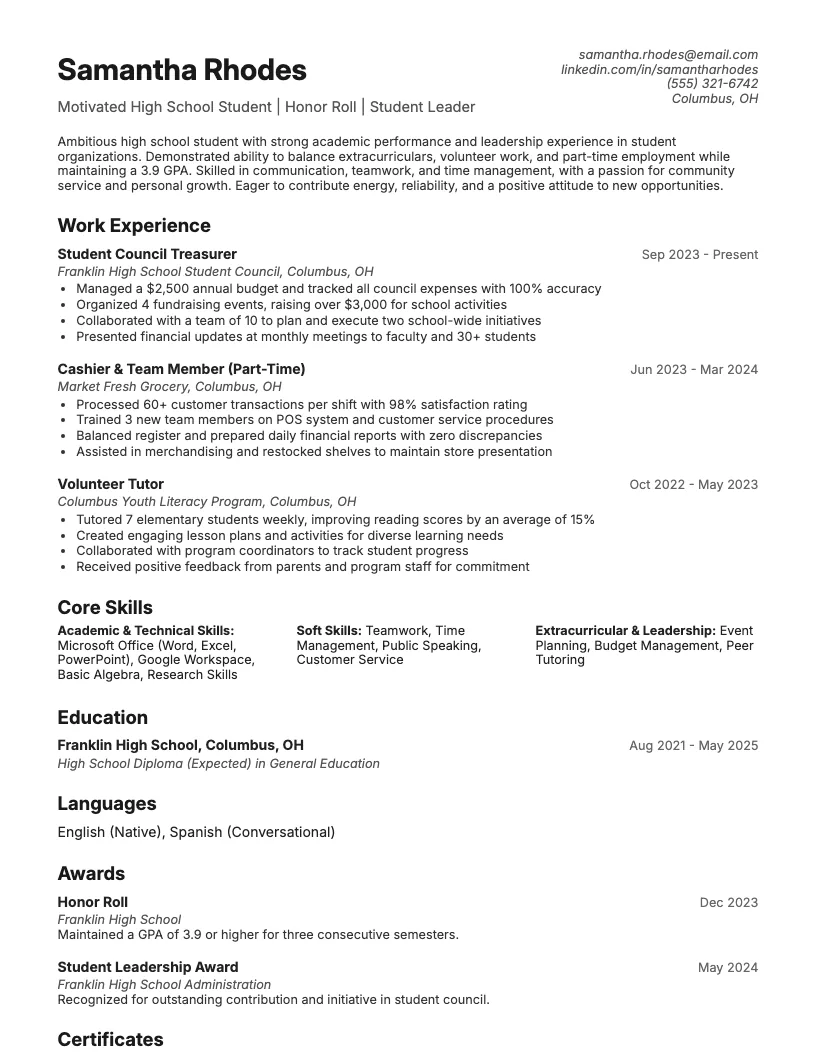
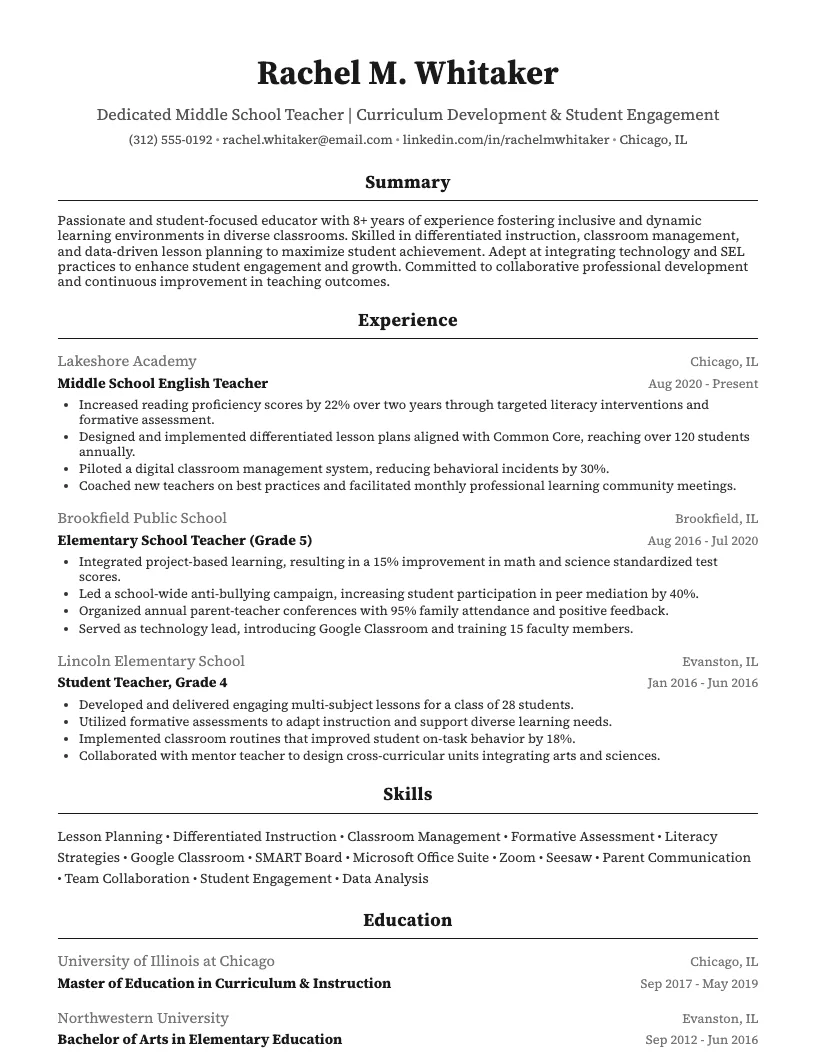
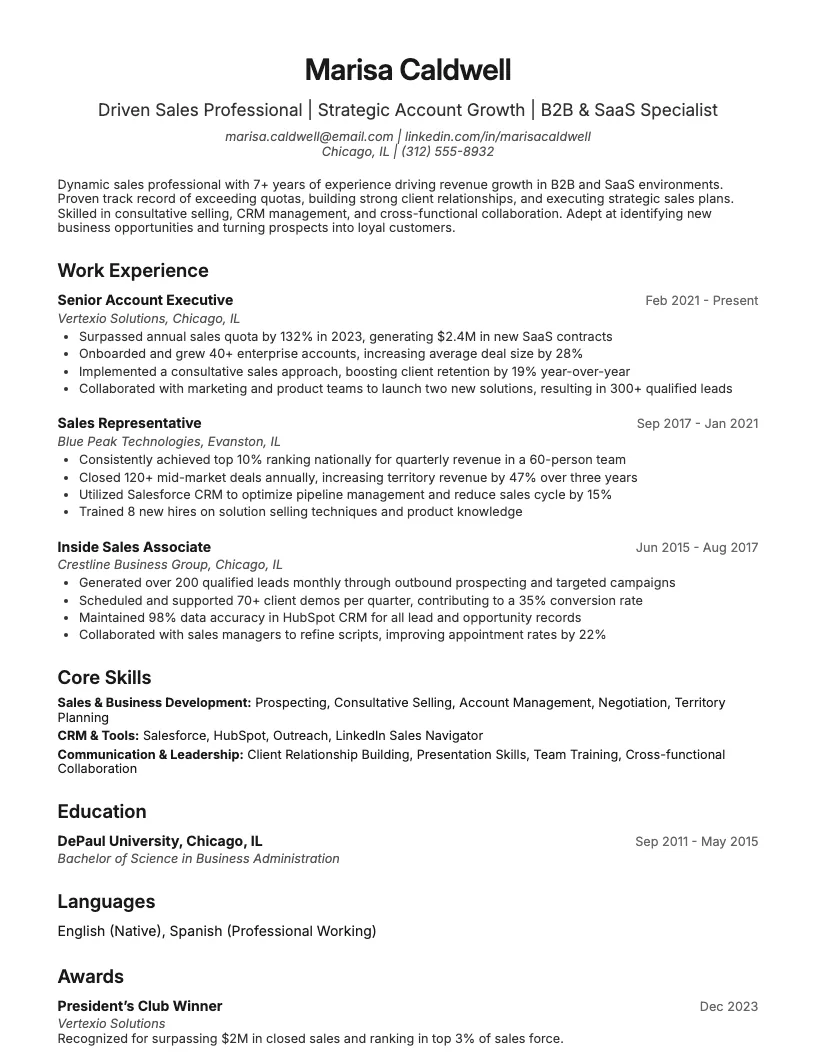
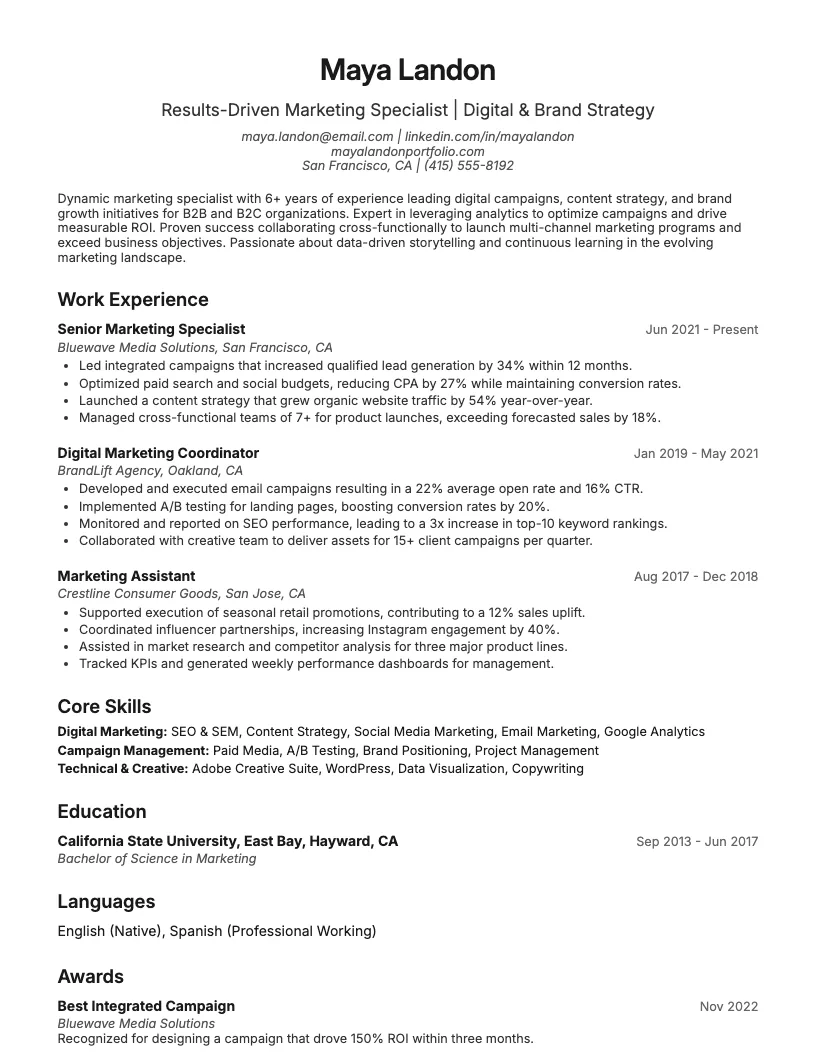
See these skills on a real resume
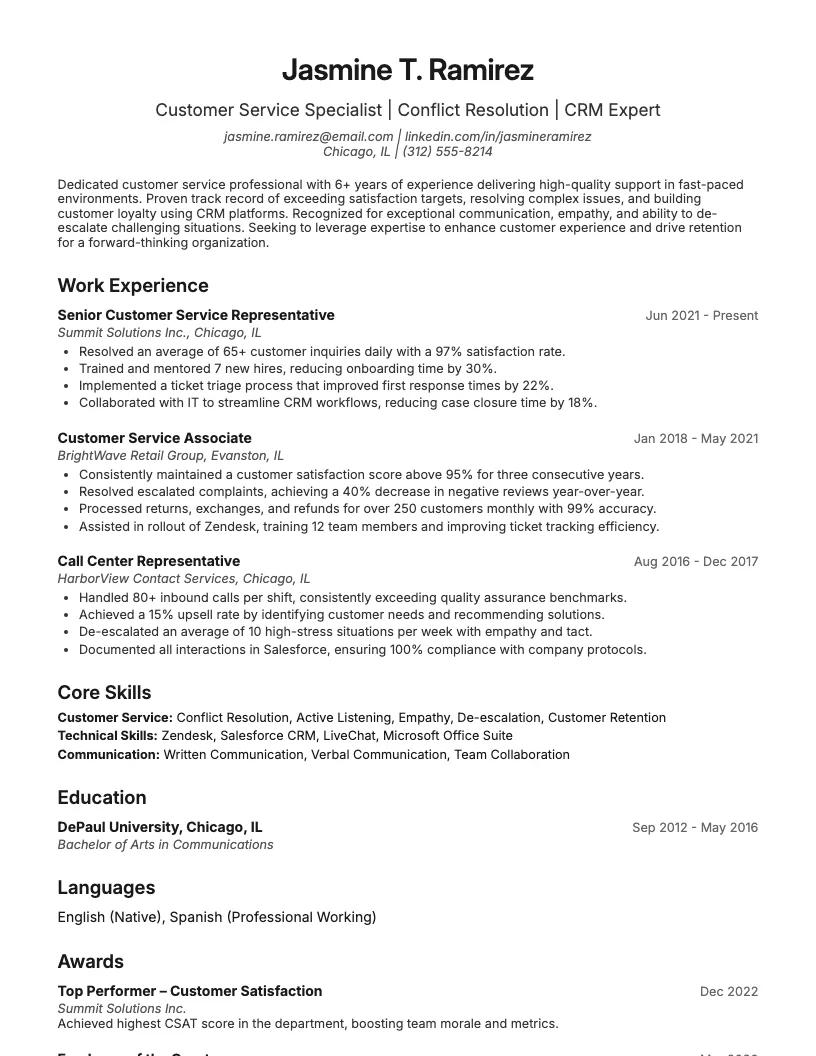
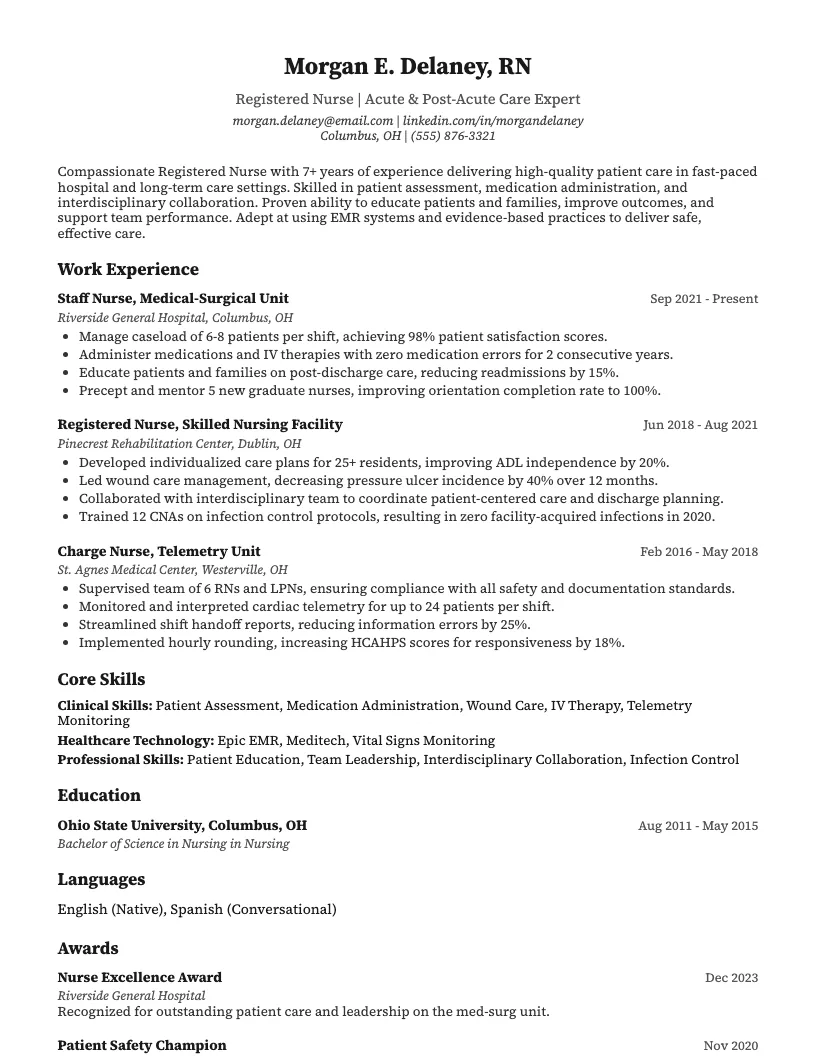
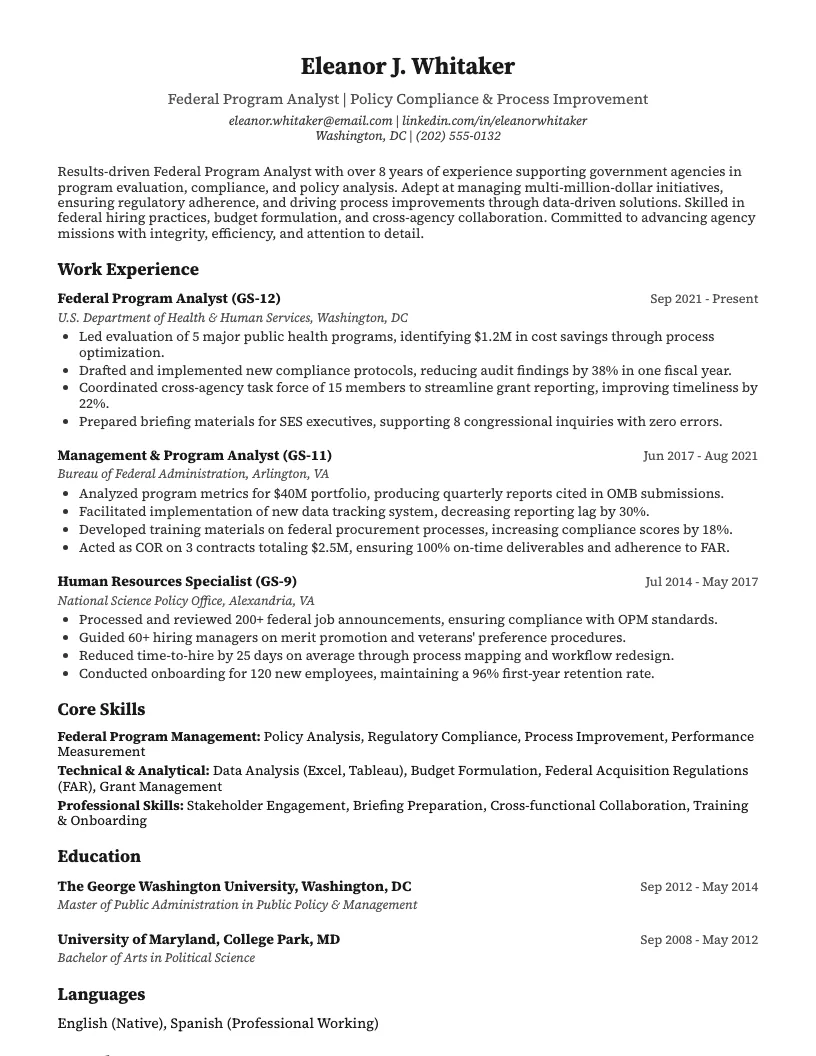
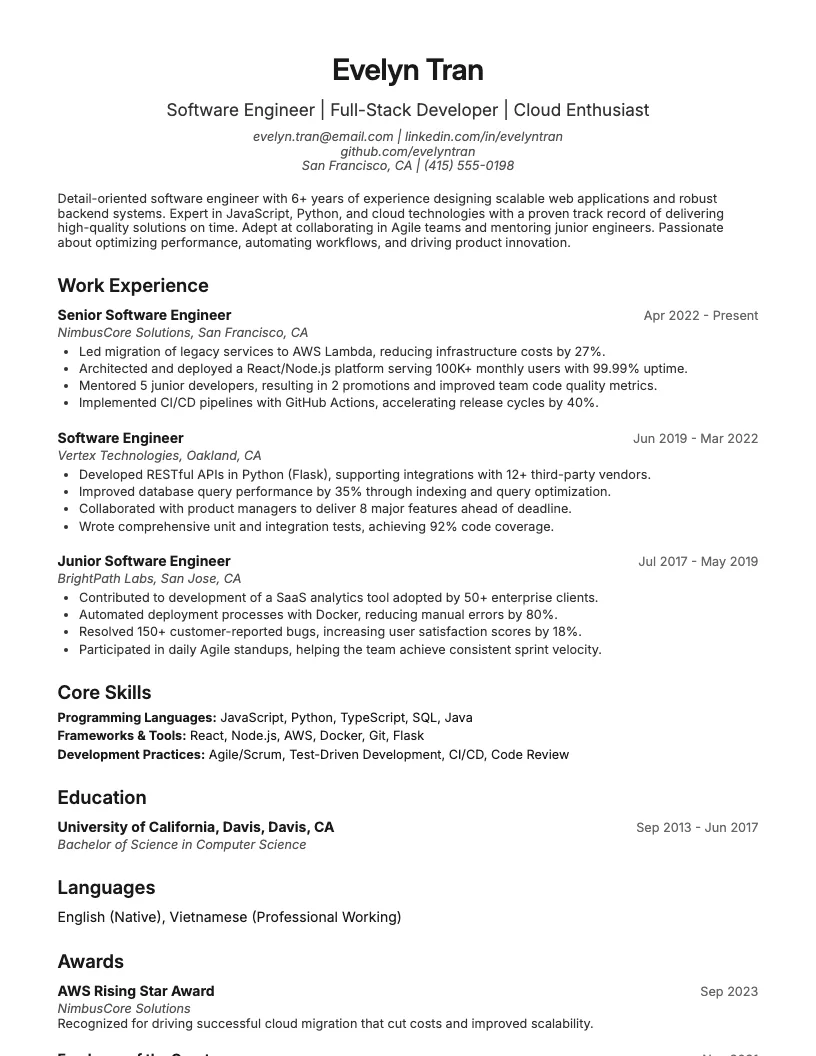
8 examplesStart from an example that already has them, and swap in your own.
Check your resume against the job you want
Scan your resume, see which skills and keywords the posting asks for that you are missing, and fix them before you apply.
Free to use • No credit card required