Resume Adjectives: 10 Categories to Use, 7 Words That Fall Flat
See the 10 categories of resume adjectives that actually hold up, the 7 words to cut, where each one belongs on the page, and how to pick the right ones from a job posting.


Written by Dr. Priya Sharma
Career Development Expert & Resume Analyst
Updated August 2026
Reviewed by Sarah Chen
Is your resume ATS-friendly?
Drop your resume in and see which of these skills a scanner can actually read, and which ones the job you want is asking for that you have not listed.
PDF or DOCX. Max 2MB.
We never share your resume or use it to train a model.
In This Guide:
What are resume adjectives?
Someone reads your bullet points, and one adjective is doing all the work: "led a collaborative team," "delivered results through strategic planning." That's a resume adjective - a word that describes the manner of what you did, not the thing itself.
An adjective describes how you did the work, not what you did
If "what you did" is manage a budget, the adjective is the word sitting in front of it: careful, disciplined, proactive. It's a modifier, not a claim on its own.
Adjective vs action verb: "led" is the verb, "collaborative" is the adjective
I've read hundreds of these, and the two get mixed up constantly. "Led" is the action verb - it tells the reader what you did.
"Collaborative" is the adjective - it tells them how. You need both, and they do different jobs.
Why an adjective on its own proves nothing
"Results-oriented team player" is three adjectives and zero evidence. Nine times out of ten, that's the line a recruiter skims straight past, because anyone can claim it and nobody can check it.
On its own, an adjective is a word choice, not a qualification.
The one rule: every adjective needs an achievement sitting next to it
The fastest gut check: cover the adjective with your thumb. If the sentence still proves something, the adjective was decoration. If it goes blank, you were missing the achievement, not the word.
This is the one rule worth remembering: never let an adjective stand alone. Pair it with a number or a result - "collaborative" next to "worked with five teams to cut delivery time."
Before you apply, it's worth running your bullets against the actual job posting to check the adjectives you've picked are the ones that posting cares about - that's exactly the kind of gap ResumeJudge will fix by rewriting your bullets to match.
What are the best adjectives to describe yourself on a resume?
Is your resume good enough?
Drop your resume in and see which of these skills a scanner can read, and which ones the job you want is asking for that you have not listed.
Upload your resumeFree. PDF or DOCX. We never share your resume or use it to train a model.
Once you've got the rule down - every adjective needs proof sitting next to it - the next question is which words are actually worth the space. I've read resumes across every field, and the same ten or so words show up on nine out of ten of them.
Here's what to reach for instead, sorted by what you're actually trying to prove.
Communication
Skip "great communicator" - it says nothing. I'd rather see articulate, persuasive, or diplomatic, because each one hints at a different skill: articulate suggests you write and speak clearly, persuasive suggests you can move a room, diplomatic suggests you can deliver bad news without starting a fire.
Pick the one that matches the story your bullet is about to tell.
Teamwork and collaboration
"Team player" is the phrase I see most often and trust least, because it's the one word that never gets backed up with a bullet. Try collaborative, or something more specific like consensus-building or diplomatic if the work was actually about getting people to agree.
A word like cooperative only lands if the sentence after it names who you worked with and what came out of it.
Leadership
Leadership words are the easiest to overclaim, so I'm strict about them: decisive, resourceful, and accountable all work because they describe a behavior, not a job title. Visionary and transformative are fine at the top of a career, but they read as empty on a first resume with no team to point to.
If you led anything, even a project with two other people on it, that's enough to earn one of these - just say what you led it toward.
Work ethic
This is where resumes get generic fastest. Committed, disciplined, and tenacious all beat "hard-working," because they survive the follow-up question - what does that look like day to day?
Use one, then answer that question in the same bullet.
Organisation
"Organized" alone tells a hiring manager nothing about how you actually work. Systematic, methodical, and precise are stronger because they point at a process - a system you built, a method you followed - rather than a personality trait.
If you can name the process, use the word; if you can't, leave it out and just describe what you did.
Problem solving and analysis
"Analytical problem-solver" has been used so many times it barely registers anymore. Words like insightful, strategic, and pragmatic do more work, because they describe how you got to the answer, not just that you got there.
Pragmatic in particular is underused - it's a good signal for anyone applying to a role where speed matters more than perfection. ResumeJudge can pull the exact skill words a job posting is asking for, which is worth checking before you guess which of these fits.
Adaptability
Adaptable and versatile are the two safest bets here, and agile if you're in a technical or process-heavy field where the word already carries weight. What I look for is a change you handled - a new tool, a reorg, a client that shifted scope - sitting right next to the word, because "adaptable" without an example is the easiest claim on the page to skip past.
Creativity
Creative on its own is a claim everyone makes, so it's worth almost nothing by itself. Inventive, original, and pioneering carry more weight if you follow them with something you actually made or launched.
This overlaps with what to leave off your resume - "innovative" has drifted into the same overused bucket as "hard-working," so use it sparingly.
Results and performance
These words only work with a number attached - results-driven, data-driven, high-performing are fine, but they're placeholders until a figure shows up next to them. I'd rather see "grew retention 12%" with no adjective at all than "results-oriented" with nothing behind it.
If you're not sure your resume proves the numbers it claims, run it against the actual job posting - ResumeJudge scores that gap and rewrites the thin sections so the evidence backs up what you're claiming.
Customer and client work
Client-centric, responsive, and dependable earn their keep here because they map to something a customer actually felt - fast replies, follow-through, being easy to work with. Attentive and service-oriented work too, but only if there's a retention number or repeat-business figure nearby to back them up.
Without that, they read exactly like "team player" does - a claim with nothing behind it.
Where do you put adjectives on a resume?
Where do you put adjectives on a resume?

Same adjective, three different jobs to do depending on where it sits.
In your resume summary
This is where adjectives earn their keep. You've got two or three lines to make someone keep reading, so two or three carefully chosen words is the right amount here, no more.
Something like "strategic, results-driven marketing manager with 8 years leading data-driven campaigns that grew revenue 22 percent." Notice the adjectives set up the sentence, but the number closes it.
In your work experience bullets
One adjective per bullet, max, and it has to sit right next to an action verb and a result. "Collaborative team member responsible for project delivery" is the version I see constantly, and it says nothing.
"Led a collaborative cross-functional team that cut project turnaround time 30 percent" is the same claim with proof attached. See what a bullet looks like before and after for more of these side by side.
In your skills section
Skip the temptation to stack adjectives next to every skill in the list. Pick one per entry, if any: data-driven project management, client-centric account development, process-oriented workflow optimization.
Pull the wording from the job posting when you can. That's also the fastest way to survive an applicant tracking system, and it's the exact check ResumeJudge runs when you paste in a posting - it finds which of these skill-section words the listing wants and writes them into your resume for you.
How many adjectives is too many
My rule of thumb: two or three in the summary, one per major bullet, and none anywhere you can't back up with a number. If a word can't be tied to a measurable result, cut it rather than soften it.
What a bullet looks like before and after
A resume bullet with an adjective
Managed a collaborative team to improve performance.
Led a collaborative team of 8 that increased quarterly productivity 25 percent.
Weak: "Managed a collaborative team to improve performance." Strong: "Led a collaborative team of 8 that increased quarterly productivity 25 percent."
Weak: "Developed a strategic marketing plan." Strong: "Implemented a strategic, data-driven marketing plan that increased lead generation 32 percent in six months."
The formula underneath both: action verb, one adjective, measurable result.
How do you pick the right adjectives for the job you're applying to?
How do you pick the right adjectives for the job you're applying to?
Here's how I'd describe yourself on a resume if I were sitting next to you: stop picking the word first.
Every strong choice I've seen starts from something you actually did, not a list of keywords to describe yourself that sounded good.
Start from the achievement, not the word
Think of a moment you're proud of at work, then ask what made it happen.
Did you keep three people aligned on a deadline? That's "coordinated," not "organized."
The achievement tells you the word, never the other way round.
Pull the wording out of the job posting
Read the posting and circle every trait it names outright.
If it says "detail-oriented" or "collaborative," those are the words it wants back. This is where I'd point you at ResumeJudge - paste the posting in and it'll rewrite your resume with the exact terms it's missing.
Match the adjective to the kind of role: leadership, technical, customer-facing, creative
The words for each kind of role are already sorted out in the best adjectives to describe yourself - leadership, problem solving and analysis, customer and client work, creativity.
The same person can honestly claim different words depending on which role they're describing.
Ask a colleague how they'd describe you
I always tell people to ask someone they've worked with, not a friend.
Colleagues notice patterns you're too close to see, and nine times out of ten they hand you a better word than the one you'd picked yourself.
Check you can back the word up before you keep it
Before a word goes on the page, ask if you have a real example sitting behind it.
No example, no word - cut it. This is the same test I'd apply to how many adjectives is too many: if you can't back it up, it doesn't earn its place.
Which adjectives should you leave off your resume?
Some words show up on so many resumes that they've stopped meaning anything. A recruiter reads them and moves on without registering them at all.
I've read enough of these to know the pattern: the word goes in because it sounds safe, not because it's true. Here's what to cut, and what I'd write instead.
| Instead of | Why it falls flat | Write this |
|---|---|---|
| Hard-working | Nobody claims the opposite | A specific effort with a result attached |
| Detail-oriented | Everyone says it, nobody proves it | The precision-heavy task you actually did |
| Results-oriented | Vague on its own | The number the result produced |
| Proactive | A buzzword with no evidence | The action verb for what you initiated |
| Team player | Says nothing about how you work with people | Collaborative, or the specific thing you coordinated |
| Seasoned | Reads as filler | Let the years and the achievements make the case |
| Responsible | Employers assume this by default | The actual responsibility, spelled out |
Hard-working
Nobody applies for a job and admits they're lazy, so this word carries zero information. Show the effort through a number instead - hours saved, a deadline hit under pressure, a project you carried without being asked.
Detail-oriented
This is the most overused phrase I see, full stop. Name the thing that needed precision - a budget you reconciled to the cent, a QA process with a defect rate - and let the reader draw the conclusion.
Results-oriented
Fine as a description, useless as a claim. Replace it with the result: revenue, retention, time saved.
If you don't have the number yet, that's the gap to fix before this section, not this one.
Proactive
I see this word land on resumes that never say what was actually started. Swap it for the action verb - launched, flagged, redesigned - and the initiative shows itself without you having to name it.
Team player
Too vague to picture. If you mean you led cross-functional work, say collaborative and back it with the project.
If you mean you supported others, say supportive and name what you supported.
Seasoned
This one dates you more than it flatters you. Your years of experience already show up in your work history - let the achievements carry the weight instead of a label.
Responsible
Every job comes with responsibilities, so stating you had them proves nothing. Say what you were responsible for and what happened as a result - that's the sentence a hiring manager actually reads.
Words nobody can check: honest, smart, loyal
These describe character, not work, and there's no way for a stranger reading a resume to verify any of them. Cut them entirely - a resume proves competence, not personality.
Words that read badly: rockstar, ninja, guru
I still see these on resumes, mostly from people trying to stand out in tech or marketing. They land as unprofessional nine times out of ten, and they tell a recruiter nothing about what you can do.
If you're not sure whether a word you've kept is actually a strength the role wants, run your resume against the job posting - ResumeJudge will find which of the posting's real requirements are missing from what you've written and rewrite it in, which is a more useful test than any adjective.
How do you say you're a fast learner on a resume?
Why "fast learner" gets ignored
"Fast learner" is one of the words to leave off your resume, and it fails for the same reason the rest of them do. The rest of this section is what to write in its place.
Better words: adept, receptive, versatile, resourceful
Swap the phrase out for a word that sounds like you already learned the thing.
Adept says you pick up new tools quickly. Receptive says you take feedback and training well. Versatile says you move between different kinds of work without missing a beat. Resourceful says you figure things out without waiting to be shown.
Pick one, not all four - using every synonym on the list reads as noise, not evidence.
Name the skill underneath instead: listening, research, planning, picking up new systems
Better than any single word: name what you're actually good at.
Being a fast learner usually breaks down into a few real skills - listening well enough that you don't need things repeated, researching a problem before you ask for help, planning your own onboarding, or picking up new software fast. Say the specific one.
Prove it with a first-year number
This is where most resumes stop, and it's the part that actually convinces someone.
Give a number from your first months in a role: booked your first deal in six weeks, hit full quota by month three, took on a second product line before your first review. A job posting will often name the exact system or skill it wants you to ramp up on fast - running your resume against it in ResumeJudge will show you if that number is landing near the right words, and rewrite the line so it does.
Where it goes: skills, education, experience
Don't stack all of this in one spot.
Put the named skill in your skills section, put certifications or coursework in education, and put the number in a bullet under experience. Spread across all three, it reads as a pattern instead of a claim.
How do you describe yourself in a CV?
US resume vs UK/EU CV wording
| US resume | UK/EU CV | |
|---|---|---|
| Opening section | Summary | Personal statement |
| Typical length | 2-3 sentences | 3-4 sentences |
| Adjective count | 2-3 | 2-3 |
| Words that misfire | Rockstar, passionate | Read as too salesy |
A US resume and a UK or EU CV want different things in this spot, and mixing them up is the single most common tell that someone copy-pasted a US template abroad.
What changes between a US resume and a UK or EU CV
A US resume usually opens with a summary. A UK or EU CV opens with a personal statement, and it runs longer, closer to three or four sentences.
The job's the same: sum up who you are before anyone reads a bullet. The tone is just a notch more formal.
Your personal statement: two or three adjectives, no more
I'd stick to two or three adjectives here, same as I would for a US summary. Pack in five and none of them land.
Pair each one with what backs it up - the same shape as the resume summary example, where the number does the proving, not the adjectives.
Example: a graduate personal statement
"A diligent and adaptable business graduate who managed a 12-person society budget and grew membership by 30 percent in one year. Now looking to bring that organisation to a client-facing analyst role."
Two adjectives, one achievement each. That's the whole formula.
Example: a mid-career personal statement
"A collaborative operations manager with six years' experience streamlining supply chains, cutting delivery times by 18 percent across three warehouses. Known for turning messy handoffs into repeatable processes."
Notice there's no "hard-working" or "dedicated" in sight - the numbers are doing that job instead.
Example: a career changer's personal statement
"A resourceful former teacher moving into UX research, bringing five years of reading a room and adapting on the fly to user interviews and usability testing."
When you're changing lanes, the adjective has to explain why your old skills transfer, not just describe you. If you're not sure which words the new field actually wants, run your draft against a real job posting and see what's missing - that's exactly the kind of gap ResumeJudge fixes for you before you apply.
Adjectives that read as American and what to use instead
"Rockstar," "results-driven," and "passionate" all read as distinctly American to a UK or EU hiring manager - see words that read badly for why those particular ones backfire everywhere. Swap them for "committed," "thorough," or "meticulous," which land as sincere rather than salesy on that side of the Atlantic.
Frequently Asked Questions
How many adjectives should I use on my resume?
Two or three in your summary, and no more than one next to any single bullet point. See [how many adjectives is too many](#how-many-adjectives-is-too-many) for the rest of the rule, including what to do with a word you can't back up.
Can I use the same adjectives in my cover letter?
Yes, reusing a few keeps your resume and cover letter sounding like the same person. The cover letter gives you more room, though, so use it to explain the adjective with a short story instead of just repeating the word.
Do adjectives help or hurt with applicant tracking systems?
On their own, adjectives don't move the needle either way - applicant tracking systems are matching skills and tools from the job posting, not scoring your vocabulary. They only matter if the posting itself uses one as a skill term, in which case matching it can help you clear the screen. ResumeJudge checks your resume against a job description and flags the skills and keywords it's missing, so you can see which ones are actually worth matching.
Should I use "I" when describing myself on a resume?
No, drop it. Resume bullets start straight with the action - "Led a team of five," not "I led a team of five" - since the "I" is understood and just eats space you could give to a result.
What three words describe me best in an interview?
There's no fixed answer, but pick three that don't repeat the same idea - one about how you work, one about your personality, and one about the quality of your output. Have a quick example ready for each one, because an interviewer will usually ask you to prove it.
Is it bad to use an adjective the job posting used?
No, it's usually a good sign - it shows you read the posting and you're speaking their language. Just make sure you can back it up with something specific from your own experience, or it reads as copying rather than fitting. ResumeJudge shows you which words from a posting are missing from your resume, so you can see where echoing its language would actually help.
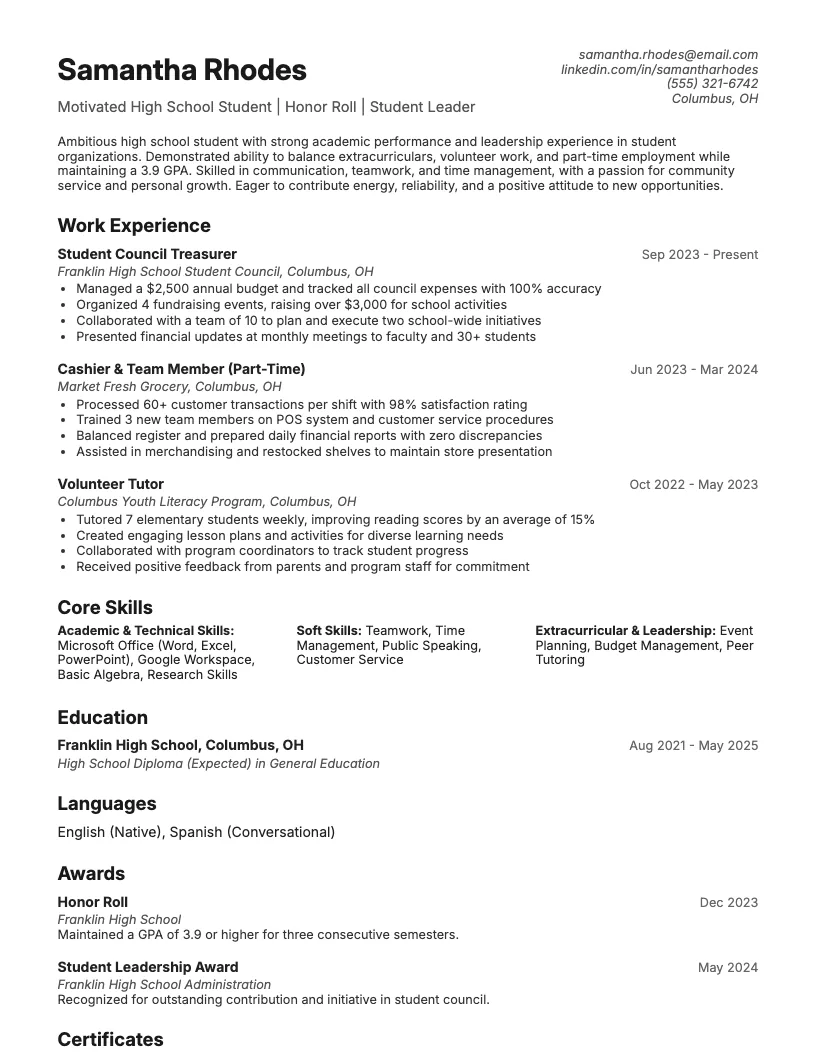
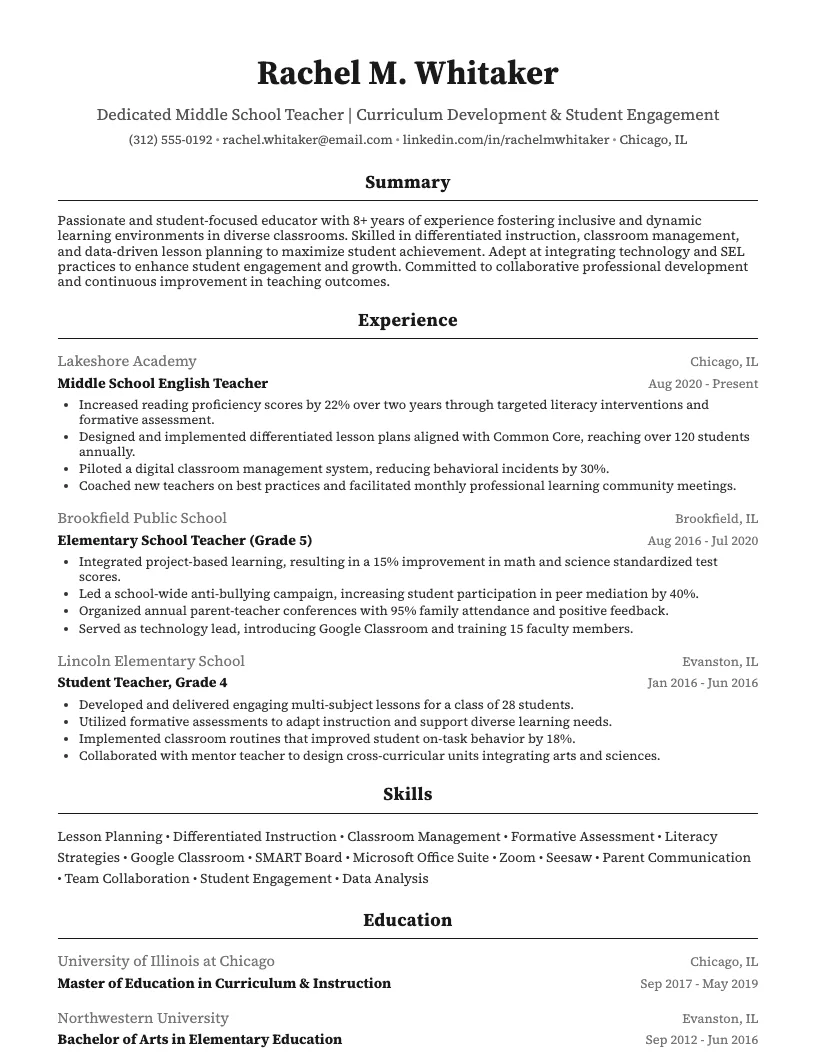
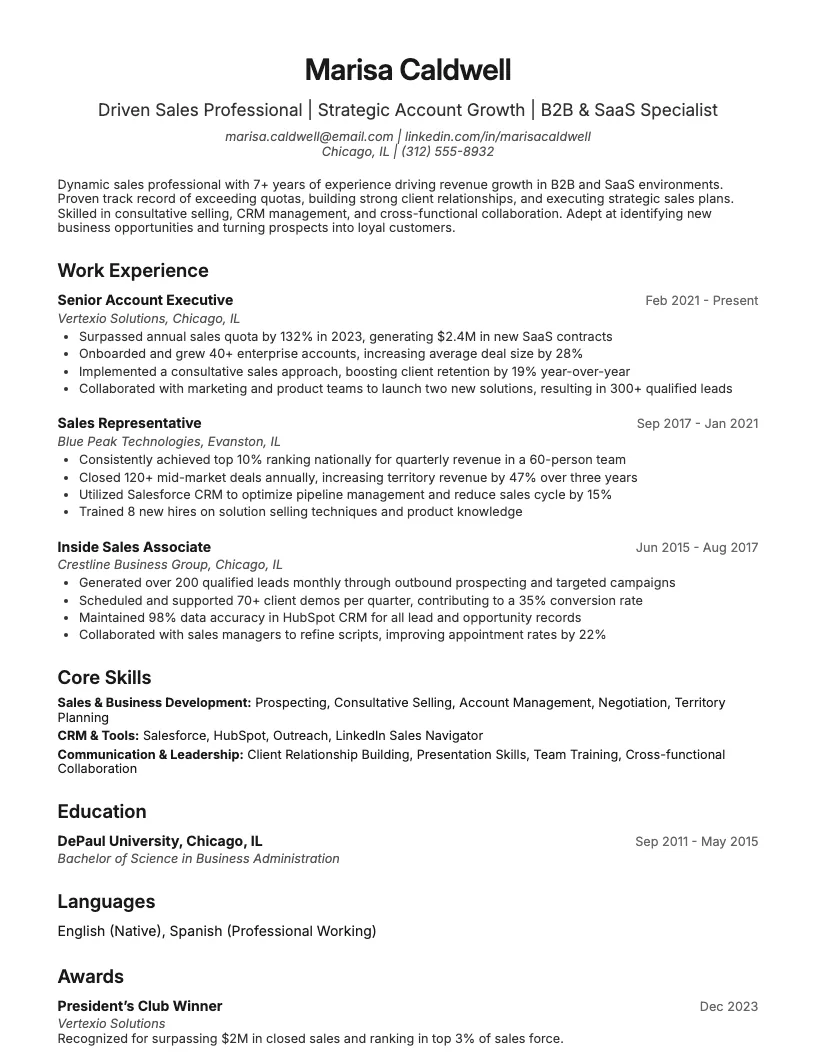
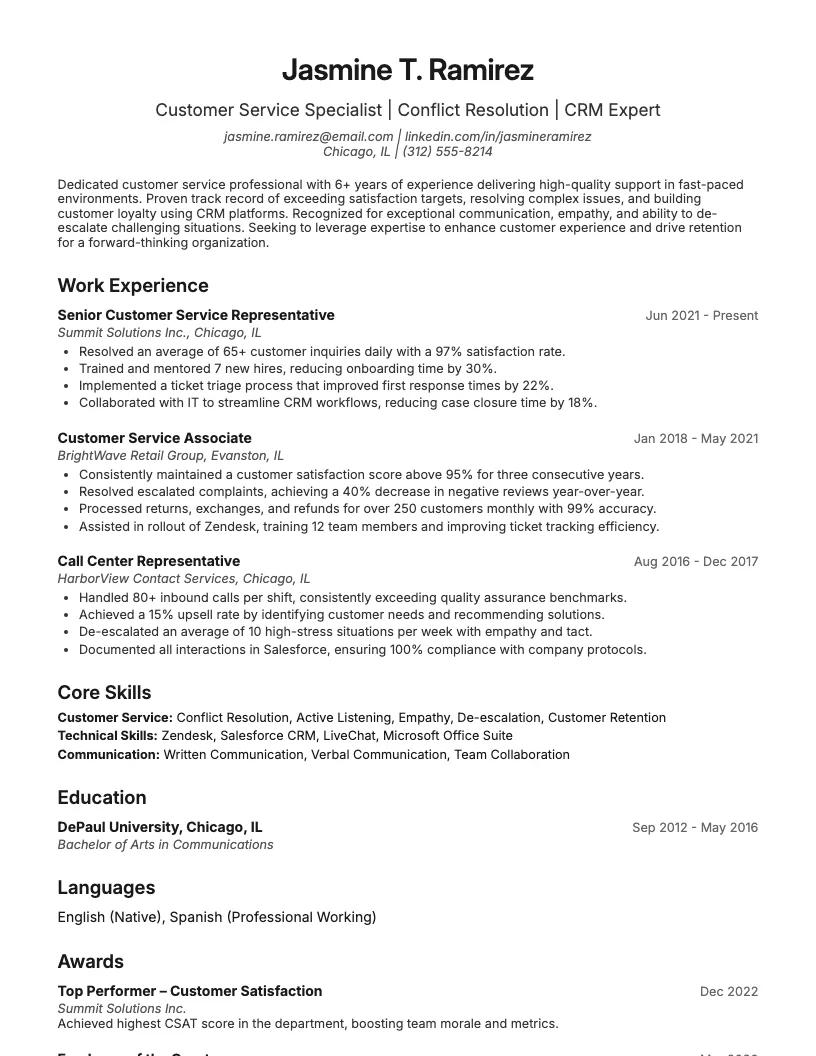
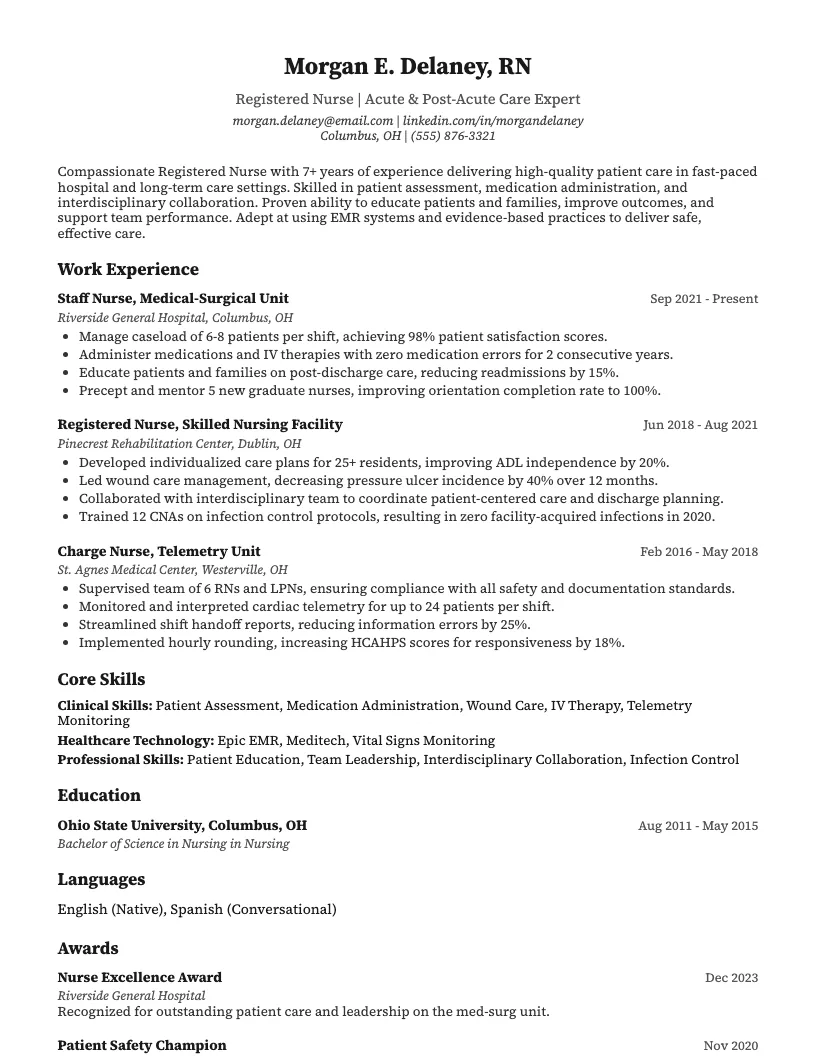
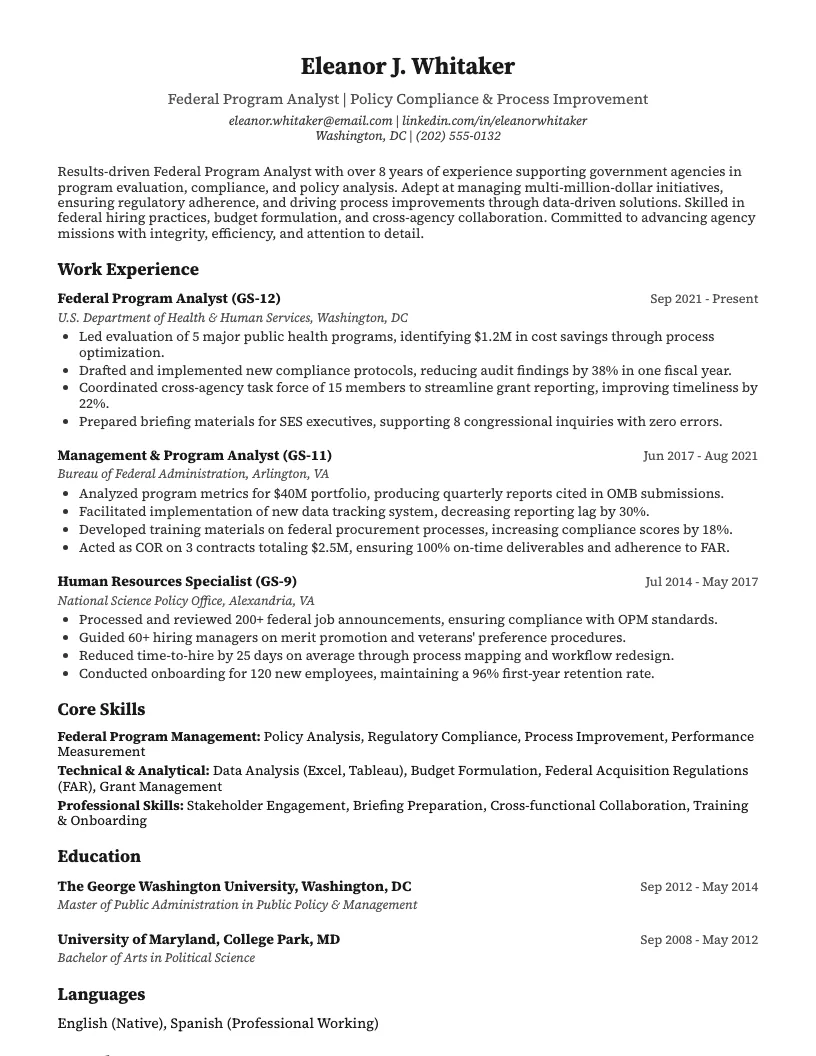
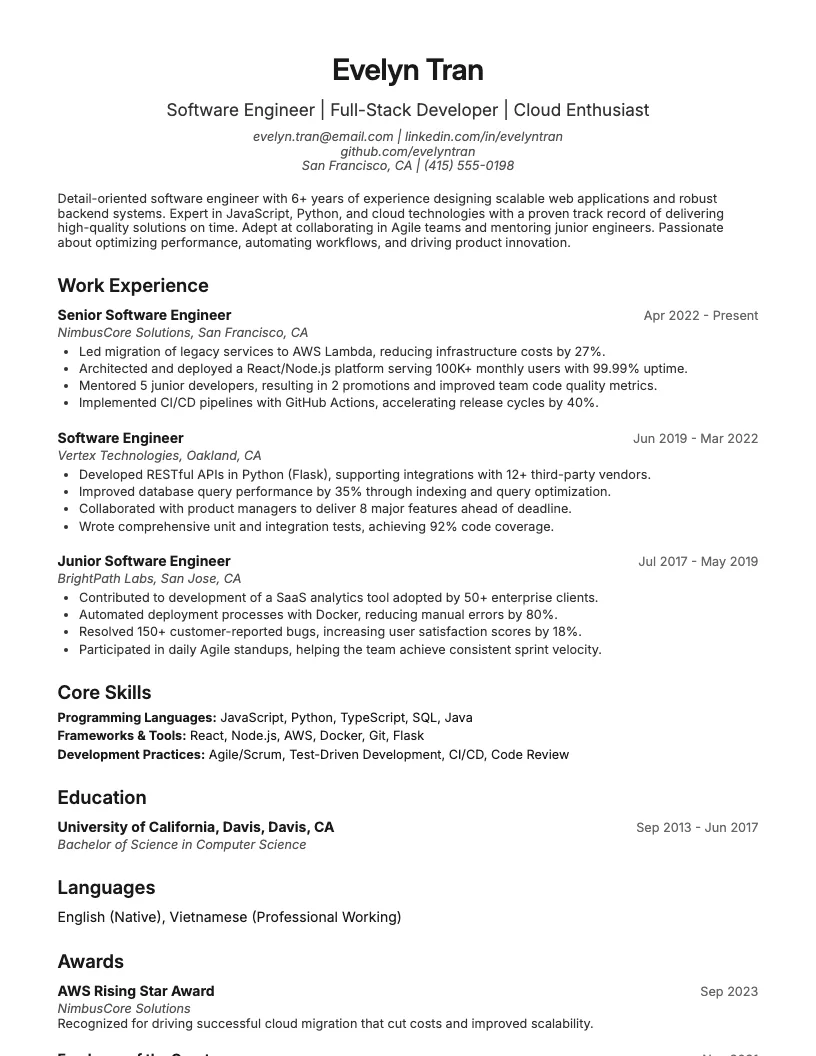
See these skills on a real resume
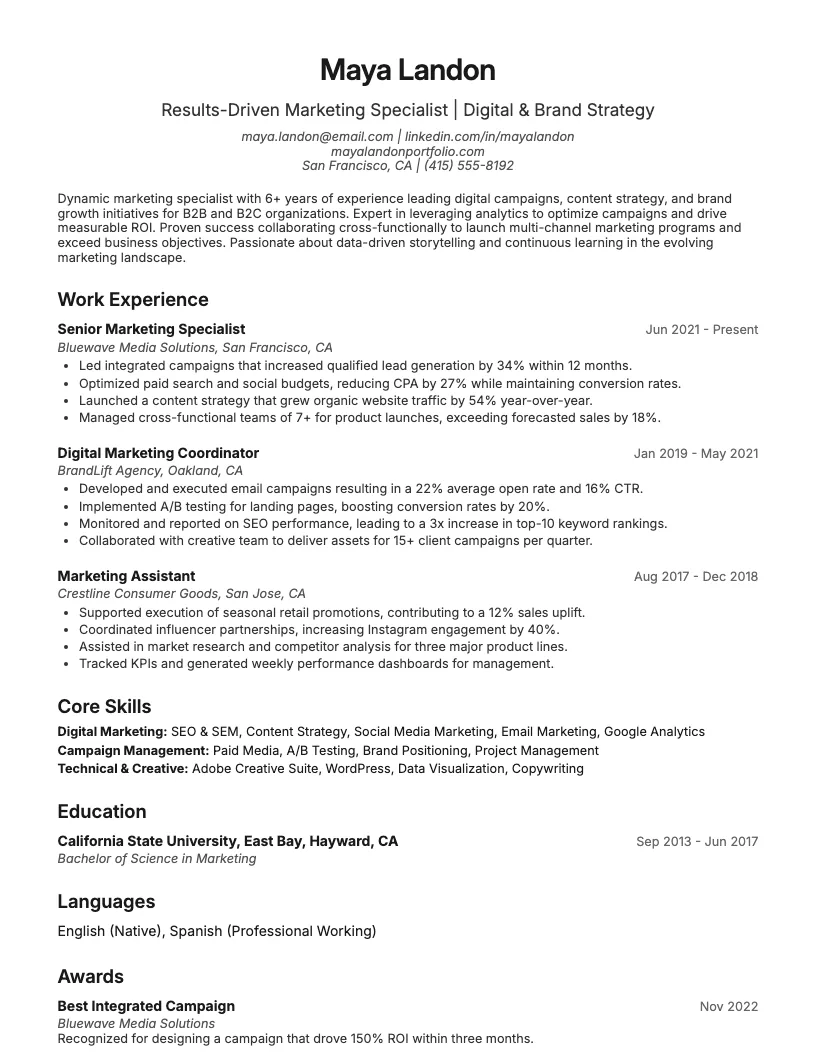
8 examplesStart from an example that already has them, and swap in your own.
Check your resume against the job you want
Scan your resume, see which skills and keywords the posting asks for that you are missing, and fix them before you apply.
Free to use • No credit card required