How Many Skills To List On Resume: 6-15, Plus 5 Steps To Pick Them
See the skills range for every career stage and field, the 5-step process for picking which ones to list, and the mistakes that make a list read as padded.


Written by Sarah Chen
Senior Career Strategist & Resume Expert
Updated August 2026
Reviewed by Marcus Rodriguez
Is your resume ATS-friendly?
Drop your resume in and see which of these skills a scanner can actually read, and which ones the job you want is asking for that you have not listed.
PDF or DOCX. Max 2MB.
We never share your resume or use it to train a model.
In This Guide:
How many skills should you list on a resume?
How many skills, by part of the resume
| Resume section | Skills to include |
|---|---|
| Skills section | 6 to 12 |
| Whole resume | 10 to 15 unique |
| Summary | 2 to 3 |
| Work experience bullets | 3 to 5 |
Somewhere between 6 and 15, depending on where you count. That's not a dodge - different parts of the resume carry different numbers, and once you know which part you're looking at, the answer gets specific fast.
6 to 12 skills in the skills section
Your dedicated skills section wants 6 to 12 entries, mixing hard and soft skills.
That's the range I come back to after looking at hundreds of these: enough to cover what the posting actually asks for, not so many it turns into a wall of text nobody reads. Go under 6 and you look like you're missing something.
Go past 15 and you look like you padded it - more on both of those in what goes wrong.
10 to 15 skills across the whole resume
The skills section isn't the only place skills live, and it shouldn't be.
Add up what's in your summary, your skills section, and your work experience bullets, and you want 10 to 15 unique skills total. Your strongest one or two should show up more than once - named in the skills list, then proven again in a bullet.
That repetition is what sticks in a recruiter's head, not the list alone.
2 to 3 skills in your summary
Your summary at the top gets 2 to 3 skills, not a dozen.
This is the first thing anyone reads, so it should name your strongest, most relevant skills and nothing else. I've seen people try to cram their whole skills section into three sentences up top - it reads as noise, and the reader skims past it.
Pick the two or three that matter most for this job and let the rest of the resume do the proving.
3 to 5 skills proven in your work experience bullets
Naming a skill and proving you can use it are two different jobs, and your bullets do the proving.
Aim for 3 to 5 skills demonstrated in context across your work experience - "managed a CRM pipeline of 200+ accounts" proves the skill instead of just claiming it. This is also where a lot of resumes fall apart: skills sit alone in a list with nothing backing them up in the experience section.
If you're not sure which of your skills actually show up in your bullets, running the resume against a real posting will surface the gap - ResumeJudge closes it too, rewriting your bullets to work the missing skill in.
What the average resume actually lists
A study of over 93,000 resumes found the average U.S. job seeker lists 9.65 skills, with most resumes falling somewhere between 6 and 20.
The median was closer to 8.81 - a sign that half of all resumes list fewer skills than you'd expect, not more. Soft skills showed up more often than hard skills across the board, and leadership-level resumes ran higher, often past 15.
None of that is a target to hit. It's just where most people land, which tells you 6 to 15 isn't an arbitrary range - it's what actually works often enough to become the norm.
When 5 skills is enough
Five is enough to win the skim - it is not enough for the section.
A recruiter reads the top of your list and skims the rest, so the first five entries are where the job gets won or lost. Put your five strongest matches there, then keep going to at least 6 - a section that stops at five reads thin, and there's no reason to stop when you have more you can prove.
For which five those are, how to choose which skills make the list names them.
How many skills should you list at your career stage?
The right number moves with your career, not just your industry.
I've reviewed resumes from new grads and VPs in the same week, and the gap in what belongs on each one is bigger than most people think.
Entry-level and new grads: 6 to 10
If you're a year or two out of school, aim for 6 to 10 skills.
You don't have the work history to fill more than that honestly, and stretching past 10 usually means you've padded the list with things you learned in one lecture.
Lean on coursework, group projects, and internships for the technical entries, then add two or three transferable skills like communication or organization to round it out.
Nobody expects a new grad's list to look like a director's - a shorter, honest list reads better than a long one that doesn't hold up in an interview.
Mid-level: 8 to 12
Once you've got a few years in, 8 to 12 skills is the range I'd tell you to aim for.
By this point you've worked across a couple of roles or projects, so your list should span more than one domain - the tools you use daily, plus one or two things you're known for that set you apart from someone earlier in their career.
This is also where proving each skill with an example starts to matter more, because a hiring manager reading a mid-level resume expects the list to hold up under a follow-up question.
Senior and leadership: 10 to 15
At senior and leadership level, 10 to 15 skills is normal, and the mix should shift.
You still need some technical depth, but strategy, team leadership, and cross-functional work should take up more of the list than they did earlier in your career.
I see too many senior resumes that still read like an individual contributor's skills section - if you've spent the last five years managing people or budgets, your list needs to say so.
Career changers
If you're moving into a new field, the temptation is to list every skill you can think of to prove you belong. Resist it.
Stick close to the ranges for the level you're entering, not the level you're leaving - a career changer moving into an entry-level tech role should look like an entry-level tech resume, built around 6 to 10 skills, mostly transferable ones plus whatever technical skills you've picked up through courses or side projects.
The skills that carry over - project management, client communication, data analysis - do more work for you here than a long list of buzzwords from your old field. If you're not sure which of your old skills actually match what the new posting wants, running your resume against the job description is the fastest way to find out, and ResumeJudge does exactly that, then rewrites your resume around what matches.
Tech and software: 10 to 15
Tech resumes carry more skills than most other fields, and 10 to 15 is the range I'd expect on a solid one.
That's because the field genuinely has more to list - languages, frameworks, cloud platforms, and methodologies all sit side by side, and a posting often names several of each.
The trap is length without proof: fifteen named technologies with nothing in your work experience bullets to back them up reads as a list you copied from a job board, not a list of things you've actually built with.
Healthcare: 8 to 12
Healthcare resumes sit at 8 to 12 skills, and the best ones balance two things: patient care and clinical ability on one side, communication and teamwork on the other.
Certifications and licenses do a lot of the heavy lifting here, so your skills section should complement them, not repeat them - list the clinical skills and soft skills that don't already show up as a credential elsewhere on the page.
Finance: 8 to 10
Finance resumes run a bit tighter, at 8 to 10 skills, and I'd rather see a focused list here than a padded one.
Analytical ability, the specific software you use daily, and attention to detail carry more weight than a long roster of generic business terms - a hiring manager in finance is scanning for precision, and a bloated list works against that impression before they've read a single bullet.
Sales, retail and education: 6 to 10
These fields sit at the lower end, 6 to 10 skills, and that's not a knock on the roles - it reflects how these resumes get read.
Customer service, sales technique, and classroom or client management are the core of the list, and a hiring manager in these fields is looking for a handful of clear, relevant skills over a long inventory.
If you're short on ideas for what belongs in that shorter list, pulling the skills straight out of the job posting is the fastest way to fill it with the right ones instead of guesses.
What goes wrong when you list too few or too many skills?

I've read enough resumes to spot the two mistakes from across the room.
Too few skills, and you look like you're hiding something. Too many, and you look like you're hiding something else.
Under 6 skills: you read as underqualified
A skills section with four or five entries doesn't read as focused. It reads thin.
Recruiters skim that section for keyword matches. Five skills usually isn't much for them to match against next to the 6 to 12 a fuller section carries, and the reader draws the conclusion you'd expect: this person doesn't have much to offer.
Nine times out of ten, when I see a skimpy list, the candidate actually has more skills. They just didn't bother writing them down.
Over 15 skills: you read as padding
The other direction is worse, and I see it more often.
Fifteen-plus skills stacked in a block stops reading as a list of strengths and starts reading as a wall. A recruiter spending six seconds on your resume is not going to parse twenty items.
They're going to assume some of them are filler, and they'll be right.
Long lists also dilute the skills that actually matter. Bury "Python" between "email" and "team player" and it loses its weight.
Obvious skills like email and Microsoft Word
Nobody in 2026 needs to be told you can send an email or open Word. Listing it costs you a line that could have held something the job posting actually asked for.
I'd cut anything that every candidate in the pile already has by default. Save the space for what sets you apart.
Skills you can't talk about in the interview
Here's the one that bites people hardest. You listed "Salesforce" because you touched it twice, and now you're in an interview getting asked to walk through a workflow you barely remember.
If you can't hold a two-minute conversation about a skill, it doesn't belong on the resume. That's not a suggestion, it's a rule I'd apply without exception.
A skill you can't defend does more damage in the room than it ever did getting you there.
The same skill written three different ways
Naming the same skill more than once
Customer Service, Client Relations, Customer Support
Customer Service
I see this constantly: "customer service," "client relations," and "customer support" all sitting in the same list, as if they're three different things.
They're one skill wearing three costumes, and it makes your list look padded even when it isn't. Pick one version, write it once, and use the space you just freed up on something real.
Fifteen named skills with no proof behind any of them
This is the mistake that matters most, and it has nothing to do with the number.
A resume with fifteen skills named and zero of them backed by an example is weaker than a resume with eight skills that each show up again in a bullet point with a result attached. Quality beats quantity here, full stop.
Naming "leadership" is a claim. "Led a team of five through a product launch two weeks ahead of schedule" is proof.
This matters most for soft skills - choosing which skills make the list covers where they belong and how to prove them.
If you're not sure which of your skills are actually worth keeping versus which ones are dead weight next to what a posting is asking for, running your resume against the job description in ResumeJudge will find that gap and rewrite your resume to cut what doesn't belong and back up the skills that do.
How do you choose which skills make the list?
How do you choose which skills make the list?
Most people fill their skills section by memory, which means whatever comes to mind first, not whatever the job actually wants. That's backwards.
Here's the order I use when I'm helping someone build this list from scratch.
Step 1: Write down every skill you have
Don't stop at your resume for this list. Check old performance reviews and your LinkedIn endorsements - people usually forget two or three skills that show up there and nowhere else.
Don't edit yet. Just dump everything: software, methods, certifications, the soft skills you'd actually claim in an interview.
Most people stop at eight or ten items here. Keep going until you hit twenty or more.
You'll cut most of it later, but you can't cut from a list that was never complete. I've watched people skip this step and end up with a skills section built entirely from whatever they typed on their last resume two jobs ago.
Step 2: Pull the skills out of the job posting
Read the posting like it's a checklist, because that's exactly what it is on the other end. Underline every skill, tool, and qualification it names, in the requirements section and in the "responsibilities" bullets too, since those often name skills the requirements list leaves out.
This is the step people rush, and it's the one that matters most. A resume that lists what you can do in general loses to one that mirrors the words in the posting.
Step 3: Mark the ones the posting names twice or more
Once you've got your underlined list, look for repeats. A skill mentioned once might be nice to have.
A skill mentioned in the requirements, then again in the responsibilities, then again in the "about the team" blurb, is the thing they actually hired for.
Rank what you found into three tiers: the repeats first, the ones named once second, everything else last. When you're deciding what makes the final six to twelve, you're pulling almost entirely from that top tier, and ResumeJudge does that pulling for you - it reads the posting, finds which of your skills match, and rewrites your resume around them.
Step 4: Cut anything you can't back with an example
This is the step that catches the skills you can't talk about in the interview before they cost you anything.
Go through your tier-one list from step 3 and ask, for each one: what's the example? A thirty-second story about a time you used it.
No example, it's gone, no matter how well it matches the posting.
Step 5: Put the most relevant skill first
Order isn't decoration. Recruiters skim top to bottom, and a hiring manager who spends six seconds on your skills section reads the first three items and skims the rest.
Whatever the posting repeated most in step 3 goes first, full stop, even if it's not the skill you're proudest of.
I've reordered skills sections for people without changing a single word on the list and watched the resume read as noticeably stronger. Sequence is doing more work than most people give it credit for.
The 5 skills to keep if you can only keep 5
Sometimes you're not choosing from twenty, you're choosing from eight, and the posting only wants five. When space is that tight, keep:
- The single skill named most often in the posting
- The one hard skill that's a hard requirement, not a preference
- The skill your most recent role actually used, not one from three jobs back
- Whatever tool or system shows up in the job title itself
- One skill that separates you from every other applicant with the same job history
That's a tight list, and it should feel tight. Treat those five as the top of your section, not the whole of it - fill out to 6 to 12 with the next-best matches, since most postings really only care about three or four things and the rest of your list is there to show the range behind them.
Balancing hard skills and soft skills in the count
Hard skills carry the skills section. Soft skills carry the rest of the resume.
That's the split I use, and it's not close to fifty-fifty. Your dedicated skills section should be mostly hard, measurable, trainable skills, the kind a posting can actually screen for.
Communication, leadership, teamwork, those are real, but they read as filler when they're sitting in a bullet list with no context. They land when they show up inside a bullet point that proves them: "led a team of six," not "leadership."
If you're weighing this against the total count on the page, how many skills you should list overall covers the range across the whole resume, not just this section. As a rule of thumb, one or two soft skills in the list is fine if the posting explicitly asks for them.
Much more than that, and you're using space a hard skill should have.
Frequently Asked Questions
Should I list a skill I'm still learning?
Only if you can already use it at some functional level, not if you've just started. A skills section reads as things you can do today, so a skill you're mid-course on is more likely to hurt you in an interview than help you get one. If you're close but not there, save it for your cover letter or summary where you can frame it as growth instead of a claim.
Do all my skills have to match the job posting?
No, but the ones at the top of the list should. Aim for most of your skills lining up with what the posting names, especially the first six to eight, and let a couple of extras round out the picture. ResumeJudge will check your list against a posting and flag which required skills it's missing, so you're not guessing at the overlap.
What if I don't have enough skills to fill the section?
Pull from coursework, class projects, certifications, and volunteer or part-time work, not just paid jobs. Those experiences count as long as you can name the actual skill they built, like a specific tool or a way of working with people. ResumeJudge can also compare your resume to a job description and show you which of the posting's required skills you're missing, which is often faster than guessing what to add.
Should I put a proficiency level next to each skill?
It's optional, and only worth doing if the label is accurate. A tag like "proficient" or "familiar" can help a reader gauge depth quickly, but an inflated one is easy to expose in an interview. If you're not confident rating yourself precisely, it's safer to leave it off and let your experience section show the level instead.
Do soft skills count toward the number?
Yes, they can sit in the skills section, but they land harder in your work experience. A bare word like "communication" or "teamwork" doesn't prove anything on its own. Attach it to a bullet point with a result, such as a process change that sped up a team's daily work, and the same skill becomes evidence instead of a claim.
Should I list the same skills in my cover letter?
Reinforce a few of them, don't just repeat the list. Pick two or three skills most relevant to the role and show them in action with a short example, which tells the reader more than seeing the same words twice. The cover letter is your chance to add context the skills section has no room for.
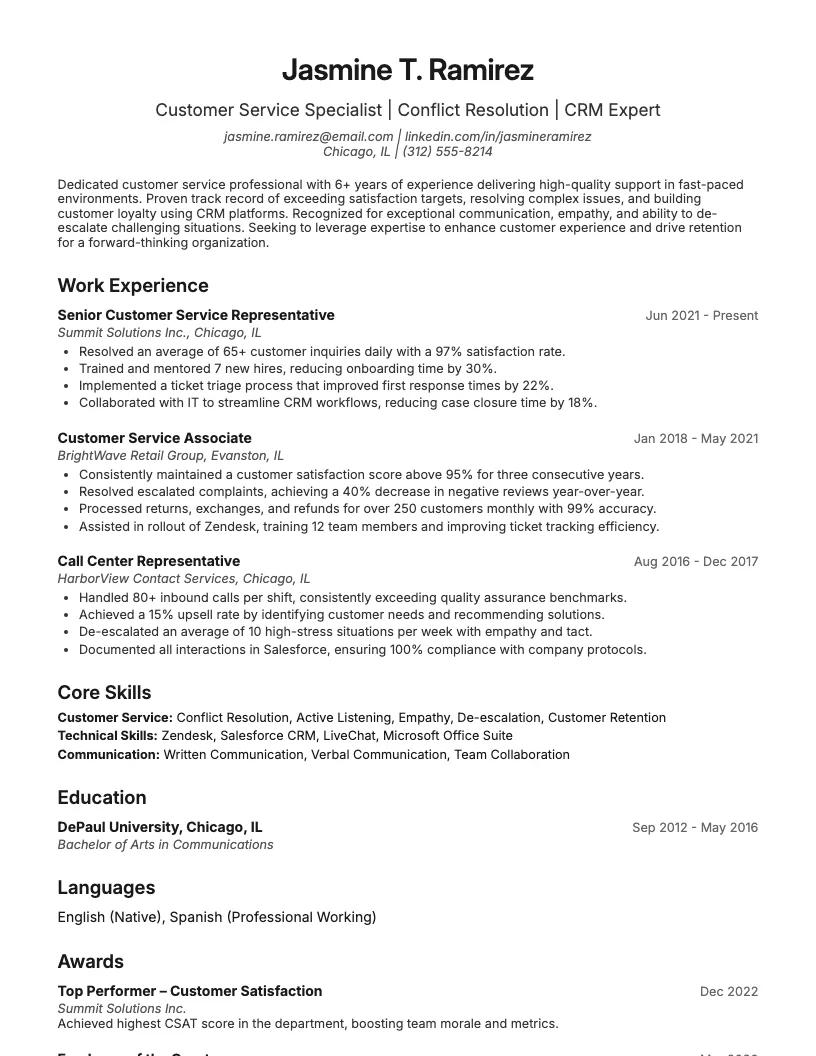
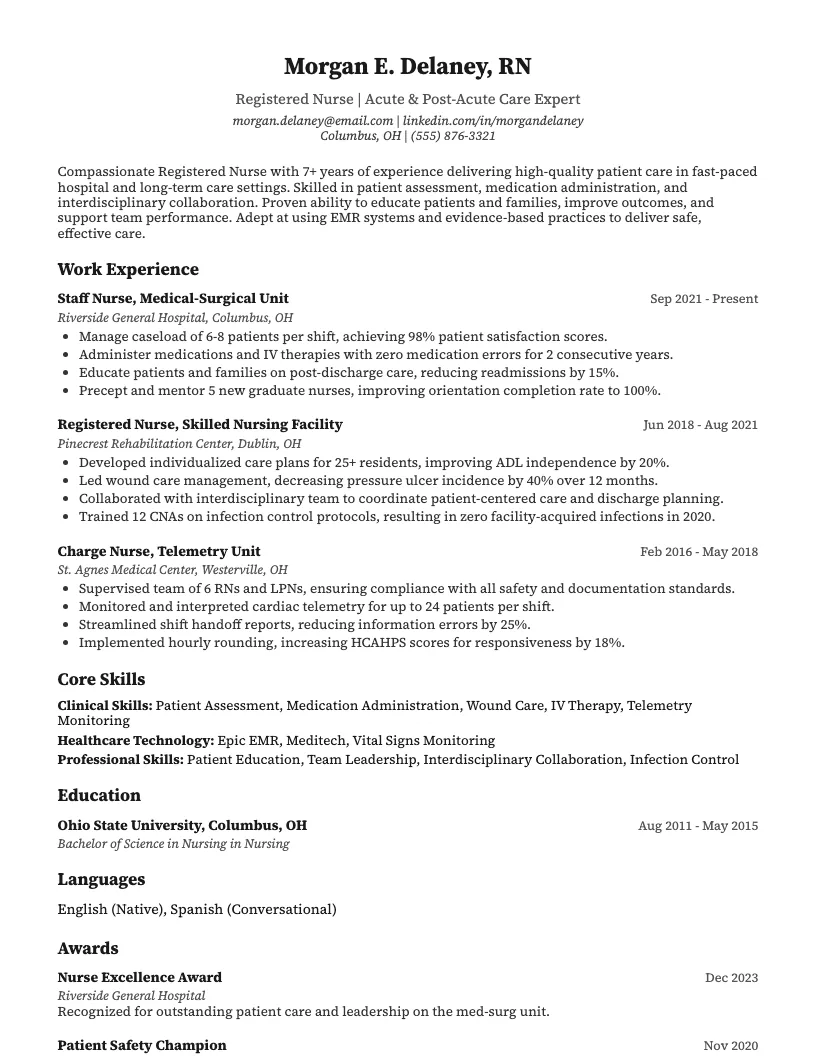
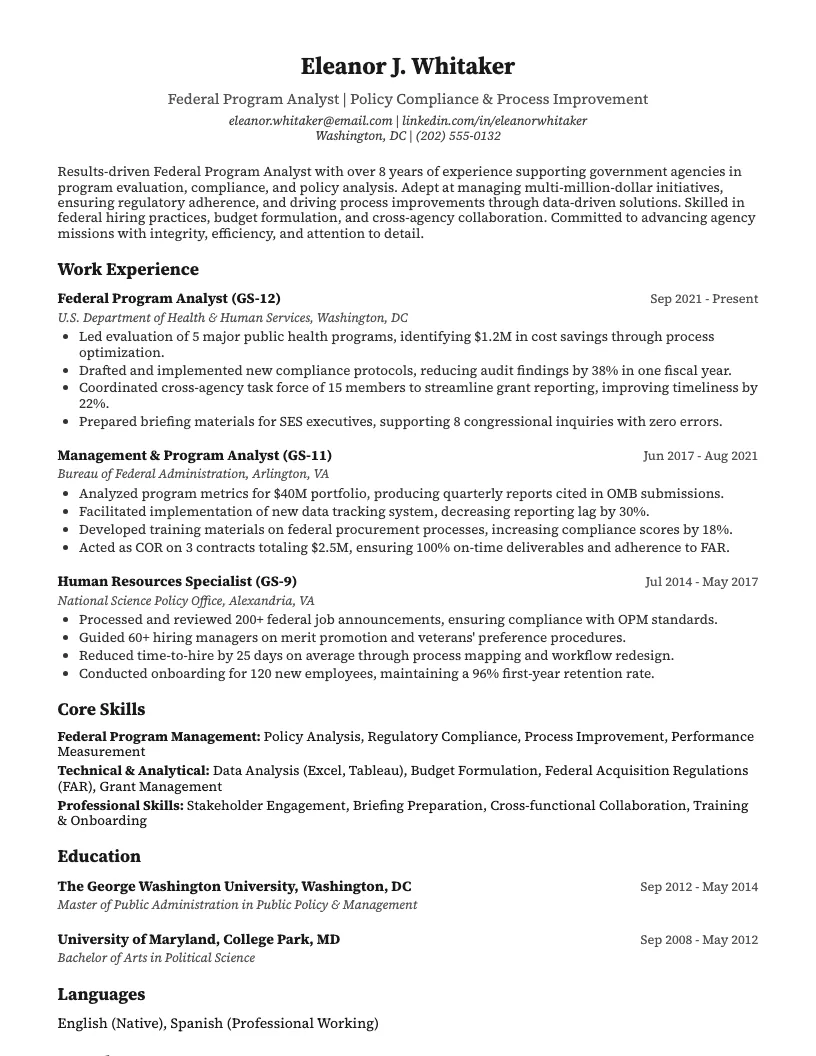
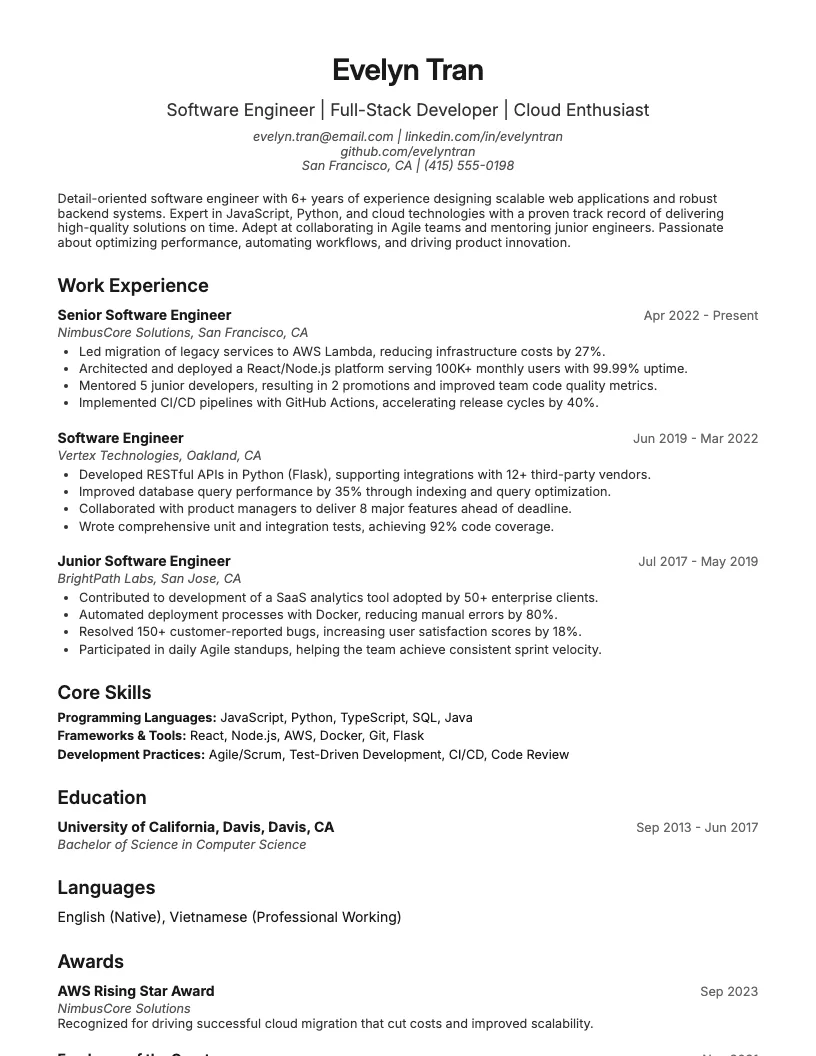
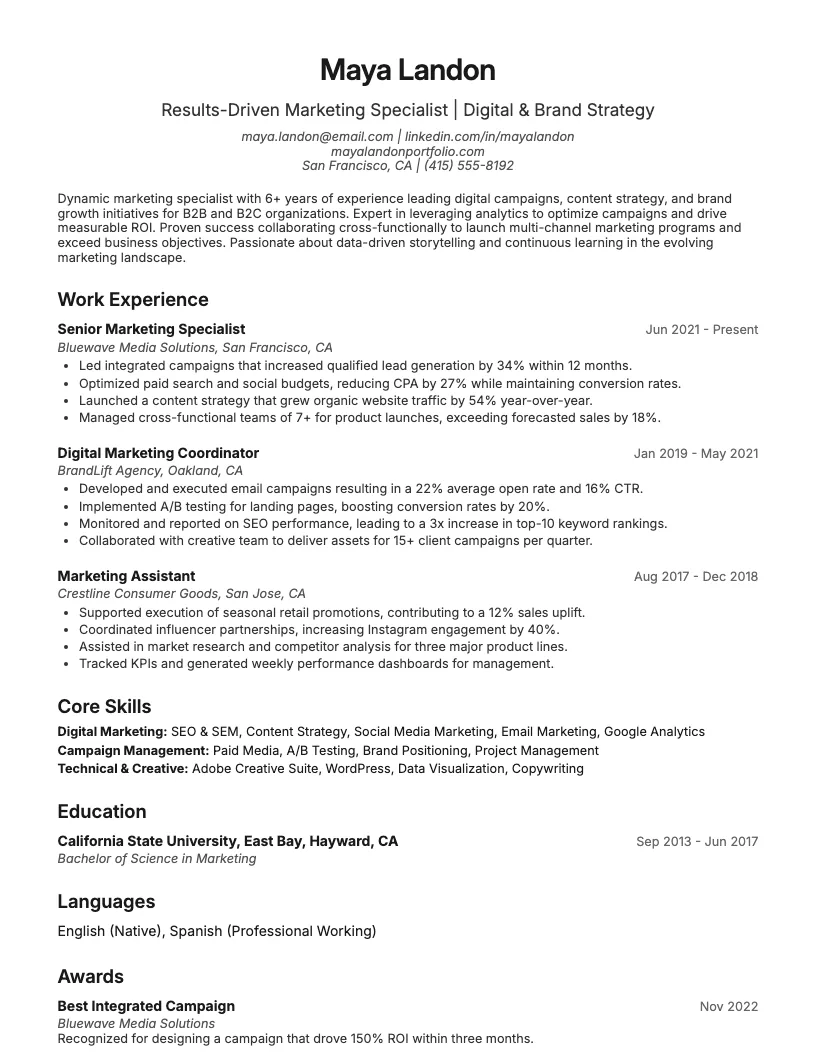
See these skills on a real resume
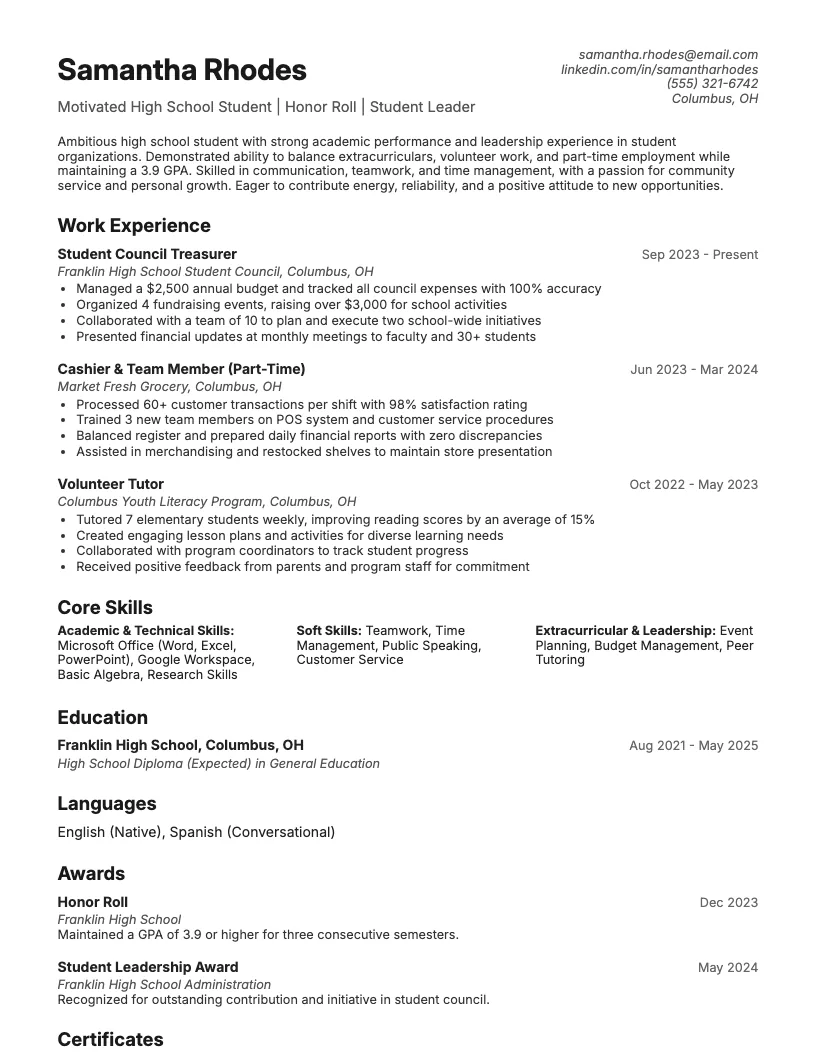
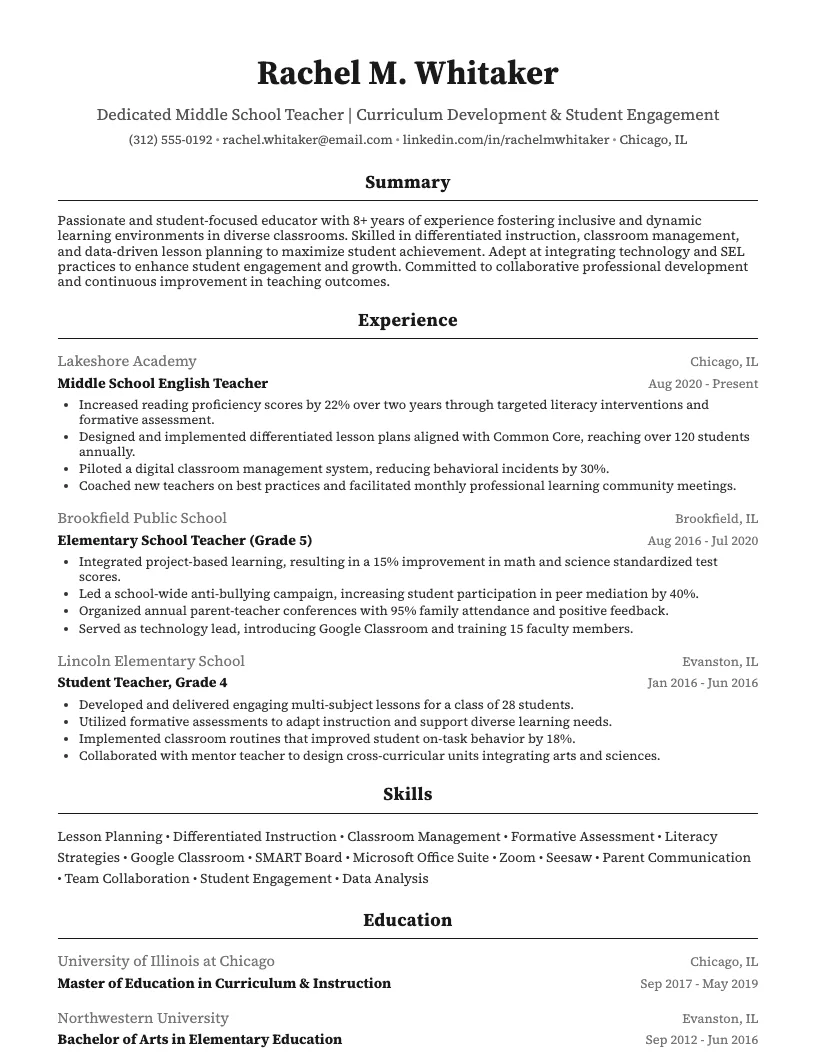
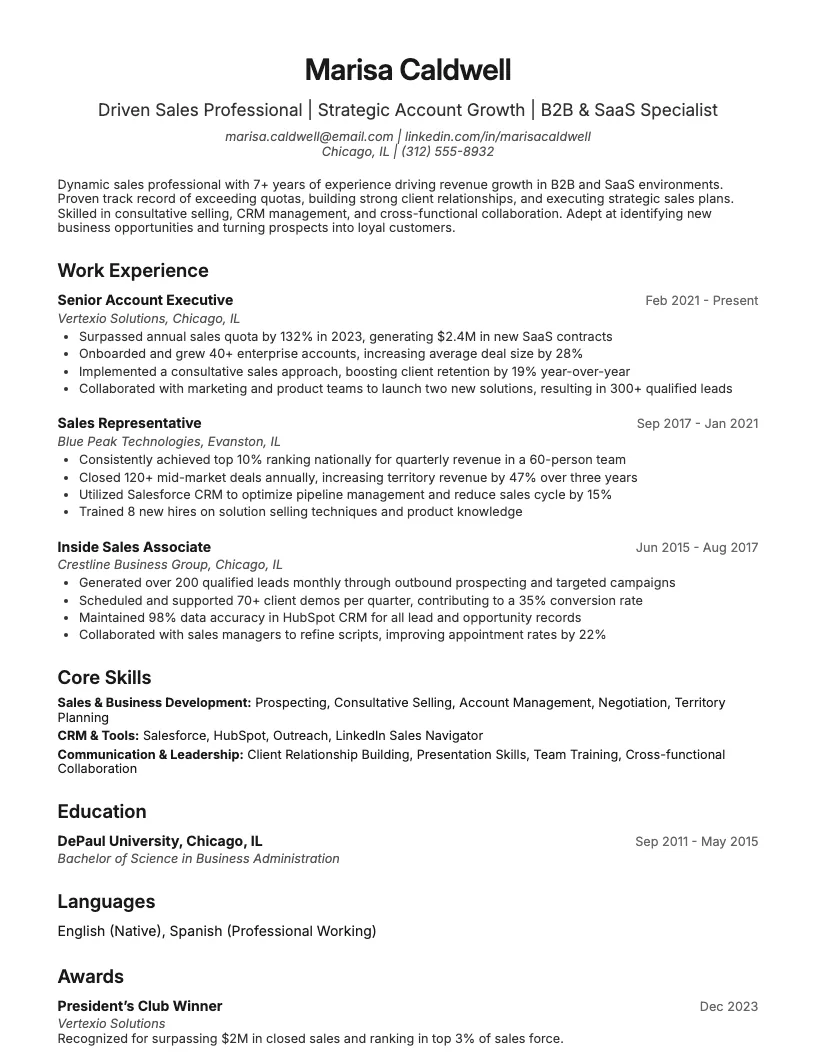
8 examplesStart from an example that already has them, and swap in your own.
Check your resume against the job you want
Scan your resume, see which skills and keywords the posting asks for that you are missing, and fix them before you apply.
Free to use • No credit card required