Customer Service Representative Resume Keywords: 10 Words, 7 Metrics
See the 10 keywords, 10 tools, and 7 metrics that get a customer service representative resume past the screener, plus weak vs strong bullet examples.


Written by Marcus Rodriguez
ATS Optimization Specialist & Career Coach
Updated August 2026
Reviewed by Dr. Priya Sharma
Is your resume ATS-friendly?
Drop your resume in and see which of these skills a scanner can actually read, and which ones the job you want is asking for that you have not listed.
PDF or DOCX. Max 2MB.
We never share your resume or use it to train a model.
In This Guide:
What keywords should a customer service representative put on a resume?
What keywords should a customer service representative put on a resume?

I've read enough of these to spot the same mistake every time: someone lists "customer service" as a skill, like it's a keyword. It isn't. The words that actually get you past a screener are the specific ones below.
Conflict resolution
This is the one every recruiter's eyes catch first, because it's the whole job. Don't just write the phrase - pair it with what you resolved: billing disputes, service complaints, escalated calls.
De-escalation
Different from conflict resolution, and worth listing separately. Conflict resolution is fixing the problem; de-escalation is calming the person down before you even get to the problem.
Call center postings ask for this by name, so use the word.
CRM software
Name the actual tool - Zendesk, Salesforce, Freshdesk, whatever you used. "CRM software" alone is a placeholder; the ATS is often matching on the product name, not the category.
First contact resolution (FCR)
This is an efficiency metric, and putting it on your resume tells a hiring manager you understand what your job is actually measured on. If you know your FCR rate, use it - a number here does more than the phrase alone.
Customer satisfaction (CSAT)
Same idea. Write "CSAT" the way your industry writes it, not "customer happiness" or some paraphrase - ATS software is often doing literal matching.
Troubleshooting
Nine times out of ten I see this word missing from resumes where the person clearly did it every day - walking someone through a fix, diagnosing an issue by phone. Say it plainly.
High-volume support
If you handled a lot of calls or tickets a day, this phrase tells them you can work under pressure without it becoming an essay. Pair it with a number if you have one - how many calls, how many tickets.
Active listening
It's a soft skill, but ATS systems still track it, and it shows up in postings constantly. Don't just claim it - one line about catching what a customer didn't say outright does more than the phrase alone.
Customer retention
This is the outcome side of the job - not just handling the customer, but keeping them. If you have a retention number, that's a stronger line than the keyword by itself.
Service level agreement (SLA)
This tells a hiring manager you understand you're being measured against a standard, not just doing your best. Write it as "SLA" - that's how the postings write it.
How many of these to use on one resume
I tell people 15 to 25, pulled from the actual posting you're applying to, not a generic list like the one above. A resume stuffed with every keyword you can find reads as noise, and a real recruiter notices that even if the ATS doesn't.
The fastest way to know your 15 to 25 is to hold your resume next to the posting - ResumeJudge scans both and tells you exactly which of these you're missing for that specific job.
Which software and tools should you name?
Which software and tools should you name?
Naming an actual product beats writing "computer skills" every time. I've read enough of these to tell you the applicant tracking system doesn't know what "computer skills" means, but it knows what Zendesk is.
Salesforce
Salesforce shows up in more customer service postings than any other CRM I see. If the job listing mentions it, put it on your resume exactly as written - "Salesforce," not "CRM software."
Zendesk
Zendesk runs ticketing for a huge share of support teams, especially in tech and SaaS. If you've worked tickets in it, say Zendesk by name, and mention the volume you handled.
Freshdesk
Freshdesk is Zendesk's most common competitor, and I see it just as often in smaller or fast-growing companies. Same rule applies - name it, don't generalize it into "helpdesk software."
Intercom
Intercom leans toward live chat and in-app messaging rather than phone or email queues. If your background is chat support, this is often the more accurate name to use than a generic ticketing term.
HubSpot
HubSpot's service hub gets used a lot in smaller companies that also run their marketing and sales through it. Worth naming separately from Salesforce - hiring managers read them as different skill sets.
Microsoft Dynamics 365
Dynamics shows up most in larger, enterprise-heavy employers, often alongside other Microsoft tools. If a posting lists it, match the exact name - not "Microsoft CRM."
ServiceNow
ServiceNow leans IT and internal help desk more than customer-facing support, but plenty of service reps use it too. Name it if you have, since it's a strong signal for corporate and enterprise roles.
Jira Service Management
This is Jira's service desk product, separate from the project-management Jira most people know. If you've worked tickets in it, spell out "Jira Service Management" rather than just "Jira."
Phone systems: VoIP, IVR, ACD, auto dialer
Call-heavy roles want to see the phone infrastructure named, not just "answered calls." VoIP, IVR (interactive voice response), ACD (automatic call distributor), and auto dialer are the terms that match what's in the posting - use whichever ones you've actually touched.
Microsoft Office and Google Workspace
Almost every posting expects one of these, so don't skip it just because it feels basic. Name the suite - Excel, Word, Outlook, or Sheets, Docs, Gmail - rather than "office software."
What to write when you only used the tool a little
You don't need months of daily use to list a tool - a few weeks of hands-on time is enough to name it honestly. Just don't pair it with a number you can't back up, and keep the surrounding bullet built around a metric you can prove. If you're not sure whether your resume already reflects the tools a posting is asking for, that's exactly the gap ResumeJudge finds when it compares your resume against the job description - then it can rewrite the line for you instead of you guessing at the wording.
Which numbers should you put next to those keywords?
Which numbers should you put next to those keywords?
Here's what separates a resume that gets a callback from one that doesn't: the second one has numbers next to every keyword, and the first one doesn't.
I've read hundreds of these, and "excellent customer service skills" tells a hiring manager nothing. A number does the telling for you.
CSAT (customer satisfaction score)
This is the one hiring managers scan for first. If you raised your satisfaction score even a few points, say the before and after - something like "raised CSAT from 85% to 98% in six months" beats any adjective you could use instead.
FCR (first contact resolution)
First contact resolution is how many customers you fixed on the first call, no callback, no ticket bouncing to someone else. I'd put a percentage here every time you have one - "resolved 85% of issues on the first call" is a real line I've seen work.
AHT (average handle time)
Average handle time shows you're fast without cutting corners. It's the whole interaction - talk time, hold time, and the work you do after the call - so a drop in it is the kind of number worth a line of its own.
NPS (net promoter score)
Net promoter score measures whether customers would recommend the company after talking to you. If a manager ever shared your NPS contribution, use it - this one's rarer on resumes, so it stands out when it's there.
Ticket or call volume per day
Volume proves you can handle pressure, not just handle customers. A daily or monthly ticket count next to your CSAT or FCR shows you kept quality up while the queue kept coming.
QA score
If your team ran quality assurance reviews on your calls or chats, that internal score is proof someone else was watching and liked what they saw. Worth including if it was consistently strong.
Retention rate
Retention numbers matter more the closer you get to a senior or lead role - a line like "grew retention 20%" says you kept accounts, not just calls, going. Pair it with the conflict resolution and de-escalation keywords you're already listing, since retention is usually the result of both.
Where to find these numbers if nobody gave them to you
A performance review is often the fastest place to find these numbers - most managers already wrote down your CSAT or QA score for a review that never made it onto your resume. Payroll or HR records can also confirm dates and titles if you need to double-check a tenure number.
Nine times out of ten, nobody handed you a scorecard - you have to go dig. Check your team dashboard, ask your old manager for a performance summary, or pull it from whatever CRM or helpdesk tool logged your work.
If you truly have nothing, estimate conservatively from what you remember and say "approximately." A rough number beats no number.
And once you've got a posting in front of you, ResumeJudge will scan your resume against it and flag exactly which of these metrics the job wants that you haven't included yet.
How do you work these keywords into your resume?
Reading the job posting for keywords is only step one. Most resumes I see stall out after that - the words get pasted into a skills list and nowhere else.
Here's the order that actually gets a resume read.
Step 1: Pull the keywords out of the job posting
Copy the posting into a doc and circle every skill, tool, and certification it names. Those are the words the ATS is scanning for, and they're also what a hiring manager skims for first.
Step 2: Put the strongest ones in your summary
Your summary is the first three lines anyone reads. Something like "Customer service rep with 5+ years handling high-volume support, 95%+ CSAT" does more work than a paragraph of adjectives, because it's specific and it's frontloaded with the terms the posting used.
Step 3: Rewrite each experience bullet around one keyword and one number
One keyword, one number, one bullet. Don't try to cram three skills into a sentence - it reads like a list wearing a costume.
Step 4: Keep the skills section to what the posting asked for
Cut anything the posting didn't ask for. A skills section that's 80% irrelevant tells the reader you copy-pasted it from an old resume.
Step 5: List certifications by their full name
Write "Certified Customer Service Professional (CCSP)," not "CCSP." The ATS may only match the spelled-out version, and a recruiter skimming fast won't decode the acronym either.
Weak bullet vs strong bullet: answering calls
Answering calls
Answered phone calls and helped customers with their problems.
Managed 80+ daily inbound calls, using active listening and de-escalation to resolve billing disputes.
Weak: "Answered phone calls and helped customers with their problems." Strong: "Managed 80+ daily inbound calls, using active listening and de-escalation to resolve billing disputes."
The second one names the volume and the technique - the first one could describe anyone.
Weak bullet vs strong bullet: using the software
Using the software
Used the computer to track orders.
Processed orders and returns in Zendesk and Salesforce, maintaining 98% data accuracy.
Weak: "Used the computer to track orders." Strong: "Processed orders and returns in Zendesk and Salesforce, maintaining 98% data accuracy."
Naming the tools turns a chore into a skill.
Weak bullet vs strong bullet: customer satisfaction
Customer satisfaction
Customers liked my service.
Achieved a 4.9/5 CSAT score, contributing to a 10% increase in retention.
Weak: "Customers liked my service." Strong: "Achieved a 4.9/5 CSAT score, contributing to a 10% increase in retention."
If you don't have your own number yet, here's where to find one.
Action verbs to start bullets with
Resolved, escalated, documented, exceeded, streamlined, de-escalated, followed up. Swap "responsible for" out for one of these and the same sentence reads like an achievement instead of a duty.
Which keywords change depending on the industry you're applying to?
What to lead with, by industry
| Industry | Lead with | Software/terms |
|---|---|---|
| Call center | High-volume, queue management | IVR, auto dialer |
| Healthcare | HIPAA compliance | Epic, Cerner |
| Retail | Cash handling, returns | POS systems |
| Banking & finance | PCI compliance | Claims processing |
| Tech & SaaS | Live chat support | Knowledge base |
Same job title, different resume. I've reviewed customer service resumes for call centers, hospitals, and SaaS companies, and the ones that land interviews all borrow the exact words the posting uses for that industry - not generic customer service language.
Call center: high-volume, queue management, script adherence, schedule adherence
Call centers care about volume and compliance more than almost anything else. Put a real number next to "high-volume" - 100+ calls a day, whatever it actually was - and name the systems: queue management, auto dialer, IVR.
Then show you can follow a script and hold your schedule adherence, because that's what QA is grading you on every day.
Healthcare: HIPAA compliance, Epic, Cerner, insurance verification, ICD-10
If you've got HIPAA compliance, lead with it - it's a differentiator, not a footnote. Name the actual system you used (Epic or Cerner, not "EHR software"), and if you touched insurance verification or ICD-10 codes, say so specifically.
Vague "medical office experience" gets skipped over.
Retail and in-person: POS systems, cash handling, returns and refunds
Retail-facing roles want proof you can run a register without drama: POS systems, cash handling, returns and refunds. These are small keywords but they're often the first filter for in-person roles.
Banking and finance: PCI compliance, claims processing, account management
Finance and banking postings lean on compliance language - PCI compliance especially. Claims processing and account management round it out if your background touches either.
Tech and SaaS: live chat support, knowledge base, ticket escalation
SaaS support wants live chat support, knowledge base work, and ticket escalation - proof you can triage and write, not just talk.
Bilingual and language skills
Fluent in a second language? Say so by name and level - "Fluent Spanish," not just "bilingual."
It's one of the fastest ways to stand out in this field. If you're not sure which of these your target posting actually wants, pulling the keywords straight from the job description beats guessing, and ResumeJudge will flag which industry-specific terms your resume is still missing against that exact posting.
Frequently Asked Questions
How many keywords should I put on my resume?
This one is answered further up the page, under "How many of these to use on one resume" at the end of the keyword list.
What keywords do I use if I have no customer service experience?
Pull from transferable skills you already have - communication, problem-solving, multitasking, working under pressure - and pair them with any tool or software you've touched, even briefly, like a scheduling app or a point-of-sale system. School group projects, volunteering, and retail or food-service shifts all count if they involved dealing with people and solving problems on the spot. ResumeJudge can take a job posting and tell you which of its required skills you can already back up from experience like that, so you're not guessing.
Can I list a CRM you only used for a few weeks?
This one is answered further up the page, under "What to write when you only used the tool a little" at the end of the tools list.
Should I put keywords in a skills section or in my bullet points?
Both - the skills section gets the keyword in front of an applicant tracking system, and the bullet point proves you actually used it. A skills section that just lists "Zendesk" with no bullet backing it up looks like a keyword dump; a bullet with no matching skills-section entry can get missed by a scanner skimming for exact matches. ResumeJudge rewrites your resume against a specific posting and places each keyword in both spots for you, so the wording lines up either way.
Do soft skills like empathy actually count as keywords?
Yes, if the posting names them - empathy, patience, active listening, and de-escalation show up in plenty of customer service job descriptions as literal requirements, not just nice-to-haves. Where they matter most is in a bullet point that shows the skill in action, like handling an upset customer, rather than listed alone with nothing behind it. Naming the skill without a moment that proves it is what makes soft skills feel weak on a resume.
What keywords do I add when I'm moving from retail to a remote support job?
Lean on the parts of retail that map directly to remote support - customer service, conflict resolution, and any point-of-sale or inventory software - then add the remote-specific terms the posting is actually asking for, like ticketing systems, written communication, or self-management. Retail experience proves you can handle people under pressure; you still need to show you can do it without someone standing in front of you. Naming tools like Zendesk or Freshdesk, even from brief exposure, helps close that gap.
How do I find the keywords my resume is missing?
Read the job posting closely and note the skills, tools, and phrases it repeats, then check your resume line by line against that list. ResumeJudge does this automatically - it scans your resume against the posting, tells you exactly which required skills and keywords are missing, and can rewrite your resume to add them in the right sections. That's faster and more reliable than eyeballing a job description on your own.
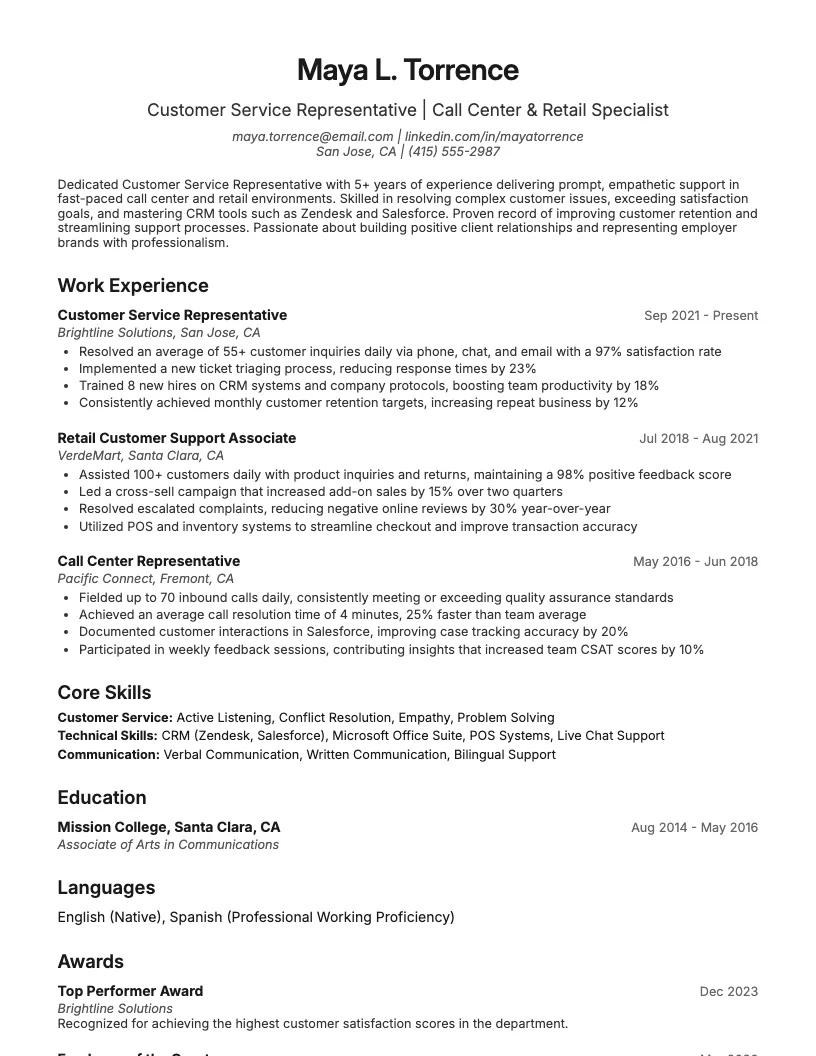
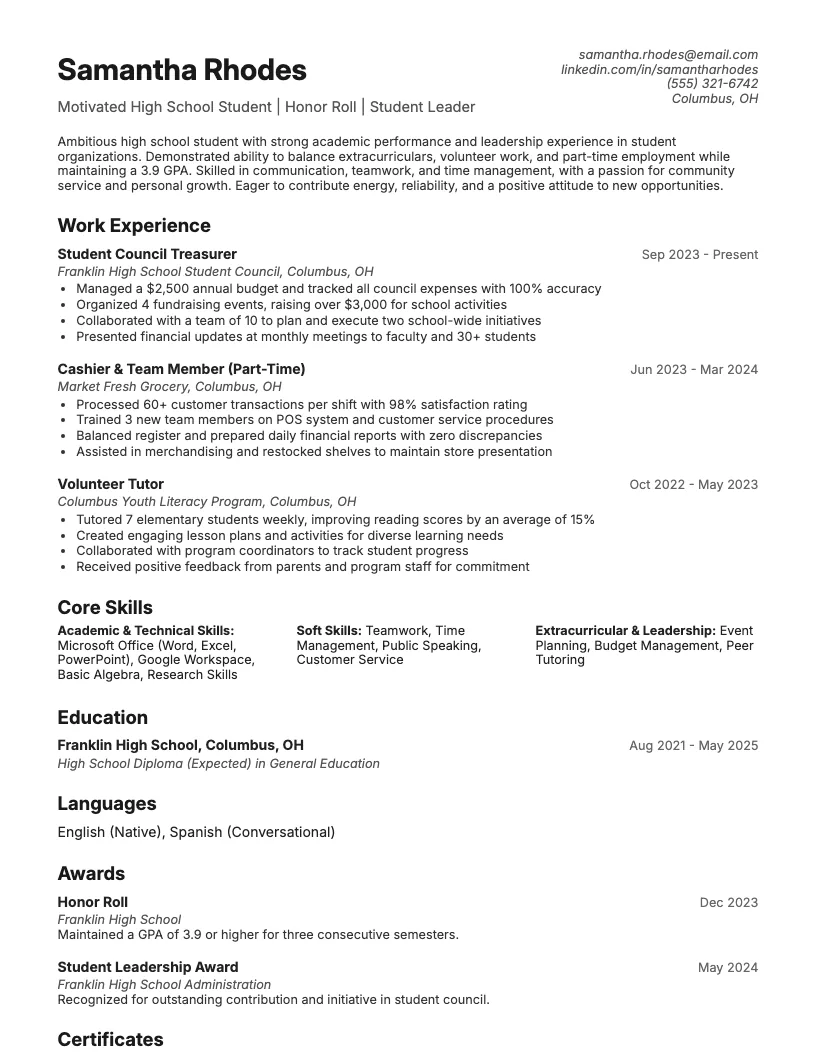
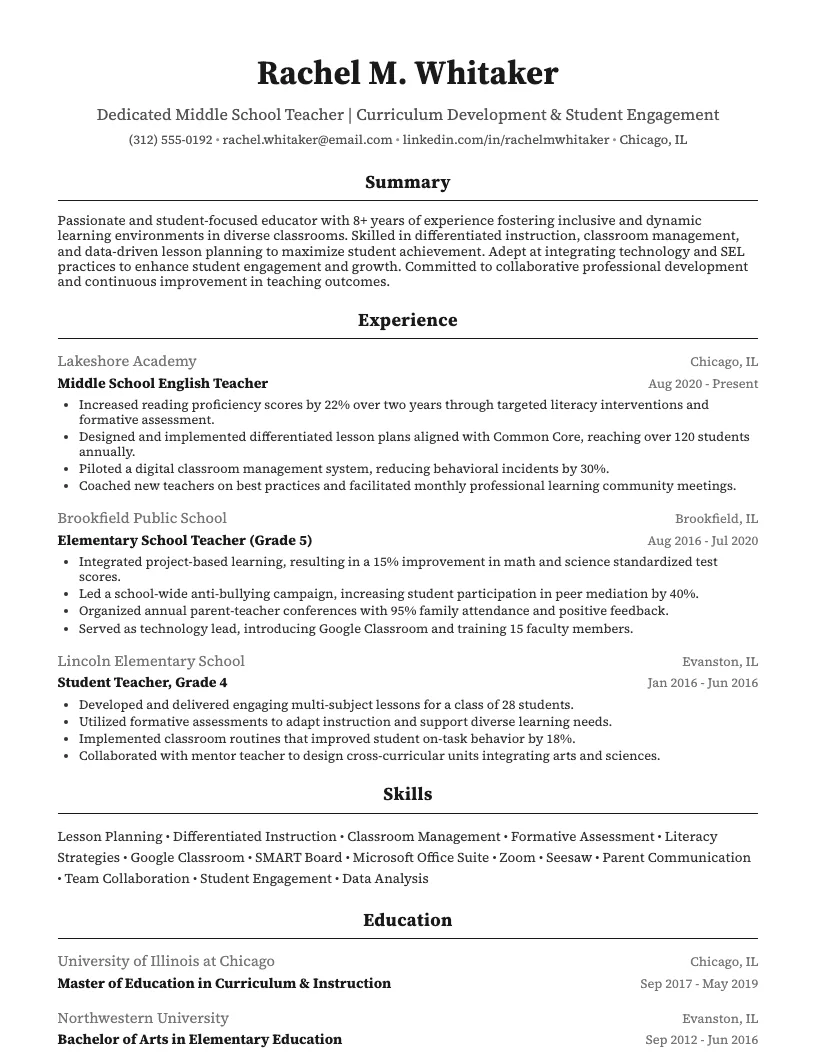
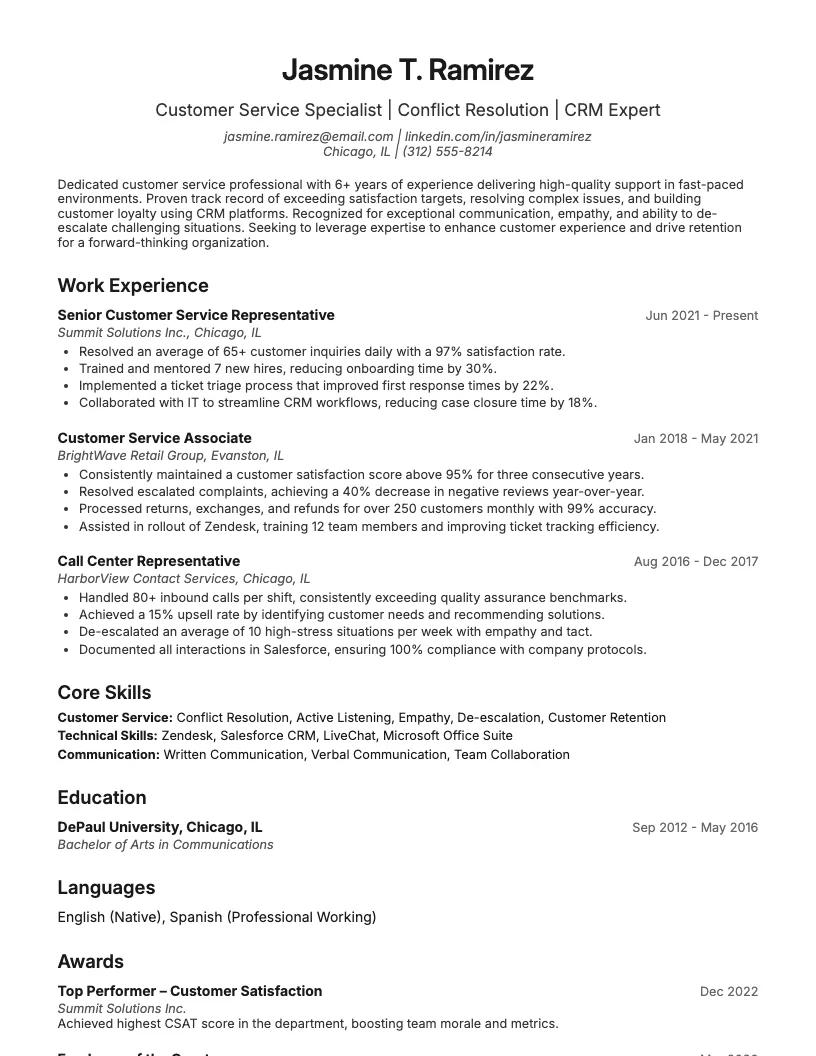
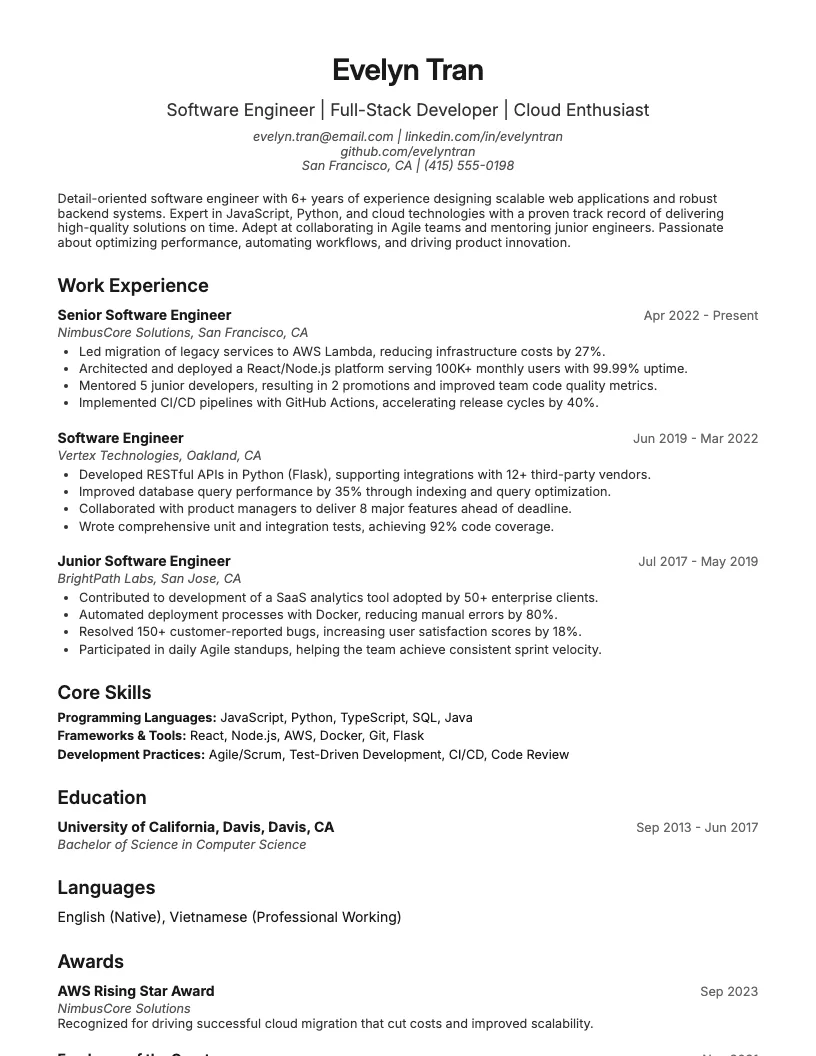
See these skills on a real resume
8 examplesStart from an example that already has them, and swap in your own.
Check your resume against the job you want
Scan your resume, see which skills and keywords the posting asks for that you are missing, and fix them before you apply.
Free to use • No credit card required