Consulting Resume Keywords: 10 That Matter, 7 Mistakes to Avoid
See the 10 keywords consulting recruiters actually look for, how McKinsey, BCG and Bain phrase them differently, and the 7 mistakes that get resumes rejected.


Written by Marcus Rodriguez
ATS Optimization Specialist & Career Coach
Updated August 2026
Reviewed by Dr. Priya Sharma
Is your resume ATS-friendly?
Drop your resume in and see which of these skills a scanner can actually read, and which ones the job you want is asking for that you have not listed.
PDF or DOCX. Max 2MB.
We never share your resume or use it to train a model.
In This Guide:
What are consulting resume keywords?
They're not a vocabulary list you memorize. They're the exact words the firm used to describe the job, sitting inside your bullets instead of your own paraphrase of them.
Words pulled from the job posting itself
Start with the posting in front of you, not a generic "top consulting keywords" list off the internet.
If it says "stakeholder alignment," you write "stakeholder alignment" - not "worked well with teams." I've seen resumes with all the right experience buried under the wrong words, and the ATS reads it as a mismatch.
Words the firm uses on its own careers page
The posting is one signal. The firm's careers page and "our values" section is another, and it tells you what a human reviewer has been trained to notice.
McKinsey talks about personal impact and courageous change; BCG leans on collaboration and insight. More on that in how the firms differ.
Why a keyword without a result behind it does nothing
Adding a result to a keyword bullet
Led stakeholder workshops
Led stakeholder workshops that cut decision time from six weeks to two
A keyword sitting next to no number is the single most common thing I flag on these resumes.
"Led stakeholder workshops" tells a screener nothing about whether it worked. "Led stakeholder workshops that cut decision time from six weeks to two" is a different resume - see how to write a bullet around a keyword.
Where they have to sit for the software to count them
Where a keyword sits changes how much it counts. Where these keywords go walks through each section and which one carries the most weight. If you'd rather not guess, ResumeJudge reads the posting and your resume together and tells you exactly which of its keywords are missing and where to put them back in.
Which consulting keywords matter most?
Which consulting keywords matter most?

Every firm phrases things a little differently, but I've read enough consulting resumes to know the same handful of ideas show up on every screener's checklist. Get these ten right and you've covered what actually gets noticed.
Problem solving
This is the one recruiters look for first, because it's the job. Don't write "strong problem-solving skills" - show a problem you found, the way you broke it down, and what changed because of it.
"Diagnosed a bottleneck in the client's fulfillment process, ran root-cause analysis across three regions, and cut delivery delays by 22%" tells them more than any adjective could.
Analytical and quantitative work
Consulting runs on numbers, so your bullets need to as well. Built a model, analyzed a dataset, sized a market - whatever it was, say what you analyzed and what the analysis led to.
A bullet with no data in it reads like you didn't do the analytical part of the job.
Strategy development
If you shaped a plan rather than just executing someone else's, say so directly. "Developed a market-entry strategy that guided the client's launch in two new regions" beats "helped with strategy" every time - the second one could mean you sat in the room.
Project and workstream management
Firms want to see you can run a piece of work end to end, on time, without someone standing over you. Name the deliverable, the timeline, and what shipped.
The experience bullets section on this page covers exactly how to structure a line like this.
Client engagement
Consulting is a client-facing job even at the junior levels, so a resume with zero mention of clients looks like you never left the back room. Say who you engaged and what came out of it - a relationship maintained, a deliverable they signed off on, satisfaction that went up.
Stakeholder management
This is different from client work - it's about aligning people who don't report to you and don't always agree with each other. Facilitated, aligned, negotiated: these verbs are doing real work when they're followed by a specific group and a specific outcome.
Leadership
Nine times out of ten I see "led" used as a filler verb, slapped on a bullet that doesn't actually describe leading anyone. If you managed a team, mentored an analyst, or ran a workstream with people under you, name the number of people and what they delivered.
If you didn't lead anyone, don't force the word in - using "led" on every line is one of the fastest ways to make a reviewer stop trusting your bullets.
Communication and persuasion
Consultants get paid to convince people, not just to be right. A bullet about presenting to a client team or securing sign-off on a recommendation shows the persuasion side that raw analysis doesn't.
Entrepreneurial drive
McKinsey in particular screens hard for this one, but every firm likes seeing it: did you start something nobody asked for? Founded a club, built a new internal process, took an idea from nothing to something.
It's the clearest signal that you don't wait to be told what to do.
Results and impact
This is where every other keyword above needs to land. A resume full of strong verbs and no numbers is still a weak resume - cost saved, revenue grown, time cut, percentage improved.
If you're not sure your bullets carry enough of these, running your resume against a real posting will show you exactly which ones are missing and where the numbers need to go.
What tools and technical skills should a consultant list?
What tools and technical skills should a consultant list?
The skills section is where I see the most wasted space on a consulting resume. A short, honest list of tools beats a long one you can't back up in an interview.
Excel and financial modeling
Say "Excel" and mean it, then prove it in a bullet: a three-statement model, a sensitivity analysis, a valuation build. Recruiters read "financial modeling" as a claim, not a label, so it needs a deliverable behind it somewhere in your experience section.
PowerPoint and deck building
Every consultant lists PowerPoint. What separates candidates is naming what the deck was for - a board presentation, a client steering committee, an executive readout.
That's the keyword an ATS and a hiring manager both want.
SQL, Python and Tableau
These three show up constantly in postings now, even for generalist strategy roles, because firms want people who can pull their own data instead of waiting on an analytics team. List the ones you've actually used, not the ones you took a weekend course in.
Market research and due diligence
Due diligence is one of the highest-value phrases in consulting postings, especially at the Big 4 and boutique firms. If you've supported a deal, an integration, or a competitive landscape study, name it directly rather than folding it into "research."
Certifications: CMC, PMP
These help, but they don't carry a resume on their own. List them once, near education or in a short credentials line - never as a substitute for a results-driven bullet.
What to leave out of the skills list
Leave off soft skills like "communication" or "leadership" - those belong in your experience bullets, proven, not asserted. Skip tools you used once.
If you're not sure which of your tools actually match a posting, running your resume against the job description will tell you exactly what's missing before a recruiter does.
Where do you put these keywords on the resume?
Is your resume good enough?
Drop your resume in and see which of these skills a scanner can read, and which ones the job you want is asking for that you have not listed.
Upload your resumeFree. PDF or DOCX. We never share your resume or use it to train a model.
Placement matters as much as which words you pick. The systems don't all treat a resume the same way - Greenhouse doesn't score or rank resumes by keyword at all, it just puts them in front of people, and Workday parses yours into fields recruiters search and filter, with any scoring set up by the employer - so where a keyword sits still changes how much work it does.
Summary
Two or three competency keywords, one or two sentences, right at the top.
This is the pitch, not a dumping ground - save the proof for the bullets below it.
Experience bullets
This is where the software looks hardest.
Open each bullet with a strong verb, work the keyword in naturally, then close with a number. I cover the exact order to write these in how you write a bullet point around a keyword.
Skills section
Tools and certifications, not soft skills - see what to leave out of the skills list.
Treat this section as an index, not evidence. If a skill sits here with nothing backing it up in your experience, a recruiter (and the software) can tell.
Education
Don't skip this one. A thesis topic, relevant coursework, or a tool you used in a class project - Excel, Python, SQL, Tableau - all read as keywords too, especially if you're light on work experience.
Job titles and section headers
I've seen candidates load every keyword into bullets and ignore the headers entirely.
If your title was "Business Analyst" and the posting says "Consultant," and the work overlaps, a parenthetical like "Business Analyst (Consultant)" is fair game and it's a keyword hit most people leave on the table.
Why the experience section counts for most
If you only fix one section, fix this one - it's scored higher than Skills by the systems firms like McKinsey actually use.
A keyword sitting in a list is a claim. The same keyword inside a bullet with a number attached is proof.
That's the difference the ranking is built on.
Nine times out of ten, the resumes that get flagged as thin aren't missing keywords - they're missing keywords in bullets. If you want to check where yours actually land before you submit, ResumeJudge will scan your resume against the posting and show you exactly which sections are carrying the weight and which ones are empty.
How do you write a bullet point around a keyword?
How do you write a bullet point around a keyword?
I've read enough consulting resumes to spot a keyword that's just sitting there, doing nothing. It got dropped in because the posting mentioned it, not because it's tied to anything you actually did.
Here's the fix, in five steps.
Step 1: Open with the action verb
Start with what you did, not what you were assigned. "Led," "built," "negotiated," "redesigned" - never "responsible for" or "worked on."
That's the single biggest thing I flag on a first pass.
Step 2: Name the deliverable you produced
A verb needs an object. What did the work turn into - a pricing model, a market entry plan, a cost-reduction roadmap, an executive deck?
That deliverable is usually a keyword in its own right, straight out of the job posting itself.
Step 3: Name the method or tool you used
This is where "structured problem solving," "financial modeling," or "stakeholder interviews" earn their place. Say how you got to the deliverable, not just that you got there.
Step 4: Give the scope: team size, budget, timeline
Scope is what tells a reader whether this was a two-week internal exercise or a six-month client engagement with a seven-figure budget on the line. Team of four, $2M budget, ten-week sprint - pick whichever number actually applies.
Step 5: End with the number
Close on the result: percent, dollars, days saved. Nine times out of ten, the bullets that get an interviewer's attention are the ones that end on a figure, not an adjective.
Weak bullet vs strong bullet, side by side
| Weak | Strong |
|---|---|
| Responsible for project management for client | Led a 5-person workstream on a supply chain redesign, using structured problem solving to cut lead times 18% over 12 weeks |
| Worked on cost reduction initiative | Built a cost-reduction model across a $3M budget, identifying $400K in annual savings |
Once you've got a bullet like the strong one, it's worth checking whether the wording actually matches what a specific posting is asking for - that's exactly what ResumeJudge's resume-versus-job-description scan does, and it'll rewrite the bullet for you if it isn't landing.
How do keywords differ between McKinsey, BCG, Bain and the Big 4?
How top firms differ in the words they use
| Firm | Words they emphasize |
|---|---|
| McKinsey | Personal impact, entrepreneurial drive, courageous change |
| BCG | Impact, collaboration, insight, client focus |
| Bain | Results orientation, practical impact, team-first |
| Deloitte | Digital transformation, Agile, risk management |
| PwC | Value creation, transformation, regulatory compliance |
| KPMG | Risk advisory, ESG, deal advisory |
Every firm asks for "problem solving" and "leadership." The word each one leans on harder than the rest is where you actually win or lose.
McKinsey: personal impact, entrepreneurial drive, courageous change
McKinsey's own language runs toward personal impact, entrepreneurial drive, inclusive leadership and courageous change.
If your bullets read as "did the work I was told to do," that's the mismatch. They want to see you push something forward that wasn't assigned to you.
BCG: impact, collaboration, insight, client focus
BCG's postings lean on impact, collaboration, innovation, insight and client focus, almost always paired with a number.
Say "impact" without a result next to it and it reads as filler - pair it with what changed and by how much.
Bain: results orientation, practical impact, team-first
Bain wants results orientation, practical impact, team-first mentality and data-driven work. "Practical" is the tell - they're allergic to bullets that sound like a theory paper.
Deloitte, PwC, KPMG and EY-Parthenon
The Big 4 split by practice. Deloitte wants digital transformation, Agile and risk management.
PwC wants value creation, transformation and regulatory compliance. KPMG wants risk advisory, ESG and deal advisory.
EY-Parthenon wants valuation, M&A and due diligence.
I've seen candidates paste the same resume across all four - it's the fastest way to get skipped, because each one is hunting for its own words.
Strategy boutiques
Roland Berger, Oliver Wyman, Kearney and Stern Stewart each lean toward their own areas rather than covering everything - Oliver Wyman toward financial services, Kearney toward operations and supply chain. Read the posting rather than assume it's "strategy consulting" generically.
Management consulting vs strategy consulting vs operations
Management consulting rewards deliverables and workstream execution. Strategy consulting rewards frameworks and hypothesis-driven analysis.
Operations and transformation roles reward process improvement with a measurable before-and-after. Same core skills, different emphasis - see where these keywords matter most for the full list.
How to read a firm's careers page for its own words
Before you touch the resume, read the firm's own careers page and the specific posting side by side - the words repeated on both are the ones to mirror. ResumeJudge does that matching for you: feed it the posting and it flags which of the firm's own terms are missing from your draft, then rewrites the bullets to use them.
How do you pull the keywords out of a specific job posting?
Every consulting posting has three kinds of information mixed together, and the mistake I see most often is treating them as one pile.
Step 1: Split the posting into responsibilities, qualifications and named tools
Read the posting once and sort it into three buckets. What the role produces (deliverables, workstreams, client-facing output).
What it asks the person to already have (analysis, stakeholder work, structured problem solving). And any tool or framework named outright.
Step 2: Match each requirement to a bullet you already have
For each item in those buckets, find a bullet on your resume that's already doing that work, just not saying so. Nine times out of ten the experience is there - it's buried under a vague verb.
Step 3: Rewrite that bullet using the posting's own wording
Swap in the posting's own phrase for your own softer one. If they say "stakeholder management," don't leave your bullet saying "worked with clients."
Then rebuild the line following the five steps in how you write a bullet point around a keyword.
Step 4: Check you can honestly back every keyword you used
The interview test isn't just knowing the framework's name - it's having one specific example ready before you walk in, because 'can you walk me through that' is usually the very next question.
Before you save it, ask whether you could explain that keyword for five minutes in an interview. If not, take it out - see claiming a framework you have never run.
"Client deliverables" and what it actually means
This phrase means the actual document, model, or recommendation you produced and handed to a client. Name it: a market entry deck, a cost model, a due diligence summary.
"Structured problem solving" and what it actually means
This is shorthand for the framework and the workstreams you actually ran, not a personality trait. If you broke a problem into hypotheses and tested them one by one, that's structured problem solving - say the framework by name.
What to do when the posting is vague
Some postings barely describe the work. Pull the themes out of whatever responsibilities and qualifications are there anyway, and translate them into plain descriptions of the work rather than guessing at buzzwords.
ResumeJudge will do this matching for you - feed it the posting and your resume and it flags exactly which requirements you're missing and rewrites the bullets to close the gap.
What keyword mistakes get a consulting resume rejected?
I've read a lot of consulting resumes, and the rejections almost always come from the same handful of habits.
Stuffing the same keyword five times
Putting "stakeholder management" in the summary, the skills list, and three bullets doesn't make you more qualified - it makes the resume repetitive to a human reader, and the software doesn't reward repeats the way people assume.
Say it once, with proof behind it, then move on to the next thing you actually did.
Bullets with no number in them
A bullet with no number is a duty, not an achievement. "Managed client relationships" tells me nothing; "managed relationships across 12 client accounts, retaining 100% through the engagement" tells me you delivered something.
If step 5 of writing a bullet is still new to you, go fix this first - it's the highest-leverage change on the page.
Using "led" on every line
Nine times out of ten, a resume that opens every bullet with "led" wasn't written carefully - it was written fast. Swap in verbs that match what actually happened: drove, facilitated, coordinated, orchestrated, built.
"Was responsible for" instead of the verb
This phrase is passive and it's a habit, not a choice - "was responsible for analyzing" should just be "analyzed." Cut the throat-clearing and start with the action.
Claiming a framework you have never run
If a firm asks about your MECE framework or your Porter's Five Forces work in an interview and you've only read about it, that's the fastest way to lose an offer. Only claim a framework or method you can walk someone through, start to finish.
Graphics, text boxes and skill-rating icons the software cannot read
Skill bars, icons, and text boxes look sharp to a person and are invisible to the applicant tracking software. Keep to a standard font, clear section headings, and plain text - no graphics carrying information the system can't parse.
Acronyms with no spelled-out version
Write it both ways once - "Return on Investment (ROI)" - so both the software's keyword match and the recruiter skimming it get what you mean. After that, the acronym alone is fine.
Running your resume against a real posting is the fastest way to catch these before a recruiter does - ResumeJudge will flag the stuffing, the missing numbers, and the repeated verbs in one pass.
Frequently Asked Questions
How many keywords should I put on a consulting resume?
There's no fixed number - aim to naturally cover the skills and terms a posting's core requirements emphasize, which is usually somewhere in the 8-to-15 range across the whole resume, rather than hitting a quota. Piling in more than the posting supports looks forced and can read as keyword stuffing even if a scanner lets it through. Focus on matching what the posting actually asks for, not on counting words.
Do I need to change the keywords for every application?
Yes - keywords should shift with each posting, because two consulting roles at the same title often prioritize different things, like restructuring versus growth strategy. Reusing one fixed list means missing what a specific employer is actually asking for. ResumeJudge takes your resume and the job posting and rewrites the wording to match it, so you're not doing that retailoring by hand for every application.
Does a high resume match score mean I will get an interview?
No - a high match score means your resume's wording lines up with the posting's language, not that you'll get an interview. Interviews also depend on your actual experience, how you compare to other applicants, and things a score can't see, like how you come across in person. Treat the score as a check on your wording, not a prediction of the outcome.
What are the strongest action verbs for a consulting resume?
Verbs that show ownership and results work best: led, advised, delivered, analyzed, quantified, and drove. Pair each one with what you actually did and a number, so it reads like "led a team of four to cut client costs by 12%" rather than the verb sitting on its own. Avoid passive phrasing like "was responsible for," which consulting recruiters read as vague.
I have no consulting experience yet - which keywords can I use?
Lean on transferable terms from school projects, case competitions, internships, or club leadership - words like problem-solving, data analysis, stakeholder communication, and project management still count if you can back them up with something real. Don't add a keyword you can't support with an actual example. If you're starting from a blank page, ResumeJudge can build a resume from your background and help fit the right language into it from the start.
Should keywords go in a separate list at the bottom?
No - a standalone keyword list at the bottom carries little weight with recruiters or with how ATS systems score relevance, since keywords count for more when they sit inside real bullet points. Work each term into a sentence describing something you did, with a result attached. Save the skills section for tools and certifications, not a dump of every term from the posting.
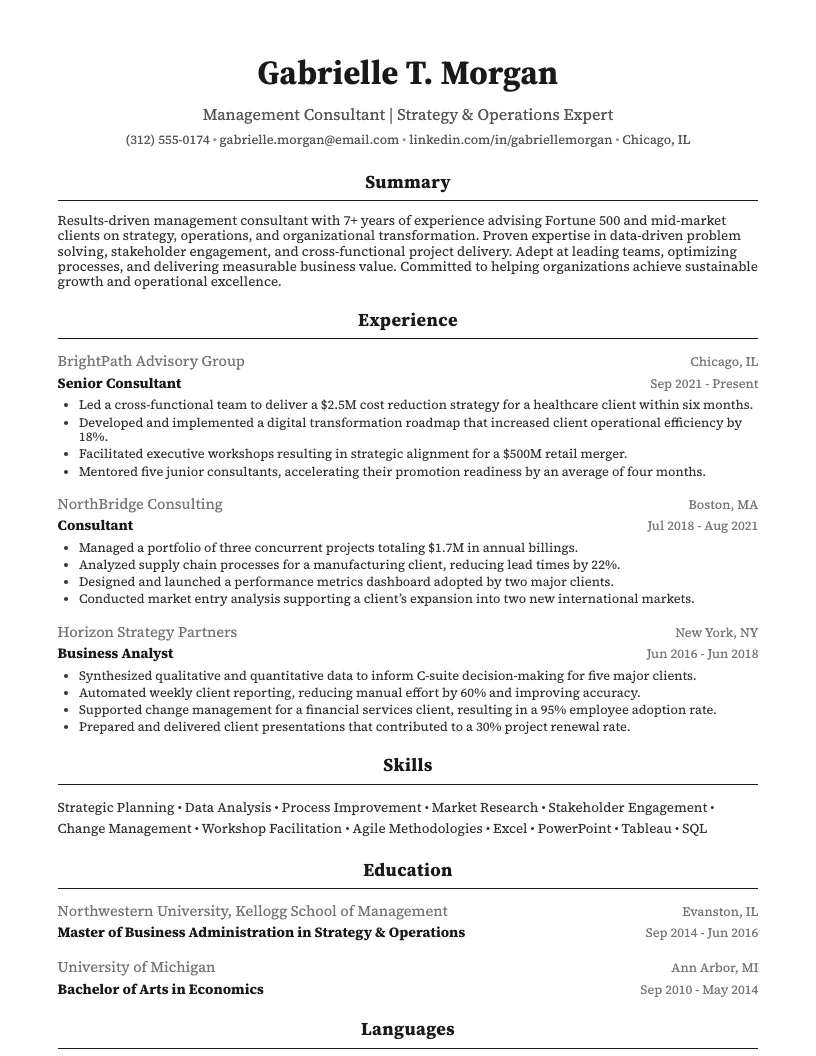
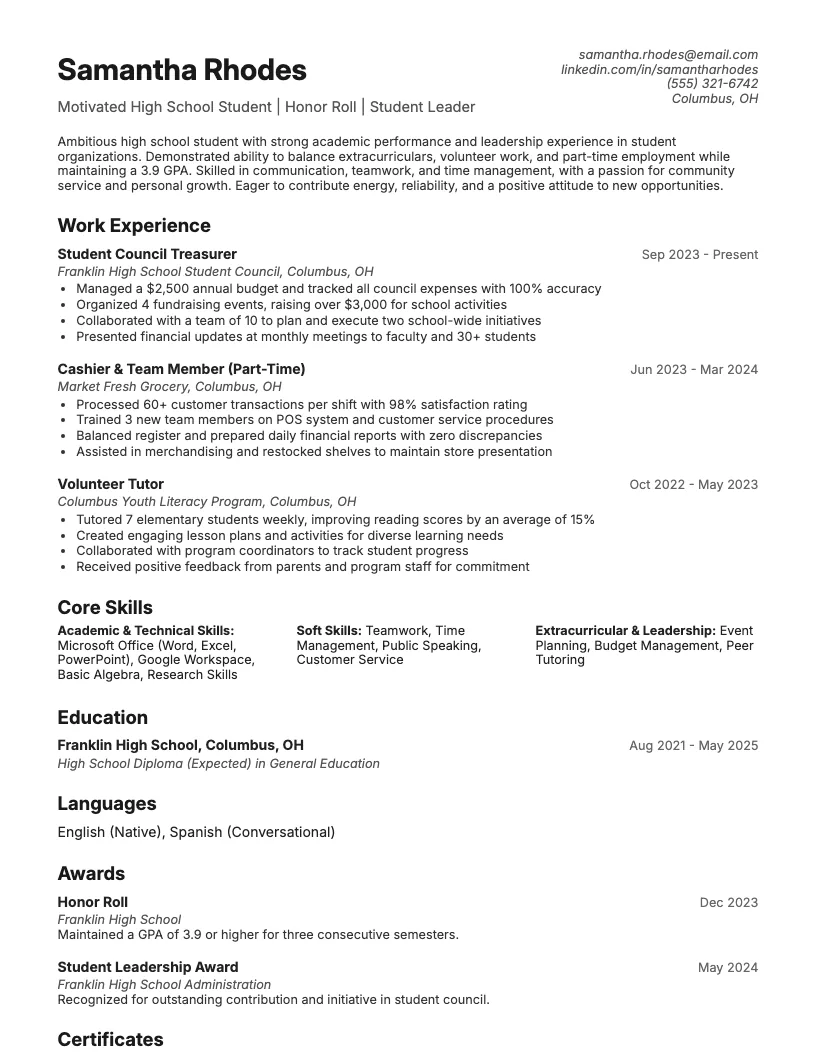
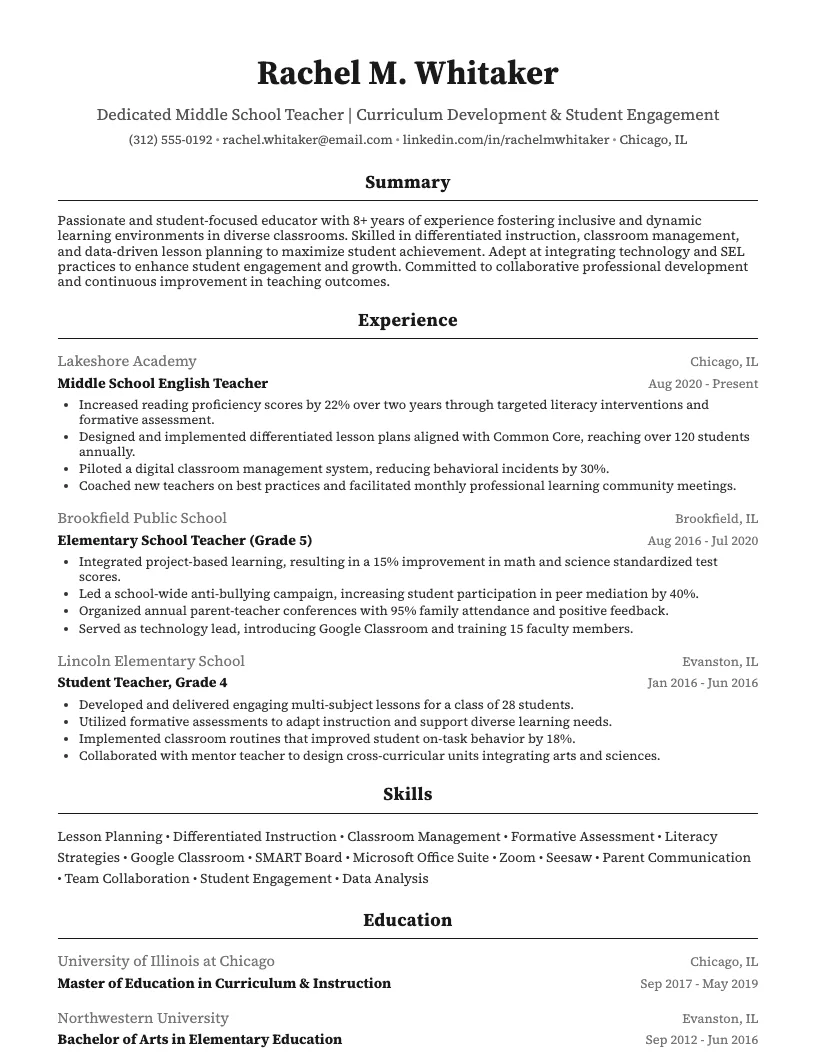
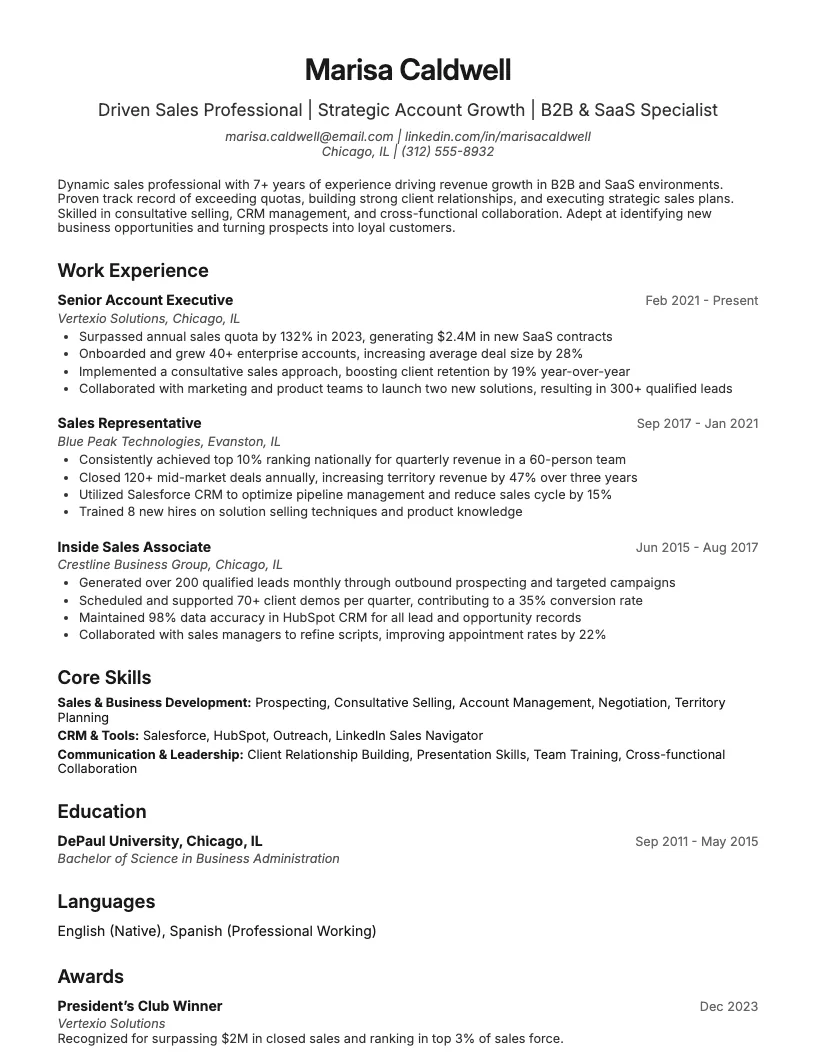
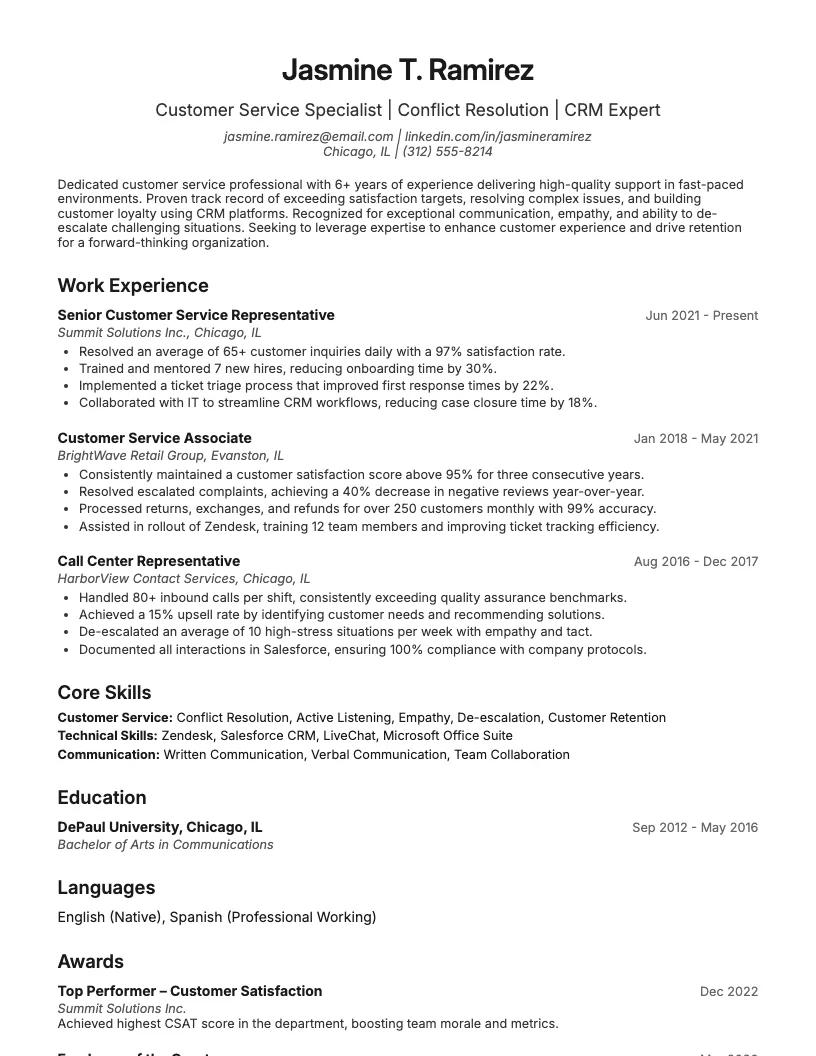
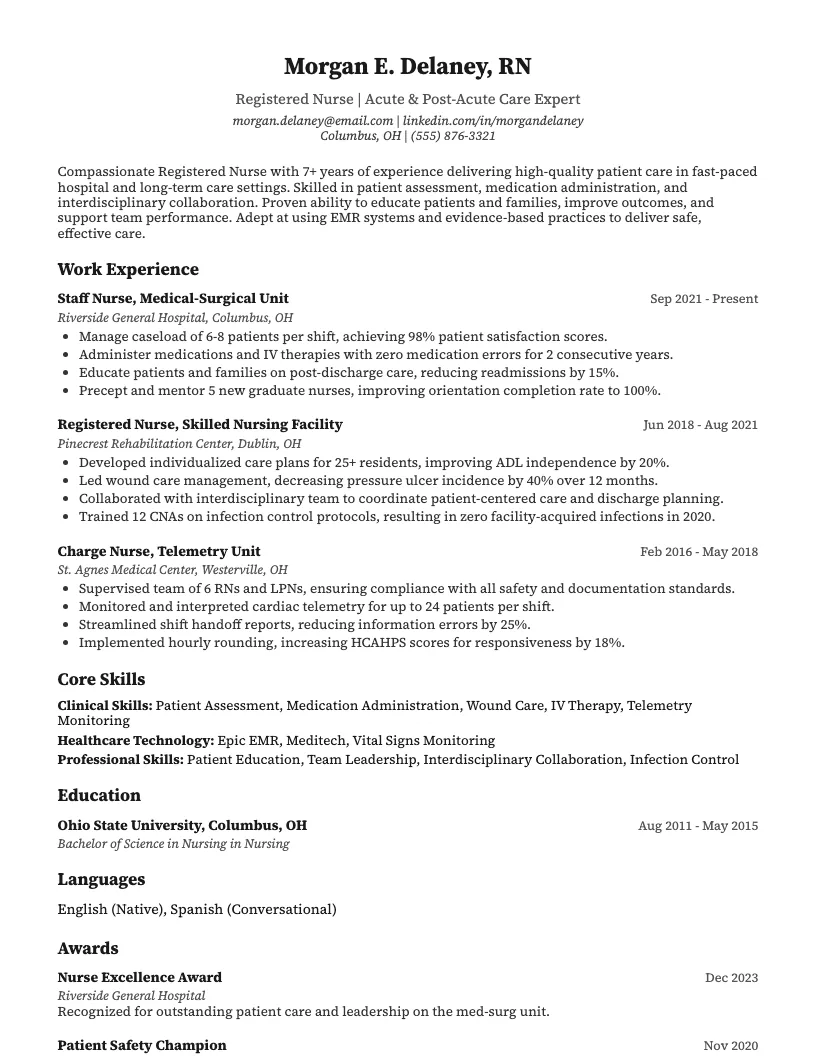
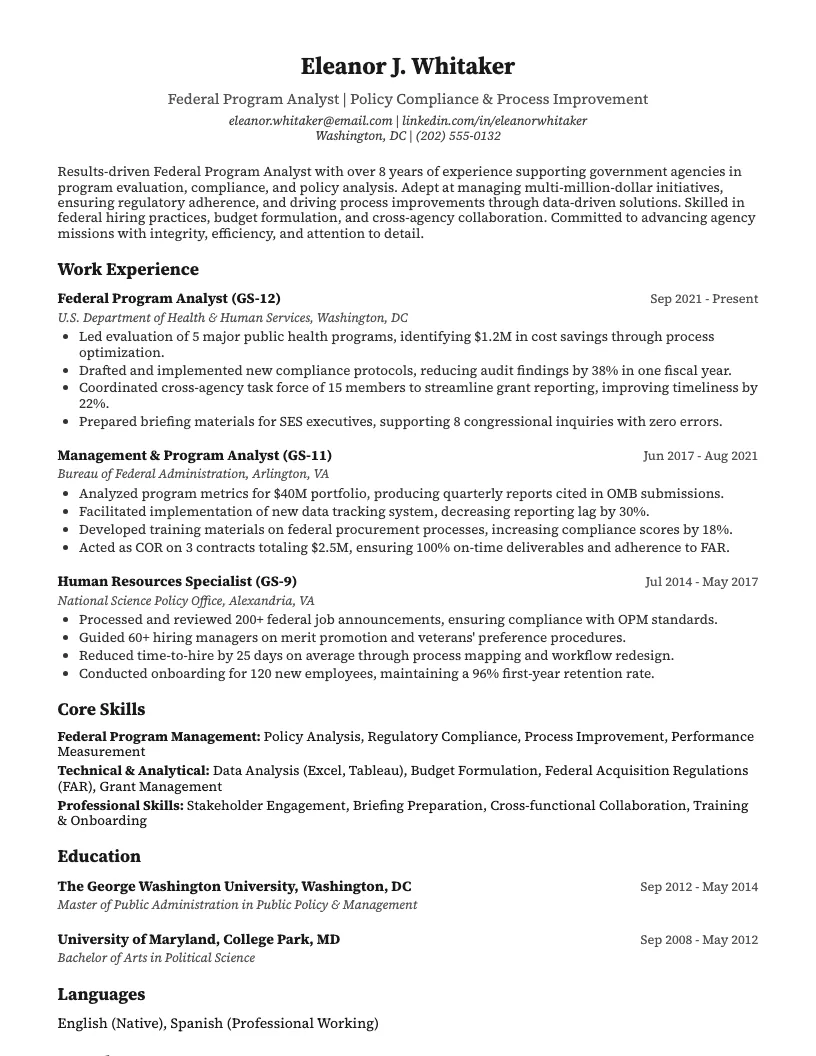
See these skills on a real resume
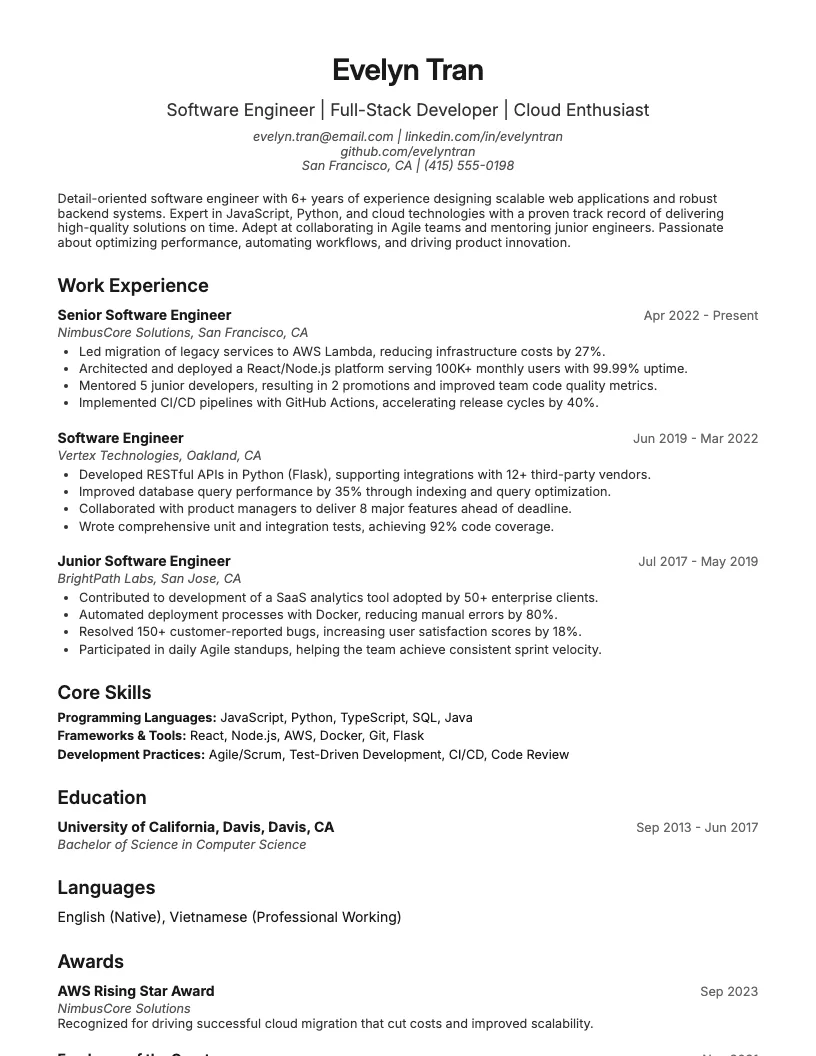
8 examplesStart from an example that already has them, and swap in your own.
Check your resume against the job you want
Scan your resume, see which skills and keywords the posting asks for that you are missing, and fix them before you apply.
Free to use • No credit card required