AI Skills for Resume: 16 to List and Where to Put Them
16 AI skills to put on your resume, which ones match your job, where each one goes on the page, and how to word it so it reads as proof, not a buzzword.


Written by Sarah Chen
Senior Career Strategist & Resume Expert
Updated August 2026
Reviewed by Marcus Rodriguez
Is your resume ATS-friendly?
Drop your resume in and see which of these skills a scanner can actually read, and which ones the job you want is asking for that you have not listed.
PDF or DOCX. Max 2MB.
We never share your resume or use it to train a model.
In This Guide:
What are AI skills on a resume?
I read a lot of resumes, and "AI" has become the word people bolt on without saying what they mean by it. That's the problem you're solving here: naming the actual thing you can do, not the buzzword.
Skills for using AI tools day to day
Most people mean this: you write prompts, you use ChatGPT or Copilot to draft, summarize, or automate something. That's a real skill.
It just needs a task attached to it.
Skills for building AI systems
A smaller group means something technical - training models, working in Python, deploying a system. That's a different resume, and which AI skills should you put on your resume breaks out both lists.
Why non-technical jobs list AI skills too
I see this on marketing, HR, and ops resumes just as often as engineering ones now. Job postings mention AI far more than they did ten years ago, and listing it signals you've kept up - not that you're a data scientist.
What counts as a skill and what is just a tool name
This is the line that separates a real skill from a name on a list, and how to write it so it sounds like proof covers it in full, with the before-and-after bullet.
Which AI skills should you put on your resume?
Which AI skills should you put on your resume?

Here's the split that matters. Some AI skills are things almost anyone can put on a resume because they use these tools every week.
Others only belong there if you can actually back them up in an interview.
I'll go through both, tool by tool, so you can pick the ones that are true for you.
Prompt writing
Prompt writing means you know how to get a useful answer out of a model instead of a vague one.
That's a real skill, not a throwaway line - a bad prompt gets you three paragraphs of nothing, a good one gets you a first draft you can actually use. If you do this daily, say so, and pair it with what you used it for: drafting emails, building reports, running research, summarizing long documents.
ChatGPT, Claude and Gemini
Naming the tool is fine. Naming it and nothing else is the mistake I see most often.
"ChatGPT" on a skills line tells a recruiter you've opened the website. What tells them something is a bullet that says what you did with it - see how to write it so it sounds like proof for the pattern.
Microsoft Copilot and Google Workspace AI
These matter more than people think, because they're the AI tools already sitting inside the software your next employer uses.
If you've used Copilot to draft documents in Word or Google's AI functions inside Sheets, that's a legitimate line - it shows you'll pick up their existing stack fast, not that you need training on it.
AI-assisted data analysis
This is one of the fastest-growing lines I see on resumes right now, and for a good reason: modern tools let you ask a question in plain language and get a chart back, no coding required.
If you've used an AI tool to spot a trend or pull an insight that changed a decision, that's worth a line - and it's worth a number if you have one, like a percentage lift or hours saved.
Workflow automation with Zapier or Make
Listing Zapier vs showing what it did
Familiar with Zapier
Automated weekly reporting with Zapier, cutting a two-hour task to fifteen minutes
Employers read this as initiative, not laziness. Automating your own scheduling, document creation, or reporting shows you look for the slow part of your job and fix it.
Say what you automated and what it freed up - "automated weekly reporting, cutting a two-hour task to fifteen minutes" beats "familiar with Zapier."
AI content creation
Marketing copy, proposals, social posts, client emails - AI is doing the first draft of a lot of this now, and employers want people who can direct that draft, not just accept it.
The line that lands is the one that shows judgment: you used AI to draft fast, then you edited it to match the brand voice and made sure it was accurate. That's the actual skill.
AI literacy and responsible use
I'd call this the most underrated line on this whole list. It's not flashy, but it's what separates someone who trusts everything a model tells them from someone who checks it.
Concretely: knowing what these tools get wrong, catching a hallucinated fact before it goes in a client deck, keeping sensitive data out of a prompt. If you've caught an AI error before it caused a problem, that's a real story for an interview.
Machine learning
This is where the list shifts from "I use AI tools" to "I build AI systems." Machine learning means training a model on data so it can predict or classify something, and employers want to see it tied to a real result, not a classroom exercise.
A strong bullet names the technique and the outcome - something like "trained a classification model that improved churn prediction accuracy," not just "machine learning" sitting alone on a skills line.
Deep learning and neural networks
Deep learning is the neural-network end of machine learning - the approach behind image recognition, speech transcription, and text generation. List it if you've actually built or fine-tuned a model, not because you've read about GPT.
Name the type of network if you know it, and the task it solved. A vague "deep learning" line next to nothing else reads like a buzzword grab.
Natural language processing
NLP is teaching a system to work with text and language - sentiment analysis, classification, chatbots, search. It's one of the more common practical uses of AI outside pure research roles, especially in customer insight and support work.
Same rule as everywhere else on this list: what did you build, and what changed because of it.
Computer vision
Computer vision means training a model to interpret images or video - defect detection, facial recognition, medical imaging. It's a specialist skill, and it's in real demand, so don't undersell it if you have it.
If you've built or deployed a vision model, say what it detected and what improved - error rate, inspection speed, accuracy.
Python, R and SQL
These are the languages that sit under almost everything above. If you can't write in at least one of them, you're describing yourself as an AI user, not an AI builder - and that's a fine thing to be, just be honest about which one you are.
List the language, then the AI work you did in it, not the language alone.
TensorFlow and PyTorch
These are the two frameworks people actually build and train models in. Listing one signals you've done real hands-on model work, not just read about it.
Pair the framework with what you built - a classifier, a prediction model, an image tool - and a number if you measured the improvement.
Retrieval-augmented generation
RAG is a way of making a model's answers more accurate by having it pull from a real, trusted source - a knowledge base or document set - before it responds, instead of relying only on what it was trained on.
It's newer, and it's a strong line if you've built one: it tells an employer you know how to keep an AI system from making things up.
Model deployment and MLOps
Building a model and running one in production are two different jobs, and MLOps is the second one - deployment, monitoring, keeping a model stable once real traffic hits it.
If you've done this, it's worth calling out separately from "machine learning," because it tells an employer you've handled the part that breaks after launch, not just the part that works in a notebook.
AI ethics and governance
This one's rising fast on job postings, especially anywhere AI touches hiring, healthcare, or finance decisions. It covers bias checking, data privacy, and making sure AI-driven decisions can be explained.
If you've worked on any policy, review process, or governance question around AI use, list it - it's a smaller pool of candidates than you'd think.
One thing worth doing before you finalize any of this: run your resume against the actual job posting. ResumeJudge checks which of these AI skills the listing asks for that your resume doesn't have yet, so you're not guessing which ones to include.
Which AI skills matter for your job?
AI skills by role
| Role | Key AI skills | What to write |
|---|---|---|
| Marketing and sales | Generative AI campaigns, prompt engineering | Cut copy turnaround, add a number |
| Software engineering | GitHub Copilot, ML frameworks, RAG, MLOps | Give Copilot its own bullet |
| HR and recruiting | AI screening tools, talent analytics | Time-to-hire cut, faster triage |
| Data and analytics | Supervised learning, foundation models, LLMs | Name the framework, not 'AI' |
| Finance | Fraud detection, AI forecasting | Hours saved, error rate dropped |
| Healthcare | Clinical decision support, AI diagnostics | Modest, well-described experience |
The skill list changes by role. I've read resumes from marketing, engineering, HR, finance, and healthcare, and the AI skills that actually land an interview are never the same list twice.
Each skill below is explained in which AI skills should you put on your resume, and the wording rule - name the tool, attach a number - is in how to write it so it sounds like proof. This section is only about which ones fit your role.
Marketing and sales
Here it's generative AI campaigns, prompt engineering, and chatbot optimization, plus ChatGPT or Jasper for ad copy.
Software engineering
Engineers should name AI-assisted coding tools like GitHub Copilot, plus anything closer to the model itself: machine learning frameworks, retrieval-augmented generation, MLOps. The mistake I see most often is engineers burying "used Copilot" in a bullet about something else entirely, when it deserves its own line with a measurable result.
HR and recruiting
Recruiters lean on AI resume screening tools, talent analytics, and workflow automation. If you've used AI to cut time-to-hire or triage a candidate pool faster, that's the kind of proof worth writing out in full - not "familiar with AI tools."
Data and analytics
This crowd should speak in specifics: supervised learning, foundation models, large language models, data labeling, model evaluation metrics.
Design and creative roles
AI image generation, AI video editing, generative design workflows. Nine times out of ten, a creative resume undersells this - they'll mention Photoshop but skip the Midjourney or Runway work that actually saved hours on a deadline.
Customer service
Chatbot management, AI-assisted ticket routing, sentiment analysis tools. If you've helped deploy or tune a support bot, that's a stronger line than "excellent communication skills."
Finance
Fraud detection models, AI-driven forecasting, automated reporting tools.
Healthcare
Clinical decision support tools, AI-assisted diagnostics, administrative automation. This field moves slower on AI adoption, so even modest, well-described experience stands out against a stack of resumes with none.
Job titles that ask for AI skills outright
Some postings don't leave you guessing: AI/ML researcher, machine learning engineer, business intelligence analyst, automation specialist, and increasingly product manager and marketing analyst roles too. When a title says it outright, match the posting's exact phrasing, not your own paraphrase.
Whatever your title, once you've picked which skills apply, ResumeJudge will scan the actual posting and tell you which of these it's asking for that your resume is still missing - faster than guessing from a list like this one.
Where do AI skills go on your resume?
Where do AI skills go on your resume?
Same skill, five spots on the page. Put it in the wrong one and it reads like padding.
Skills section
This is where a recruiter or an ATS scans for the exact words in the job posting.
List the tools and methods by name: ChatGPT, TensorFlow, PyTorch, prompt writing, whatever the posting actually says. Skip the vague "AI" line - a bare word helps nobody.
If you're not sure which words the posting wants, that's exactly the gap ResumeJudge checks for: it compares your resume against the job description and tells you which of its terms you're missing.
Resume summary
Your summary is the one place you get to say what AI skill means for the reader, in a sentence.
I only put AI in the summary when it's central to the role or to your identity as a candidate - a data analyst, a product manager, someone using it daily. If it's a nice-to-have skill buried in month six of a job, leave it out of the summary and let the work experience bullets carry it instead.
Work experience bullets
This is where the skill stops being a claim and becomes proof.
Name the tool, the task, and a number: hours saved, error rate down, accuracy up. See how to write it so it sounds like proof for the full pattern.
Education and coursework
If you're a recent grad or changing careers, list the actual course names: Machine Learning, Neural Networks, AI Ethics. Working professionals can keep this section short - your experience is already doing the talking.
Projects section
State the goal, your role, the tool, and the outcome - a chatbot built with NLP, a prediction model that won an award. Treat a side project the same as a job: specific and measurable.
Certifications section
Name the certification, the issuer, and the date. A solid certificate can cover for missing hands-on experience, so put it near the top if the posting names it directly.
Saying the same skill in each place without repeating yourself
Repeating the identical phrase in five places looks like you ran out of material.
Keep the keyword the same, but change the sentence: the skills section names it, the summary frames why it matters, the bullet proves it with a result. Once your resume is worded right, that's the moment to point it at a real posting - ResumeJudge can then write the cover letter for that job and even apply on your behalf.
How do you write an AI skill so it sounds like proof?
Is your resume good enough?
Drop your resume in and see which of these skills a scanner can read, and which ones the job you want is asking for that you have not listed.
Upload your resumeFree. PDF or DOCX. We never share your resume or use it to train a model.
I've read enough of these to tell in one line whether someone actually used the tool or just added it to sound current.
The pattern: verb + tool + task + result
Every strong AI bullet has the same shape: what you did, with what tool, on what task, with what outcome.
Drop any one of those four and it reads as filler.
"AI tools: ChatGPT, Copilot" vs a bullet that shows the work
Naming a tool vs proving you used it
Used AI tools including ChatGPT and Copilot
Used ChatGPT and Copilot to automate weekly reporting, cutting prep time 40%
"AI tools: ChatGPT, Copilot" tells a recruiter nothing except that you've heard of them.
"Used ChatGPT and Copilot to automate weekly reporting, cutting prep time 40%" tells them what you built and what it was worth. Same two tools, completely different bullet.
Action verbs that fit AI work
Lead with something that describes what you actually did: developed, implemented, automated, deployed, streamlined, optimized, engineered.
"Utilized" and "leveraged" are where most of these bullets go to die - they don't say anything a verb couldn't say better.
Numbers you can honestly measure: hours saved, error rate, turnaround
Nine times out of ten, the number is sitting right there and people just don't write it down: hours saved per week, accuracy before and after, turnaround time, response time.
I've seen resumes report an accuracy jump from 85% to 92% off a single model tweak - that's a real, checkable number, and it's exactly the kind that lands.
Pulling the exact wording from the job posting
If the posting says "prompt design," write "prompt design" - not "prompt work" or "prompt skills." Newer screening tools do pick up on related wording, but the posting's own phrase is the one nobody has to interpret, and it's the one a human skimming the page is looking for.
ResumeJudge will read the posting and tell you exactly which of its terms are missing from your resume, so you're not guessing at the wording by eye.
AI skills to leave off
Cut anything you can't defend in an interview, anything vague like "AI-savvy," and any tool that has nothing to do with the role. A resume that reads as fully AI-written raises the same doubt in reverse - it undercuts the very skills you're trying to prove.
What if you have no AI experience yet?
What if you have no AI experience yet?
Nine times out of ten, "I have no AI experience" turns out to be false. You've used it.
You just never wrote it down.
AI you already use at work without calling it a skill
If you've asked ChatGPT to draft an email, used Grammarly's AI suggestions, or let Excel's AI-powered functions clean up a spreadsheet, that counts.
I see people leave this off constantly because it feels too small to mention. It isn't - name the tool and what you did with it.
Coursework and class projects
A class project where you used AI-powered Excel functions to analyze 200+ survey responses is a real bullet point. So is a chatbot you built for an assignment.
Treat the class the way you'd treat a job: what tool, what task, what came out of it.
A small project you can build this week
If you've got nothing yet, build something small - a basic chatbot, a script that automates a task you're tired of doing by hand. It doesn't need to be impressive, it needs to exist.
Once it's built, write it up like proof, not a tool list.
Internships and volunteer work
Unpaid work counts the same as paid work here. Volunteer AI work that improved a process by even a small, honest margin belongs on the resume - the employer doesn't check whether you were paid for it.
Certifications worth listing: Google AI Essentials, Azure AI Fundamentals, AWS Certified AI Practitioner
Three worth your time, depending on direction: Google AI Essentials is the easiest entry point for non-technical roles, Microsoft Azure AI Fundamentals is a recognized entry-level credential, and AWS Certified AI Practitioner leans more technical. Pick the one that matches the job you want, not all three.
Transferable skills for career changers
Coming from another field, lead with analytical thinking, data handling, and problem-solving - skills that transfer straight into AI-adjacent work without a rebrand.
Once you've got a real list, run it against the posting - ResumeJudge will tell you which of your transferable skills the job actually cares about, and rewrite your bullets to say so in the employer's own words.
Frequently Asked Questions
Should I list ChatGPT as a skill?
No - naming ChatGPT alone tells a hiring manager nothing about what you did with it. List what you used it for and what came out of it: drafted client emails, summarized research, built a workflow. A tool name with no action attached reads as filler, not a skill.
How many AI skills should I put on my resume?
Two or three, and only ones you can back up with a real example. Padding the list further doesn't help - it starts to read as buzzwords instead of proof. A job posting usually names the exact skills it cares about, so match those instead of listing everything you've ever touched. ResumeJudge can check your resume against a posting and show you which of the skills it asks for are missing.
Do I need AI skills if I'm not in tech?
Not required, but worth including if AI tools already touch your daily work - writing, analysis, scheduling, customer replies. In fields like finance, healthcare, and marketing, showing you use AI to work faster or more accurately can set you apart. If AI isn't part of your job, don't force it onto the resume just to have it there.
Will a recruiter test me on an AI skill in the interview?
Possibly, if you put something specific on the page. Anything you claim about AI use should be something you can talk through in detail - what tool, what task, what changed because of it. If you can't explain it past the resume line, leave it off.
Should I say I used AI to write my resume?
No - say what you did, not what wrote it. A resume that reads as fully AI-generated, with generic phrasing and no specific results, makes a hiring manager doubt the rest of it too. Use AI as a starting point if that helps, but the wording and the claims should end up being yours.
Is 'AI' on its own enough, or do I need to name tools?
Name the tools. "AI" by itself is too vague for a recruiter or an applicant tracking system to credit you for it - say ChatGPT, Midjourney, Copilot, or whatever you actually used. ResumeJudge can pull the specific AI tools and skills a job posting names, so you know exactly which ones belong on the page.
See these skills on a real resume
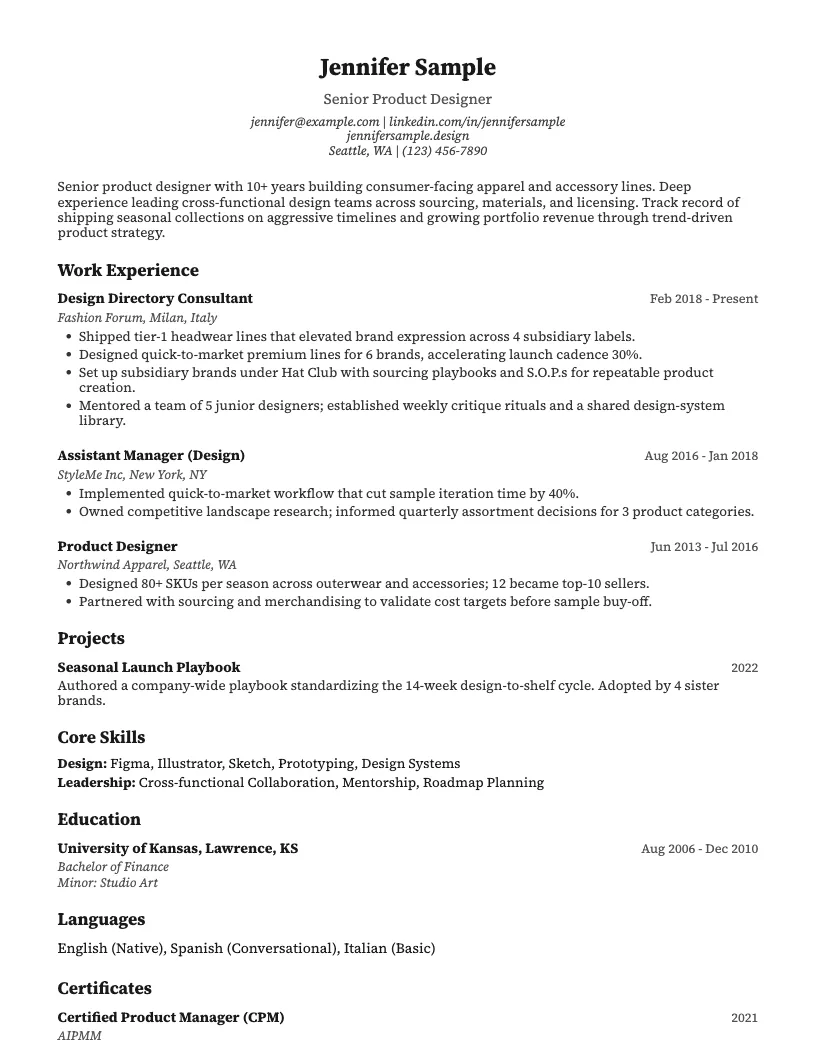
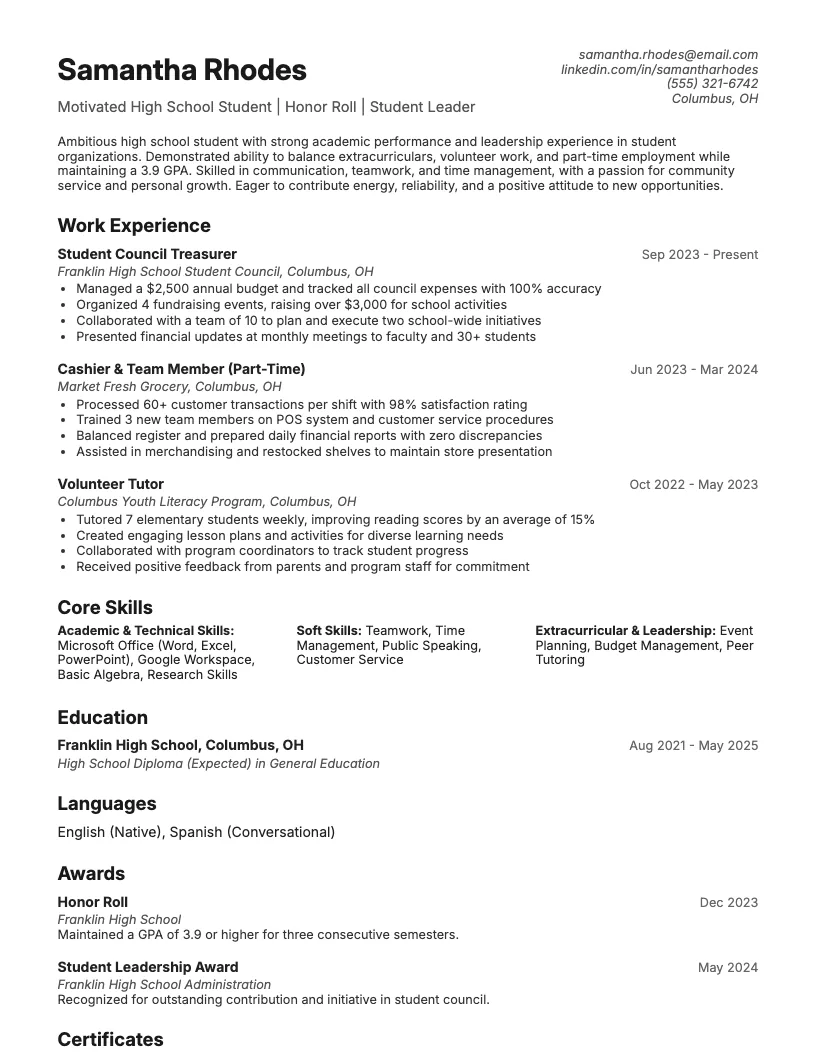
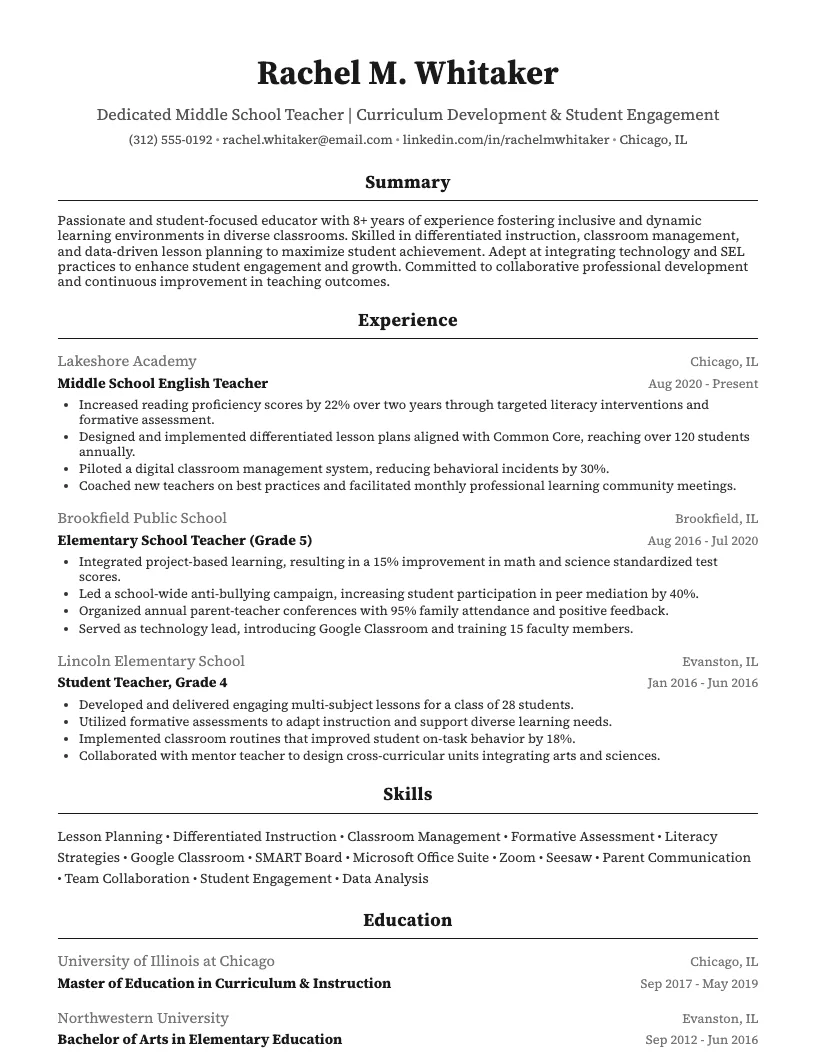
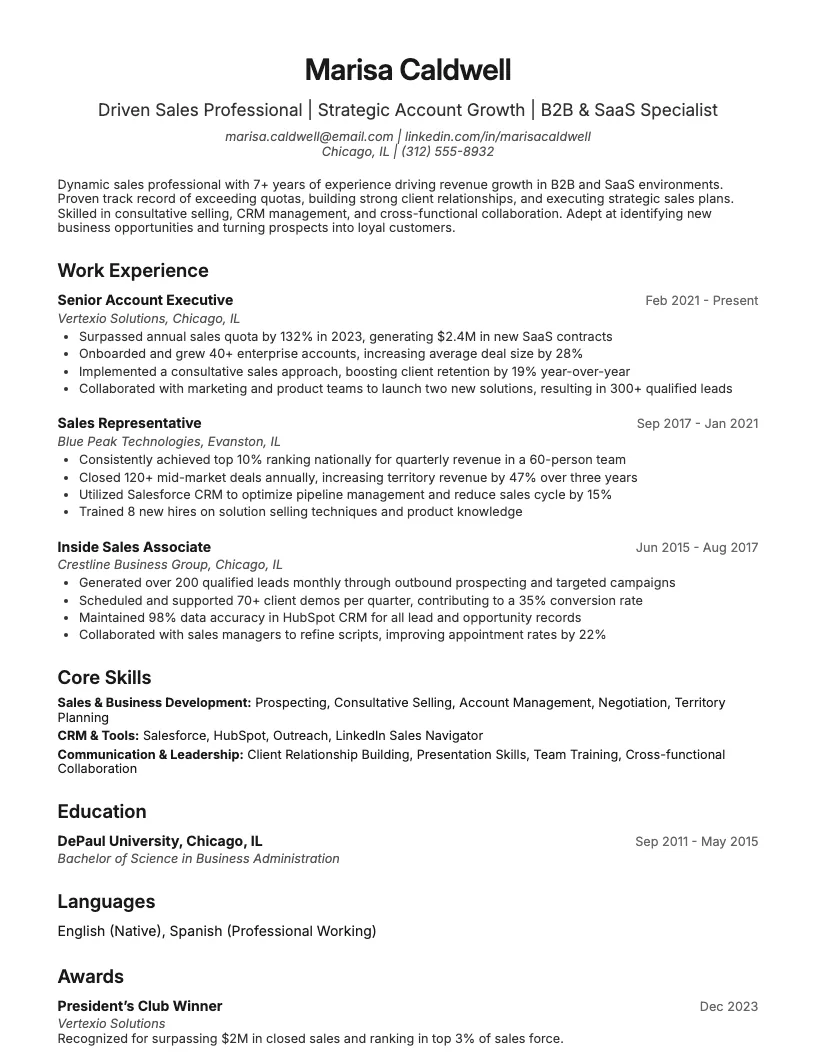
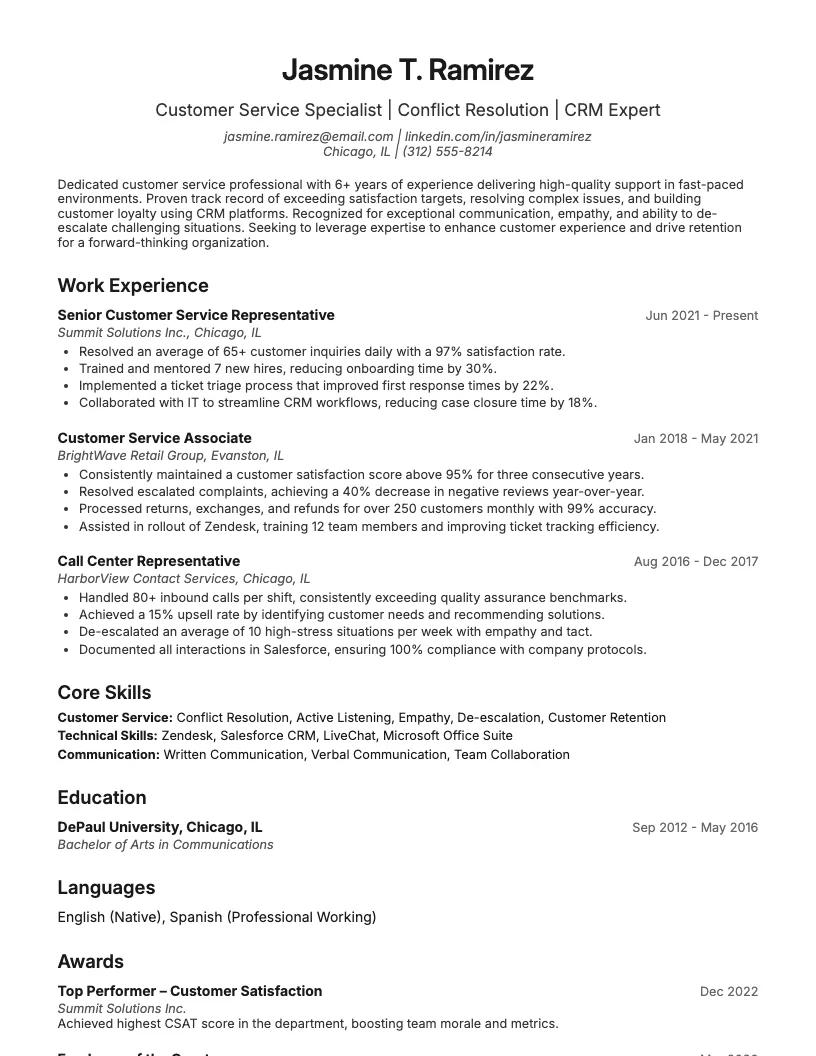
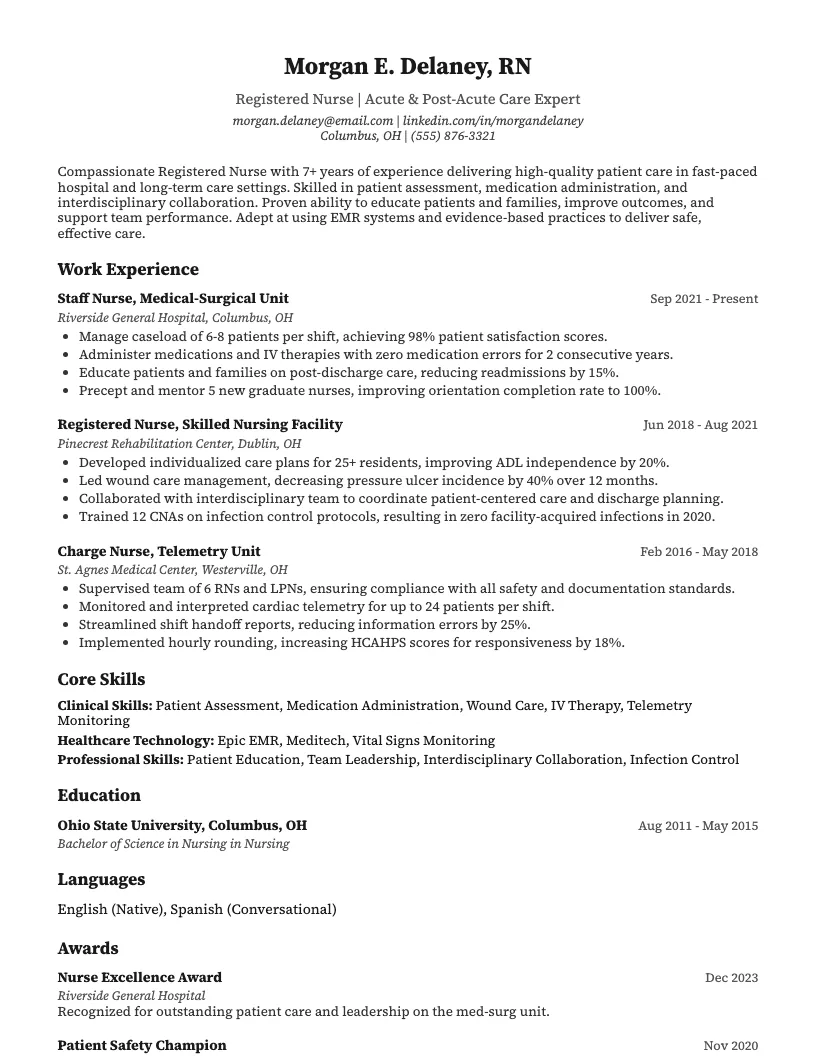
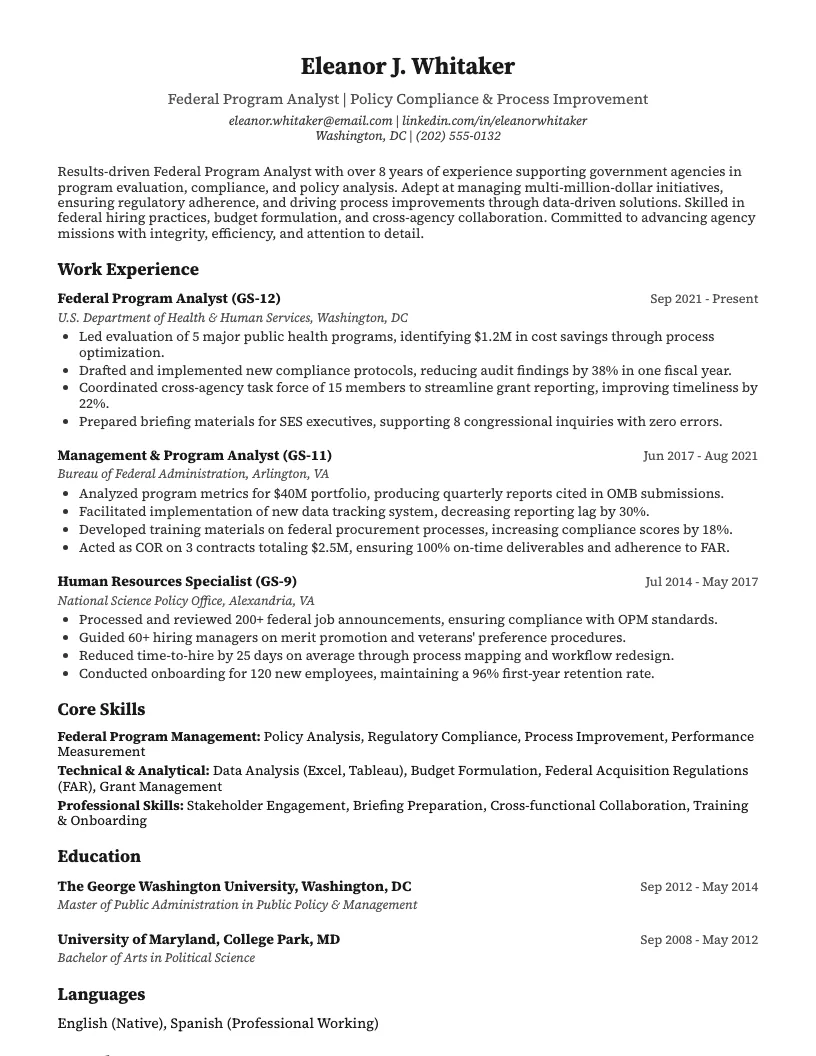
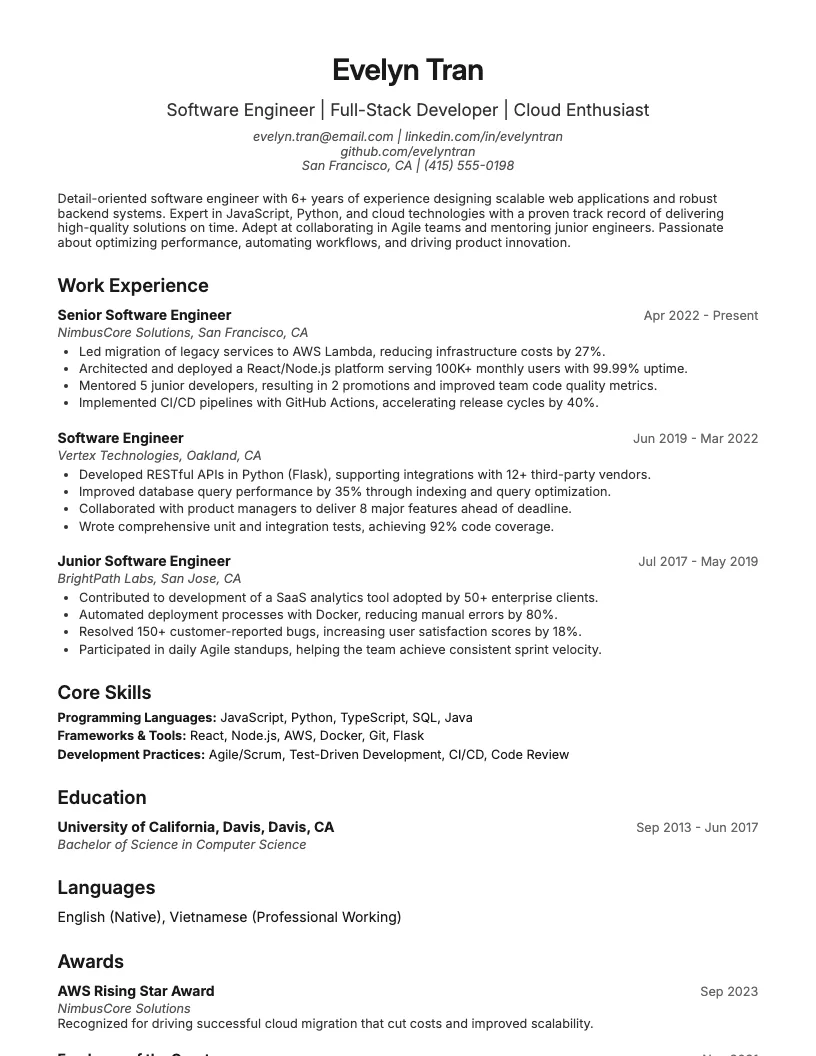
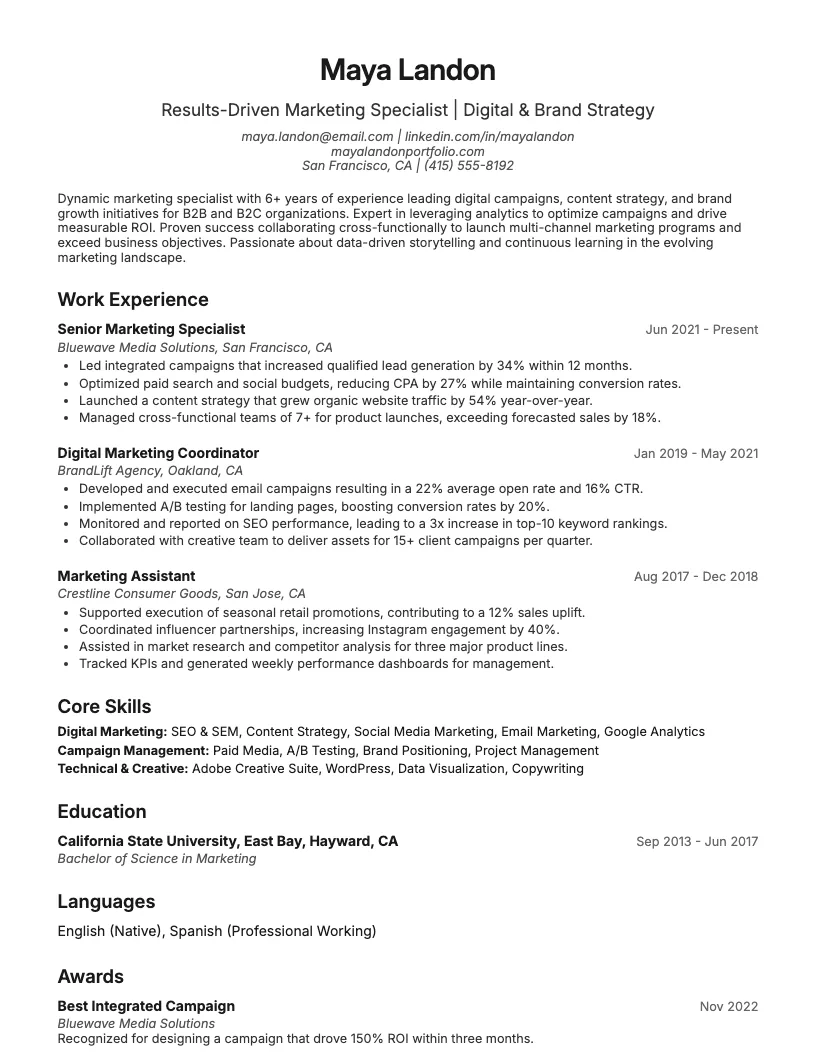
8 examplesStart from an example that already has them, and swap in your own.
Check your resume against the job you want
Scan your resume, see which skills and keywords the posting asks for that you are missing, and fix them before you apply.
Free to use • No credit card required