Web Developer Resume Keywords: 10 I See in Every Job Posting
The 10 keywords that show up most in web developer job postings, plus front-end, back-end, CMS, accessibility, and soft-skill terms to match by level.


Written by Marcus Rodriguez
ATS Optimization Specialist & Career Coach
Updated August 2026
Reviewed by Dr. Priya Sharma
Is your resume ATS-friendly?
Drop your resume in and see which of these skills a scanner can actually read, and which ones the job you want is asking for that you have not listed.
PDF or DOCX. Max 2MB.
We never share your resume or use it to train a model.
In This Guide:
What are web developer resume keywords?
They're the exact words a job posting uses for your skills, and if your resume uses different words for the same thing, you lose credit for it.
Keywords ATS software matches on
Plenty of employers run resumes through an ATS before a person ever sees one, and the bigger the company, the more likely that is. The system is looking for literal terms: HTML5, JavaScript, Git, WordPress, REST API.
Miss one that's central to the posting - TypeScript or CI/CD, say - and you can get filtered out before a recruiter opens the file.
Keywords a human recruiter scans for
Once a resume clears the software, a recruiter skims it in seconds for the same terms, plus context: which CMS, which framework, whether you shipped anything real. I've read hundreds of these, and the ones that pass are specific - not "worked on websites" but "built WooCommerce checkout flows."
Where the keywords have to appear
Skills section, summary, and inside your experience bullets - not just one list at the bottom. ResumeJudge will check your resume against a posting and tell you exactly which of these are missing before you hit apply.
How many to include
Recruiters skim top to bottom, so the first few keywords you list get read closest. Put the posting's own top terms at the front of the row, not in alphabetical order.
Fifteen to twenty-five, matched to that specific posting. Fewer looks thin; forty starts to read like keyword stuffing, which recruiters spot immediately.
Which keywords appear in the most web developer job postings?
Which keywords appear in the most web developer job postings?

I run these postings side by side a lot, and the same names show up near the top every time. If you're short on time, these ten are the ones to get right first.
HTML5
It's in roughly 9 out of 10 postings I look at, and it's the one nobody skips. How to write the language and framework entries out is in what front-end keywords should you list.
CSS3
Almost as common as HTML5. Don't stop at the name - name Flexbox and Grid too, because that's what tells a recruiter you can actually lay out a page, not just style text.
JavaScript (ES6+)
Over 9 in 10 listings ask for it, and it's where I see the most vague entries.
Responsive design
Every site has to work on a phone now, so this one's close to mandatory. Pair it with a real number if you can - pages shipped, breakpoints handled - and check how you write keywords into a bullet point for how that looks.
Git / version control
Shows up in the vast majority of postings, and it's not really optional anymore - teams assume you know branching and pull requests before you walk in. If you list it, be ready to talk about it; see what gets a resume rejected for what happens when you can't.
WordPress
Common, but the mistake I see constantly is people naming the platform and stopping there. Name a plugin, a theme you built, a hook you used - what CMS keywords should you list covers this properly.
Cross-browser compatibility
Still a strong-tier keyword. It tells a hiring manager you test before you ship, not after a bug report comes in.
Core Web Vitals
Now shows up in over half the postings I check - a newer one that's become expected fast. If you've improved LCP or CLS on a real site, that's a number worth putting on the page.
WCAG 2.2 AA
Also past the halfway mark in frequency, and it's becoming a legal requirement in more places, not just a nice-to-have. Worth its own line if you've done accessibility work.
Tailwind CSS
The framework I'd bet on right now - it's overtaken a lot of the older CSS libraries in postings.
Ten keywords is a starting point, not a target list - pull the exact ones a posting uses and check your resume against them one by one, which is the whole first job ResumeJudge does for you.
What front-end keywords should you list?
What front-end keywords should you list?
Front-end is where I see the most padding, so let's fix that first.
Languages: HTML5, CSS3, JavaScript, TypeScript, Sass/SCSS
These five are non-negotiable. TypeScript belongs on your resume the moment you've used it on a real project; postings ask for it constantly at mid-level and up.
CSS frameworks: Tailwind CSS, Bootstrap 5, CSS Modules, BEM
Pick the one you actually shipped with, not the one you think sounds better. Tailwind's the one I see requested most now, but if you've built a component library with CSS Modules or organized a large stylesheet with BEM, name that too - it shows you can work at scale, not just style a landing page.
JavaScript frameworks: React, Vue, Angular, Next.js, Alpine.js
React still shows up in the most postings. List whichever framework the job you want actually names first, then your others after it - don't lead with your favorite if it's not the one they asked for.
Build tools: Vite, Webpack, npm, Babel, esbuild
Name the one you actually run, not every tool you've heard of.
Static site generators: Astro, Eleventy, Hugo, Jekyll
Worth listing if you've shipped a site with one - a growing share of front-end roles run static or hybrid pipelines instead of a full single-page app.
Browser APIs worth naming: Fetch, IntersectionObserver, async/await, DOM manipulation
These prove you understand the platform underneath whatever framework you use. Once you've pulled a stack together this way, ResumeJudge will check it against the actual posting and tell you which of these you're still missing.
What back-end and full-stack keywords should you list?
What back-end and full-stack keywords should you list?
If your resume only shows front-end work, a lot of full-stack postings will skip right past you. Here's the split I use with clients.
Node.js and Express
Node.js and Express are the baseline for a JavaScript back end. If you've built an API, name it - "Express" alone tells a recruiter more than "back-end development" ever will.
Databases: PostgreSQL, MySQL, MongoDB, Redis
List the databases you've actually queried, not just "SQL." PostgreSQL and MySQL cover relational work, MongoDB covers document stores, and Redis signals you understand caching - a detail a lot of mid-level resumes leave out.
APIs: REST, GraphQL, JSON, Postman
REST is close to universal on full-stack postings now. If you've worked with GraphQL, say so - it still reads as the more modern choice.
Postman belongs here too; it's a small keyword that proves you've actually tested what you built, not just written it.
PHP, Python and Java for web work
Each of these points at a different kind of job: PHP usually means WordPress or Laravel, Python means Django or Flask, Java means Spring Boot and enterprise systems. Match the language to the postings you're chasing, not the other way around.
Deployment: Docker, CI/CD, GitHub Actions, Vercel, Netlify, AWS
This is the row that proves you ship, not just build locally. Docker and CI/CD tend to show up more in senior and enterprise postings, while Vercel and Netlify are common shorthand for modern, fast-moving teams.
If you're not sure which of these your target postings actually want, running your resume against a real one is faster than guessing - that's exactly what ResumeJudge checks for, and it'll fix the wording for you against that specific posting instead of leaving you to reword it by hand.
What CMS keywords should you list?
CMS keywords by platform
| Platform | Keywords to name | Best for |
|---|---|---|
| WordPress | Custom themes, Gutenberg blocks, ACF, WP REST API | Agency & blog sites |
| WooCommerce | Stripe, payment gateways, checkout, cart | E-commerce |
| Shopify | Liquid, sections, theme architecture, Functions | Shopify stores |
| Drupal / Webflow / Squarespace | Twig modules, Webflow CMS, Squarespace | Enterprise, agency, small business |
| Headless CMS | Contentful, Sanity, Strapi, Storyblok | Decoupled front-end builds |
Most job postings for this role name a specific CMS, not just "web developer." If the posting says WordPress, your resume needs to say WordPress back, with the parts you actually touched.
WordPress: custom themes, Gutenberg blocks, ACF, custom post types, WP REST API, WP-CLI
WordPress still runs a huge share of the web, so it shows up in most CMS-heavy postings.
Naming the platform and stopping there is one of the things that gets a resume cut - see what gets a web developer resume rejected.
Name the parts you actually worked in: custom theme development, Gutenberg blocks, Advanced Custom Fields, custom post types, the WP REST API, WP-CLI scripts. Any one of those tells a hiring manager more than the word "WordPress" on its own.
WooCommerce and e-commerce: Stripe, payment gateways, checkout, cart
If you've built or maintained a store, say so directly: WooCommerce, Stripe or another payment gateway, checkout flow, cart logic. E-commerce work is its own line item to a recruiter, not a WordPress detail.
Shopify: Liquid, sections, theme architecture, Functions
Shopify roles want Liquid by name, along with sections, theme architecture, and Functions if you've used them.
Drupal, Webflow and Squarespace
Drupal still holds ground in enterprise and government work. Webflow and Squarespace turn up more in agency and small-business roles.
List whichever you've actually shipped on.
Headless CMS: Contentful, Sanity, Strapi, Storyblok
Headless setups are increasingly common on job postings, especially where content and front end are decoupled. Contentful, Sanity, Strapi, and Storyblok are the names to know, and if you've connected one to a front end, that's worth its own bullet - see how to turn that into a real accomplishment.
Site maintenance: plugin management, security hardening, backups, migrations
A lot of CMS work is upkeep, not building: plugin management, security hardening, backups, migrations. Don't leave this off just because it feels routine - it's often exactly what the posting is asking for.
Once you've pulled together which of these terms actually belong on your resume, ResumeJudge can check the full list against the posting and rewrite the wording to match it for you.
What accessibility, SEO and performance keywords should you list?
What accessibility, SEO and performance keywords should you list?
This is the section most web developer resumes leave thin, and it's the one that decides whether marketing, legal, and content teams trust you.
WCAG 2.2 AA compliance
Name the actual standard, not "accessibility best practices." Putting a version number on your resume tells a hiring manager you've sat through a real audit, not just skimmed a checklist once.
Accessibility tools: axe-core, Pa11y, Lighthouse, screen-reader testing
Name the tool you ran, not "tested for accessibility." axe-core, Pa11y, and Lighthouse are the ones I see most, and screen-reader testing with VoiceOver, NVDA, or JAWS says you checked with a real assistive device, not just an automated scanner.
Core Web Vitals: LCP, INP, CLS
LCP, INP, and CLS with real before-and-after numbers is what proves the work happened - see how to write keywords into a bullet point for the exact phrasing.
Performance work: lazy loading, WebP/AVIF, critical CSS, CDN, code splitting
List the technique you actually used: lazy loading, WebP or AVIF images, critical CSS extraction, CDN configuration, code splitting. Each one maps to a specific Core Web Vital, so pairing the technique with the metric it moved is stronger than either alone.
Technical SEO: schema.org markup, canonical URLs, sitemap.xml, meta tags
Schema.org markup, canonical URLs, sitemap.xml, meta tags - these are the terms that tell a technical recruiter you've shipped a site that had to actually rank, not just render. Before you apply, ResumeJudge can check your resume against a specific posting and flag which of these it's asking for that you haven't named.
Testing: Jest, Cypress, unit testing, end-to-end testing
I've seen hundreds of resumes skip testing vocabulary entirely, and at mid-to-senior level that's a gap ATS software in product companies filters on. Jest for unit testing, Cypress for end-to-end - name both if you've used them, since listing just one reads as partial coverage.
Which soft skill keywords are worth including?
Which soft skill keywords are worth including?
These are the words that get ignored most on a web developer resume, and I think that's a mistake.
Agile and Scrum
If your team ran sprints, say so. Name the ceremonies you sat through - standups, sprint planning, retros - and pair them with the tool: Jira or Trello.
"Agile" alone is thin; "Agile" next to the tracker you used reads as real.
Code review and pair programming
I've seen hundreds of these, and the ones that stand out say who reviewed and what changed because of it. "Reviewed pull requests" is nothing.
"Caught three accessibility regressions in code review before they shipped" is a sentence a hiring manager remembers.
Client communication and requirement gathering
Agency and freelance developers live here - you're translating a client's vague ask into a build plan. Name it: requirement gathering, stakeholder management, scoping.
Skip it and your resume reads like you only ever got handed a finished spec.
Working with design: Figma handoff, design systems, design tokens
Pixel-perfect implementation from a Figma file is a real, checkable skill - say you built to it. If your team maintained a design system or used tokens, name that too; it tells a lead you can keep a UI consistent across a whole product, not just one page.
Mentoring junior developers
This one matters most from mid-level up. Don't just write "mentoring" - say how many people and on what: code review depth, a specific practice you taught.
A vague claim here gets skipped exactly as fast as a vague technical one.
Technical documentation
Wikis, READMEs, onboarding guides - if you wrote them, list it. It signals you leave a codebase better than you found it, which is a different claim than "team player" and a more believable one.
Once you've picked your keywords, our job-tailored resume fix will slot the ones a specific posting asks for into the right bullets for you.
How do you pull the right keywords out of a job posting?
How do you pull the right keywords out of a job posting?
Step 1: Collect five postings for the role you want
One posting tells you what one company wants. Five tell you what the role actually needs.
Grab five for the kind of shop you're targeting - WordPress agency, Shopify store, in-house product team, whatever's closest to your next move.
Step 2: Mark every term that shows up in three or more
Read all five and highlight anything that repeats across at least three. That's your must-include list.
Terms that show up once or twice go in a maybe pile - add them only if you can back them up.
Step 3: Check each one against a site you actually built
For every must-include term, find a real project where you used it. No project, no claim.
This is also the fastest way to catch gaps. ResumeJudge will scan your resume against a posting and tell you which of these must-include terms you're actually missing, instead of you eyeballing five tabs at once.
Step 4: Add the missing ones in the posting's exact wording
If the posting says "Core Web Vitals" and your resume says "site speed," fix the wording. Some systems do read related terms as close enough, but plenty still look for the literal string, and I wouldn't bet an application on which one you're facing - see where the keywords have to appear for placement.
Where do the keywords go on the resume?
Where do the keywords go on the resume?
Same keyword, six spots on the page. Where you put it changes whether the parser catches it at all.
Skills section, directly under the summary
Put Skills right after the summary, before Experience. Most parsers weight the top third of the page more heavily, and most recruiters skim top-down too, so a labelled row of HTML, CSS, JavaScript, WordPress, and Shopify needs to hit them before they've even reached your job titles.
Bury it near Education at the bottom and you're betting the reader gets that far.
Eight labelled rows instead of one comma wall
I've seen hundreds of these skills sections, and the ones that work are broken into labelled rows: Languages, CSS Tooling, CMS, Frameworks, Accessibility & SEO, Performance, Hosting & DevOps. Two to four tools per row, not forty items in one comma-separated wall nobody reads past line two.
See how many to include for the count that row structure should add up to.
The professional summary
Your top two or three keywords belong in the summary too, not just the skills block - it's the first thing a human actually reads.
Experience bullet points
This is the one people skip. A skills list proves you've heard of a tool; a bullet that uses it in context proves you've done the work.
See how to write keywords into a bullet point for the before-and-after. If you're not sure your bullets actually cover what a posting wants, ResumeJudge will scan your resume against the job description and tell you exactly what's missing before you hit apply.
Contact header: GitHub and portfolio links
Modern ATS software parses LinkedIn and GitHub URLs directly, so put both in the header. A live portfolio link does more for a web developer than another line of text ever will.
A projects section for freelance and side work
Side and open-source work gets its own Projects section: repo or live link, the stack you used, and a real result - a PageSpeed score, a launch date, traffic served. Freelance client work goes in Experience as a real job entry with dates.
Once that resume's built, ResumeJudge can also write the cover letter for the specific job you're targeting and tailor a fresh version of the resume for each posting you apply to.
How do you write keywords into a bullet point?
Is your resume good enough?
Drop your resume in and see which of these skills a scanner can read, and which ones the job you want is asking for that you have not listed.
Upload your resumeFree. PDF or DOCX. We never share your resume or use it to train a model.
I've rewritten hundreds of these bullets, and the pattern is always the same: the task is fine, the sentence just never names the tool or the number.
"Made websites look good on phones" → responsive design with numbers
Responsive design bullet
Made websites look good on phones
Implemented mobile-first responsive design with CSS Grid and media queries, reaching 100% compatibility across iOS and Android
"Made websites look good on phones" tells me nothing I can verify. Say what you actually built: "Implemented mobile-first responsive design with CSS Grid and media queries, reaching 100% compatibility across iOS and Android."
Name the technique, name the result.
"Improved website performance" → LCP before and after
Performance bullet
Improved website performance
Reduced LCP from 4.2s to 1.7s by lazy-loading and compressing hero images to WebP
Nine times out of ten, "improved performance" means someone touched images and called it a day. Give the number instead: "Reduced LCP from 4.2s to 1.7s by lazy-loading and compressing hero images to WebP."
A before-and-after LCP figure is the single most convincing line on a front-end resume.
"Fixed bugs on the website" → cross-browser testing with a retention figure
Cross-browser testing bullet
Fixed bugs on the website
Led cross-browser testing, resolving display issues in Safari and Firefox, lifting retention 15%
Name the browsers and the payoff: "Led cross-browser testing, resolving display issues in Safari and Firefox, lifting retention 15%."
"Improved accessibility" → WCAG version, tool, findings closed
Accessibility bullet
Improved accessibility
Closed 180+ WCAG 2.2 AA findings using axe-core in CI
Cite the standard, the scanner, and a count: "Closed 180+ WCAG 2.2 AA findings using axe-core in CI." That line alone beats a whole skills list of accessibility buzzwords.
The numbers hiring managers believe: sites launched, traffic served, Web Vitals, audit findings, conversion lift
Stick to five kinds of numbers: sites launched or maintained, traffic or page count served, Web Vitals before-and-after, audit findings closed, and conversion lift. If you're not sure your bullets carry the right ones, ResumeJudge will rewrite them against the actual posting, swapping in the wording and metrics that job wants to see.
Which keywords change with your experience level?
Keywords by experience level
| Level | Keywords to lead with | Scope to show |
|---|---|---|
| Junior (0-2 yrs) | HTML5, CSS3, basic JavaScript, WordPress themes, Git | Template pages built under review |
| Mid-level (2-5 yrs) | Core Web Vitals, WCAG 2.2 AA, CMS migrations, GitHub Actions | Sites you own end-to-end |
| Senior (5-8 yrs) | Design tokens, headless CMS, CRO, CDN configuration | Architecture decisions |
| Lead / Principal (8+ yrs) | Platform modernization, vendor governance | Cross-team ownership |
The words don't change much by level. What changes is the scope behind them, and that's what recruiters actually check.
Junior web developer (0-2 years)
At this stage you're naming HTML5, CSS3, basic JavaScript, and whatever CMS you learned on - usually WordPress themes or ACF. Add Git, a framework like Tailwind or Bootstrap, and Lighthouse testing if you've run it.
Keep the scope honest: template pages built under review, not sites you owned.
Mid-level web developer (2-5 years)
Now you own sites, not just pages. This is where Core Web Vitals work, WCAG 2.2 AA audits, and CMS migrations belong, along with GitHub Actions and a deploy target like Netlify or Vercel.
If you've mentored anyone, say so.
Senior web developer (5-8 years)
Add design-token systems, multi-brand WordPress or headless CMS work, conversion-rate optimization, and CDN configuration. You should be naming architecture decisions, not just tools.
Lead or principal web developer (8+ years)
Here the keywords are strategic: platform modernization, hosting and vendor governance, cross-team ownership. If you're this senior and your resume still reads junior, that's the mistake I see most - checking it against a posting for the level you're targeting catches it before a recruiter does.
Agency, in-house and freelance roles want different words
Agencies want volume and multi-CMS range. In-house teams want measured impact.
Freelancers should write client work as real job entries with dates, or it won't parse.
What gets a web developer resume rejected?
I've read hundreds of web developer resumes, and the same handful of mistakes knock people out before a human ever sees the page.
Repeating the same keyword a dozen times
Naming "WordPress" in your skills row, your summary, and three site bullets is fine - that's two to five honest mentions.
Repeating it twelve times, or pasting it in white text to fool a scanner, gets caught by modern parsers and downranked as stuffing.
Reading like an app engineering resume with no CMS in it
Cramming in Next.js, Redux, and GraphQL with nothing about the CMS platform leaves a hiring manager unsure if you ship marketing sites or product features.
Lead with HTML, CSS, and JavaScript, name the CMS, and push framework rows down the page.
Listing "WordPress" with no module or hook named
"WordPress" alone reads as having installed a theme once.
The parts worth naming on each platform are in what CMS keywords should you list.
Self-rated tags like "Expert CSS"
Nobody can verify "Expert" or "Advanced." Drop the label and prove the level with a bullet naming the site and the outcome instead.
Skills you can't defend in an interview
If you list Astro with no Astro site in your recent roles, that's the first thing a technical interviewer will probe - and the gap shows. Before you apply, check each entry against a site you actually built.
Dead terms: Flash, Web 2.0, Internet Explorer compatibility
These date you instantly. Cut them.
Formatting that breaks the parser: columns, tables, skill bars, graphics
Multi-column layouts, skill bars, and graphics can break ATS parsing outright, no matter how strong the content is underneath. If you want to know before you hit submit whether your resume actually parses against a given posting, that's exactly what ResumeJudge's scan is for - it scores the resume against the job description and flags what's missing.
Frequently Asked Questions
Is a web developer the same as a front-end developer?
No, though the titles overlap. Front-end developer resumes lean hard on framework depth - React, Vue, state management, build tooling - while web developer resumes read broader: HTML and CSS fundamentals, a CMS like WordPress or Shopify, hosting and DNS, and a live site you can point to. Match your resume title and the skills you lead with to whichever the posting actually calls itself.
Do I need React on my resume in 2026?
Not always - it depends on the posting. Roughly half of web developer job listings ask for React, Vue, Svelte, or Astro, usually naming it as one acceptable option rather than a hard requirement, so a resume built around vanilla JavaScript or a lighter framework can compete fine if that's genuinely your experience. ResumeJudge can check your resume against a specific job description and tell you whether that posting actually expects React or is fine with an alternative, so you're not guessing.
Should I still list basic HTML and CSS?
Yes. They're still the terms applicant tracking systems search for, and leaving "HTML5" or "CSS3" off your resume can get you filtered out even with strong React skills. These fundamentals signal you can build a page from scratch, not just wire up components.
Which certifications are worth listing?
A handful carry real weight: AWS Certified Developer, Meta Front-End Developer, Google UX Design, MongoDB certifications, and Shopify Partner if you do CMS work. They're optional, not a substitute for shipped projects, but worth a line if one is relevant to the job you're applying for.
How do I list freelance client work?
Treat it like a formal job: client or company name, your role, the month and year, and outcome-focused bullets - not a vague "various freelance projects" line. For example: "Freelance Web Developer, Smith & Co. Legal - built and launched Webflow site, improved PageSpeed score to 95." Keep personal or open-source projects in a separate section with a repo or live link.
How long should a web developer resume be?
One page if you have under five years of experience, two pages once you're past ten. Hiring managers skim fast, so a longer resume only helps once you have enough senior-level scope and results to fill it - padding an early-career resume to two pages usually dilutes it rather than strengthens it.
I'm self-taught - does that change anything?
Not for the format - stick with a standard reverse-chronological resume even without a CS degree or bootcamp behind you. Lean on personal projects, freelance work, and any open-source contributions to fill in for formal job history, and be specific about the stack you used and what you shipped. If you don't have a resume yet, ResumeJudge can build one from scratch around those projects rather than making you start from a blank page.
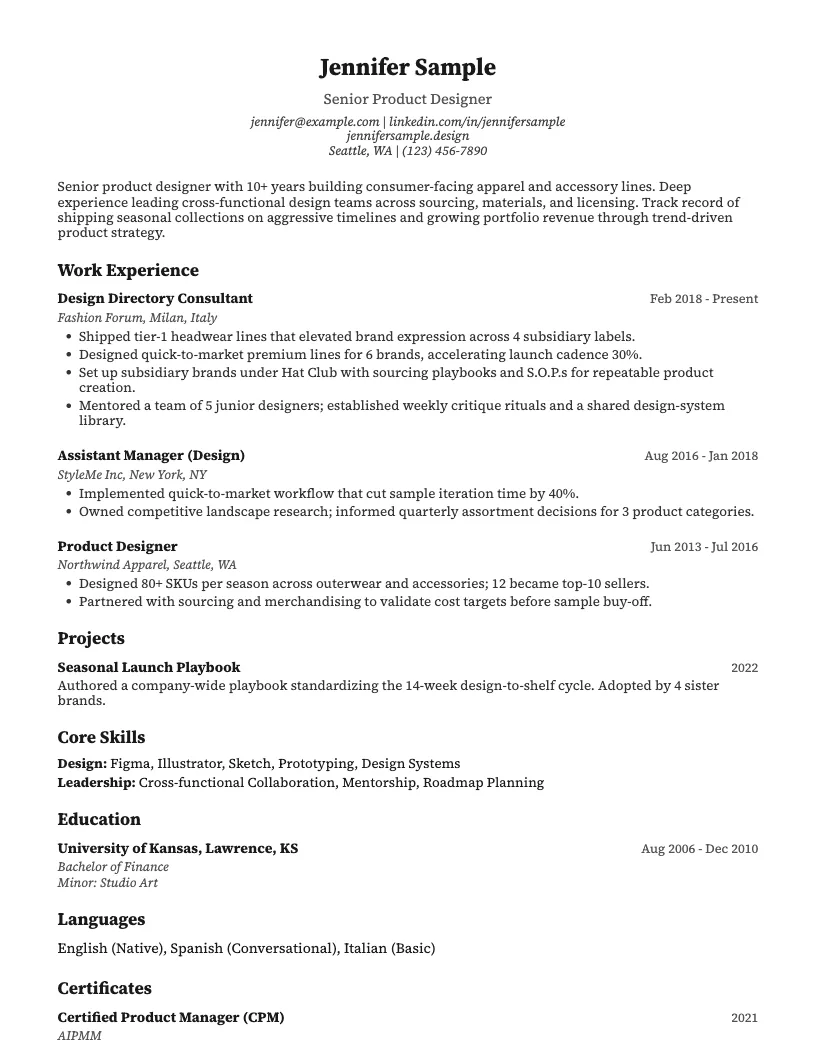
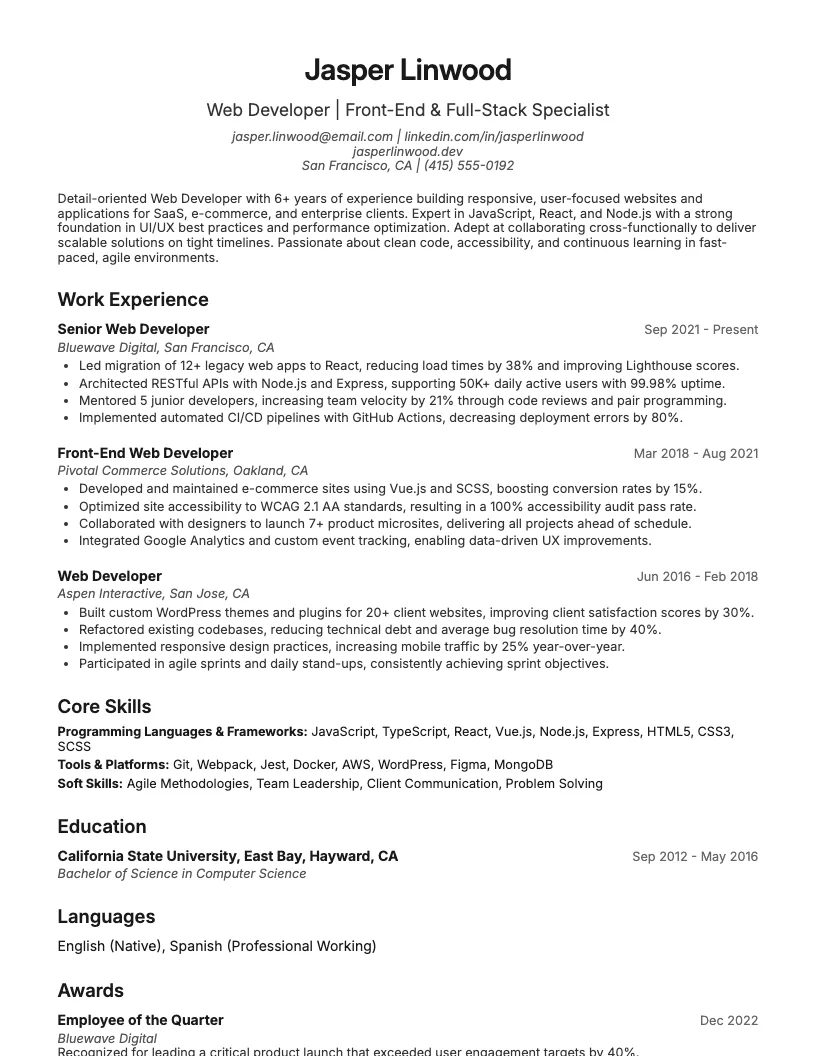
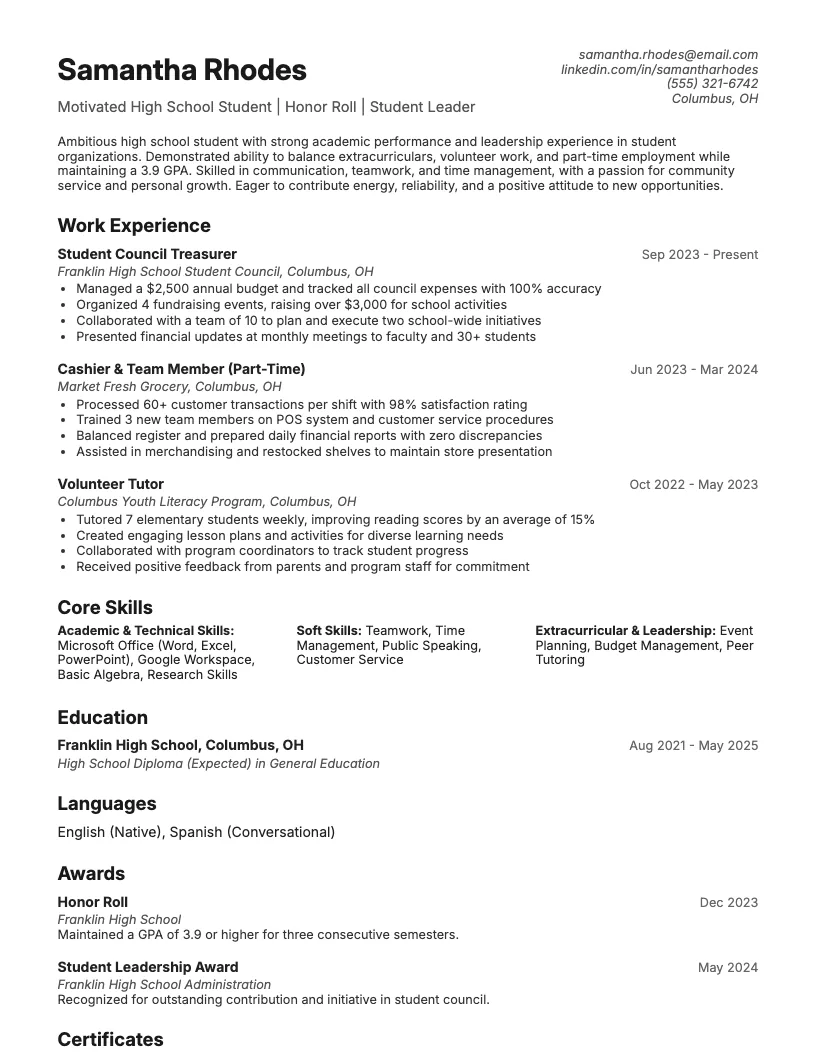
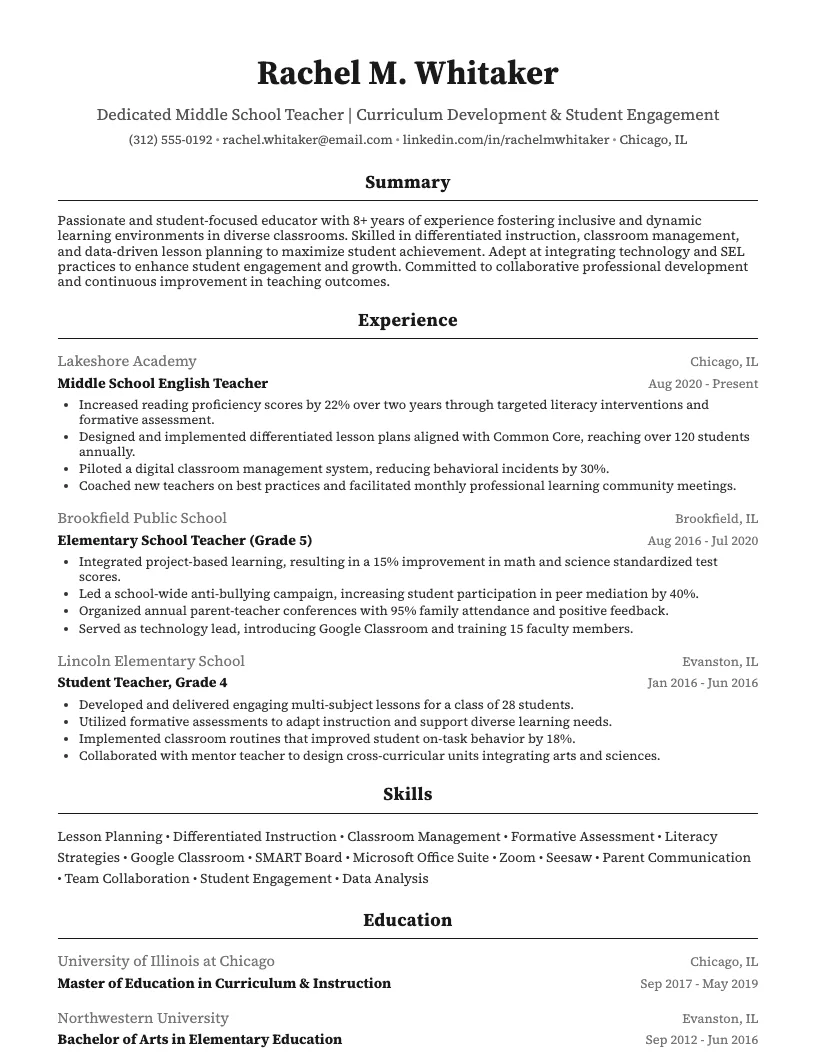
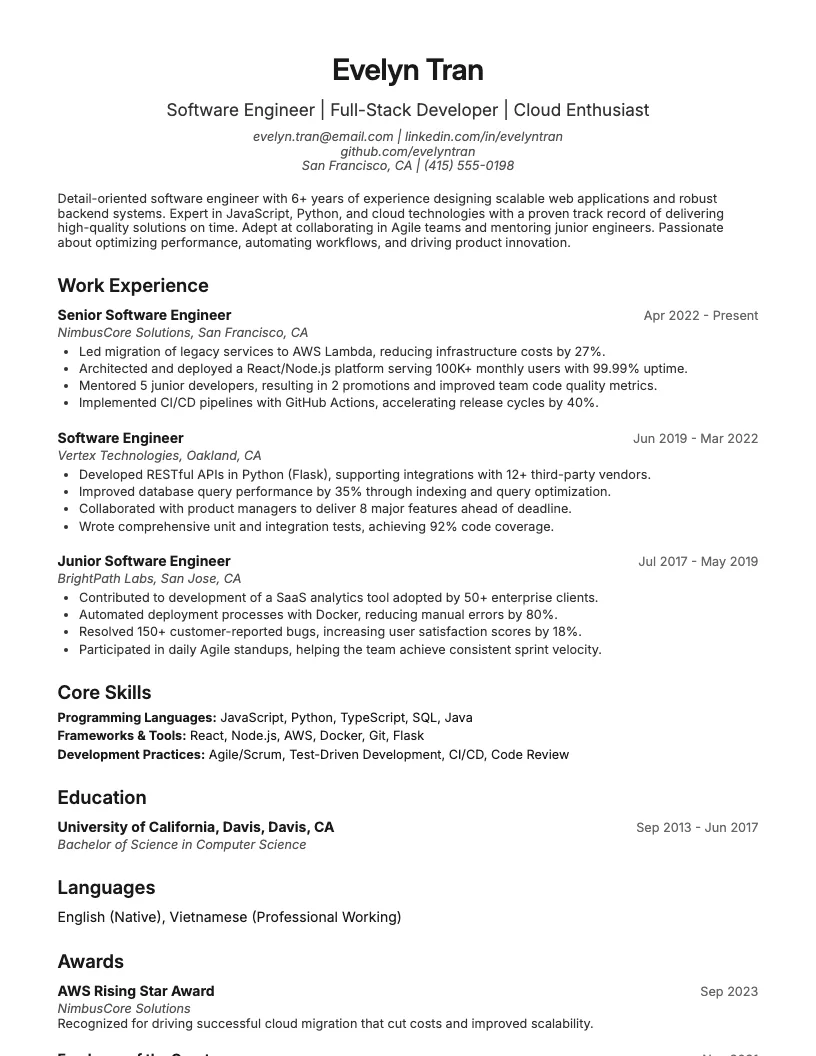
See these skills on a real resume
8 examplesStart from an example that already has them, and swap in your own.
Check your resume against the job you want
Scan your resume, see which skills and keywords the posting asks for that you are missing, and fix them before you apply.
Free to use • No credit card required