Technical Writer Resume Keywords: I Found 6 Reasons You Get Filtered
See the 6 things that get technical writer resumes filtered, plus the exact tools, standards, and keywords hiring managers scan for at every seniority level.


Written by Marcus Rodriguez
ATS Optimization Specialist & Career Coach
Updated August 2026
Reviewed by Dr. Priya Sharma
Is your resume ATS-friendly?
Drop your resume in and see which of these skills a scanner can actually read, and which ones the job you want is asking for that you have not listed.
PDF or DOCX. Max 2MB.
We never share your resume or use it to train a model.
In This Guide:
What are technical writer resume keywords?
Is your resume good enough?
Drop your resume in and see which of these skills a scanner can read, and which ones the job you want is asking for that you have not listed.
Upload your resumeFree. PDF or DOCX. We never share your resume or use it to train a model.
I've read enough of these resumes to know which ones pass: exact tools, doc types, standards - not "technical writing" as a skill.
The tools you write in
MadCap Flare, Confluence, Markdown, Git - the full list is longer.
The documents you produce
API references, release notes, user guides - name the kind, not just "documentation."
The standards and methods you work to
DITA, a style guide, a release cycle you've shipped against.
Why a resume without these words gets ranked low
Plenty of these resumes get scanned by software before a person reads them, so this vocabulary keeps a resume out of the reject pile. Run yours against a posting in ResumeJudge and it'll rewrite your resume to add the words you're short on.
Which keywords appear in the most technical writer job ads?
Which keywords appear in the most technical writer job ads?

I run these resumes against real postings all day, and the same terms come up over and over. Developer documentation comes up constantly, so if that phrase isn't on your resume, start there.
Developer documentation
This is the single most-requested term, and it needs to sit near the top of your summary or skills section, not buried in a bullet from three jobs ago.
API documentation
Another one I see on plenty of postings. The API and developer documentation section covers the exact terms to use.
User guides and tutorials
Guides and tutorials sit in the majority of postings too. I'd pair this with a number wherever you can - how many guides, how many users they reached.
Release notes
Smaller than the top tier, but still common enough that leaving it off costs you when a posting asks for release-aligned publishing.
Markdown and MDX
Markdown and MDX appear in most postings now, right alongside docs-as-code.
Docs-as-code and Git
Same tier as Markdown, and the two go together. ResumeJudge will flag when a posting expects docs-as-code and rewrite your resume to say so if it's missing.
Information architecture
This one separates writers who structure content from writers who just produce it. Worth its own line if you've owned a docs site's structure.
Style guide ownership
Owning a style guide, not just following one, is what employers are actually screening for here.
Content management platforms
Name the platform, not just the category - the tools section covers which ones.
Version control
Postings list this on its own, and the tool they mean is Git.
Which authoring tools should you name on your resume?
Which authoring tools should you name on your resume?
Name the ones you've actually used. Three tools you can defend beat twelve you can't.
MadCap Flare, Adobe FrameMaker, RoboHelp and Paligo
These are the help-authoring tools regulated and enterprise teams still run on. List one if your background is DITA-heavy.
Oxygen XML Editor and other XML editors
Name Oxygen specifically. It's the XML editor hiring managers actually scan for.
Markdown, AsciiDoc and reStructuredText
Software and SaaS postings expect one of these. Markdown is the safest bet if you only know one.
Docusaurus, MkDocs, Sphinx and other site generators
These pair with Markdown - list them together, since that's how they show up in real postings.
Confluence, SharePoint, Notion and GitBook
Pick the one you published in, not the one your team just stored files in.
Snagit, Camtasia, Lucidchart and Visio
List these only if you built the visuals yourself, not just dropped a screenshot into a doc.
Git, GitHub and GitLab
Nine times out of ten, a docs-as-code role wants this on its own line, not buried in a paragraph.
How many tools to list, and only the ones you can be tested on
Five or six is plenty. I've seen people lose an interview over a tool they hadn't opened in years - if you can't survive a live question on it, leave it off. Run your resume against a posting in ResumeJudge and it'll flag the tools the job asks for that you left off, then write them into your resume.
Which documentation standards and methods do employers ask for?
Which documentation standards and methods do employers ask for?
Postings for anything above entry level assume you know a framework, not just a tool.
DITA and structured authoring
DITA still shows up constantly in enterprise and regulated postings - it's the standard for splitting content into reusable topics instead of writing one long document. If you've worked in it, name it.
Structured authoring is the broader term for the same idea.
Single-sourcing and content reuse
Writing one topic once and publishing it into five different outputs. Employers ask for this because it's cheaper than five writers maintaining five copies.
Diataxis
The framework that splits docs into tutorials, how-to guides, reference and explanation. I'm seeing it named directly in job ads now, not just implied.
Microsoft and Google developer style guides
Pick one, know it, say so. These two are the reference points every editor checks against, and "style guide ownership" on your resume should point to one of them.
Vale and other documentation linters
Vale checks your prose against a style guide automatically, the way a code linter checks syntax. Teams that run docs-as-code expect you to know at least one of these tools exists and why.
Agile, Scrum and release-aligned publishing
Docs ship on the same clock as the product now. Naming Agile or Scrum tells a hiring manager you've kept up with a sprint schedule, not written in isolation.
Localization and translation management
If you've prepped content for translation - clean sentences, no idioms, consistent terminology - say so. It's a distinct skill from writing itself, and postings for global products call it out on its own.
If you're not sure which of these a specific posting actually wants, running it through ResumeJudge will tell you which ones you're missing and rewrite your resume to include them.
Which keywords matter for API and developer documentation roles?
Which keywords matter for API and developer documentation roles?
If you document APIs, this is the list that gets you shortlisted.
OpenAPI and Swagger
Say OpenAPI (Swagger) only if you've built or edited a spec - it's the term recruiters search for first.
REST, GraphQL and SDK references
Name REST API, GraphQL, and SDK documentation - "API docs" alone reads as vague.
Postman, ReadMe, Stoplight and Redocly
These four show up together across postings - list only the ones you've actually published in.
Code samples you have run yourself
I've seen plenty of writers claim "code documentation" with nothing behind it. Say you ran the sample and filed the PR yourself.
JSON, YAML, cURL and the languages you read
You don't need to write Python - just read JSON and YAML, and run a cURL command without help.
Authentication flows and rate limit docs
OAuth, API keys, rate limiting - these are the sections developers read first. Check your resume against a posting in ResumeJudge and it'll rewrite your resume to include the ones you're missing.
Which soft skills belong on a technical writer resume?
Which soft skills belong on a technical writer resume?
Documentation is a people job before it's a writing job. I've read hundreds of these resumes, and the ones that get callbacks show the skills below, not just the tools.
Working with subject matter experts
You're pulling accurate information out of engineers who'd rather be coding. Say so directly: "interviewed backend engineers to document a new auth flow" beats "collaborated with stakeholders."
Audience analysis
Knowing a beginner needs a different page than a senior developer is a real skill, and it belongs on the resume, not just in your head.
Attention to detail and editing
Showing editing rigor with a number
Strong attention to detail and thorough editor.
Cut documentation error rate 40% by building a peer-review process across 30 docs.
One typo in a hiring manager's eyes and the whole resume reads as sloppy. Show your editing rigor with a number - docs reviewed, an error rate cut, a style guide enforced.
Deciding what to cut
Nine times out of ten, the strongest documentation is shorter than the first draft. Cutting a doc in half while keeping it accurate is a harder skill than writing it, and worth a bullet of its own.
Working across engineering, product and support
You're the translation layer between three teams that don't talk the same way. If a posting lists cross-functional collaboration, check that word against your resume - ResumeJudge will flag it if it's missing and add it in for you.
Handling shifting release dates
Docs due the day a feature ships, then the ship date moves. Writers who can handle that without missing the real deadline are the ones I see get hired.
How do the keywords change by seniority?
What the resume leads with, by seniority
| Level | What to lead with |
|---|---|
| Entry / junior | 3 defensible tools, drafts under review, a filed Markdown PR |
| Mid-level | 6-10 guides owned solo, release-aligned cadence, a docs-as-code pipeline |
| Senior | Information architecture, Diataxis, style guide ownership, 25+ pages stewarded |
| Lead / manager | Team leadership, stakeholder management, a documentation roadmap |
Entry level and junior technical writer
I'd rather see three tools you can defend than ten you've opened once. Draft guides under review, file a Markdown pull request, own a small glossary.
Mid-level technical writer
You're carrying a product area solo now: six to ten guides, a release-aligned publish cadence, a docs-as-code pipeline you maintain yourself.
Senior technical writer
Swap task words for ownership words - information architecture, Diataxis, style guide ownership, 25-plus pages stewarded, not just written.
Documentation lead or manager
Tools drop lower on the resume. Team leadership, stakeholder management, and a documentation roadmap carry the weight instead.
How do keywords change by industry?
What the resume leads with, by industry
| Industry | Keywords to lead with |
|---|---|
| Software and SaaS | Docs-as-code, Git, API references |
| Medical devices and pharma | Regulatory writing, SOPs, IFUs, ISO 13485, 21 CFR Part 11 |
| Aerospace and defense | DITA, structured authoring, export-control awareness |
| Finance and regulated industries | Compliance documentation, audit trails |
| Hardware and manufacturing | Assembly instructions, IFUs, Visio diagrams |
Same job title, different resume, depending on who's hiring you.
Software and SaaS
Docs-as-code, Git, and API references carry the most weight here.
Medical devices and pharma
Swap those for regulatory writing, SOPs, IFUs, and standards like ISO 13485 and 21 CFR Part 11.
Aerospace and defense
DITA and structured authoring show up constantly, alongside export-control awareness.
Finance and other regulated industries
Compliance documentation and audit trails matter more than any tool on your list. Run your draft against the actual posting - ResumeJudge will flag when you're leading with Markdown instead of the regulation you wrote to, and rewrite it to lead with what the posting asks for.
Hardware and manufacturing
Assembly instructions, IFUs, and diagramming tools like Visio round it out.
The rule holds everywhere: match the posting in front of you, not a generic list.
How do you pull the right keywords out of a job posting?
How do you pull the right keywords out of a job posting?
Step 1: Collect five or six postings for the job you want
Six is the number I use. One posting tells you what a single manager wants; six tells you what the role actually wants.
Step 2: Mark the terms that show up in most of them
Anything that appears in four of the six is a priority term, not a nice-to-have.
Step 3: Check each one against your own resume
Every priority term needs to live in your skills list and in a bullet, not just one or the other. ResumeJudge will run this check against a specific posting for you if you'd rather not do it by hand.
Step 4: Use both the acronym and the full term
Write "API documentation" and "API" both. A scanner matching on the short form skips you if only the long one is on the page.
Step 5: Decide what to do about the gaps
A gap is either something true you forgot to write down, or a sign the posting sits a level above where you are right now.
Where do you put these keywords on your resume?
Where do you put these keywords on your resume?
Same words, three different jobs. Don't put them in only one place.
In the professional summary
Two or three sentences, top of the page: years of experience, your specialty, one number. "Technical writer with 4 years building developer documentation and API references, cut onboarding time from 5 days to 2."
In a labeled skills section
Group by type instead of one long comma-soup line - Authoring, API docs, Standards, Tools. A scanner and a hiring manager both read a grouped list faster than a paragraph.
In your experience bullets, attached to a result
This is the one people skip. A keyword sitting alone in the skills section proves nothing - attached to a bullet with a number, it proves you used it.
If you're not sure which of your bullets actually back up your skills list, check what's missing against a posting - ResumeJudge will flag skills you've claimed but never backed with a result.
Action verbs that start a documentation bullet
Authored, Drafted, Standardized, Documented, Streamlined, Maintained, Migrated. Skip "Responsible for" - it's the first thing I flag on a weak resume.
A weak bullet and the same bullet rewritten
A documentation bullet, before and after
Wrote user documentation.
Authored API documentation using Swagger and Postman, serving 2,000+ developers and cutting support tickets 25%.
Weak: "Wrote user documentation." Rewritten: "Authored API documentation using Swagger and Postman, serving 2,000+ developers and cutting support tickets 25%."
Numbers that prove documentation work
Page views, ticket deflection, time-to-first-call, publish time, pages migrated. I've read hundreds of these - the resumes with a number in every bullet are the ones that get a callback.
What gets a technical writer resume filtered out?
I've seen hundreds of these get filtered before a human opens them, and it's almost always one of six things.
No Git or Markdown anywhere on the page
Zero mentions of Git or Markdown reads as a marketing writer, not a docs engineer.
Marketing language instead of documentation language
"Passionate storyteller" gets you misclassified. Say what you documented and who read it.
Bullets with no numbers in them
"Wrote user manuals" says nothing. Pick one of the numbers that prove documentation work and attach it.
Listing tools you cannot demonstrate
Nine times out of ten, an interviewer tests the first tool on your list - see which tools to name.
Repeating the same keyword too many times
Two to five honest mentions per term is healthy; more reads as stuffing. ResumeJudge flags which keywords from a posting you're missing and works them into your resume, so you're not guessing at what to repeat.
Reading like a content writer instead of a technical writer
A hiring manager who reads you as the wrong role stops there. Before you send it, check your resume against the difference between the two keyword sets.
Frequently Asked Questions
How many keywords should I put on my technical writer resume?
Aim for 20 to 30 keywords pulled straight from the job posting, worked into your bullet points rather than dropped into a list. More than that starts to read as stuffing, and fewer means you're probably missing tools or terms the posting actually names. ResumeJudge can show you how many of a given posting's keywords your resume already covers, so you're matching the job rather than guessing at a round number.
Do I need to know how to code to be a technical writer?
No, you don't need to code, but being able to read code and follow a developer's logic matters if you're aiming at API or software documentation roles. You should be able to run a snippet locally, spot when an example is broken, and talk through it with an engineer. For user guides or general documentation work outside of software, this matters much less.
Should I list programming languages I only half know?
No, only list languages and tools you can actually use, since an interviewer will ask about anything on your resume and getting caught short there costs you more than leaving it off. If you can read a language well enough to verify an example works but couldn't write it from scratch, say so honestly rather than listing it flat. ResumeJudge lets you check your current skills list against a specific posting, so you can see which ones actually match instead of padding the resume with languages you're shaky on.
Do I need DITA, or is Markdown enough?
It depends on the industry. Regulated fields like finance, healthcare, and aerospace still expect DITA and structured authoring, while software companies and startups are usually fine with Markdown, Git, and other docs-as-code tools. Check what the job posting names and match your resume to that rather than assuming one standard applies everywhere.
What is the difference between technical writer and content writer keywords?
Technical writer keywords center on documentation tools and developer workflows, like API documentation, DITA, structured authoring, and docs-as-code, while content writer keywords center on SEO, blog writing, brand voice, and marketing tools. The two roles overlap in basic writing skills, but a resume aimed at technical writing should lead with the documentation-specific terms, not the marketing ones. Mixing the two signals to a hiring manager that you're not sure which job you're applying for.
Are technical writing certifications worth listing?
Yes, if you have one, it's worth a line, but it won't make up for missing keywords or thin experience elsewhere on the resume. The one I see most is the Certified Professional Technical Communicator (CPTC), from the Society for Technical Communication. Treat a certification as a small addition to a resume that's already built around the right tools and experience, not a substitute for either.
How do I write a technical writer resume with no documentation job yet?
Lean on adjacent proof: readme files, internal wikis, help articles, onboarding guides, or a personal project you documented from scratch all count as writing samples. Common paths into the role include journalism, English degrees, a computer science new-grad pivot, or moving over from a support engineering job where you were already writing how-tos. Frame that past work in documentation terms, and use ResumeJudge to check your resume against real technical writer postings so you can see exactly which keywords and skills you're still missing.
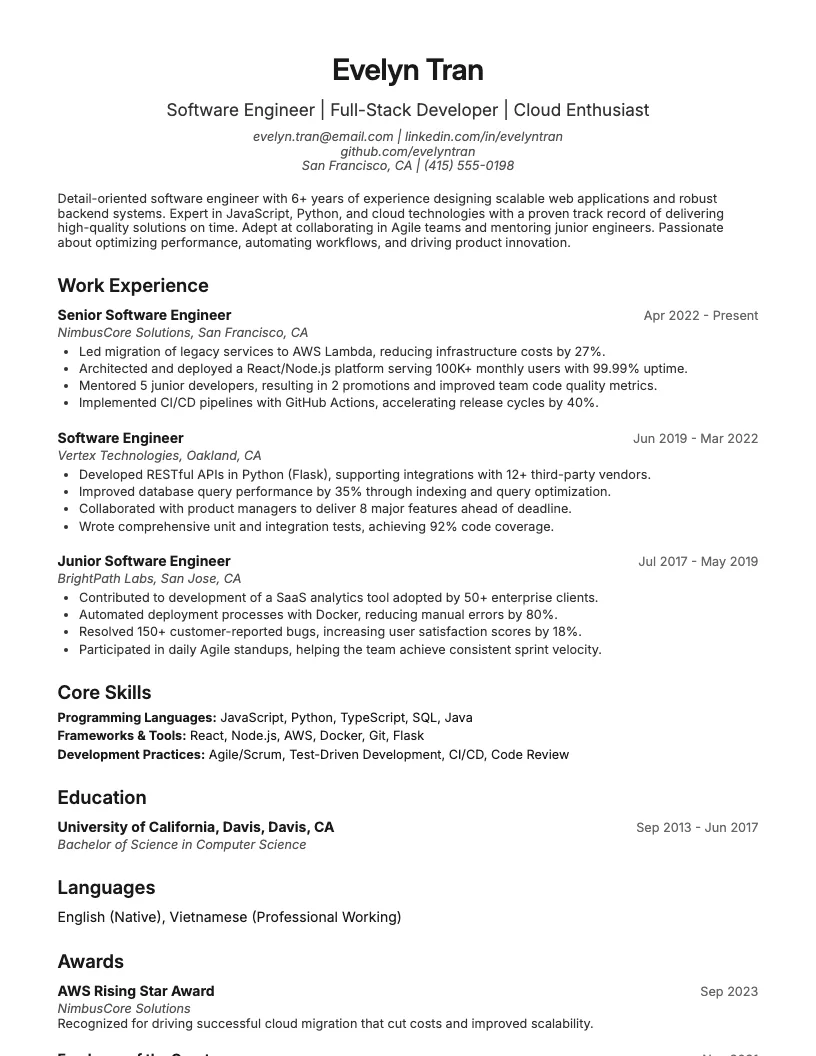
See these skills on a real resume
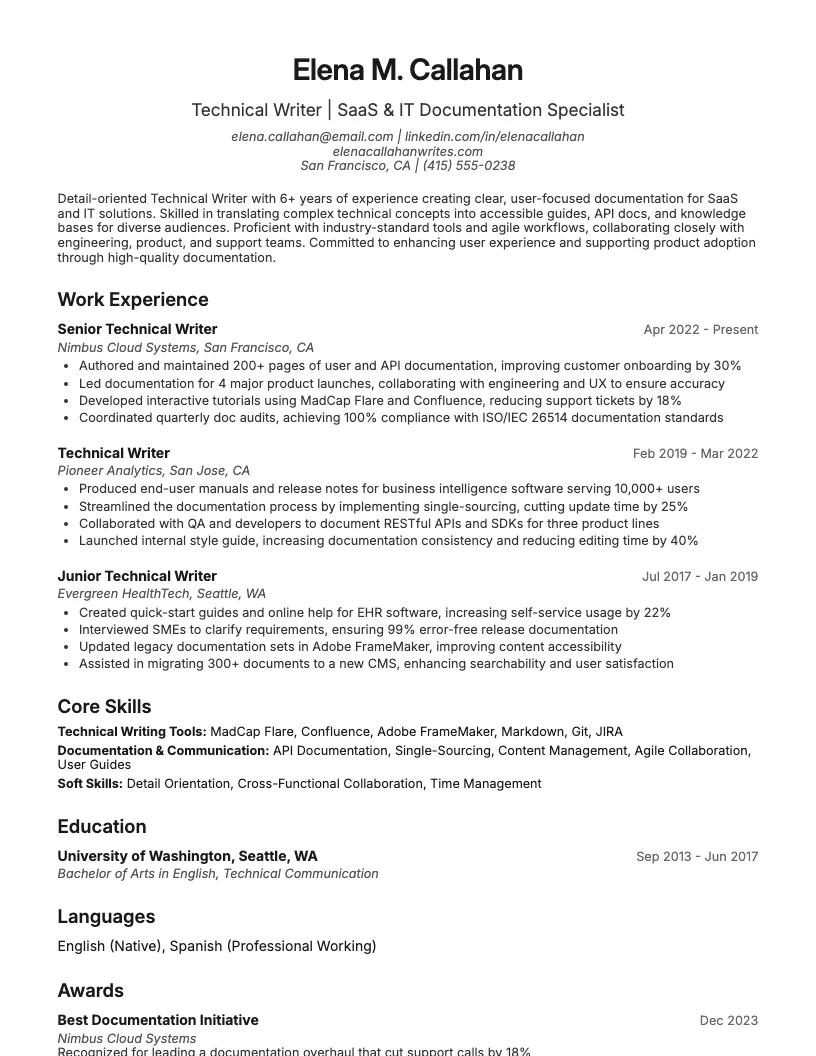
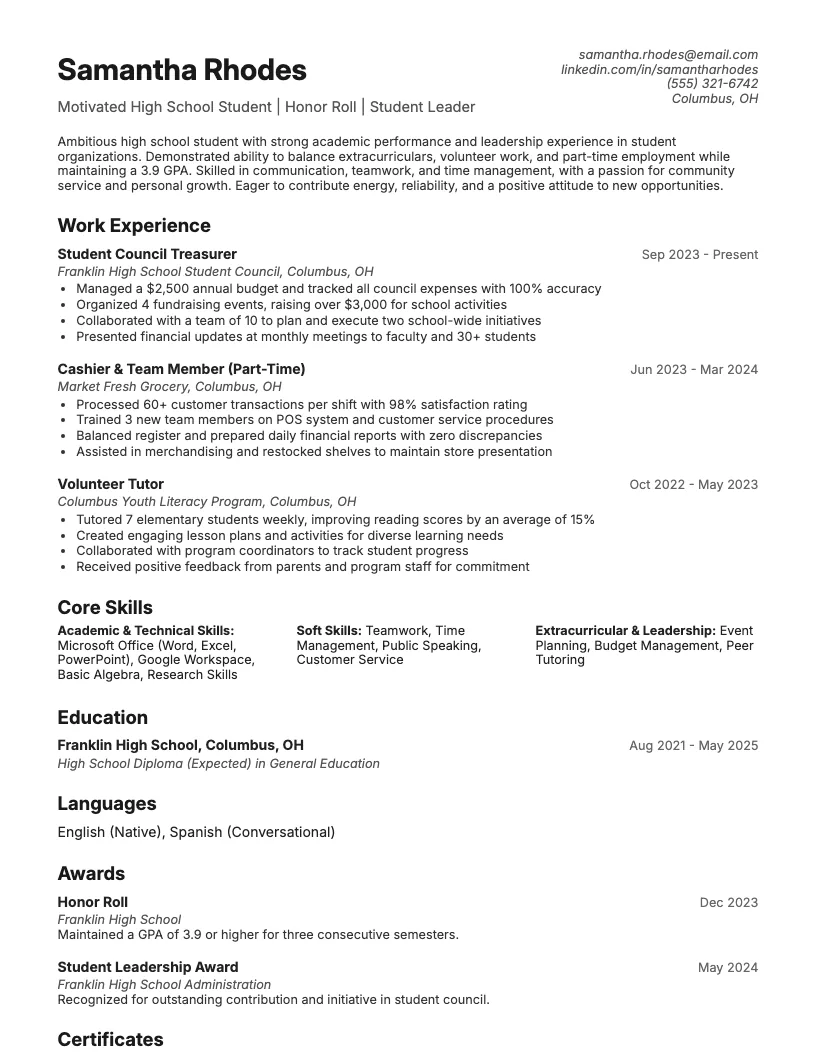
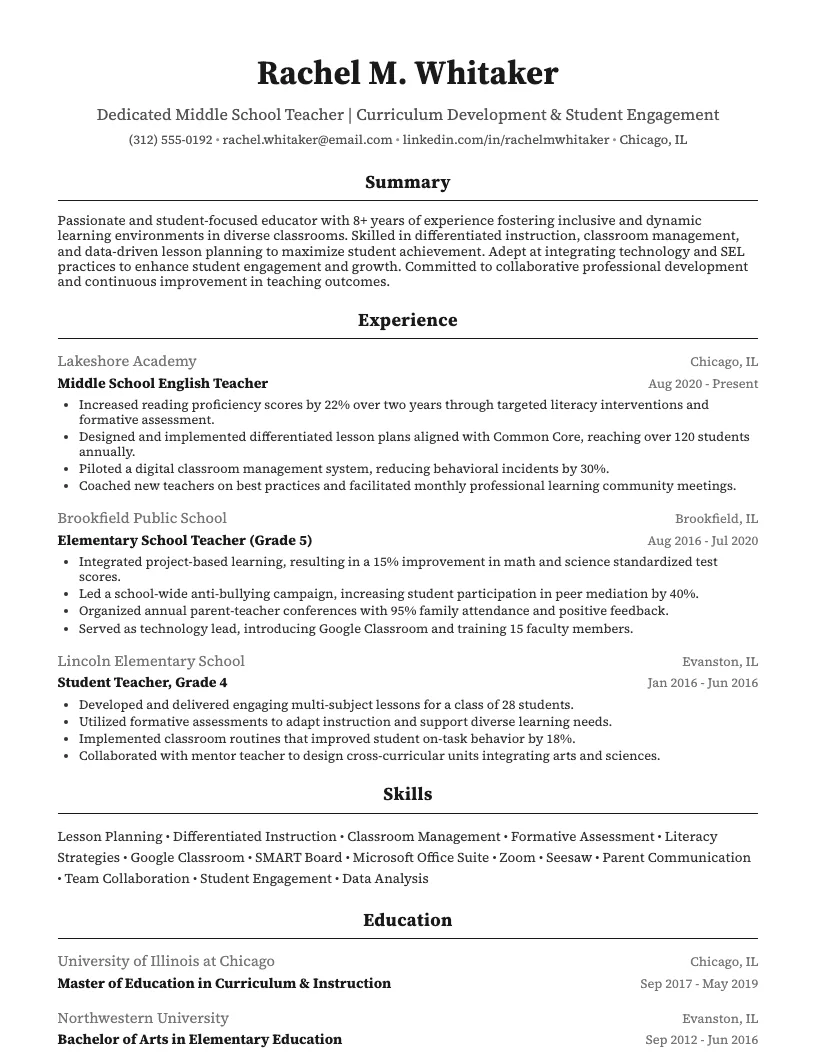
8 examplesStart from an example that already has them, and swap in your own.
Check your resume against the job you want
Scan your resume, see which skills and keywords the posting asks for that you are missing, and fix them before you apply.
Free to use • No credit card required