Software Developer Resume Keywords: 6 Places, 7 Mistakes to Avoid
I checked over 1,000 developer job postings for keywords, found the 6 places to put them on your resume, and the 7 mistakes that get resumes rejected.


Written by Sarah Chen
Senior Career Strategist & Resume Expert
Updated August 2026
Reviewed by Marcus Rodriguez
Is your resume ATS-friendly?
Drop your resume in and see which of these skills a scanner can actually read, and which ones the job you want is asking for that you have not listed.
PDF or DOCX. Max 2MB.
We never share your resume or use it to train a model.
In This Guide:
What are software developer resume keywords?
Is your resume good enough?
Drop your resume in and see which of these skills a scanner can read, and which ones the job you want is asking for that you have not listed.
Upload your resumeFree. PDF or DOCX. We never share your resume or use it to train a model.
I've screened hundreds of developer resumes, and the ones that get skipped almost never lack skill - they lack the words that name it. Recruiters and applicant tracking systems both search for specific terms, not vague descriptions.
"Backend work" tells nobody anything; "Node.js" and "PostgreSQL" do.
Programming languages
Java, Python, JavaScript, TypeScript, C++, C#, Go, Kotlin - name the ones you actually shipped code in, not every language you took a class in once.
Frameworks and libraries
React, Angular, Node.js, Spring Boot, Django, Flask, Express - these map straight to a stack, and a posting almost always asks for a specific one.
Databases and APIs
REST APIs, GraphQL, SQL, MongoDB, PostgreSQL. Say what you built with them, not just that you've "worked with databases."
Cloud platforms and tools
AWS, Azure, Google Cloud, serverless, cloud deployment. Nearly 4 in 10 postings ask for one of these by name - see which keywords show up most for the exact numbers.
Version control
Git, GitHub, GitLab. Everyone has this, so it's table stakes, not a differentiator - but leaving it off still costs you a screen.
Ways of working: Agile, Scrum, code review
Agile, Scrum, SDLC, code review, debugging. These tell a hiring manager you know how to work on a team, not just alone in an editor.
Core skills: system design, scalability, performance optimization
Tools alone don't cut it. I see resumes packed with technology names and nothing about system design or scalability - the concepts that show you can think past a single feature.
Soft skills the postings actually name
Problem solving, communication, collaboration, mentoring. Postings name these outright, so don't assume they're implied - which keywords show up most has how often each one comes up.
Once you've pulled your own list together, ResumeJudge will check it against a specific posting and tell you exactly what's still missing.
Which keywords show up most often in developer job postings?
Which keyword categories show up most often
| Keyword category | % of postings |
|---|---|
| Programming languages | 68% |
| Problem solving | 52% |
| Team collaboration | 46% |
| Cloud platforms | 38% |
| Frameworks and libraries | 37% |
| Databases | 36% |
I looked at over a thousand real developer postings to see what actually gets asked for, and the order surprised some people I've shared it with.
Programming languages - 68% of postings
More than two out of three postings name a specific language. Not "programming skills" - an actual language, usually two or three of them.
If your resume doesn't name whatever the job actually runs on, you're invisible to that first scan.
Problem solving - 52%
Second most common, and most people leave it as a throwaway line. It only counts when it's attached to something you fixed - a bug, a bottleneck, a system that kept breaking.
Team collaboration - 46%
Nearly half the postings I've reviewed care as much about how you work with people as what you can code. Pair programming, code review, cross-functional work with product or design - name the actual activity.
Cloud platforms - 38%
Over a third of postings expect you've touched one of the platforms named under cloud platforms and tools. I've seen candidates with real cloud experience lose points just because they described it as "deployed the app" instead of naming the platform.
Frameworks and libraries - 37%
Whatever you actually built with, and pair it with the language it sits on, since where you put these keywords matters as much as having them.
Databases - 36%
SQL still dominates, but plenty of postings want a specific engine, whatever you actually queried.
Web development - 34%
APIs, front-end frameworks, HTTP - this one overlaps with a few categories above it, which is exactly why the same term can cover more than one bucket.
Testing - 32%
Unit tests, integration tests, a specific framework name. Skipping this is one of the more common gaps I see on otherwise strong resumes.
Version control - 31%
Git shows up almost everywhere, which is also why it's one of the easiest to leave out by accident - people assume it's implied.
Communication - 31%
Tied with version control, and just as often skipped. Nine times out of ten, the fix is one line about presenting work to a non-technical team, not a whole new section.
None of these numbers tell you which ones your target job actually needs - for that you're matching against one posting, and that's a job ResumeJudge does directly: it scans your resume against the description and tells you exactly which of these you're missing before you hit submit.
How do you pull the right keywords out of a job description?
How do you pull the right keywords out of a job description?

Step 1: Mark every skill, tool and language named in the posting
Print the posting or copy it into a doc, then underline every technical noun you see: languages, frameworks, databases, cloud tools. Don't stop at the requirements list - the "about the role" paragraph usually hides two or three more.
Step 2: Note which terms repeat
Whatever shows up two or three times in one posting is the term that gets you past the applicant tracking system, not a nice-to-have buried in the sixth bullet.
Step 3: Use the employer's exact wording, not your paraphrase
If they wrote "REST APIs," your resume says "REST APIs" - not "backend work." I've seen strong candidates get filtered out over this exact swap.
Matching wording is the whole game here.
Step 4: Separate the must-haves from the nice-to-haves
Requirements sections almost always split into "must have" and "preferred." Lead your skills section with the must-haves you actually have.
Step 5: Check the job title itself against your own
If they're hiring a "Software Engineer II" and your last title was "Junior Developer," use their term where it's honest to do so - it's one of the first things a scanner checks. Once you've pulled this list by hand a few times, running it against a tool that scores your resume against the actual posting and flags what's missing saves you from second-guessing your own read.
Where do you put these keywords on your resume?
Where do you put these keywords on your resume?
I've read enough of these to know the mistake right away: a decent list of skills, stuffed into a box at the bottom, and nowhere else. That's not how the scanner or the recruiter reads it.
Keywords need to show up in six places, each doing a different job.
Job title line
Right under your name, put the title you're going for - "Backend Developer," "Full-Stack Engineer" - matching the posting's wording, not your last employer's internal title.
Professional summary
Two or three lines, and this is where your strongest keywords go first: your main languages, your stack, one standout result. A scanner and a hiring manager both read this before anything else.
Skills section, grouped by category
Don't dump forty terms into one line. Group them - Languages, Frameworks, Databases, Cloud & DevOps - so a recruiter can scan it in five seconds and see you're not just listing everything you've ever touched.
Work experience bullets
This is where keywords carry the most weight, because they're attached to proof. Say what you built, what you built it with, and what changed - never a bare skill sitting alone in a sentence.
Projects section
If you're short on work history, this is your work history. Name the stack, the problem, the outcome - it reads the same as an experience bullet.
Certifications
List only what you can defend in an interview. A cert that only repeats a skill you've already shown elsewhere adds nothing on its own - list it for the credential itself, not to get the term on the page a second time.
Matching your resume's wording to a specific posting, section by section, is exactly what ResumeJudge's resume fix does - it takes the job description and rewrites your bullets, summary, and skills list to use the employer's own terms.
How do you write a bullet point that carries a keyword and a number?
I read hundreds of these bullets a week, and the weak ones almost always stop at the verb. "Improved database performance."
Improved it how much? From what to what?
A recruiter can't verify that, and neither can the scanner counting your keywords against the posting.
Reduced API response time by 30%
This one names the system (API), the action (reduced response time), and the size of the win. Swap in your own stack - Node, Go, whatever you actually shipped in - and it still works.
Improved query runtime by 34%
Same pattern, different layer. If you tuned an index or rewrote a slow join, say so and put the before-and-after next to it.
Cut database query times by 18% with caching
Notice the "with caching" - that's the keyword doing double duty. It's not just a number, it names the technique a hiring manager is scanning for.
Held 99.9% uptime over 12 months
Reliability numbers work even without a dramatic before-and-after. A steady 99.9% over a year says you can be trusted with production.
Saved $8,000 a week in labor costs
Dollar figures land harder than percentages because nobody has to do math to feel the size of it.
Resolved 100+ bugs against tight deadlines
Volume plus pressure. It tells a manager you can move fast without a single flashy metric.
The pattern: what you built, what you built it with, what changed
A bullet point that carries a keyword and a number
Improved database performance.
Cut database query times by 18% by adding Redis caching to the search endpoint.
That's really the whole formula: subject, tool, result. If a bullet is missing one of the three, it reads as filler.
Once your bullets are written, run them against the actual posting - ResumeJudge will check the wording and rewrite anything that's still light on the keywords the job asks for, instead of you guessing.
Which keywords change with your experience level and your stack?
What to lead with by level or stack
| Level or stack | Keywords to lead with |
|---|---|
| Entry-level | coursework, personal projects, shipped work |
| Mid-level | the stack you own, deployed, kept running |
| Senior and lead | architecture, mentoring, scalability, system design |
| Front-end | React, Vue, or Angular, accessibility, responsive design |
| Back-end | your language, API design, the databases you used |
| Mobile | Swift, Kotlin, React Native, or Flutter, app store deployment |
The same job title means different things at different levels, and your keywords have to move with it.
Entry-level and bootcamp grads: coursework, personal projects, shipped work
No experience yet? Lean on coursework, personal projects, and anything you shipped, even a side project nobody paid you for.
I've seen plenty of junior resumes get interviews on the strength of one real project, described with the same language as a work experience bullet: what you built, what you built it with, what changed.
Mentorship, team projects, and bootcamp capstones count too. Name the languages and frameworks you used, not just "coding."
Mid-level: the stack you own end to end
By mid-level, the posting wants ownership words: you built it, deployed it, and kept it running.
Name your stack top to bottom, list it in the skills section, and back it up in your bullets with the tools you actually used daily.
Senior and lead: architecture, mentoring, scalability, system design
Senior postings ask for architecture, system design, and scalability, plus mentoring and cross-team work. If you led a redesign or grew a team, say so directly.
Nine times out of ten, a senior resume that only lists tools reads as mid-level. Concepts carry as much weight as tools at this stage - more on that under naming tools but never concepts.
Front-end
Front-end postings want your framework (React, Vue, Angular), plus accessibility, responsive design, and performance.
Back-end
Back-end leans on your language, your API design experience, and the databases you've worked with - see databases and APIs.
Full-stack
Full-stack resumes need both sides represented, but don't pad the list - name the parts of each layer you actually touched.
Mobile
Mobile roles want the platform named outright: Swift, Kotlin, React Native, or Flutter, plus app store deployment experience.
Embedded
Embedded postings ask for C/C++, RTOS, microcontrollers, and hardware debugging - a different vocabulary from web work entirely.
QA and testing
QA roles want your testing frameworks named, automated and manual, plus bug tracking and CI pipelines.
Data and machine learning
Data and ML roles want Python, your ML libraries, and the size or kind of data you've handled - this is the one specialty where the math and modeling terms matter as much as the code.
Checking your resume against a specific posting for your level and stack is exactly what ResumeJudge does - it scores your resume against the job description and tells you which of these keywords you're actually missing before you apply.
What keyword mistakes get developer resumes rejected?
I've read enough of these to spot the same handful of mistakes over and over. Here's what actually costs you interviews.
Stuffing the same term over and over
Writing "Python" five times doesn't make you more Python. Say it once in your skills section, then let it show up naturally where you used it in a project or job.
Listing dead technologies like Flash or Web 2.0
If a term hasn't been current in a decade, drop it. Swap "Web 2.0" for what you actually built, and put outdated tools under a past role, not near the top.
Naming tools but never concepts like scalability
Pair "Docker" or "Kafka" with what it did for you - scalability, performance optimization, reliability. See core skills for the terms that carry weight here.
Sending the same keyword set to every job
One resume for every posting is the single biggest reason I see good candidates get skipped. Pull the terms fresh from each posting the way I laid out in how to pull keywords out of a job description - ResumeJudge does this automatically, scoring your resume against the posting and flagging exactly what's missing before you apply.
Dropping soft skills entirely
Communication shows up in 31% of postings, problem solving in 52%. Skip them and you're ignoring more than half the postings out there.
Claiming a language you cannot discuss in an interview
I've watched candidates get asked to write a quick function in the exact language they listed, on a whiteboard, on the spot. If you'd freeze doing that, take the language off your resume.
Nine times out of ten, this is the fastest way to lose an offer you already had. If you can't explain a decision you'd make in that language, leave it off.
Hiding keywords in white text or the page footer
Modern applicant tracking systems catch this, and recruiters who spot it toss the resume outright. Put the words where a human reads them instead.
Frequently Asked Questions
How many keywords should a developer resume have?
Aim for 15 to 25 keywords pulled straight from the job posting, spread across your skills section and your bullet points. There's no magic number that guarantees a pass - what matters is that the terms match how the posting actually describes the role, not that you hit a count. A resume with 40 keywords crammed into one block reads as stuffing to a recruiter, even if it scores fine with a scanner.
Can I list a language I only used at a bootcamp?
Yes, list it, but be ready to talk about what you actually built with it. Put it under a bootcamp project or a projects section rather than mixing it in with languages you've used on the job for years, so the resume doesn't overstate how deep your experience with it really goes. If you only touched it in one exercise, say that in the interview rather than letting the resume imply more.
Do I need a separate skills section, or is experience enough?
You need both. A skills section gives a recruiter and a scanner a fast list to check against the posting, but your experience section is what proves you actually used those skills. A skill sitting only in a list with nothing backing it up reads as weaker than the same skill shown inside a bullet with a result attached to it.
Should I spell out both the acronym and the full term, like CI/CD and continuous integration?
Yes, write both at least once. Some systems and some recruiters search for the acronym, others search for the full term, so if a posting says "continuous integration" and your resume only says "CI/CD," that match can get missed. After the first mention you can drop back to just the acronym for the rest of the page.
Does the applicant tracking system read keywords inside a skills table or a two-column layout?
Not reliably. Many systems read a resume column by column or cell by cell, so a two-column layout or a table can scramble the order the text comes out in, and a keyword that's technically on the page can end up missing from what the system pulls out. Stick to a single column with plain text lists for anything you need read correctly.
How do I check my resume against a specific job posting?
Put the job description next to your resume and go term by term through the technologies, tools, certifications, and specific verbs the posting uses, checking each one against what's actually on the page. ResumeJudge does this for you - hand it your resume and the posting and it scores the match, tells you exactly which skills and keywords are missing, and rewrites your resume to work them into the right sections.
Do soft skills count as keywords?
Yes, postings often list soft skills like collaboration or communication as requirements, and some scanners look for them the same way they look for technical terms. They carry less weight than a specific tool or language though, so don't let them crowd out the technical keywords - put them in a bullet point paired with a result rather than as a standalone list.
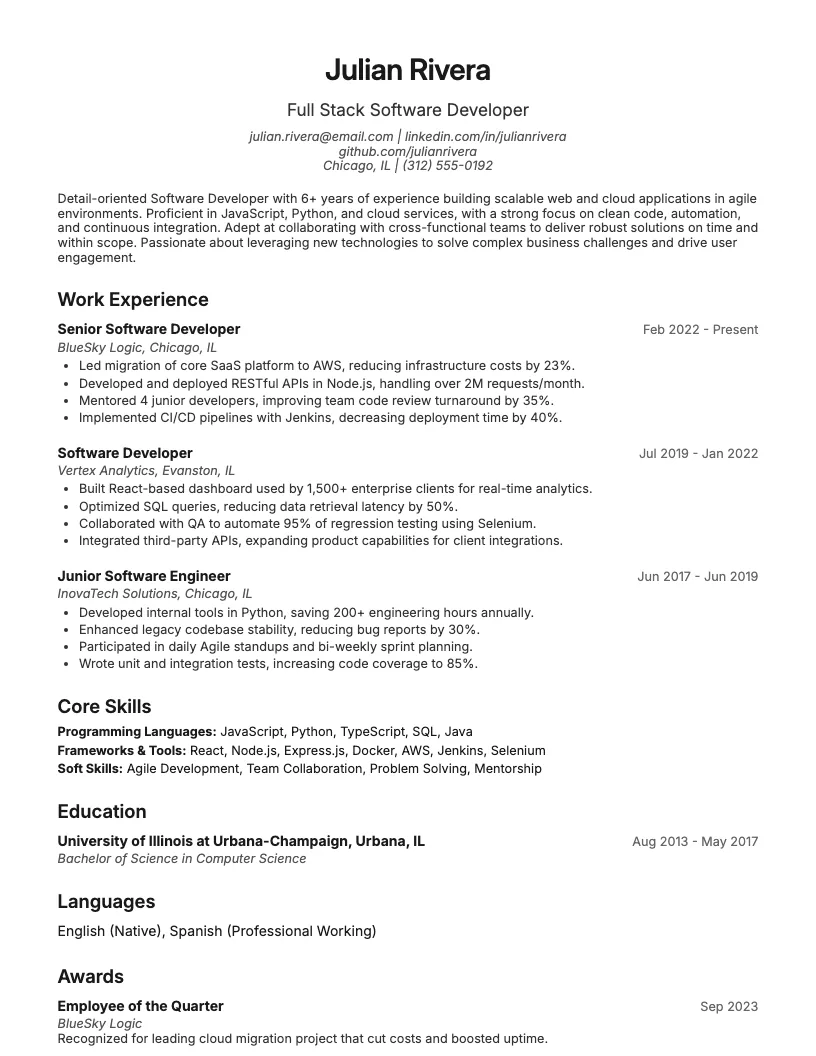
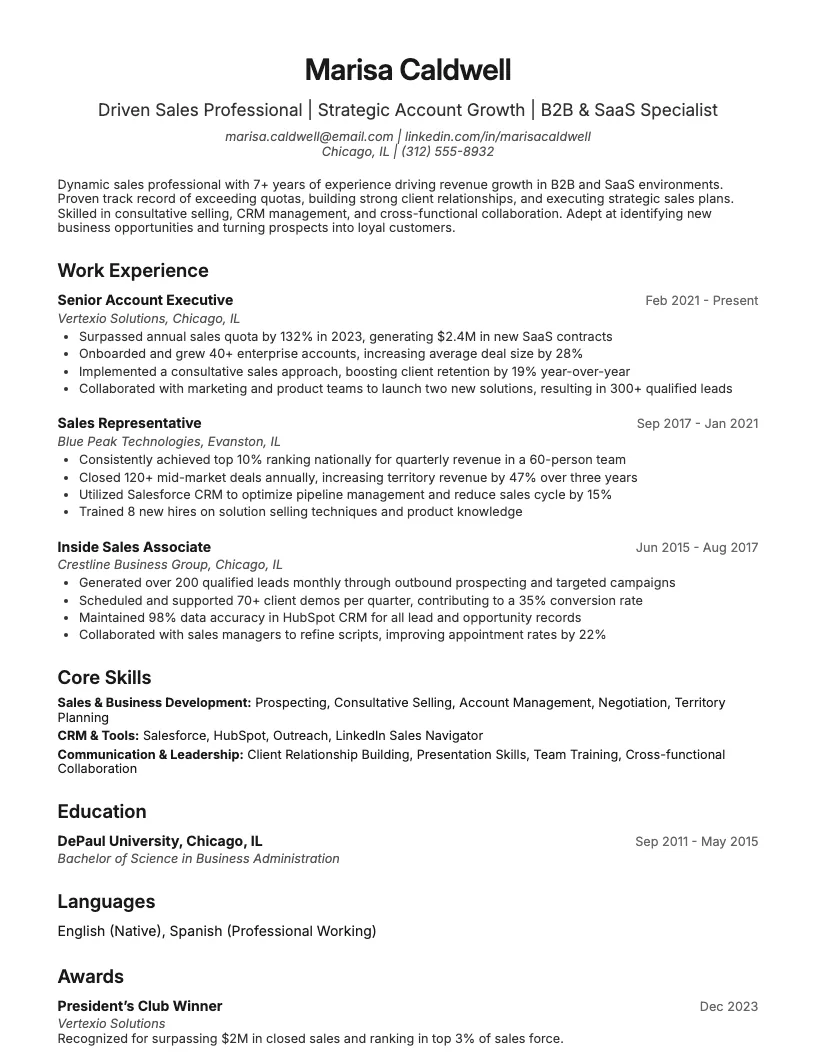
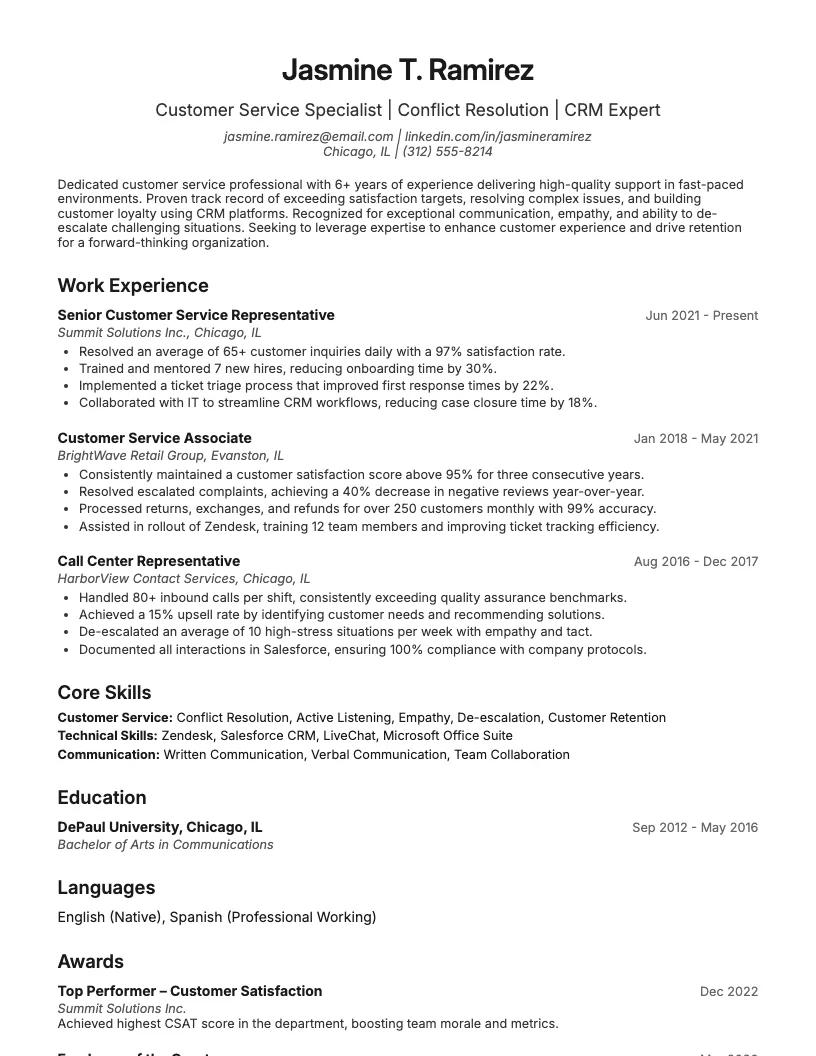
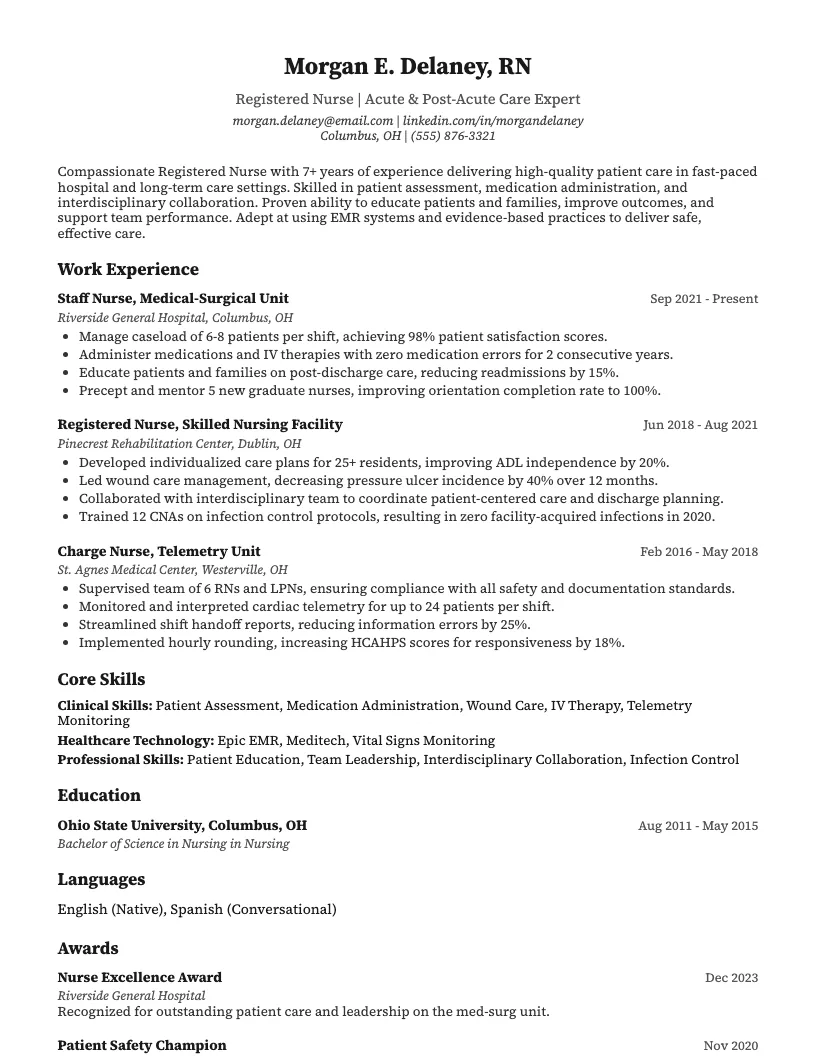
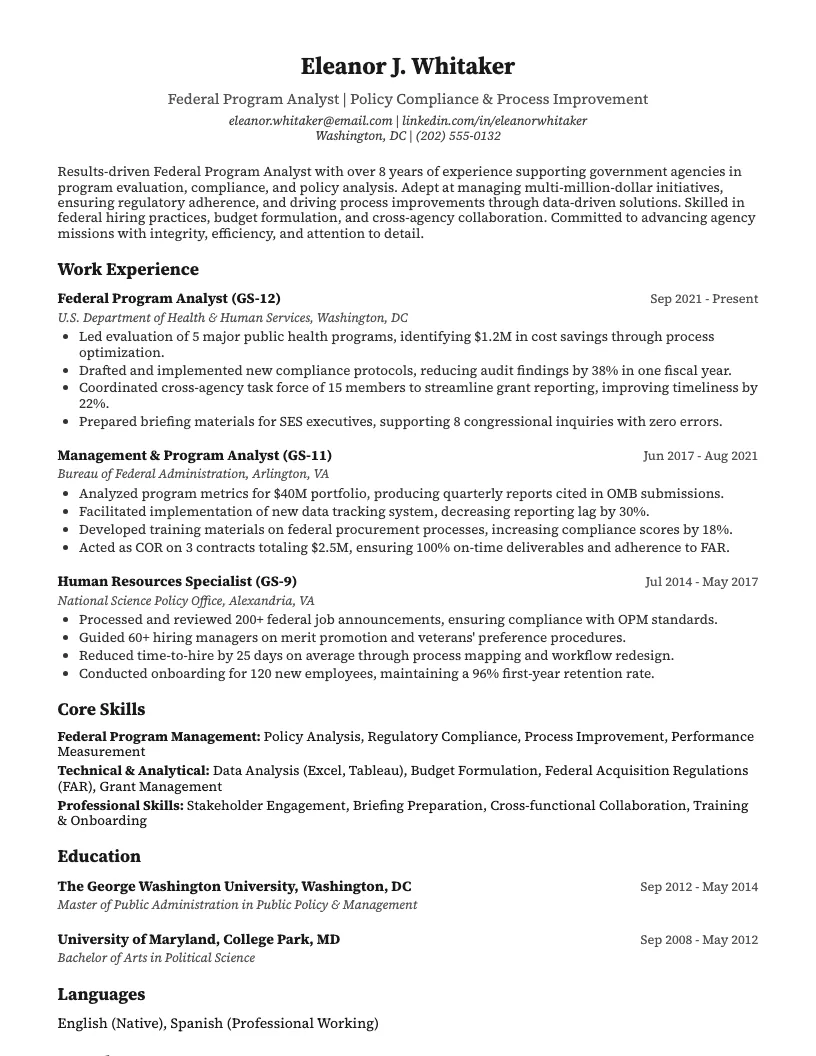
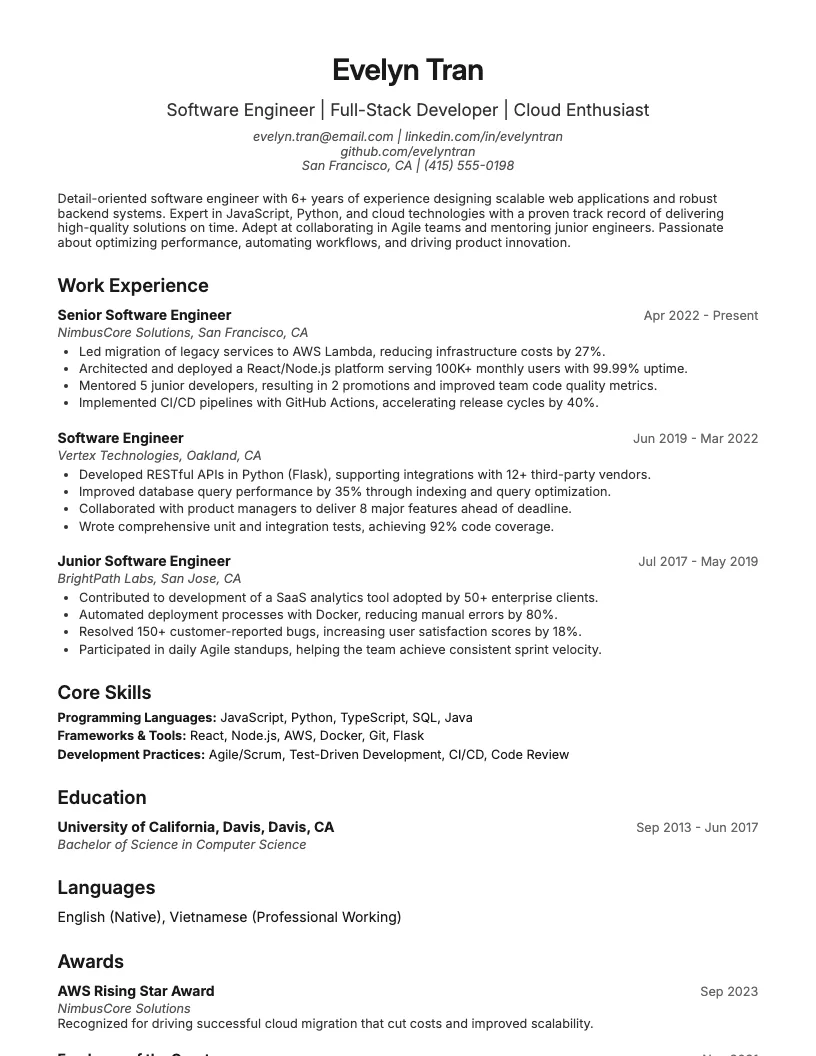
See these skills on a real resume
8 examplesStart from an example that already has them, and swap in your own.
Check your resume against the job you want
Scan your resume, see which skills and keywords the posting asks for that you are missing, and fix them before you apply.
Free to use • No credit card required