Keywords for social work resume: 12 terms that get interviews
12 keywords, 12 therapy models, and 9 licence credentials for a social work resume, plus which systems, settings, and people skills actually matter.


Written by Dr. Priya Sharma
Career Development Expert & Resume Analyst
Updated August 2026
Reviewed by Sarah Chen
Is your resume ATS-friendly?
Drop your resume in and see which of these skills a scanner can actually read, and which ones the job you want is asking for that you have not listed.
PDF or DOCX. Max 2MB.
We never share your resume or use it to train a model.
In This Guide:
What keywords should go on a social work resume?
What keywords should go on a social work resume?

I've read hundreds of social work resumes, and the ones that get interviews all have the same core vocabulary. This isn't jargon for its own sake - it's the exact language a hiring manager and an ATS scanner are both hunting for.
Case management
This is the single most common term across social work postings - you'll find it in nearly every job ad in the field, regardless of setting.
Don't just write "case management." Show the size of your caseload and what you did with it: "managed a caseload of 45 families" tells a screener far more than the bare term.
Psychosocial assessment
This is the clinical skill under almost everything else you do - the intake, the treatment plan, the referral all start here.
Name it directly if you run assessments. Vague phrases like "worked with clients" don't register the same way.
Crisis intervention
Any mental health or hospital role wants to see this term specifically. If you've talked someone down, coordinated an emergency placement, or handled an involuntary hold, this is the word for it.
Treatment planning
Pair this with the therapy models you actually use - that's covered separately further down the page - but the phrase itself needs to appear on its own too.
Risk assessment
This shows up on essential-keyword lists again and again, right alongside safeguarding. Employers read it as: can you spot danger before it becomes a crisis?
Safeguarding
Especially common in child welfare and UK-style postings. If your job touched protection plans, mandated reporting, or child welfare checks, use this exact word.
Client advocacy
Some postings say "patient advocacy," some say "client advocacy" - match whichever term the posting you're applying to actually uses.
Care coordination
This is the connective tissue between providers, agencies, and family - spell out who you coordinated with, not just that you did.
Discharge planning
If you've worked hospital or medical social work, this one's close to mandatory. I'll show you how to turn it into a real bullet later on this page.
Documentation and case notes
SOAP notes, progress notes, EHR systems - this deserves its own section, and it gets one below.
Community outreach
Common in program development and macro-level roles. If you built partnerships or ran outreach events, name the term, then name the result.
Resource navigation
Connecting clients to housing, benefits, or outside services - worth naming on its own, since it's a distinct skill from case management even though the two get lumped together.
The mistake I see most often: candidates list eight or ten of these terms in a skills block and never let them touch the experience section. A hiring manager wants to see the word land inside a real sentence.
If you're not sure which of these actually match the posting you're applying to, ResumeJudge will scan your resume against the job description and flag exactly which of these terms are missing before you hit submit.
Which therapy models should you name on your resume?
If you work anywhere clinical, this is the part of your resume hiring managers read first.
Name the specific modalities you use. "Strong therapeutic skills" tells them nothing - CBT, DBT, or MI tells them exactly what you can do in a session.
Cognitive Behavioral Therapy (CBT)
CBT shows up on more social work job postings than any other modality, across school, outpatient, and hospital settings alike.
If you've used it, it's one of the first terms to put in your core competencies block.
Dialectical Behavior Therapy (DBT)
DBT reads as a specialty skill, not a general one. It's tied closely to borderline personality disorder work, eating disorders, and adolescent caseloads.
Name it only if you've run or co-run DBT groups or used the skills modules directly with clients.
Motivational Interviewing (MI)
MI is the modality I see under-claimed the most. If you've done any substance use or behavior-change work, you've almost certainly used it, even if you never called it that on paper.
Once you know the term, go back and check whether your bullets actually say it.
Solution-Focused Brief Therapy (SFBT)
SFBT matters most in school settings and short-term outpatient work, where you don't have the luxury of a long treatment arc.
If your job was mostly six sessions or fewer, this is probably the term that describes what you did.
Trauma-Focused CBT (TF-CBT)
This one's specific to child and adolescent trauma work. Don't shorten it to plain CBT on your resume - TF-CBT is its own credentialed modality, and a hiring manager in child welfare or pediatric mental health is scanning for that exact string.
EMDR
EMDR is a trauma and PTSD modality, and it's one of the few where the acronym alone is the industry-standard term. Spelling it out doesn't add anything - just make sure you only list it if you're actually trained in it.
Acceptance and Commitment Therapy (ACT)
ACT shows up most in anxiety and chronic pain caseloads. It's less common than CBT or DBT, so naming it signals a specific kind of clinical range.
Trauma-informed care
This is different from the trauma-specific modalities above - it's a framework, not a technique. It belongs on nearly every social work resume regardless of setting, because it describes how you approach a client, not a session structure.
Play therapy
Play therapy is a pediatric and child welfare term. If your caseload was mostly kids, this belongs next to your child welfare setting keywords, not buried in a general skills list.
Group therapy facilitation
Group work is common in inpatient, outpatient, and addiction settings, and it's worth its own line because facilitating a group is a different skill than running individual sessions - say which group types you ran.
Psychoeducation
Psychoeducation covers family and caregiver-facing work - explaining a diagnosis, a treatment plan, or coping strategies to someone who isn't the client. It's easy to forget you did this constantly.
Only list a model you have actually delivered
Here's the mistake I see most often: someone lists five modalities because they were mentioned in a training, not because they used them with clients.
An interviewer who works in DBT will ask you about your DBT caseload in the first ten minutes. If you can't answer, the resume did you a disservice, not a favor.
The fix is matching your list to the posting instead of padding it. Run the job description and your resume through ResumeJudge and it'll flag which modalities the posting names that your resume doesn't back up - and rewrite the bullet so the modality sits next to real client work, not just a training certificate.
How do you list your licence and credentials?
Social work credentials at a glance
| Credential | Full title | Level |
|---|---|---|
| BSW | Bachelor of Social Work | Entry-level, pre-licence |
| MSW | Master of Social Work | Graduate, pre-licence |
| LSW | Licensed Social Worker | Licensed, pre-clinical |
| LMSW | Licensed Master Social Worker | Licensed, state-dependent |
| LCSW | Licensed Clinical Social Worker | Full clinical licence |
| CADC | Certified Alcohol and Drug Counselor | Addiction specialty |
Your credential is the first thing a hiring manager and the screening software both look for, so get it right before you touch anything else on the page.
BSW
Bachelor of Social Work. This tells an employer you have the accredited undergraduate degree - entry-level, not yet clinically licensed.
MSW
Master of Social Work. The graduate degree most clinical and many macro roles require, and the credential that opens the door to licensure.
LSW
Licensed Social Worker. In a handful of states - New Jersey, Pennsylvania, Illinois and Ohio among them - this is the license you hold right after your MSW, before you've logged the supervised hours for clinical licensure. Most states call that first license the LMSW instead, so check what your own board issues.
LMSW
Licensed Master Social Worker. A step up from LSW in some states - check your state board, because the ladder of titles isn't the same everywhere.
LCSW
Licensed Clinical Social Worker. This is the one hiring managers search for first on a clinical posting, and I've seen strong candidates get passed over because it was buried in a paragraph instead of sitting next to their name.
LICSW
Licensed Independent Clinical Social Worker. A handful of states issue this instead of LCSW - use whichever your state actually issues.
ACSW
Academy of Certified Social Workers, a NASW credential. Worth adding if you have it, but it's a bonus line, not a load-bearing one - leave it out of a headline where LCSW or LMSW belongs.
C-SWCM
Certified Social Work Case Manager. If your background is heavy on case management, this is a credential worth naming rather than folding into your skills list.
CADC
Certified Alcohol and Drug Counselor. Specific to addiction and substance use roles - put it right next to your licence if that's the work you're applying for.
Where the credential goes: name line, summary, education
Put your primary credential right after your name - "Jordan Ellis, LCSW" - in the same line, same size as your name, not buried in a footer.
Repeat it once in your professional summary, and list it again with full detail - state, license number if the posting asks, expiration date - under education or a dedicated licensure line. Three placements, same credential, no more.
Write the acronym and the full title once each
Screening software matches both forms, so write "Licensed Clinical Social Worker (LCSW)" the first time it appears, then use just LCSW everywhere after that. A resume that only ever says "LCSW" risks missing a search built around the spelled-out title, and one that spells it out five times just reads clumsy.
If you are pre-licensure or hours-in-progress
Say exactly where you are - "MSW, LSW, accumulating supervised hours toward LCSW" - rather than leaving the licence line blank or, worse, implying a credential you don't have yet.
If you're not sure your resume's licensure section is complete for the specific posting you're chasing, ResumeJudge will check it against that job description and tell you what's missing before you hit submit.
Which keywords change with your setting?
Core terms by setting
| Setting | Core terms | Key acronym or system |
|---|---|---|
| Hospital and medical | Discharge planning, care coordination | HIPAA, CMS |
| School | Student advocacy, attendance intervention | IEP, 504, MTSS |
| Child welfare and CPS | Family preservation, reunification | SACWIS |
| Outpatient mental health | Individual and group therapy, crisis stabilization | Prior authorization |
| Substance use and addiction | Recovery planning, harm reduction | MAT, ASAM |
| Aging and adult services | Elder abuse screening, capacity assessment | Long-term care planning |
The core terms from case management carry across every setting, but each one has its own vocabulary layered on top. Naming it tells a hiring manager you've actually worked there, not just adjacent to it.
Hospital and medical social work
Lead with discharge planning, care coordination, and length-of-stay management.
Name the population you worked with - geriatric, pediatric, oncology, palliative care, ICU. Then the compliance terms: HIPAA, Joint Commission, CMS, Medicaid.
A resume that says "hospital social worker" without one of these reads like it was written by someone who's never seen a discharge order.
School social work
This setting has its own acronyms, and they're not optional: IEP, 504 plans, MTSS, RTI.
Pair them with student advocacy, attendance intervention, and the collaborators you sat across from - school counselor, school psychologist, multidisciplinary team.
Child welfare and CPS
Family preservation, foster care, and reunification are the functions. Mandated reporter status and court testimony are the legal terms that prove you've been in the room.
Name your documentation too - case plans, court reports, safety and risk assessments. If your county runs a state child welfare case management system, name whichever one the posting names.
Outpatient mental health
Individual and group therapy, crisis stabilization, and the modalities I cover under therapy models - CBT, DBT, trauma-informed care. Add the administrative reality of the job: prior authorization, managed care, outcome measurement.
Substance use and addiction services
Recovery planning, harm reduction, motivational interviewing. If you've worked with MAT or under ASAM criteria, those two terms alone tell a recruiter you know the field.
Aging and adult services
Elder abuse screening, capacity assessment, long-term care planning, and caregiver support are what this work actually looks like day to day - use them.
Macro practice, policy and program work
Program development, grant writing, needs assessment, community organizing. This resume reads nothing like a direct-practice one, and it shouldn't.
I've seen social workers apply to five different settings with one unchanged resume, and it's the fastest way to look like you don't understand the job. ResumeJudge checks your resume against the actual posting and tells you which of these terms it's missing before you send it.
Which systems and software should you list?
Which systems and software should you list?
The software line is where I see the most wasted space on a social work resume.
People either leave it blank because they think it doesn't matter, or they cram it with everything they've ever clicked on. Neither works.
What matters here is naming the systems your next employer actually runs, because that's what a hiring manager's eye catches first.
Epic
If you've worked in a hospital, Epic is probably the first thing you should name.
It's the record system most large health systems run - the terms that go with that setting are in hospital and medical social work.
Cerner
Cerner shows up constantly in the same hospital and health-system postings as Epic.
Meditech
Meditech is the third name I see in hospital and long-term care postings.
Smaller hospitals and rehab facilities lean on it more than the big academic centers do, so it's worth naming if that's the setting you're targeting.
Allscripts
Allscripts rounds out the group of medical record systems worth naming if you've touched one.
You only need the ones you've used - don't list all four to look thorough, because an interviewer can ask you to walk through a workflow and you'll be caught flat.
SACWIS
SACWIS (or your state's version of it) is a keyword that signals real experience, not just interest.
TherapyNotes and SimplePractice
These two run most outpatient practices, and postings name them constantly.
Liquid Logic and Mosaic
Liquid Logic and Mosaic are case management platforms you'll mostly see in public-sector and child welfare postings.
SOAP notes and progress notes
This isn't software, it's a format - but it belongs on this list because postings ask for it by name.
If you write SOAP notes daily, say so.
HIPAA, DSM-5, ICD-10
HIPAA compliance is close to universal in healthcare postings, and DSM-5 and ICD-10 show up wherever diagnosis or billing touches your role.
Checking your resume against a specific posting is exactly what ResumeJudge does - it flags which of these a job description asks for that your resume is missing, so you're not guessing.
Leave off Microsoft Office
Nine times out of ten, I tell people to cut Microsoft Office entirely.
Every hiring manager assumes you can use Word and Excel - naming it just tells them you ran out of real things to list.
Which people skills are worth listing, and which are filler?
Every social work resume I read has the same five words on it: empathy, communication, compassion, teamwork, dedicated. None of them do any work.
Here's which ones actually earn their place.
Empathy and active listening
Keep this one, but don't leave it bare.
Empathy on its own is a claim. Empathy tied to a bullet - "used active listening and open-ended questioning to build rapport with clients disclosing trauma for the first time" - is evidence.
De-escalation
This is one of the highest-value terms on the whole page, and I see it left off constantly.
If you've talked someone down from a crisis, name it: de-escalation, crisis de-escalation, or crisis intervention if that's the formal function. A hiring manager scanning for it won't credit "stayed calm under pressure" as the same thing.
Cultural humility
Not "cultural competence" - the field has mostly moved past that term, and cultural humility is what's showing up in job postings now. Use the one the posting uses.
Ethical decision-making and boundaries
Every licensing body drills this into you, so name it directly rather than gesturing at "professionalism." Boundary setting is its own line item, not a subset of empathy.
Interdisciplinary collaboration
If you've sat in a room with nurses, teachers, probation officers, or psychiatrists to plan care, that's this. It reads stronger than "team player" because it names who was actually in the room.
Court testimony and mandated reporting
Specific to child welfare, CPS, and school settings - see which keywords change with your setting. If you've testified or filed a mandated report, both terms belong on the resume; they're legal functions, not soft skills, and postings search for them by name.
Skills that say nothing on their own
"Compassionate," "dedicated," "hardworking," "people person" - cut all of them. They're the words every applicant reaches for when they haven't decided what to say instead, and a hiring manager skims past them without registering anything.
If you're not sure which of your own skill words fall into this bucket, running the resume against a real posting will show you fast which ones score and which just sit there - that's a faster gut check than staring at your own bullet points trying to guess.
Where do these keywords go on the page?
Where do these keywords go on the page?
Placement matters as much as which words you pick.
In the professional summary
Your first three or four lines get the most attention, so put your setting and your strongest terms there. Something like "MSW-level case manager with five years in hospital discharge planning and crisis intervention" does more work than a generic objective line ever will.
In a core competencies block
A short skills block under your summary is where the scanner looks first. List the clinical terms, the modalities, and the systems you actually use - not a wish list.
In your experience bullets
See how do you turn a keyword into a bullet a hiring manager believes for the before-and-afters.
In education, licensure and certifications
See how do you list your licence and credentials for where the credential goes. Modalities you trained in but haven't billed hours on belong here too, not in your summary.
How many times one term should appear
I don't chase a repeat count - two or three natural mentions across the resume beats stuffing a term in five times, and modern scanners flag the second. If you're not sure which terms this posting actually cares about, ResumeJudge will scan your resume against it and rewrite the wording into the right sections for you.
How do you turn a keyword into a bullet a hiring manager believes?
Here's the mistake I see most often: someone reads that "case management" is a keyword, so they write "responsible for case management." That's not a bullet, that's a label.
A hiring manager wants proof.
Case management: before and after
Turning 'case management' into a bullet
Managed client cases.
Managed a caseload of 45+ clients, conducting psychosocial assessments that helped cut readmissions by 22%.
Weak: "Managed client cases." Strong: "Managed a caseload of 45+ clients, conducting psychosocial assessments that helped cut readmissions by 22%."
Same keyword, but now it's a claim someone can believe.
Crisis intervention: before and after
Turning 'crisis intervention' into a bullet
Responded to crises.
Delivered crisis response on an inpatient psychiatric unit serving 300+ high-acuity patients a year, including safety assessment and planning.
Weak: "Responded to crises." Strong: "Delivered crisis response on an inpatient psychiatric unit serving 300+ high-acuity patients a year, including safety assessment and planning."
The setting and the volume are what sell it.
School social work: before and after
Turning school social work keywords into a bullet
Supported student behavior.
Coordinated IEP and 504 plans for 60+ students, improving attendance 31% over two years.
Weak: "Supported student behavior." Strong: "Coordinated IEP and 504 plans for 60+ students, improving attendance 31% over two years."
That's the difference between a duty and an outcome.
Discharge planning: before and after
Turning 'discharge planning' into a bullet
Helped patients leave the hospital.
Coordinated discharge planning on a 32-bed unit, cutting average length of stay by 1.4 days through faster post-acute placement.
Weak: "Helped patients leave the hospital." Strong: "Coordinated discharge planning on a 32-bed unit, cutting average length of stay by 1.4 days through faster post-acute placement."
Numbers a social worker can actually count
Caseload size, percent change in a rate, days saved, students or clients served. If you don't have an exact figure, a reasonable range still beats no number at all.
Verbs that carry weight: advocated, facilitated, coordinated, assessed
Drop "helped" and "worked with." Advocated, facilitated, coordinated, assessed, established - these tell a reader what you actually did, not that you were nearby when it happened.
If you're stuck matching your own experience to a posting's language, ResumeJudge will rewrite your bullets against that specific job description, keywords and all.
How do you pull keywords out of the job posting itself?
How do you pull keywords out of the job posting itself?
Every posting is a cheat sheet. Most people skim it once and start writing.
I read it three times before I touch the resume.
Step 1: Mark the terms the posting repeats
Anything that shows up twice in a posting is a term the employer cares about. A word buried once in a long paragraph matters less than one that appears in both the summary and the requirements.
Step 2: Match their wording, not your paraphrase
If they wrote "psychosocial assessment," don't write "client evaluations." The screener is matching text, not meaning.
Step 3: Check which of those terms your resume already has
Put the posting next to your resume and go term by term. This is slow by hand - it's the exact check ResumeJudge runs in seconds, scoring your resume against that posting and flagging every term it's missing.
Step 4: Cut the terms this employer never asked for
A hospital posting won't care about your SACWIS experience. Trim what's irrelevant here - save it for the next application.
What to do when you have the skill but not the term
You did the work, you just called it something else. Rewrite the bullet with their word in it - see the before-and-afters for how that looks in practice.
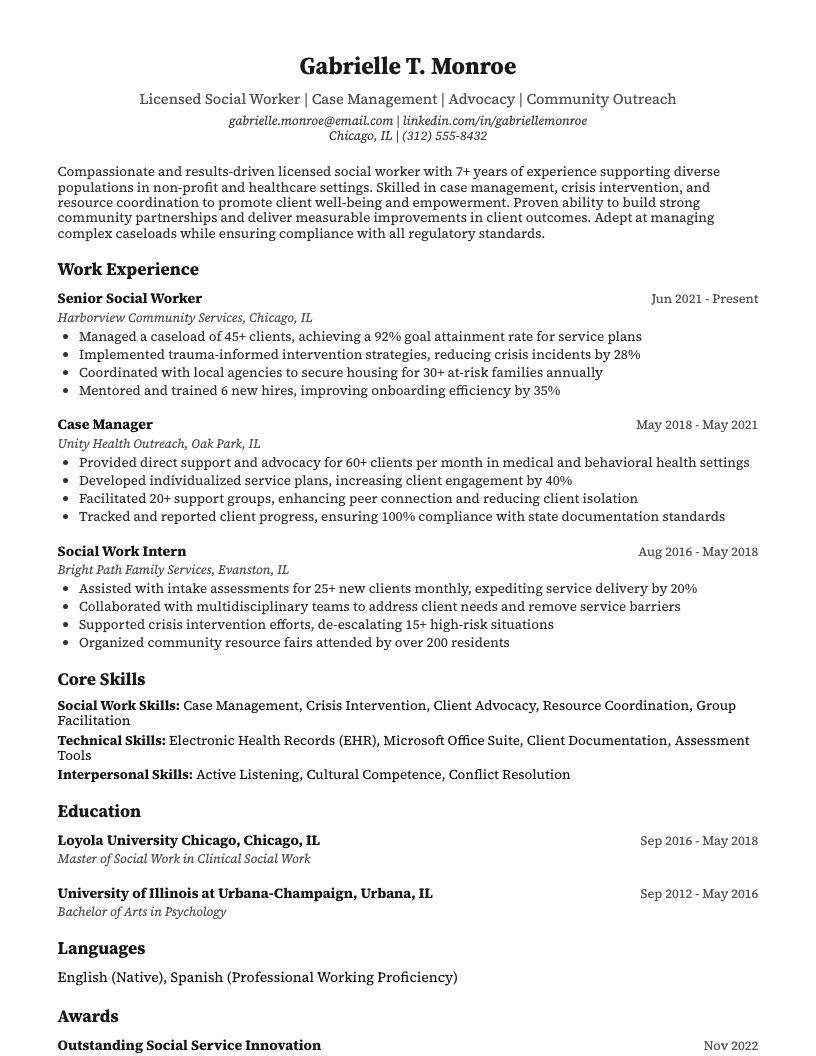
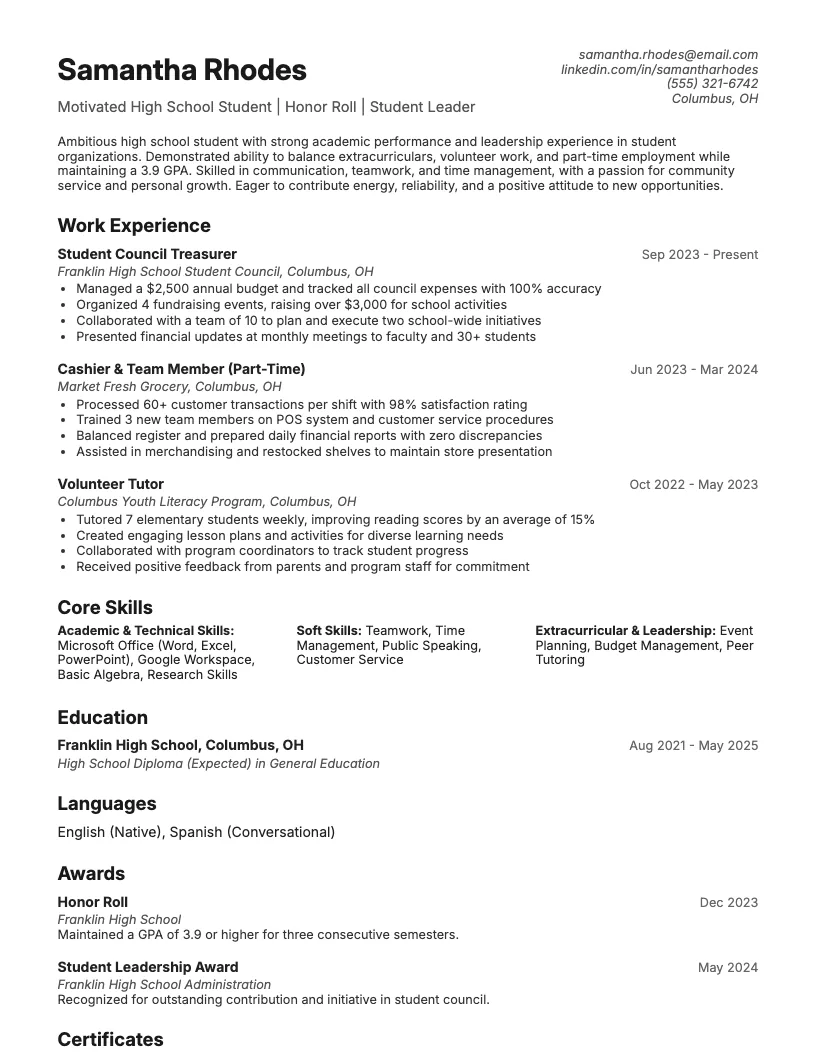
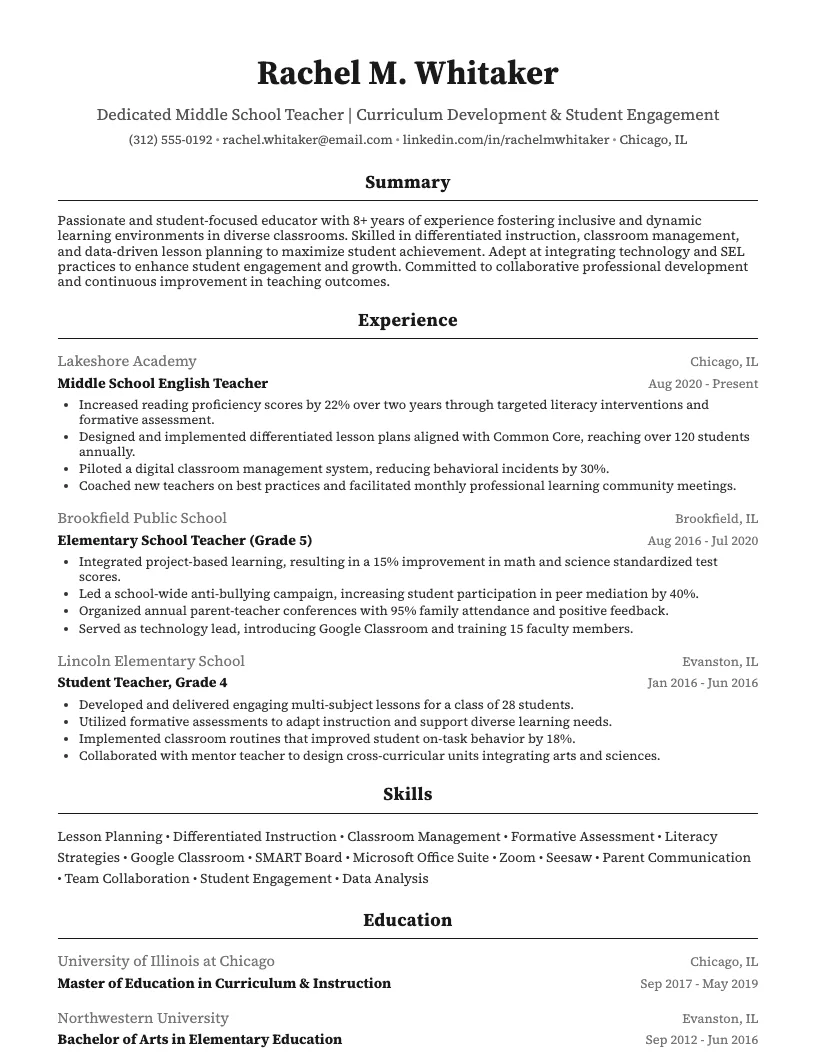
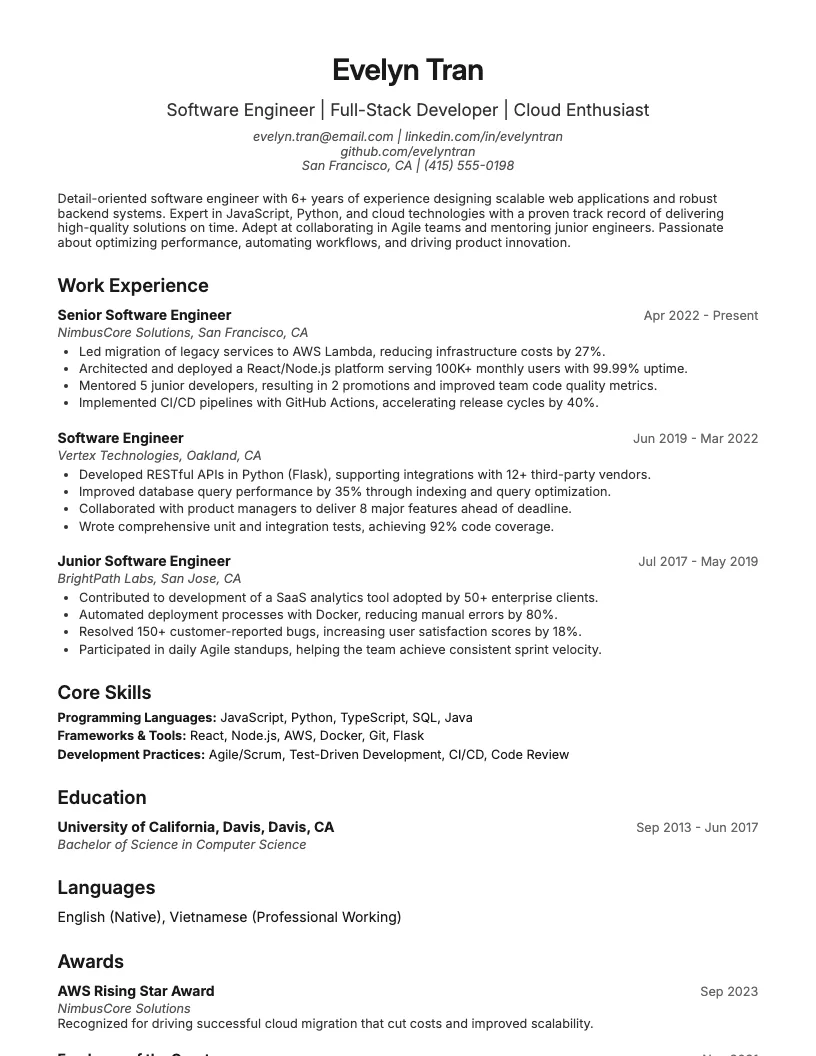
See these skills on a real resume
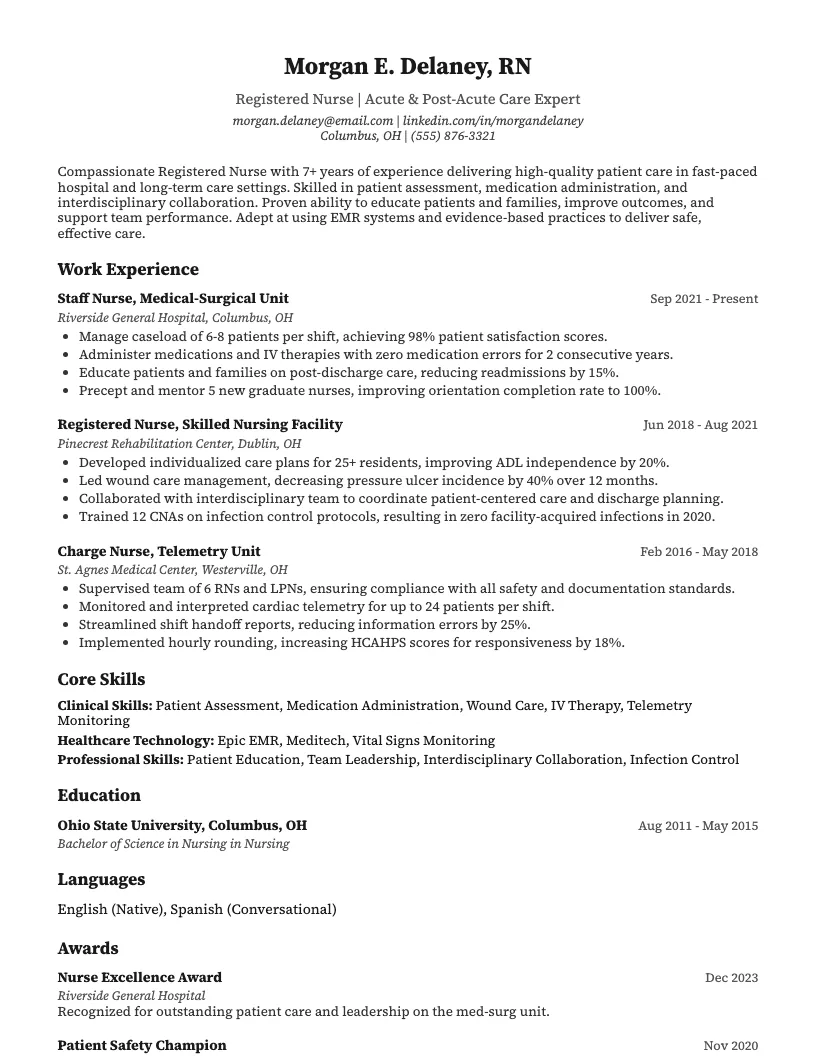
8 examplesStart from an example that already has them, and swap in your own.
Check your resume against the job you want
Scan your resume, see which skills and keywords the posting asks for that you are missing, and fix them before you apply.
Free to use • No credit card required
Frequently Asked Questions
What are the most important keywords for a social work resume?
The core ones are case management, crisis intervention, psychosocial assessment, treatment planning, and motivational interviewing, plus your license and your EHR system. Beyond that, match the exact wording in the posting itself, since one employer's "discharge planning" is another's "transition planning." ResumeJudge will scan your resume against a specific job posting and tell you which of its required terms are missing.
Do social work resumes really get screened by software?
Yes. Hospitals, school districts, and large nonprofits almost all run resumes through applicant tracking software before a person ever sees them, and that software is matching your wording against the posting's wording, not judging your experience. A resume that says "helped clients" instead of "case management" can get filtered out even from a qualified candidate.
Does my LCSW count as a keyword?
Yes, and it's one of the strongest ones you have. Licenses like LCSW, LMSW, and LSW often act as a hard requirement in the screening software, so put both the acronym and the spelled-out title somewhere on the resume, since a system searching for one might miss the other.
How many keywords should I put on my resume?
There's no target number to hit. Work the terms from the posting into your actual job descriptions and accomplishments, because repeating the same word over and over to game the system reads as stuffing and can hurt you with modern screening tools. ResumeJudge takes the posting and your resume and rewrites your bullet points so the right terms land in the right sections, instead of you counting keywords by hand.
I'm a new MSW grad with only practicum hours - which keywords can I use?
Your practicum counts as real experience, so describe it with the same terms you'd use for a paid role: case management, biopsychosocial assessments, treatment planning, client caseload size, and any group work you ran. Naming the population you worked with and the number of clients or sessions makes the practicum read as substantial rather than as a school requirement.
I'm changing careers into social work - what do I list?
List the skills from your old career in social work terms - if you managed cases, coordinated services, or supported people through a difficult process, call it case management or advocacy on the resume, since that's the language the screening software and the hiring manager are both looking for. Pair that with your MSW or BSW and any field hours, and use the rest of the resume to spell out why you're making the switch. ResumeJudge can write the cover letter for that specific posting, which is normally where a career change gets explained.
Should I use different keywords for a hospital job than a school job?
Yes. A hospital posting wants terms like discharge planning, psychiatric units, and HIPAA, while a school posting wants IEP, truancy, and multi-disciplinary team, so the same social work background gets described differently depending on the setting. Read each posting closely and swap in its specific terms rather than sending the same resume to both.