Server Skills for Resume: 10 Skills, 9 POS Systems to Name
See which of the 10 server skills, 9 POS systems, and 6 certifications your resume covers, plus bullet rewrites and fine-dining vs. casual wording choices.


Written by Sarah Chen
Senior Career Strategist & Resume Expert
Updated August 2026
Reviewed by Marcus Rodriguez
Is your resume ATS-friendly?
Drop your resume in and see which of these skills a scanner can actually read, and which ones the job you want is asking for that you have not listed.
PDF or DOCX. Max 2MB.
We never share your resume or use it to train a model.
In This Guide:
What skills should you put on a server resume?
What skills should you put on a server resume?

I've read hundreds of server resumes, and most of them just list "customer service" and "teamwork" and stop there. That's not wrong, it's just not enough to stand out when a posting gets 200+ applicants.
Customer service
Postings ask for this one constantly. The mistake I see most often is leaving it as a bare word instead of tying it to what you actually did - resolved a complaint, kept a table happy through a mistake in the kitchen, that kind of thing.
POS systems
Name the systems you've used. Toast, Square, Aloha, Micros, Clover - hiring managers scan for these by name, and a resume that just says "point of sale experience" reads as vague.
More on which ones to name is in which POS systems should you name on your resume.
Menu and allergen knowledge
Knowing the menu cold, and knowing which dishes carry common allergens, is what keeps a table safe and keeps you from having to run back to the kitchen every five minutes. Write it as "allergen awareness" or "dietary accommodation," not just "menu knowledge."
Upselling and suggestive selling
This is a sales skill dressed up as a hospitality one, and it belongs on the resume that way. If you increased your average check by suggesting a wine pairing or an appetizer, say the number - even a modest one beats no number at all.
Cash handling and split checks
Accuracy is the whole point here. A drawer that balances and a split check that comes out right the first time tells an employer you won't cause problems at the end of a shift.
Multitasking during a rush
Anyone can say they multitask. What actually lands is the size of what you were juggling - an 8-table section, a 200-cover Friday night, whatever your real numbers were.
Order accuracy
Getting orders right the first time, especially with modifications and allergies in the mix, is a skill in its own right, not just part of "attention to detail." I'd write it that specifically.
Teamwork with the kitchen and bar
Service breaks down the moment front-of-house and back-of-house stop talking to each other. Relaying orders clearly, flagging problems early, covering a teammate's tables - that's what this skill actually looks like on the floor.
Table service and section management
This is about owning a section: knowing your tables, managing turns, keeping the pace right so nobody waits too long and nobody feels rushed. Nine times out of ten, a resume that shows section size or covers-per-night beats one that just says "provided table service."
Food safety
Certifications matter here - ServSafe and similar cards are worth their own mention, covered in which certifications should a server list - but the underlying skill is knowing safe food handling and reporting hazards before they become problems.
Once you've got this list down, the harder question is where each one goes on the page - that's how many skills should you list, and where do they go. If you'd rather not guess which of these a specific posting cares about, ResumeJudge will scan the job description against your resume and tell you exactly which of these skills you're missing before you hit apply.
How many skills should you list, and where do they go?
How many skills should you list, and where do they go?
How many to list
Fifteen to twenty-five skills, spread across the whole resume, not crammed into one box.
I see servers try to fit forty skills into a bulleted list and it just reads as noise. Split it: eight to twelve hard skills like POS systems and cash handling, five to ten soft skills backed by a number, and two or three certifications on their own line.
The skills section
Keep this to six to ten items, and group them if the list gets long - communication skills together, then handling-a-rush skills together.
A recruiter skims this section in seconds, so don't bury POS software between "friendly" and "hardworking." Name the software.
If you're not sure which skills a posting actually wants named, ResumeJudge will scan the job description and tell you exactly which ones from your resume are missing.
The resume summary
Two or three lines, and one real number in it - years of experience, section size, or a promotion.
"Server with 3 years fine dining experience, promoted to trainer" does more work than any adjective.
Inside your work experience bullets
This is where skills prove themselves. Naming "customer service" in your skills box means nothing if no bullet backs it up - see how to turn a skill into a bullet for the actual before/after wording.
A separate certifications line
ServSafe and TIPS get their own line, not buried in skills - see which certifications matter for the full list.
Once the sections are in place, tailor the wording to the posting in front of you - nine times out of ten that's the step people skip, and it's the one ResumeJudge does for you: feed it your resume and the job description and it rewrites the wording section by section to match.
Which POS systems should you name on your resume?
POS and reservation systems worth naming
| System | Common in | Write it as |
|---|---|---|
| Toast | Casual and full-service | Processed orders and payments on Toast POS |
| Square | Small restaurants, cafes | Point-of-sale on Square |
| Aloha | Chains, full-service | Ran service on Aloha POS |
| Micros | Larger, established restaurants | Micros POS experience |
| Clover | Independent restaurants | Clover POS |
| OpenTable, Resy, SevenRooms | Reservations and seating | Managed reservations on OpenTable |
Restaurant hiring managers search for these systems by name. Write "computer skills" and you're invisible to that search.
Toast
The one you'll hit most in casual and full-service spots right now. If you've used it, say so plainly: "Processed orders and payments on Toast POS."
Square
Common in smaller restaurants, cafes, and counter-service places. It's easy to pick up, but naming it still beats leaving it out - hiring managers scan for the exact word.
Aloha
Older system, still everywhere in chains and full-service dining. If your last job ran on it, list it - it tells a manager you can handle a system with more screens and more training behind it.
Micros
Another one you'll see a lot in bigger, established restaurants. I've seen candidates who trained new hires on Micros skip mentioning it, then wonder why a posting that named it by name never called back.
Clover
Shows up in smaller independent restaurants and some retail-adjacent food spots. Same rule applies: if you touched it, name it.
Lightspeed
Popular in restaurants that also handle retail or need heavier reporting. Worth naming if the job posting mentions it or something similar.
SpotOn
Newer, but spreading fast through independent restaurants. Don't assume it's too niche to list - a posting that runs on it will search for exactly that word.
TouchBistro
Common in smaller full-service and fine dining spots, especially ones that also want tableside ordering. List it the same way: by name, not as "POS experience."
OpenTable, Resy and SevenRooms
These aren't POS systems - they're reservation and table management tools, and a lot of servers who've used them don't think to list them. If you've booked tables, managed a waitlist, or handled seating through one of these, it's a real, separate skill line.
Name the specific one you used.
What to write if you only used one
You don't need five systems on your resume - one is fine, as long as you name it. Nine times out of ten, the mistake I see isn't too few systems, it's none at all: "proficient with POS systems" instead of "Toast POS."
When a posting does name its system, a resume that echoes that exact word gets noticed by both the applicant tracking system and the person reading it after. If you're not sure which systems the jobs you're targeting actually run - or whether your resume even has the right one on it - running it against a real posting will show you the gap.
Once you've got the system named, go back and check it's showing up in the right spot on the page, not just buried in a bullet.
How do you turn a server skill into a resume bullet?
Take any duty from your shift and ask one question: what number was attached to it? That's the whole method.
"Took customer orders" → covers served in a named section size
Taking orders, turned into a bullet
Took customer orders
Managed a 6-table section serving 80+ covers per shift
"Took orders" tells a manager nothing. "Managed a 6-table section serving 80+ covers per shift" tells them you can run a real section under real volume.
Name the section size and the covers. If you know your ticket times too, add them - under-18-minutes is a specific claim a generic bullet can't make.
"Handled money" → till accuracy
Handling money, turned into a bullet
Handled money and cash register
Processed split checks and cash handling with zero till variances
Every server handles money. What separates a resume line is whether the till balanced.
"Processed split checks and cash handling with zero till variances" beats "handled money" because it proves something instead of just claiming it.
"Was friendly" → guest satisfaction or repeat business
Being friendly, turned into a bullet
Friendly and outgoing with guests
Built repeat business through personalized service, noted in quarterly guest reviews
Nobody hiring a server doubts you can be pleasant. What they can't tell from "friendly" is whether it changed anything.
Turn it into a repeat-customer number or a satisfaction score if you were ever told one - even an estimate from a manager review is more convincing than the adjective alone.
"Upsold drinks" → check average increase
Upselling, turned into a bullet
Upsold drinks and appetizers
Increased average check 18% through wine-pairing recommendations
This is the easiest rewrite on the page because the number usually already exists somewhere - a POS report, a manager comment, a shift recap.
"Increased average check 18% through wine-pairing recommendations" is a bullet that answers the upselling line item recruiters specifically scan for.
"Trained new staff" → ramp time cut
Training new hires, turned into a bullet
Trained new hires
Trained 9 new servers on POS workflow and coursing standards, cutting ramp time from 3 weeks to 10 days
I see "trained new hires" on nine out of ten server resumes and it almost never has a number attached. Count the people, and count the days it took them to get up to speed.
"Trained 9 new servers on POS workflow and coursing standards, cutting ramp time from 3 weeks to 10 days" does the work three vague words can't.
Numbers a server can actually count
If you don't have the exact figure, ask a former manager or use a fair estimate rather than skipping the bullet. A rounded number that's honest still beats no number at all.
Covers per shift, table count, check average, ticket time, till variance, new hires trained, days to ramp them - those are the seven numbers worth digging for before you write a single bullet. If you're staring at a job posting and can't tell which of these it actually wants highlighted, ResumeJudge will scan the posting against your resume and tell you exactly which numbers to lead with.
Which certifications should a server list?
Which certifications should a server list?
I see servers leave certifications off entirely, like they don't count as skills. They do, and for a lot of restaurants they're the first thing a manager checks.
ServSafe Food Handler
This is the baseline. It's a national food safety course, it's cheap, and it takes an afternoon.
ServSafe Alcohol
This is the alcohol-service version of ServSafe. If the restaurant serves wine, beer, or cocktails, list it.
TIPS
TIPS stands for Training for Intervention ProcedureS, and it's the other big name in alcohol-service training. Some employers ask for ServSafe Alcohol specifically, some ask for TIPS, some take either.
If you have one, put it on the page - don't worry about which one the job posting technically named.
State alcohol permits (RBS, TABC, MAST, OLCC, RAMP)
A handful of states run their own alcohol permit on top of TIPS or ServSafe Alcohol: RBS in California, TABC in Texas, MAST in Washington, OLCC in Oregon, RAMP in Pennsylvania. If you're in one of those states and you've served alcohol, that permit's name belongs on your resume, not just "alcohol certified."
State and county food handler cards
Some states and counties issue their own food handler card instead of, or alongside, ServSafe. If that's what you hold, write the actual name of the card.
A hiring manager scanning for it won't credit you for a generic "food safety certified" line.
WSET and Court of Master Sommeliers
These are for fine dining. WSET Level 1 or 2, or a Court of Master Sommeliers introductory course, tells a wine-heavy restaurant you can talk a guest through a list, not just carry plates.
Casual and high-volume places won't care - save it for the fine dining wording roles.
How to write them on the page
Keep a photo of the actual card on your phone. Some hiring managers ask to see it on day one, and a few will check the certification number against the issuing body's site before your first shift.
Name the certification exactly, skip the vague "food safety trained" version, and note it's current if it has an expiration. A separate certifications line near your skills is usually the cleanest spot - see where things go.
If you're not sure which ones a specific posting is actually asking for, ResumeJudge will check your resume against the job description and flag any certification the listing wants that you haven't listed.
Which skills change between fine dining and casual?
Fine dining vs. casual wording
| Aspect | Fine dining | Casual / high-volume |
|---|---|---|
| Core wording | coursing, decanting, crumbing, tableside | covers, table turns, ticket times |
| Wine and beverage | pairing suggestions, tasting notes | basic beverage service |
| Bar knowledge | cocktail presentation | backing up the bar during a rush |
| Events | VIP and tasting-menu service | banquet and catering volume |
The skill is the same shift after shift. The words you put on the resume aren't.
Fine dining wording: coursing, decanting, crumbing, tableside
If you've worked upscale, drop "friendly" and "fast" - a fine dining hiring manager has read that a thousand times. Use the words that show you've actually done the job: coursing and pacing a tasting menu, decanting a bottle at the table, crumbing the cloth between courses, tableside prep on a Caesar or a dessert.
I've seen a plain "took orders and served food" turned into "coordinated pacing across a 7-course tasting menu with kitchen and sommelier" - same job, and it reads like a different candidate.
High-volume casual wording: covers, table turns, ticket times
Casual and high-volume rooms want proof you can move. Talk in covers, table turns, and ticket times - a number here does more than any adjective.
"Served 80+ covers per shift with a 20-minute average table turn" tells a manager exactly what they're getting. See how to turn a skill into a bullet for more of this.
Wine and beverage service
Wine knowledge belongs on the resume the moment you've had any real training - passing an internal tasting on 40+ selections, pouring and presenting tableside, making pairing suggestions that raised the check average. Nine times out of ten, a candidate who names a wine skill beats one who just writes "beverage service."
Bar and alcohol knowledge
Even if you never worked the bar, alcohol knowledge sells: basic mixology, craft and domestic beer, ID verification, liquor liability law, garnish prep. It tells a manager you can back up the bar during a rush, not just carry plates.
Banquet and catering service
Banquet work is its own résumé line - large-party service, plated or buffet, timed courses for 50+ guests at once. If you've done it, name it; it shows you can handle volume under a fixed clock, which is exactly what a events-heavy restaurant is hiring for.
Once the wording's right for the room you're applying to, ResumeJudge can rewrite your whole resume against that specific posting, matching this vocabulary automatically instead of you guessing which words the job wants.
What skills do you list with no restaurant experience?
No restaurant on your resume yet doesn't mean you have no server skills. You've almost certainly done the underlying work somewhere else, and you just need to say so in restaurant language.
Retail and cashier work
Cashiering is the closest thing to serving without the tray. You handled money, dealt with a line of people who wanted to be helped now, and worked a register the way a server works a POS.
Say that directly: cash handling, till accuracy, customer service in a fast-paced environment.
Fast food and food running
A drive-through, a counter job, or food-running shifts all count. Nine times out of ten, this is where I find the best hidden material: high-volume order handling, working under time pressure, working alongside a kitchen.
That's the same muscle a full-service floor uses.
Volunteer and event serving
Catering a wedding, running a church fundraiser, working a food booth at a festival - all of it is guest service under pressure, and it belongs on the resume next to paid work, not left off because nobody paid you.
Get a food handler card before you apply
This is the one certification you can get before you've ever worked a shift, and it tells a hiring manager you took the job seriously enough to prepare. See which certifications a server should list for the exact one your state wants.
Say your availability out loud
Restaurants live and die by weekend and night coverage. A line stating you're open nights, weekends, and holidays can outweigh a thin work history - it tells them you'll actually cover the shifts nobody else wants.
Once you've got the wording down, ResumeJudge will check it against the actual posting and rewrite the section so it uses the exact terms that job is asking for.
Which skills do you add as you move up?
Which skills do you add as you move up?
The skills on your resume should change every year or two, and I still see people using the same bullet list they wrote for their first serving job five years in.
Entry level (0-1 years)
Keep it to the basics you can actually back up - the first few lines of what skills should you put on a server resume are the ones that belong here.
Don't reach for fine dining language yet - it reads as copied, not earned.
Mid-career (1-3 years)
This is where the rest of that same list earns its place, once you can point to shifts where you handled it without a manager stepping in.
If you've trained anyone, even informally, that belongs here too - it's the first sign you're ready for more than a station.
Senior and fine dining (3+ years)
Three-plus years is where fine dining vocabulary earns its place - see which skills change between fine dining and casual for the words themselves. Using them too early is one of the faster ways to look like you're padding.
Training and shift lead
The mistake I see most often at this stage is servers who've been training new hires for a year and never write it down.
"Trained 3 new servers" or "onboarded new hires each quarter" is a management signal, and it's the single easiest skill to add if you're not already claiming it.
Moving toward captain or floor supervisor
To move toward captain or floor supervisor, stack deeper beverage knowledge, tableside presentation, and shift-lead experience on top of everything above - that combination is what those titles actually screen for.
Once you've got a specific posting in front of you, ResumeJudge will tell you which of these you're missing for that job and rewrite your bullets to match it, rather than you guessing at what "captain-ready" means from one posting to the next.
What gets a server resume rejected?
The same handful of mistakes show up again and again. Here's what I flag every time.
Writing "food service experience" instead of the restaurant type
"Food service experience" tells a hiring manager nothing. Write what it actually was - "fine dining server at a 120-seat Italian restaurant" or "server at a high-volume sports bar."
The specific version places you instantly; the vague one gets skimmed past.
Leaving POS systems out
The full list of systems worth naming, and how to write each one, is in which POS systems should you name on your resume.
Skipping certifications
Which ones to get, and how to write them on the page, is in which certifications should a server list.
Skills with no numbers behind them
Putting a figure behind a skill is the whole subject of how do you turn a server skill into a resume bullet, which has the before-and-after wording.
Multi-column and graphics-heavy templates
Fancy layouts with columns, icons, and graphics can scramble when a bigger restaurant group's system reads your resume - sections get reordered or dropped entirely. Plain, single-column layouts parse cleanly every time.
If you're not sure yours does, run it against the actual posting - ResumeJudge scores your resume against a job description and flags formatting and missing keywords before you hit apply, not after.
A job title that isn't "Server"
If the posting says "Server," your resume should say "Server" too - not "Front of House Associate" or "Dining Specialist." Save the alternate titles for career pivots outside restaurants.
Frequently Asked Questions
What are the most important skills for a server resume?
Order accuracy, POS systems, and food safety are the core three, with upselling and handling a full section of tables close behind. Round those out with soft skills that show up during a rush: staying calm under pressure, reading a table's pace, and working smoothly with the kitchen and bar. Name the specific systems and certifications you've used rather than listing the skill in the abstract, since that's what a hiring manager and an applicant tracking system are both scanning for.
How do I describe serving on a resume if I'm applying outside restaurants?
Translate what you did into the language of the industry you're targeting rather than restaurant terms. If you're moving into retail, hotels, or events, describe the same work as guest service, high-volume customer handling, or managing multiple priorities at once. If you're moving into an office or tech role, lead with communication, problem-solving under pressure, and reliability, backed by a concrete example rather than the word 'server' itself.
How do I professionally say I was a server?
If the job posting says 'Server,' use that word - it's the title an ATS and a hiring manager are both looking for. When you're pivoting into a different field, swap it for a title that matches where you're headed: Hospitality Associate for hotel or retail work, Guest Services Representative for hotels or event venues, or Customer Experience Specialist if you're aiming at a tech or support role. Match the new title to the job posting in front of you, not the other way around.
How many years of server experience should I list?
Cover your most recent five to seven years in detail. If you're just starting out, list every serving-adjacent job you've had, including catering and food-running, since that shows stability more than depth. Once you've got seven or more years in, keep the last ten spelled out and fold anything earlier into a single older-experience line, and if you're changing careers, lead with your transferable skills rather than your years served.
Should I put my tips or sales numbers on my resume?
Yes, if you have a real number attached to them - an average check size you raised, a per-shift sales figure, or a ranking like top performer of the month. A specific number proves you can upsell and drive revenue in a way the word 'upselling' alone doesn't. If a posting asks for exactly that kind of proof, ResumeJudge can take your resume and that job description and rewrite the bullet so your number lands in the section and the wording the posting is actually looking for.
How do I explain a gap between restaurant jobs?
A short, honest line covers most gaps: seasonal work, caregiving, travel, or picking up gig and catering shifts in between jobs. Fill the space on the page with whatever you were doing, even informally, rather than leaving a bare unexplained stretch of time. Once the resume itself is solid, ResumeJudge can also find serving and hospitality roles that fit you and apply to them with a resume tailored to each one, so you're not starting the job search from scratch on top of explaining the gap.
See these skills on a real resume
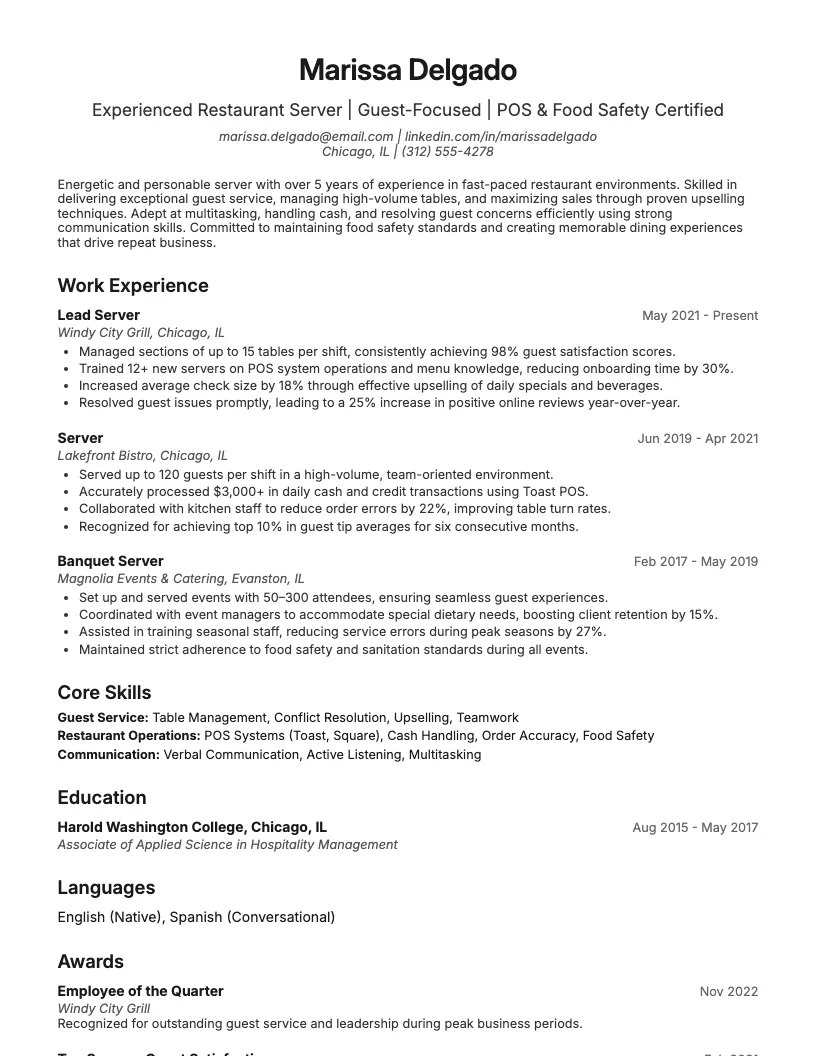
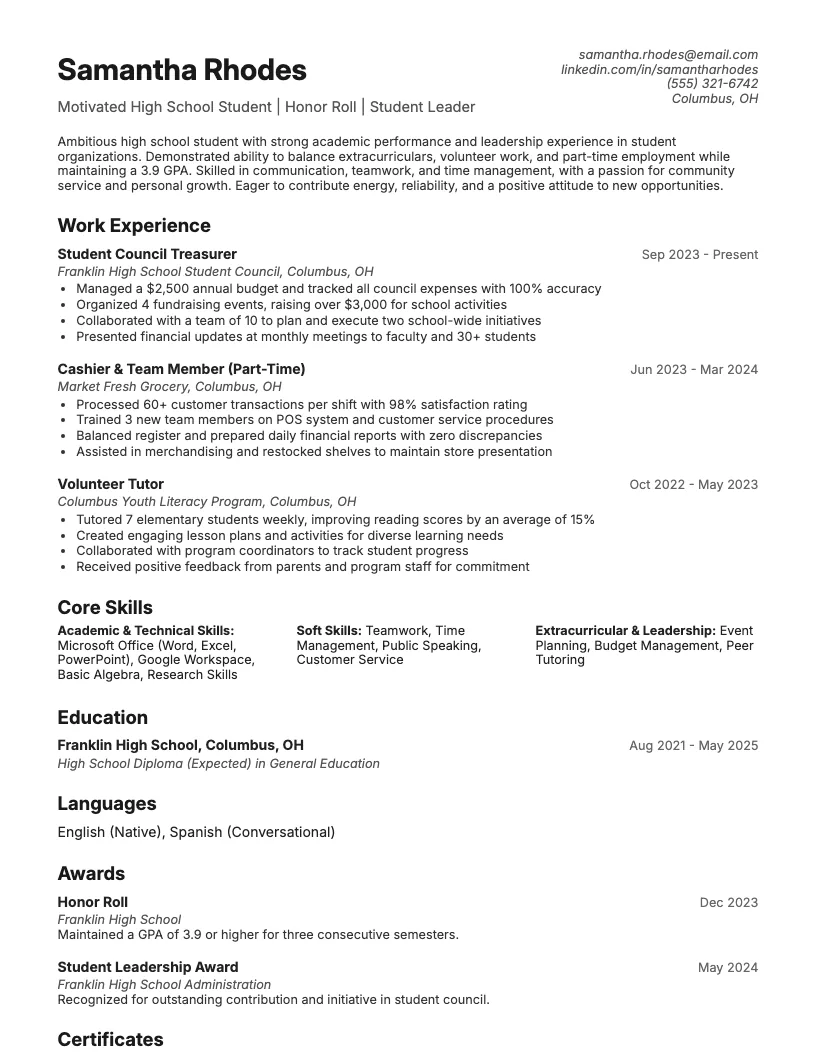
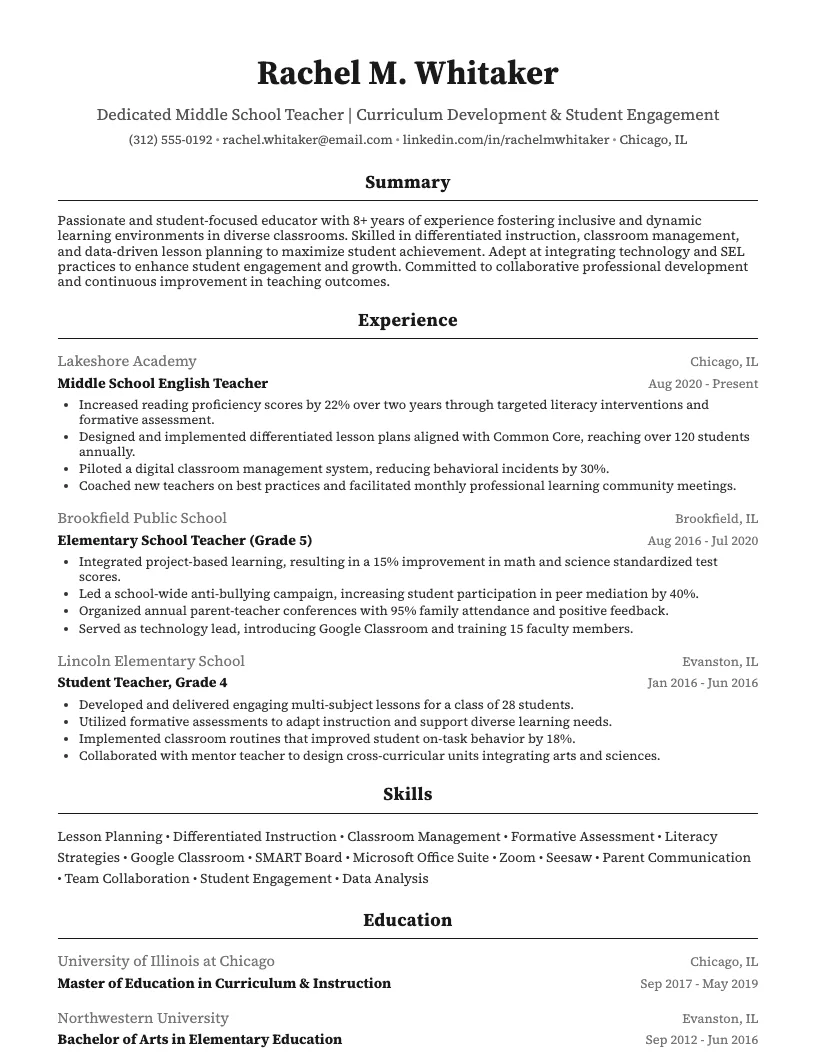
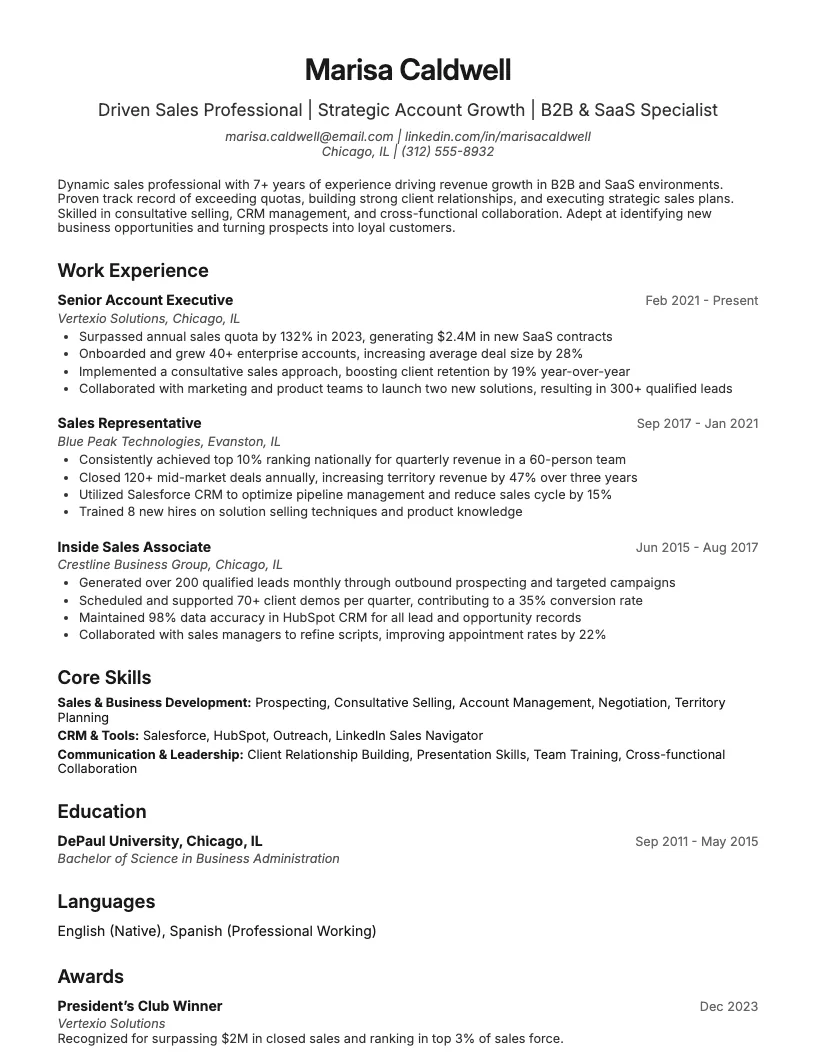
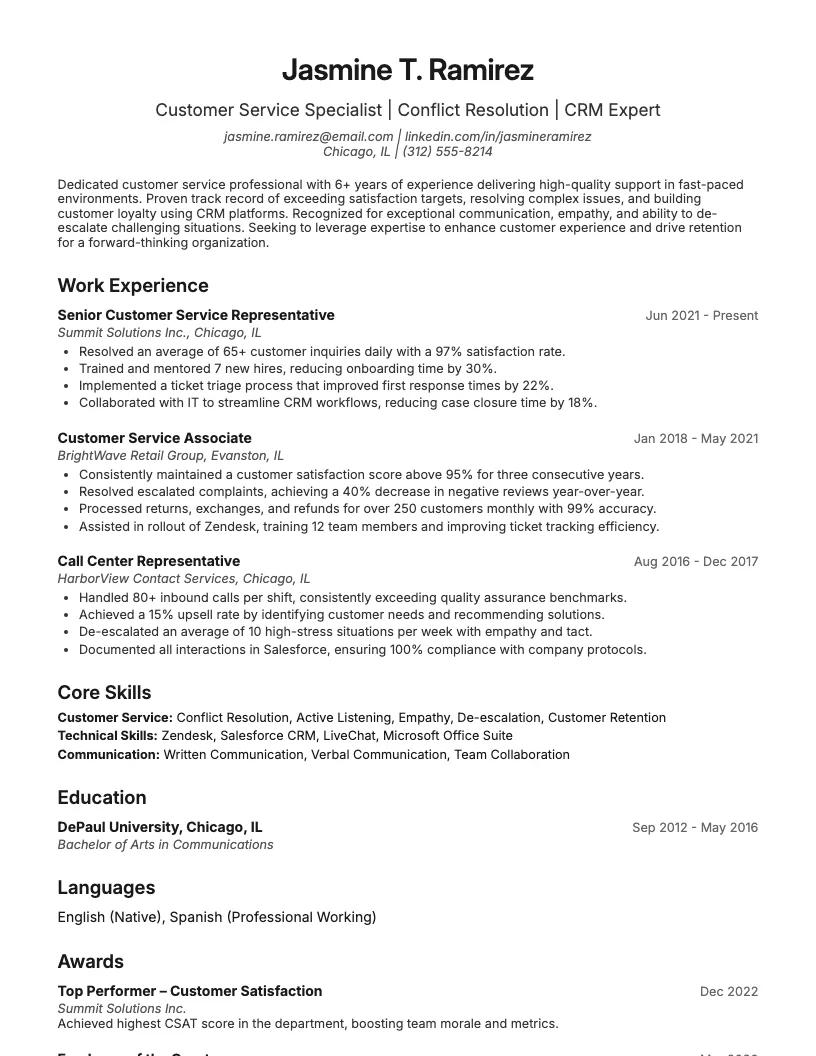
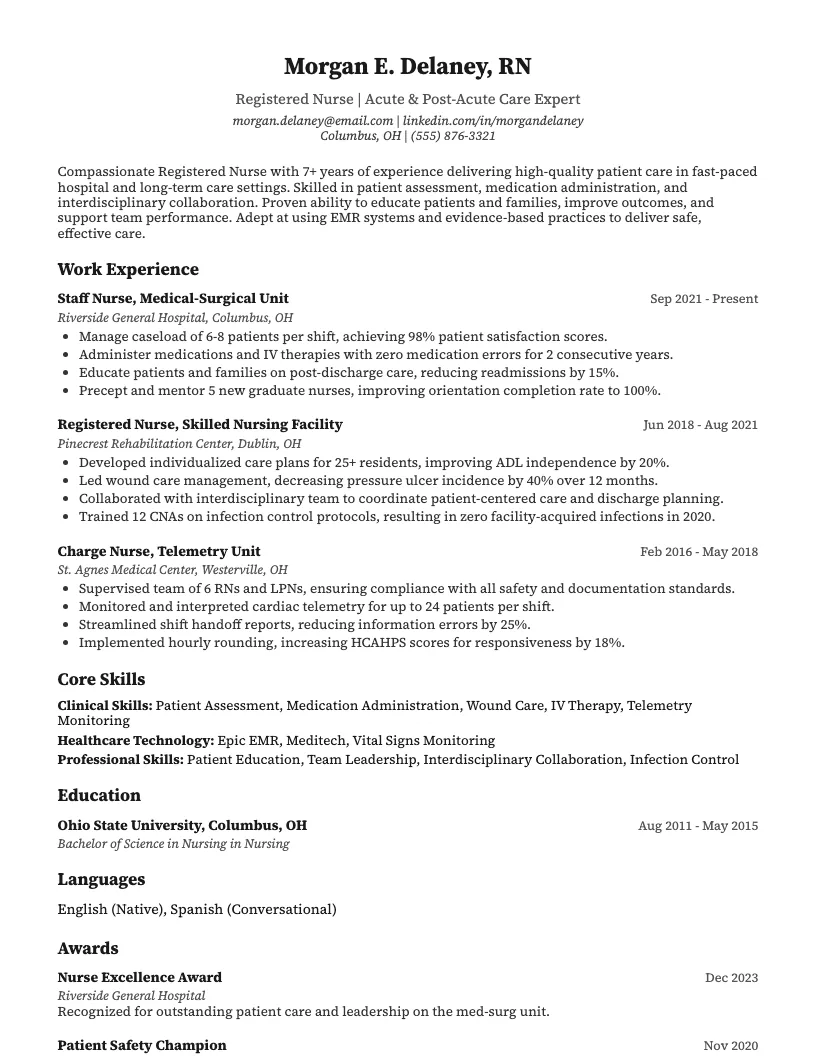
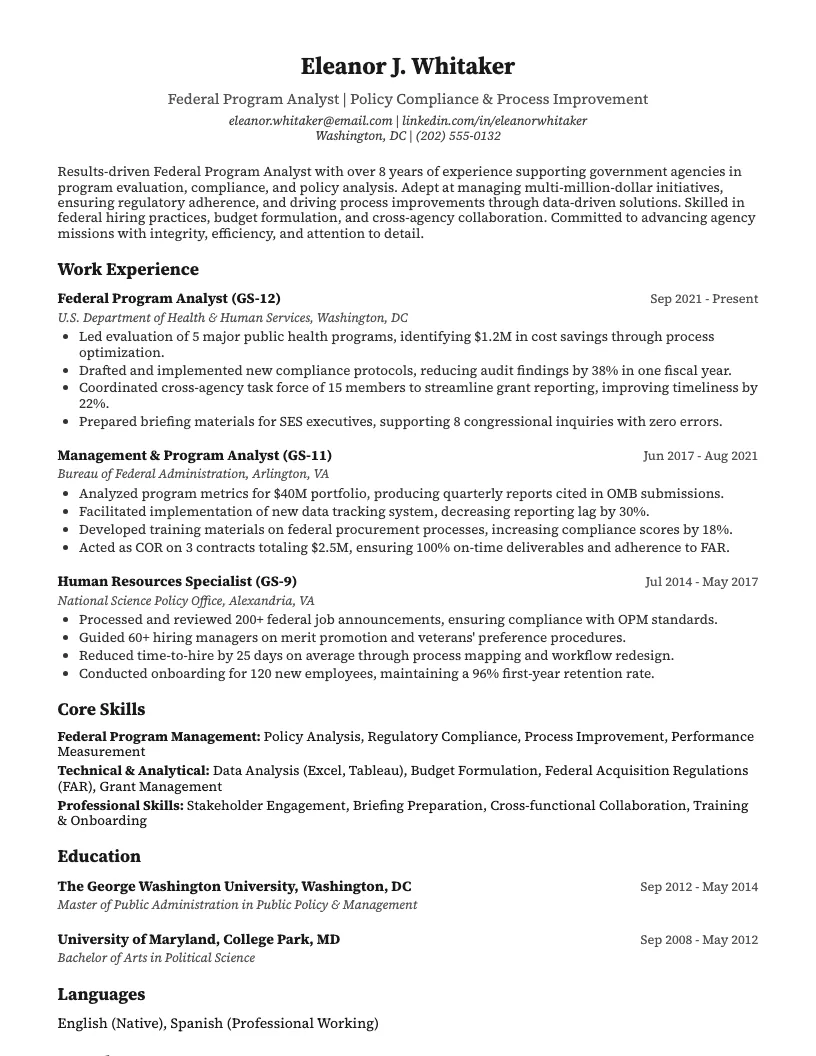
8 examplesStart from an example that already has them, and swap in your own.
Check your resume against the job you want
Scan your resume, see which skills and keywords the posting asks for that you are missing, and fix them before you apply.
Free to use • No credit card required