Digital Marketing Resume Keywords: 12 I Look For, Reviewing Resumes
The 12 keywords marketing job postings ask for most, the tools and soft skills recruiters check for, plus the bullet formula that proves you've used it.


Written by Sarah Chen
Senior Career Strategist & Resume Expert
Updated August 2026
Reviewed by Marcus Rodriguez
Is your resume ATS-friendly?
Drop your resume in and see which of these skills a scanner can actually read, and which ones the job you want is asking for that you have not listed.
PDF or DOCX. Max 2MB.
We never share your resume or use it to train a model.
In This Guide:
What are the most important keywords on a marketing resume?
What are the most important keywords on a marketing resume?

I've read enough marketing resumes to spot the same twelve terms missing, over and over, from otherwise strong candidates. These are the ones that carry the most weight with both the scanner and the person reading after it.
For how often each term actually turns up in postings, see which marketing keywords employers ask for most often.
Marketing strategy
This is the umbrella term. Don't just claim it - name what you built a strategy for (a launch, a channel mix, a budget) and what it produced.
Campaign management
Employers want to know you can run something end to end: plan it, launch it, track it, adjust it. If you've owned a campaign calendar or a budget, say the size.
Brand management
Brand means more than "made things look nice." It's guarding consistency across channels and owning how the company sounds and looks.
Market research
Nine times out of ten, "market research" on a resume means someone read a report once. Show what you did with it - a positioning change, a new segment, a pricing decision.
Content marketing
Content is a keyword recruiters search for on its own, separate from social. If you wrote, edited, or managed a content calendar, use that word, then attach a traffic or engagement number to it.
SEO and SEM
These two get lumped together constantly, and they shouldn't be - one is organic, one is paid. Say which one you actually touched, and check what a digital marketing resume needs for the tool names that go with each.
Email marketing
Still one of the highest-ROI channels, and still underused as a resume keyword. Open rate, click rate, list growth - any of these next to "email marketing" makes it real.
Social media marketing
This is not the same line as content marketing, even though I see candidates merge them constantly. Name the platforms and what you moved - followers, engagement, leads.
Marketing analytics
Analytics is the term that separates people who can read a dashboard from people who can act on one. Say what decision your numbers drove.
Lead generation and demand generation
These sound interchangeable but recruiters read them differently - demand gen is about creating interest, lead gen is about capturing it. Use whichever one matches what you actually did.
Go-to-market strategy
If you've helped launch a product or a feature, this phrase belongs on your resume. What to name next to it is in go-to-market strategy.
Product positioning
This one's rarer outside product marketing roles, but when it applies, it signals strategic thinking rather than execution. What to pair it with is in product positioning.
Which marketing keywords do employers ask for most often?
I've pulled resumes against thousands of marketing postings, and the same words show up again and again. If you know the odds each one hits, you can stop guessing which ones earn a spot on your resume.
Strategy, in 69% of marketing job postings
Seven in ten postings mention strategy in some form. That doesn't mean you write the word once and move on - it means you show a plan, a channel mix, a reason behind the campaign, not just a list of tasks you executed.
Management, in 66%
Almost as common. Employers use it loosely, for budgets, campaigns, people, vendors, so read the posting closely to see which kind they mean before you echo it back.
Sales, in 57%
Marketing and sales overlap more than most candidates admit. If you've ever handed leads to a sales team or reported on pipeline, that's sales exposure worth naming.
Marketing strategy, in 47%
This is the two-word phrase, not the standalone term above, and postings treat it as its own line item. I cover how to build it into your skills section in marketing strategy.
Brand, in 44%
Under half of postings ask for it by name, but it's rarely optional in practice. See brand management for what belongs under it.
Content, in 37%
One in three postings. If you've written copy, briefed a freelancer, or managed a content calendar, that counts, don't wait until you have a "content" title to claim it.
Analytics, in 31%
Nearly a third of postings want someone who can read a dashboard, not just launch a campaign. A resume checker like ResumeJudge will catch it fast if a posting asks for analytics and rewrite the bullet to work a number in.
Digital marketing, in 30%
The umbrella term itself shows up in three of ten postings, mostly as a catch-all title or department name rather than a skill you demonstrate.
Project management, in 29%
Marketing runs on deadlines and moving parts, so postings ask for this more than people expect. Naming a tool you used to run projects helps it land.
Creative and Leadership, the two most-asked soft skills
On the soft-skills side, creative and leadership sit well ahead of everything else, communication, organized, and the rest trail far behind. See creativity for how to show it instead of claiming it.
What keywords should a digital marketing resume have?
What keywords should a digital marketing resume have?
Digital marketing job postings pack in more tool names and acronyms than almost any other resume I review, and that's exactly the problem. You don't need all of them.
You need the ones the posting in front of you actually names.
SEO
SEO means more than "I know keywords matter." Name the actual work: on-page optimization, internal linking, technical audits, building topical authority.
If you've written content briefs or managed an editorial calendar, say so - those are the words a hiring manager scans for.
SEM and PPC
SEM and PPC get used almost interchangeably, but I'd list both if you've touched paid search - some ATS setups match on one and not the other. Pair the term with the platform you ran it on.
"SEM" alone tells a recruiter nothing about what you actually did.
Paid social
This is its own line item, separate from SEM. If your budget lived on Meta or TikTok rather than Google, say paid social specifically, then name the platform.
Lumping it under "social media" buries the skill a paid role is actually screening for.
Google Analytics 4
I still see resumes listing the old Universal Analytics by name. What to write next to GA4 is in the tools section.
Google Ads
Same logic as GA4: name the current product, not a generic "paid advertising." The budget number that should sit next to it is covered in the tools section.
Conversion rate optimization
CRO pairs naturally with A/B testing below, and I'd usually mention them together on a resume too - they're rarely done in isolation. Landing page tests, checkout flow changes, form optimization all count.
A/B testing
Don't just write "A/B testing" and stop. What did you test, and what moved?
A test you ran that changed a number is worth more on the page than the term by itself.
Marketing automation
This is a skill and a tool name at once - name the platform alongside what you automated: nurture sequences, lead scoring, lifecycle campaigns. HubSpot and Marketo each get their own entry in the tools section.
Attribution and tracking
Attribution is one of the terms candidates most often leave off, and it's one hiring managers for paid and growth roles specifically scan for. If you've had to prove which channel drove a conversion, that's attribution work - name it.
ROAS, CAC and LTV
These three metrics carry more weight than almost any skill word you could list, because they prove you managed spend against a return. If you've cut CPA or moved ROAS in either direction, that's the bullet - a tool like ResumeJudge can write it for you, built around whichever metric the posting is actually asking for.
Email deliverability and segmentation
Deliverability, segmentation, and open/click-through rate are the vocabulary of lifecycle and CRM roles specifically - don't substitute generic "email marketing" if the posting uses these sharper terms.
HTML and CSS
You don't need to code, but basic HTML/CSS shows up often enough in postings - usually for email template edits or landing page tweaks - that it's worth a line if you have it. Skip it if you don't; claiming it without proof is the fastest way to get caught in an interview.
What keywords should a product marketing resume have?
What keywords should a product marketing resume have?
Product marketing resumes get mistaken for product management resumes more than any other pairing I review.
The fix isn't a different job title. It's different verbs and a different set of terms that show you sell the product, not just build it.
Product positioning
This is the one recruiters scan for first.
Positioning means you can state what makes the product different and why a specific buyer should care. Don't just write "positioning" and move on - pair it with the market or segment you positioned it against.
Messaging
Messaging and positioning get used interchangeably, and that's a mistake.
Positioning is the strategy; messaging is the words a rep or a webpage actually uses. If you wrote sales decks, web copy, or a messaging guide, say so - that's the proof.
Go-to-market strategy
Show up on close to half the product marketing postings I've looked at, usually shortened to GTM.
Name the channels and the team you worked with, not just the phrase itself.
Product launch
Launches are where a resume can carry a real number: adoption in the first 90 days, revenue in the first quarter, accounts signed.
If you're short on ideas for how to phrase one, the product launch bullet example further down shows the shape.
Competitive analysis
Battle cards, win-loss reviews, competitor teardown decks - any of those count as competitive analysis, and naming the deliverable does more work than the keyword alone.
Customer segmentation
Segmentation shows up alongside persona development almost every time I see it, and for good reason - one feeds the other.
Product lifecycle management
This one covers the whole span from concept to sunset, so it's a strong keyword if you've actually touched more than one stage of a product's life. Don't reach for it if you only ever worked launches.
Sales enablement
Training decks, objection-handling guides, competitive one-pagers for reps - sales enablement is the keyword for anything you built to help sales close, not market.
Persona development
Buyer personas built from real research read very differently from ones built from a hunch. If yours came from interviews or data, say that.
Pricing and packaging
Fewer candidates can claim this one, which makes it worth more when you can. If you influenced tiers, discounting, or bundling, put a number next to it, the way the experience bullets section further up recommends.
A job posting for a product marketing role rarely uses all ten of these - run yours through ResumeJudge against the actual posting and it'll rewrite yours to work in the ones you're missing before a recruiter ever opens it.
Which marketing tools should you name on your resume?
Which marketing tools should you name on your resume?
A hiring manager scanning your resume isn't just checking whether you know "digital marketing." They're checking whether you know their stack.
I pull up a job posting and match tool names before anything else - it's the fastest way to tell if a candidate has actually done the work or just read about it. Name the ones you've used.
Skip the ones you haven't, for the reason in don't name a tool you haven't used.
Google Analytics 4
Almost every marketing posting expects it. Say what you did in it - built dashboards, tracked conversions, set up events - not just that you have "GA4 experience."
Google Ads
Pair it with what you managed: budget size, campaign type, or the result. "Ran Google Ads" tells me nothing; "managed a $40K/month Google Ads budget" tells me everything.
Meta Business Suite
Covers Facebook and Instagram ad management. If your paid social work lived here, say so - it's a specific, searchable term recruiters look for.
HubSpot
The most common CRM-and-automation platform I see on entry-level and mid-level resumes alike. Free certifications exist, so "no experience" isn't a real excuse to leave it off if you've earned one.
Marketo
More common at larger B2B companies. If a posting names it specifically, match the wording exactly rather than swapping in "marketing automation platform."
Klaviyo
Shows up constantly in ecommerce and DTC postings, usually alongside Shopify. Name it if that's the world you're applying into.
Mailchimp
Smaller-team email marketing. It's a fine tool to list, but pair it with a number - list size, open rate, campaign count - so it isn't just a name floating on the page.
Salesforce
The CRM I see requested most often outside of HubSpot, especially where marketing and sales share a pipeline. Worth naming even if your access was limited to reporting.
Semrush
SEO and competitive research. Nine times out of ten, the resumes that name it also back it up with a traffic or ranking number nearby - do the same.
Ahrefs
Backlink and keyword research, frequently listed right next to Semrush. You don't need both if you've only used one.
Google Search Console
The tool people forget. It's free, it's specific, and naming it signals you actually monitor search performance rather than just running campaigns.
WordPress
Still the most common CMS on marketing job postings. List it if you've published, edited, or managed a site in it.
Tableau, Looker and Power BI
Reporting and dashboard tools. I see these most on resumes for marketing analytics or growth roles - list whichever one your team actually used, not all three for good measure.
Asana, Jira and Trello
Project management tools that show you can run a campaign calendar or coordinate with a cross-functional team. Pick one; you don't need to prove you know all of them.
Canva and Adobe Creative Suite
Design tools matter most for content and brand roles. If you're not sure which tools a posting expects, run your resume against it - ResumeJudge will work the ones it's asking for into your resume, so you're not guessing.
Which soft skills belong on a marketing resume?
Which soft skills belong on a marketing resume?
Marketers get judged on two things at once: the channels you've run and the way you work with people around you. Skip the second half and your resume reads like a tools list, not a hire.
Creativity
Creative is the single most requested soft skill on marketing postings, ahead of everything else. That tracks with what I see in the resumes that get interviews - the candidates who show a specific idea they had, not just a job title, are the ones who stand out.
Communication
Communication shows up in nearly a quarter of postings, and it's the one hiring managers actually mean literally. Marketers write copy, brief designers, and explain results to people who don't touch marketing tools all day - so put a number on it, like the size of the audience you wrote for or the stakeholders you briefed weekly.
Adaptability
Every marketer who's run email, SEO, or paid social has had a platform change the rules overnight. I look for candidates who name a specific shift they adjusted to, because "adaptable" alone is a word everyone claims and nobody proves.
Storytelling
Storytelling covers more ground than most people think - ebooks, video scripts, social captions, landing pages. If you've built a narrative that changed how people saw a product, that's worth its own bullet, not a buried mention.
Cross-functional collaboration
This one matters more in B2B roles, where you're coordinating with sales, product, and design on the same launch. Name the teams you worked across and what you delivered together - it reads stronger than "team player" ever will.
Prioritization and time management
Marketing days rarely go as planned. Strategy, analytics, copywriting and a stakeholder fire drill can all land the same afternoon, and the people who get promoted are the ones who decide fast what actually matters.
Organization
Nine times out of ten, "organized" on a resume means nothing to me until I see what it was applied to - a content calendar, a multi-channel launch, a budget across a dozen line items. Say what you kept on track.
Stakeholder management
Whoever you answer to - a VP, a client, a founder - your resume should show you can manage that relationship, not just the campaign. If you're not sure your version of this actually reads clearly, running it against a real posting in ResumeJudge will rewrite it for you.
Attention to detail
A typo in a campaign email or a broken tracking link costs real money, so this skill earns its place. Prove it with a result - error rates you caught, QA you owned - rather than the phrase itself.
How do you find the right keywords for the job you're applying to?
How do you find the right keywords for the job you're applying to?
Every marketing posting is a little different, even for the same title at two companies. So don't build one keyword list and paste it into every application.
Step 1: Pick one posting and read it twice
Read it once for the shape of the role, then again with a pen. The second pass is where you catch the terms that matter.
Step 2: Pull out the skills, tools, channels and metrics it names
Underline anything specific: a skill like SEO or CRO, a tool like HubSpot or GA4, a channel like paid social or email, a metric like ROAS or CAC. These four buckets cover almost everything a posting will name.
Step 3: Write down your own skills and results
Separately, list what you've actually done. Don't look at the posting while you do this - you want your real experience, not a version already bent toward the job.
Step 4: Match your list against the posting's list
Now put the two side by side. This is the step people skip, and it's the one that matters most - I've reviewed resumes where the candidate had every skill the posting asked for and still didn't say so anywhere.
ResumeJudge will do this comparison for you and fix what's missing if you'd rather not do it by hand.
Step 5: Use the posting's exact wording, not a synonym
If the posting says "paid social," write "paid social," not "social advertising." ATS matching is literal more often than people expect.
Step 6: Only claim what you can prove
Nine times out of ten, the resumes that fall apart in an interview are the ones that mirrored the posting's language without the experience behind it. Only pull in a term from step 5 if you can back it with a real result.
Step 7: Redo this for every application
Yes, every time. It takes ten minutes and it's the difference between a resume that gets read and one that doesn't.
Where do keywords go on a marketing resume?
Where do keywords go on a marketing resume?
Placement matters almost as much as the words themselves. I've reviewed marketing resumes where every right keyword was buried in a spot no scanner or recruiter weighs heavily, and the resume still fell flat.
In the summary: 6 to 10 of them
Your top three lines should name your specialty and one measurable strength. Something like: performance marketer focused on paid search and paid social, using GA4 and CRM-based attribution to lift conversion.
That's 6 to 10 keywords doing real work, not a pile of buzzwords.
In the skills section, grouped by channel, tool and metric
Don't dump every tool into one line. Group by paid media, analytics, lifecycle and automation, and optimization, same as your skills section decisions elsewhere.
Grouped lists read faster and match how job postings are structured.
In experience bullets, next to a number
This is where most resumes waste their best keywords. Every bullet should pair a keyword with a result, like the action verb, keyword, number, result structure I use everywhere.
In the job title line
If your actual title doesn't match the posting's language, add a line under it that does. ResumeJudge will close this gap directly when it rewrites your resume against a posting.
In certifications and projects
A short line naming GA4 or a HubSpot workflow project gives the ATS one more clean match, and gives a recruiter proof you weren't just guessing at the terms.
How do you turn a keyword into a bullet point that proves it?
A keyword on its own is a claim. A bullet point is the proof.
I've read enough marketing resumes to tell the difference in about two seconds - one just names a skill, the other shows what happened when you used it.
Action verb + keyword + number + result
The formula is simple: start with a strong verb, drop in the keyword, add a number, then say what it led to.
"Optimized SEO strategy" is a fragment. "Optimized SEO strategy, increasing organic traffic 32% in four months" is a sentence a hiring manager remembers.
Weak bullet vs strong bullet, side by side
a bullet describing social and email campaign work
Responsible for social media and email campaigns.
Managed paid social and email campaigns across a $15,000 monthly budget, lifting conversion rate 35% and organic traffic 50%.
Weak: "Responsible for social media and email campaigns."
Strong: "Managed paid social and email campaigns across a $15,000 monthly budget, lifting conversion rate 35% and organic traffic 50%."
Same job, same channels. One proves it, one just describes a task.
Numbers marketers can use: traffic, conversion rate, CPA, ROAS, leads, open rate, follower growth, budget managed
If you're stuck for a metric, you almost certainly have one of these sitting in a report somewhere: traffic percentage, conversion rate, cost per acquisition, ROAS, leads generated, email open rate, follower growth, or the size of the budget you managed.
Pick whichever one you can actually back up.
SEO bullet example
"Rebuilt on-page SEO and content structure using keyword research and Search Console data, growing organic traffic 32% in four months."
Paid media bullet example
"Ran paid social and search campaigns on a $15,000 monthly budget, cutting CPA 20% while lifting ROAS."
Email bullet example
"Segmented email lists and rebuilt automation flows, raising open rate and driving a 60% lift in campaign-attributed sales."
Product launch bullet example
"Led go-to-market for a product launch across three teams, generating 20% more qualified leads in the first quarter."
Notice each one leans on a keyword from where keywords go on a marketing resume - it's just sitting inside a result instead of a list.
Action verbs to open with
Lead with something active: led, built, launched, optimized, negotiated, generated, drove, scaled. Skip "responsible for" and "helped with" - they describe a role, not an outcome.
If you're not sure your bullets actually match what a posting is asking for, running the resume through ResumeJudge against the job description will rewrite the bullets to close the keyword gaps and flag where the proof is thin.
How do you use marketing keywords without stuffing your resume?
How do you use marketing keywords without stuffing your resume?
Pick 10 to 15 keywords, not 25
I've read resumes that try to hit every term in the posting, and they all read the same way: exhausting. Pick 10 to 15 keywords out of the 25 or so you could plausibly use, and let those carry the page.
Never repeat a term the ATS already counted
Once "SEO" or "campaign management" shows up in your skills section, you don't need it again in three bullets below. The ATS counted it. Repeating it just eats space you could spend on proof.
Don't name a tool you haven't used
This is the one I see backfire most in interviews. Someone lists Marketo because the posting did, then can't answer a single follow-up question about it. Check your list against a real posting before you send anything - ResumeJudge will flag a claim that isn't backed up anywhere else on the resume.
Skip the vague self-praise words
"Results-driven" and "detail-oriented" aren't keywords, they're filler. Neither ATS software nor a hiring manager scores them. Swap that space for a real term from the tools list or a number from your last campaign.
The 30-second read-through check
Read the whole resume out loud in under 30 seconds. If it sounds like a list of terms instead of a person who did the work, you've stuffed it. That's usually the moment I tell someone to cut five keywords and add one more number instead.
What keywords can you use with little or no marketing experience?
What keywords can you use with little or no marketing experience?
I've reviewed plenty of resumes from people who've never held a marketing job, and most of them undersell what they actually have. You don't need a title to have proof.
Free certifications: Google Analytics, Google Ads, HubSpot, Meta Blueprint
Start here if you have nothing else. Google Analytics, Google Ads, HubSpot, and Meta Blueprint all run free courses, and the certificate name goes straight into your certifications section.
They're not a substitute for experience, but they tell a recruiter you can read a dashboard before day one.
A blog or site you built yourself
A site you built and grew is the single best signal I see from people breaking in. It proves you can plan content, chase SEO, and read your own traffic numbers without anyone assigning you the work.
Put the URL on the resume. If you can say what your traffic did, say it.
Freelance and volunteer campaigns
Ran a friend's Instagram, wrote emails for a local nonprofit, built a landing page for a club? That's campaign management and email marketing, in real language, not classroom language.
Coursework and class projects
A capstone project where you built a go-to-market plan or ran a mock ad campaign counts. Name the deliverable and the tool you used, not just the class title.
Internship results, however small
Even a one-month internship usually has a number in it: emails sent, posts scheduled, a report you built. Use it.
Transferable keywords from a non-marketing job
Retail, events, customer service - all of it has content, communication, and data underneath. Before you apply, run your resume against the actual posting; ResumeJudge will fix the keyword gaps and write the cover letter for that posting too.
Frequently Asked Questions
How many keywords should I put on my marketing resume?
Aim for 10 to 15, and only ones you can back up with real experience. Cramming in ten tools you've barely touched reads worse than five you can speak to in an interview. Aim to cover the skills, tools, and terms that show up more than once in the job description, spread across your skills section and your bullets.
Do keywords guarantee I'll pass the ATS?
No. Most ATS platforms are parsing your resume for keyword matches, but they're also reading your formatting, section headers, and dates, so a resume with the right words in a broken layout can still fail. Keywords raise your match score, they don't guarantee a human ever sees the resume. ResumeJudge scores your resume against a specific job description and flags the skills and tools it's missing, so you're not guessing at what the scanner is looking for.
Should I use a skills section or work them into my experience?
Use both. The skills section is what a recruiter or scanner checks first for a quick match, but a keyword sitting alone in a list doesn't prove anything - it needs to also show up in a bullet with a result attached, like a campaign you ran or a number you moved. A skill that only appears once, and never inside your work history, tends to read as padding.
Do I need to change my keywords for every application?
Yes, at least the emphasis. Two marketing roles with the same title can ask for very different things - one wants paid social experience, another wants marketing automation and lifecycle campaigns - so a resume tuned for one posting won't necessarily match the next. ResumeJudge checks your resume against the specific job description you're applying to and tells you which of its keywords are missing, so you can adjust before you send it rather than after you get rejected.
Should I list a tool I've only used once?
Only if you can talk about it comfortably in an interview. Listing a tool you touched for a single afternoon can get you past a keyword scan, but it falls apart the moment someone asks a follow-up question about how you used it. If it's genuinely relevant to the role, it's fine to include, just don't lean on it as one of your main selling points.
Are marketing acronyms like SEO, CRO and ROAS safe to use, or should I spell them out?
Common ones like SEO, CRO, and ROAS are safe to use as-is - both recruiters and ATS software recognize them, and marketing job descriptions themselves use the short form most of the time. It's still worth spelling out the acronym the first time it appears in your resume, since some ATS platforms match on the full phrase and some hiring managers outside marketing may not know every abbreviation. After that first mention, the acronym alone is fine.
Which marketing keywords are worth learning for 2026?
Marketing is shifting toward AI-assisted work and privacy-first measurement, so terms like generative AI tools, prompt writing, AI search optimization, and first-party data are showing up in more postings. Marketing automation and data analysis are also becoming baseline expectations rather than specialist skills. These are worth building real experience with, not just adding to a resume, since interviewers are increasingly likely to ask how you've actually used them.
See these skills on a real resume
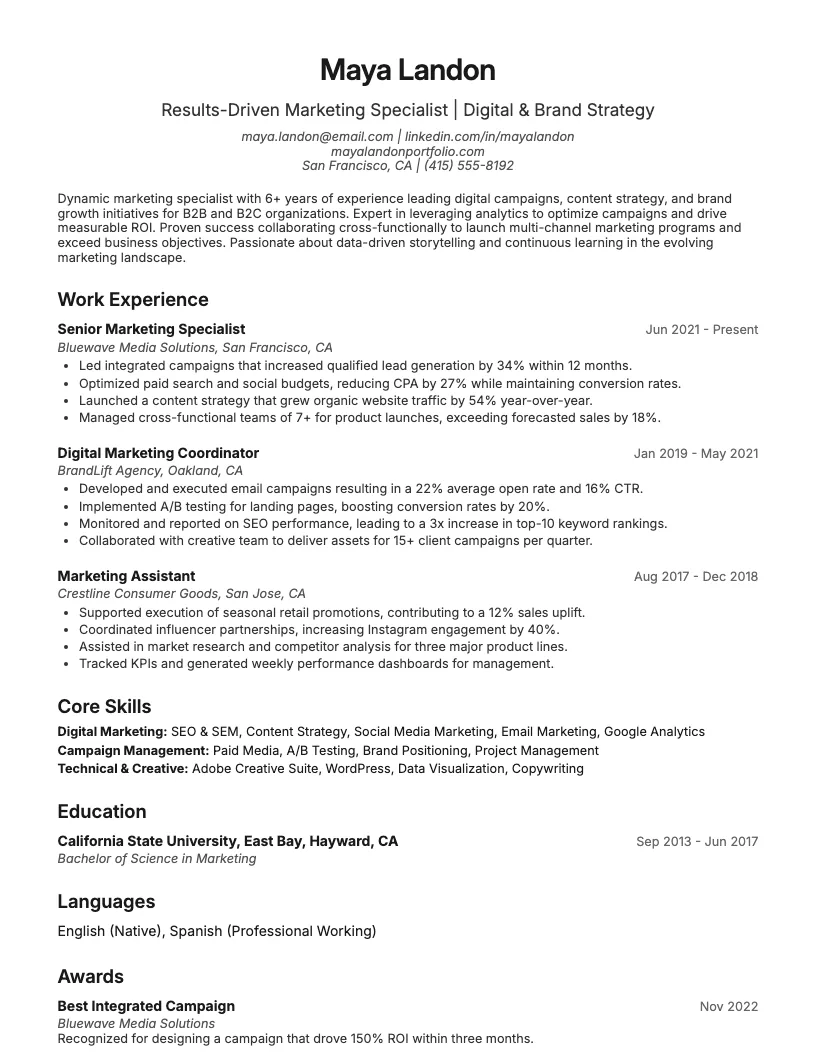
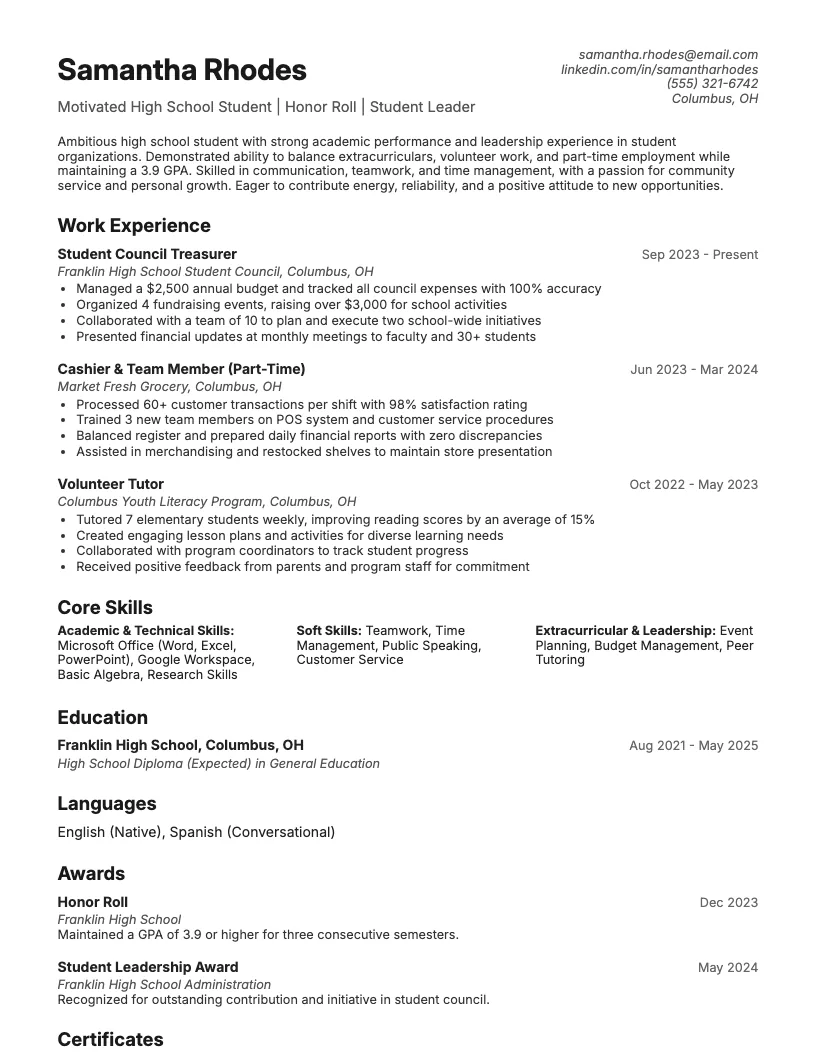
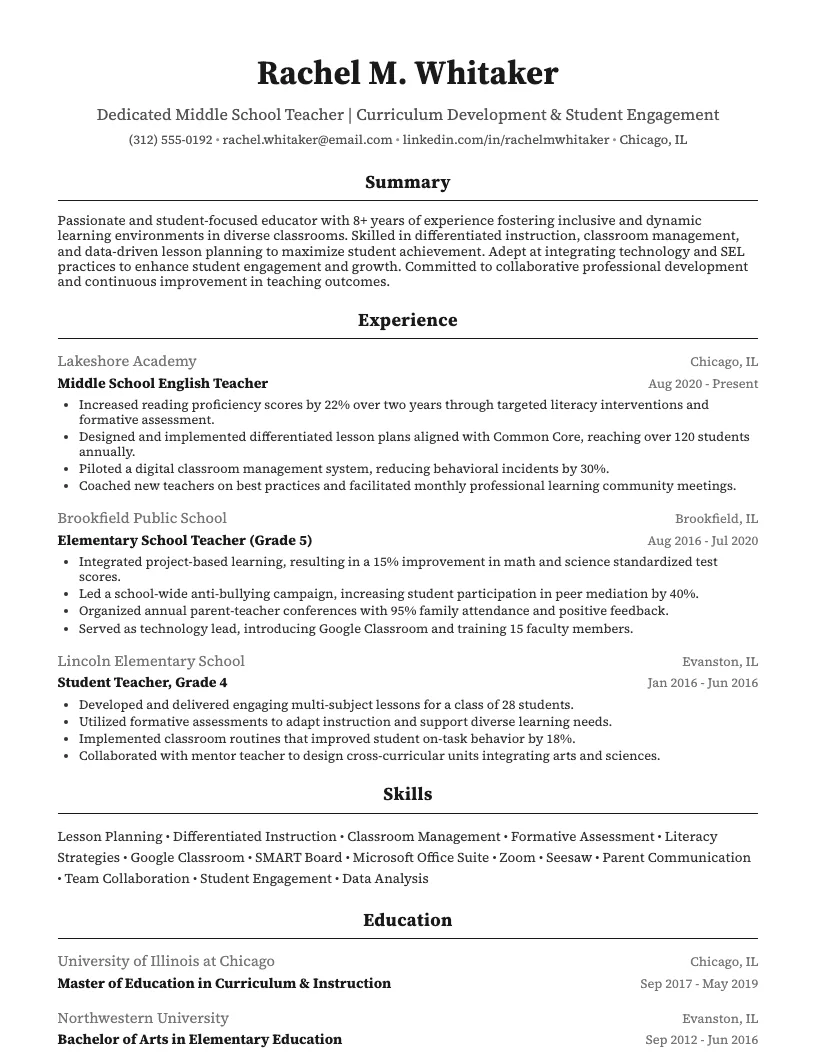
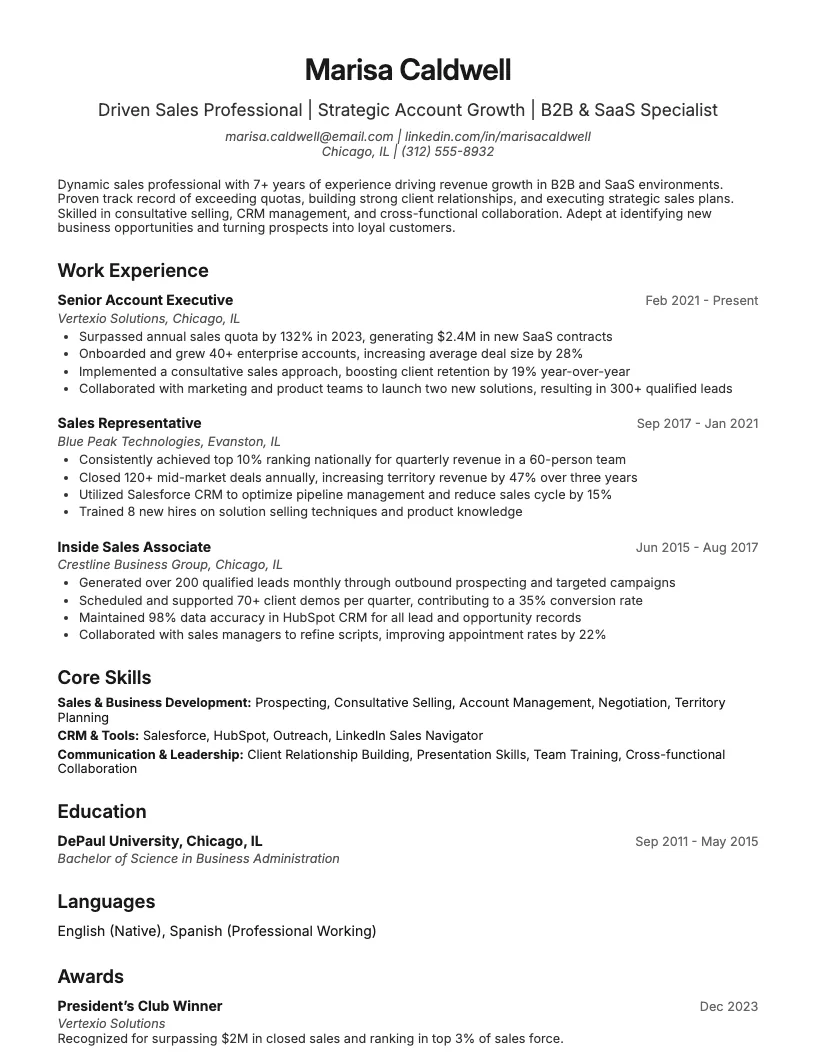
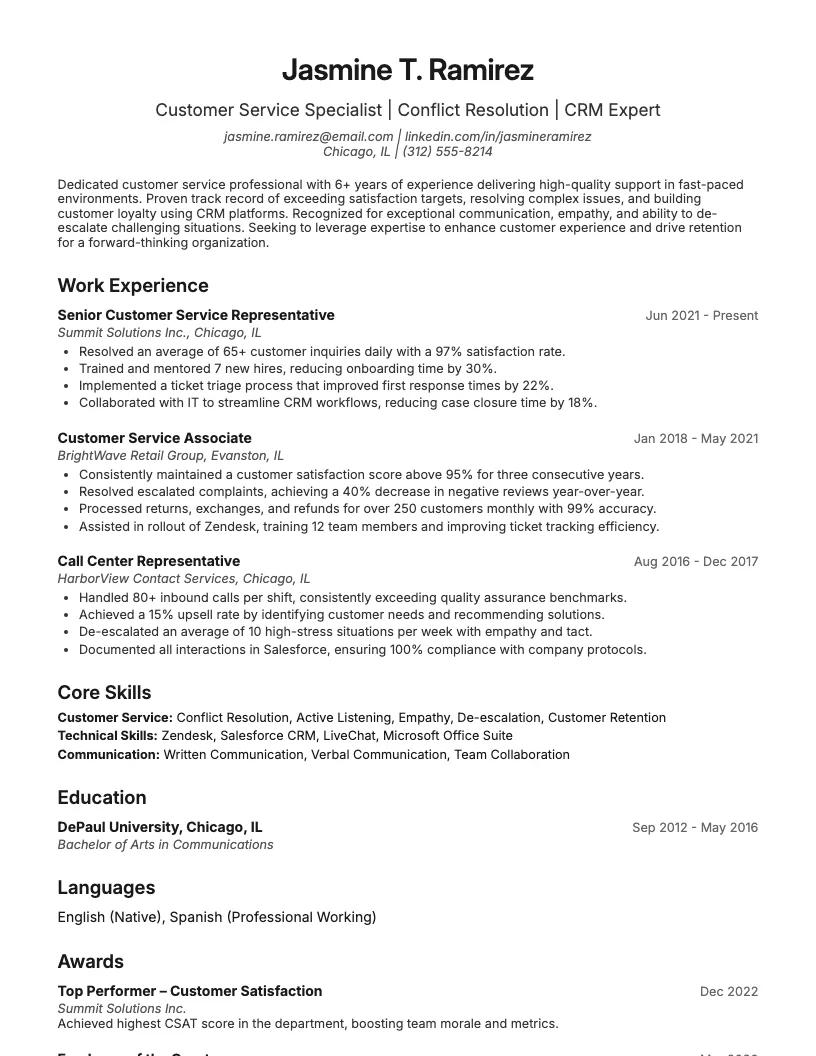
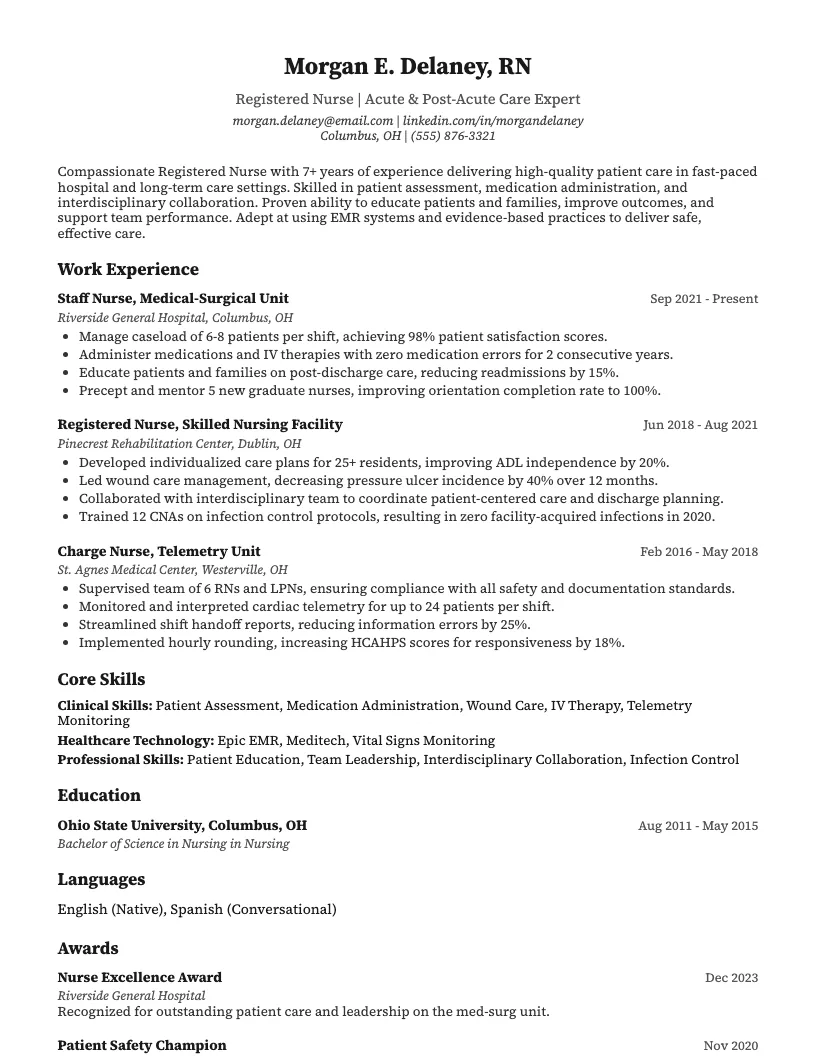
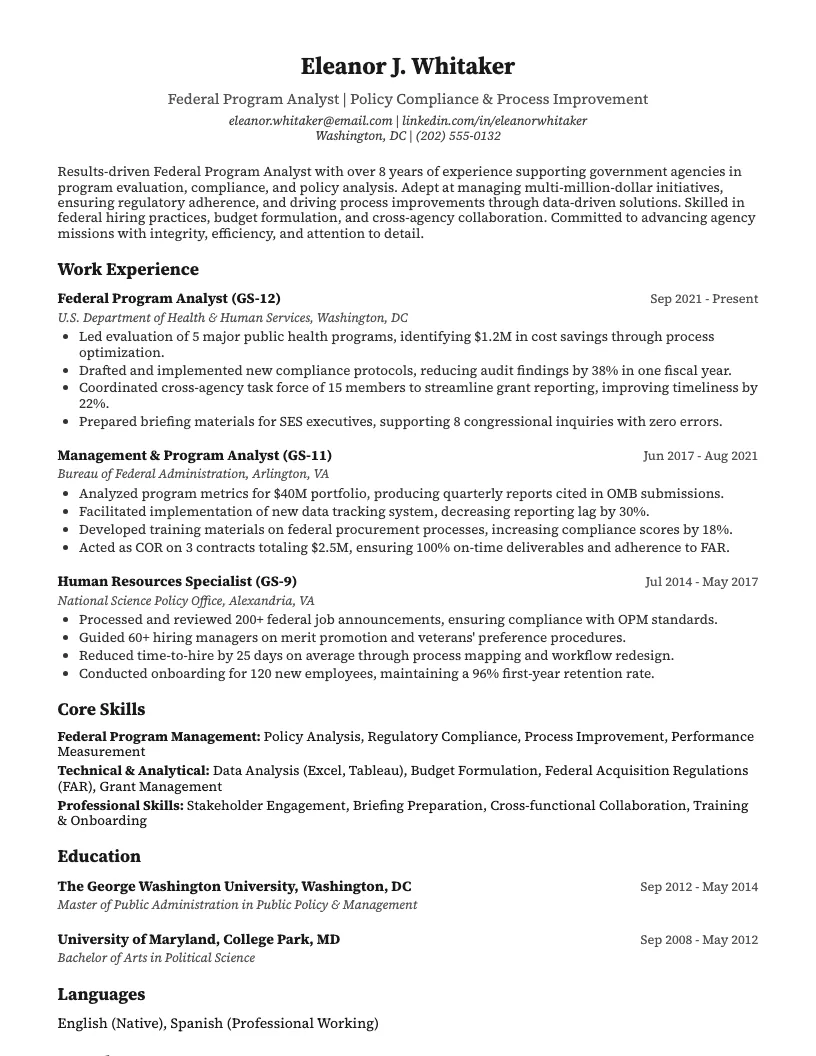
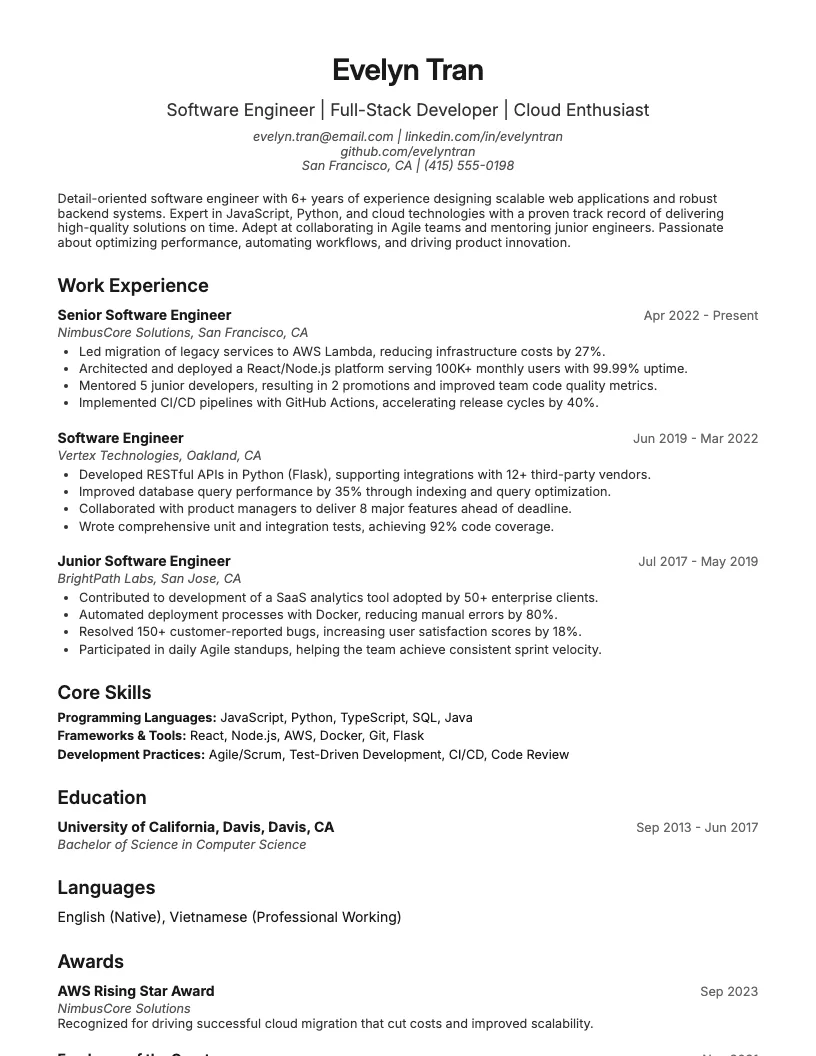
8 examplesStart from an example that already has them, and swap in your own.
Check your resume against the job you want
Scan your resume, see which skills and keywords the posting asks for that you are missing, and fix them before you apply.
Free to use • No credit card required