janitor skills for resume: 24 skills, from mop to OSHA rules
12 skills to name, 12 pieces of cleaning and safety equipment to know, where each goes on the resume, and how to pick the right ones for the job you want.


Written by Marcus Rodriguez
ATS Optimization Specialist & Career Coach
Updated August 2026
Reviewed by Dr. Priya Sharma
Is your resume ATS-friendly?
Drop your resume in and see which of these skills a scanner can actually read, and which ones the job you want is asking for that you have not listed.
PDF or DOCX. Max 2MB.
We never share your resume or use it to train a model.
In This Guide:
What skills should you put on a janitor resume?
What skills should you put on a janitor resume?

I've read enough janitor resumes to know the ones that get called back all do the same thing: they name the exact skills the building needs, not a vague "hardworking and reliable." Here's the full list, grouped the way a hiring manager actually reads them.
Cleaning and sanitation
Start with the basics, and name them like you've actually done them: sweeping, mopping, dusting, vacuuming, disinfecting high-touch surfaces. Add window cleaning and upholstery cleaning if you've done those too.
Vague "cleaning duties" tells a manager nothing - "daily disinfection of high-touch surfaces across a 40,000-square-foot facility" tells them everything.
Floor care
Floor work is its own skill, not a subset of cleaning. List waxing, stripping, buffing, and polishing by name, and say what kind of floors - tile, VCT, hardwood, carpet.
If you've run a carpet extractor or done pressure washing, that goes here too.
Restroom and kitchen sanitation
Restrooms and kitchens are where inspections happen, so employers care a lot about this one. Mention restocking supplies, disinfecting fixtures, and following health-code sanitation standards.
If you've worked in a facility with a kitchen - a school cafeteria, a hospital - say so; kitchen sanitation carries its own rules and naming it signals you already know them.
Trash removal and recycling
This sounds too basic to list, but it isn't - recycling management shows an employer you can sort and follow a system, not just haul bags to a dumpster. If you've handled recycling programs or managed waste for multiple buildings, that's worth a line of its own.
Basic maintenance and repair
Nine times out of ten, the janitors who get promoted are the ones who can also fix things. Light carpentry, painting, drywall patching, basic plumbing, minor electrical work - even if you've only done small jobs, list them.
Employers read this as "I don't need to call someone else for a stuck door hinge."
Supply ordering and inventory
If you've ever tracked what's running low and placed the order, that's inventory management - a real skill, not busywork. It tells an employer you can be trusted with a budget line, not just a mop.
Reliability and punctuality
I'll say something blunt: for janitorial work, reliability is often the single most important line on the resume. Buildings need to be clean before people show up, and a janitor who's late or unpredictable creates a real problem for whoever's in charge.
If you have a strong attendance record, say it plainly - "consistent attendance across three years, no missed shifts" beats "reliable" every time.
Working without supervision
A lot of this job happens early morning, late night, or alone in an empty building. Employers want to know you'll do the full job whether or not someone's watching.
If you've worked a shift with no direct supervisor on-site, say that outright - it answers the question before they ask it.
Attention to detail
This is the skill that separates "looks clean" from "is clean." Inspecting your own work, catching what a walk-through would miss, following a checklist without skipping steps - all of that is attention to detail, and it's worth its own line rather than folding into "cleaning."
Physical stamina
Don't be shy about this one. Lifting equipment, standing for a full shift, moving supplies between floors - if the posting mentions lifting a specific weight, match it in your own words rather than ignoring it.
Customer service with building occupants
You're not just cleaning a building, you're working around the people in it - tenants, students, patients, office staff. Being polite, responsive to complaints, and discreet about what you see on the job matters more than people expect.
Teamwork and following instructions
Most janitorial teams run on a schedule set by a supervisor, so showing you can take direction and coordinate with coworkers matters as much as working solo. Mention if you've trained a new hire or covered shifts for a teammate - that's teamwork with proof behind it.
Once you've got your list, the real work is matching it to the posting in front of you - pulling the exact words the employer used instead of guessing. ResumeJudge will scan your resume against that job description and tell you which of these skills the posting asks for that you haven't listed yet, so you're not relying on memory to catch the gap.
Which cleaning equipment and safety knowledge should you name?
Which cleaning equipment and safety knowledge should you name?
A skills list that just says "cleaning" tells a hiring manager nothing. Naming the equipment does - it proves you've actually run a shift, not just wiped a counter.
Floor buffers and auto-scrubbers
This is the equipment line I see missing most often, and it's the one that separates "janitor" from "custodial technician" in a hiring manager's head.
If you've run a floor buffer or an auto-scrubber, say so by name. Facilities managers scan for these two words specifically because they mean you can be handed a hard-floor building on day one without training.
Carpet extractors and wet/dry vacuums
Same logic applies here. Carpet extractors, industrial wet/dry vacuums - these show up on almost every equipment list I've reviewed, and for good reason: any office or school with carpeted common areas needs someone who already knows the machine.
Pressure washers and steam cleaners
If your work has included exterior walkways, loading docks, or deep restroom sanitation, pressure washers and steam cleaners belong on your list. These two get overlooked because they feel like "outdoor" or "occasional" tasks, but they're exactly the kind of specific, named skill that makes a resume stand out from the ten other applicants who just wrote "cleaning duties."
Ride-on sweepers
If you've operated a ride-on sweeper, put it down. It's a narrower skill than the others here - usually tied to warehouses, parking structures, or large industrial floors - but when a posting mentions a facility that size, this is one of the first words they're scanning for.
Chemical dilution and safe handling
Knowing how to dilute a chemical correctly, rather than just pour it, is a real skill and employers know it. I always tell people to phrase it as "chemical dilution and safe handling" rather than just "cleaning supplies" - it's specific, it's accurate, and it signals you won't damage a floor or a client's fixtures because you eyeballed a ratio.
Safety Data Sheets
Being able to read a Safety Data Sheet, sometimes still called an MSDS, is worth a line of its own. It tells an employer you understand what you're spraying, not just how to spray it.
OSHA safety rules
General OSHA knowledge is one of the most commonly requested lines across janitorial postings I've read, and it costs you nothing to include if it's true. Even a general familiarity with workplace safety standards is worth naming - it's the difference between "does the job" and "does the job without creating a liability."
Personal protective equipment
PPE use goes hand in hand with chemical handling and OSHA knowledge, and I'd group all three together on the resume if you can. Gloves, goggles, respirators when needed - say you know when each one applies, not just that you own them.
Bloodborne pathogen and cross-contamination control
This one matters more than people think, especially for anyone applying to a hospital or medical facility role. Knowing how to prevent cross-contamination between a restroom and a kitchen, or how to handle a bloodborne pathogen incident, is exactly the kind of line that gets a healthcare-adjacent posting to take a second look.
Lockout/tagout
Lockout/tagout comes up specifically when maintenance and janitorial duties overlap - if you've ever had to secure a machine before servicing it, this belongs on your resume. It's a smaller audience than the equipment skills above, but where it applies, it's a strong signal of trustworthiness with equipment.
Safe lifting
Proper lifting technique is worth naming here, alongside the other safety training you list. For how to state the physical demands of the job itself, see physical stamina.
Green cleaning products
More employers are asking for this than they used to. If you've worked with eco-friendly or green cleaning products, name it - client demand for sustainable cleaning is only growing, and it can be a genuine tiebreaker between two similar candidates.
Where do janitor skills go on the resume?
Where each part of a janitor resume goes
| Section | What goes there |
|---|---|
| The skills list | Floor care, sanitation, safety terms |
| Summary at the top | Years, specialty, one strength |
| Job bullet points | Skills proven with real numbers |
| Certifications and licenses | CDL, OSHA training, trade credentials |
| What to leave off | Anything not cleaning, maintenance, reliability |
Where you put a skill matters almost as much as having it. I've read enough of these to tell you the same five or six skills show up on every janitor resume example - the difference between the ones that get callbacks and the ones that don't is placement.
The skills list
This is where a hiring manager's eye lands first, so put your strongest, most job-relevant items here - floor care equipment, sanitation, safety knowledge.
Split it into two groups if you can: hands-on tasks (mopping, buffing, trash removal) and the traits that make you easy to manage (dependability, working without supervision). See what to put on a janitor resume for the full breakdown.
The summary at the top
Two or three sentences, right under your name. State your years of experience, your specialty (schools, offices, hospitals), and one thing you're known for - reliability, a clean inspection record, whatever's true.
If you're new to this, skip the summary and write a short objective instead. Nobody expects ten years of experience from someone who doesn't have it yet, so don't pretend.
Your job bullet points
Skills only prove themselves when they show up in your work history. A bullet that says "maintained cleanliness of 3 buildings, 40,000 sq ft, with zero safety incidents in two years" tells a manager more than any skills list ever could - I cover the exact phrasing to use in how to write janitor skills into your bullets.
This is also where ResumeJudge earns its keep: paste in the posting and it rewrites your bullets to match the wording the employer actually used, instead of you guessing at it.
Certifications and licenses
If you've got a CDL, an HVAC ticket, OSHA training, or a certified electrician credential, give it its own line near the top of the resume, not buried at the bottom. These are rare enough among janitor applicants that they instantly separate you from the pile.
No certifications? See do you need certifications to get a janitor job.
What to leave off
Cut anything that isn't cleaning, maintenance, or reliability. Hobbies, unrelated retail jobs from a decade ago, an objective that talks about your career goals instead of what you'll do for them - all of it just pushes the good stuff further down the page.
Keep this to one page if you can; nobody hiring a janitor is reading page two.
How do you write janitor skills into your experience bullets?
The mistake I see most often on a janitor resume is a duty list dressed up as bullet points. "Responsible for cleaning" tells a hiring manager nothing about how well you did the job.
Action verbs for janitorial work
Swap "did" and "responsible for" for words that show action: applied, inspected, removed, maintained, replaced, sanitized, monitored, swept, gathered, recorded. Nine times out of ten, the resume that gets a callback uses verbs like these instead of "helped with" or "in charge of."
Numbers to add: square footage, buildings, headcount
A number turns a duty into proof. Note the square footage you covered, how many buildings or floors, how many people used the space, or how many nights a week you worked solo.
"Maintained a 62,000-square-foot facility across nine buildings" says more in one line than three sentences of description.
Before and after: "did groundskeeping" vs "removed trash from 9 buildings nightly"
A job bullet, written two ways
Did groundskeeping
Removed trash from 9 buildings nightly
"Did groundskeeping" could mean anything. "Removed trash from 9 buildings nightly" tells the reader exactly what you owned and how big the job was.
Every bullet on this resume should pass that test: could a stranger picture the actual work?
Bullets for a school janitor
- Cleaned and sanitized 24 classrooms and 3 restrooms daily before student arrival
- Coordinated with facilities staff to complete repairs during summer break without disrupting the school year
- Set up and broke down furniture for 15+ school events per semester
Bullets for an office or night-shift cleaner
- Vacuumed, dusted, and disinfected 40,000 square feet of office space nightly with no supervision
- Restocked supply closets across 6 floors, cutting reorder requests by tracking usage weekly
- Reported and logged maintenance issues, closing out repairs before the morning shift arrived
Bullets for a hospital or medical facility
- Followed bloodborne pathogen protocols while sanitizing patient rooms between discharges
- Maintained infection-control standards across 3 hospital wings, passing every facility inspection
- Handled biohazard waste disposal in line with OSHA and facility safety rules
Bullets for a lead janitor or supervisor
- Trained and scheduled a crew of 5 janitorial staff across two shifts
- Coordinated with building managers to plan cleaning around facility needs and events
- Initiated a recycling program that cut waste disposal costs across the site
None of this works if the wording doesn't match what the posting actually asks for - ResumeJudge can take your resume and the job description and rewrite these bullets so the phrasing lines up with what that employer is scanning for, instead of you guessing at it. Once your bullets are solid, see how to pick the right skills for the job you're applying to.
Which skills do you pick for the job you're applying to?
Which skills to lead with, by building type
| Building type | Lead with |
|---|---|
| Schools | Reliability, working around people |
| Hospitals | Bloodborne pathogen, cross-contamination training |
| Offices and retail | Night-shift independence, equipment range |
You don't put every skill from the lists above on one resume. You pick the ones that match the job in front of you.
Pull the words straight from the posting
Open the job posting and read it like a checklist, not a paragraph.
If it says "floor care experience" or "OSHA compliance," those exact words need to show up somewhere on your resume. Many applicant tracking systems still reward the exact words from the posting, and I've seen plenty of good candidates get filtered out because they wrote "sanitation" when the posting said "disinfection."
ResumeJudge will scan the posting against your resume and tell you exactly which of its words are missing, so you're not guessing.
Skills for a first janitor job with no experience
With no work history, lean on reliability, working without supervision, and attention to detail. Add anything physical you've done before, even outside a job, since it backs up your stamina claims.
Skills when you're moving from another cleaning or trade job
Coming from housekeeping, food service, or a maintenance trade, you already have most of what a janitor posting wants. Translate your old title's duties into the equipment and safety language in the equipment section - a hotel housekeeper who ran an extractor already knows carpet care, they just haven't called it that on paper yet.
Skills for a supervisor or head custodian role
Once you're aiming at lead or supervisor titles, the resume needs to shift toward delegation, training, scheduling, and inventory management, not just the cleaning tasks themselves. I tell people at this stage to cut a third of their hands-on bullets to make room for team results - nine times out of ten, a resume that's still all mop-and-bucket language reads as entry-level no matter how many years are behind it.
Skills employers ask for by building type
Schools want visible reliability and work-around-people skills. Hospitals want bloodborne pathogen and cross-contamination training front and center.
Offices and retail want night-shift independence and general equipment range. Match the building type in the posting to the skills you lead with, and ResumeJudge can take that same posting and rewrite your bullets and skills list to match it section by section, instead of you doing it by hand.
Frequently Asked Questions
How many skills should a janitor resume list?
Aim for around 8 to 12 skills, mixing hands-on skills like floor care or equipment use with traits like reliability and teamwork. Too few looks thin, too many buries the ones that actually matter for the job. The right number depends on what the posting itself asks for, and ResumeJudge can check your list against a posting and show you exactly which skills you're missing.
Do you need certifications to get a janitor job?
No, janitors and building cleaners typically need no formal education, though some employers prefer a high school diploma, so certifications aren't necessary to get hired. Credentials like the IJCSA Master Certificate or ISSA membership can help for supervisory roles or if you want to specialize in green cleaning, but they're extras, not requirements. Reliability and hands-on experience carry more weight for entry-level openings.
What's the difference between a janitor and a custodian on a resume?
Janitor and custodian describe the same work - cleaning and maintaining a building - so the safest move is to use whichever title the job posting uses. Custodian shows up more in schools and public institutions, while janitor is used more broadly in offices, retail, and commercial buildings. Matching the posting's own wording matters more than picking one term over the other.
Should you list physical ability, like lifting 40 pounds?
Yes, list physical requirements like lifting 40 pounds if the job calls for it, since employers want to know upfront that you can handle the physical demands. Standing for long shifts, climbing ladders, and operating equipment are worth mentioning too. It gives hiring managers a realistic read on whether you're fit for the day-to-day work before they even call you in.
Do you need an education section for a janitor resume?
No, an education section isn't required for a janitor resume, especially once you have relevant work experience. If you include one, keep it short - school name, location, and years attended - since a high school diploma covers most entry-level roles. It's only worth expanding if you hold a certification tied to cleaning, maintenance, or facility management.
Will a janitor resume go through an applicant tracking system?
Yes, even janitor postings are commonly screened by an applicant tracking system before a person reads them. See "Which skills do you pick for the job you're applying to?" above for how to pull the posting's own wording into your resume. ResumeJudge scans your resume against the job description and rewrites the wording to match it, so you're not left guessing which terms the system is looking for.
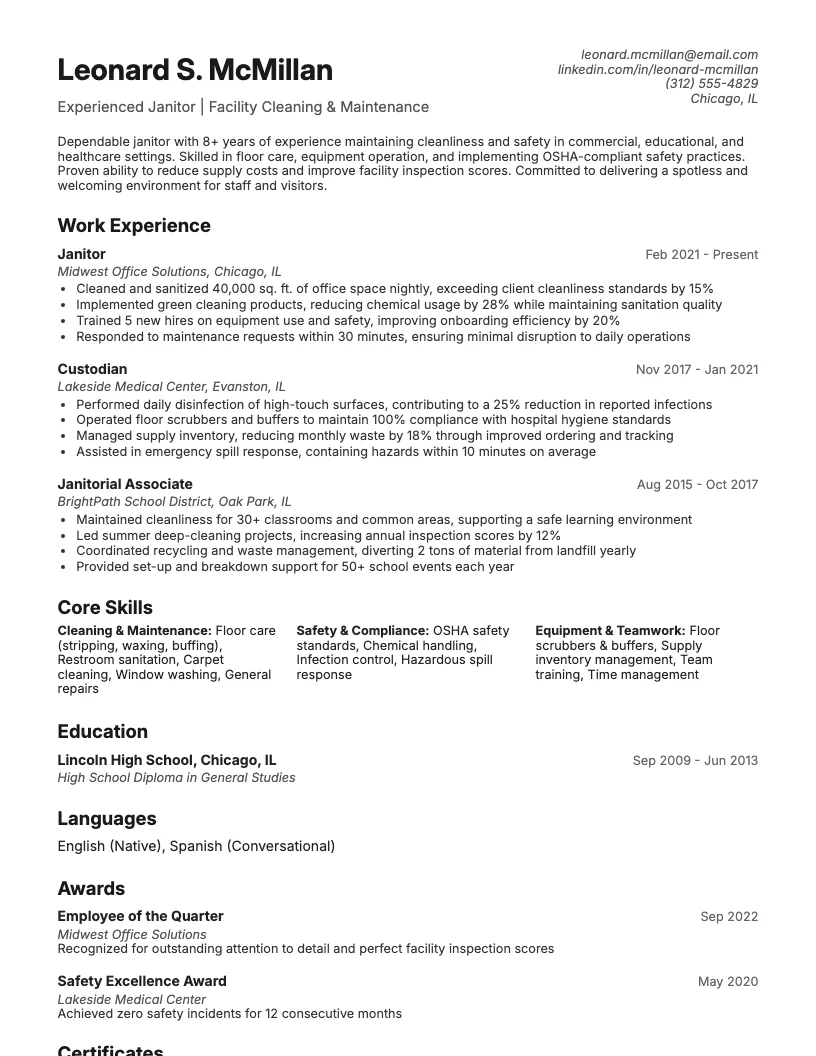
See these skills on a real resume
8 examplesStart from an example that already has them, and swap in your own.
Check your resume against the job you want
Scan your resume, see which skills and keywords the posting asks for that you are missing, and fix them before you apply.
Free to use • No credit card required