Food Service Resume Skills: 8 to List, Matched to 8 Job Titles
The 8 skills to put on a food service resume, matched to 8 job titles, how to phrase them as bullets, beat the ATS scan, and what to list with zero experience.


Written by Sarah Chen
Senior Career Strategist & Resume Expert
Updated August 2026
Reviewed by Marcus Rodriguez
Is your resume ATS-friendly?
Drop your resume in and see which of these skills a scanner can actually read, and which ones the job you want is asking for that you have not listed.
PDF or DOCX. Max 2MB.
We never share your resume or use it to train a model.
In This Guide:
What skills should you put on a food service resume?
What skills should you put on a food service resume?

I've read enough of these to tell in five seconds whether someone's actually worked a shift. The resumes that stand out don't list "hard worker" and "team player" - they name the exact things a manager cares about.
Here's what actually belongs.
Customer service
This is the job, not a bullet point. Whether you're taking an order, resetting a table, or handling a complaint, you're the reason someone comes back.
Say it in terms of what you did: greeted guests, upsold specials, resolved a complaint on the spot. "Friendly" means nothing on its own.
Food safety and hygiene
Every manager I've talked to checks for this first, because it's the one thing that can shut a place down. Name what you actually followed - proper food handling, sanitizing procedures, temperature checks.
If you've got a ServSafe card or a food handler certification, put it here, and check the certifications section for where else it belongs.
Point-of-sale and cash handling
Running a register, closing out a shift, handling cash and card transactions accurately - this is a hard skill, not a soft one, and it's worth naming the system if you know one (Toast, Square, Micros).
Speed under pressure
Food service runs on timing. Orders have to go out fast, both because guests are waiting and because food quality drops the longer it sits.
The mistake I see most often: people write "works well under pressure" and stop there. Better is naming the pressure - a full dining room, a lunch rush, a solo shift - because that's what a hiring manager is picturing when they read it.
Order accuracy
Getting the order right the first time, remembering modifications, catching a mistake before it leaves the kitchen. This one's easy to undersell because it sounds basic, but it's a named hard skill on every serious job posting.
Teamwork with kitchen and floor staff
Nothing in food service happens alone. Servers pass information to the kitchen, cooks talk to each other mid-rush, hosts coordinate seating with everyone else on the floor.
If you've cross-trained across stations or covered for a coworker, that's a stronger line than "team player" every time.
Cleaning and closing procedures
Closing duties, keeping a station or dining area up to code, restocking for the next shift - this is organization work, and it's worth its own line, not a footnote under "other duties."
Stock and inventory help
Counting inventory, flagging low stock, helping with orders - even a small role here shows a manager you can be trusted with more than your own station.
Once you've got a full list drafted, running it against the actual posting is where ResumeJudge earns its keep - it tells you which of these the job is asking for by name and which ones you're missing, before you send anything.
What is the difference between hard and soft food service skills?
Hard skills vs soft skills
| Hard skills | Soft skills | |
|---|---|---|
| What they are | Provable: a tool, system, or certification | How you handle the shift itself |
| Examples | Food safety, POS systems, cash handling | Friendliness, patience, adaptability |
| Share of your list | About two-thirds | About one-third |
| Matched by the ATS | Yes, if named exactly | Rarely matched by name |
Nine times out of ten, the resumes that stall out are the ones with only one kind of skill on them. You need both, and they do different jobs.
Hard skills: food handling, equipment, POS, cash, allergen knowledge
Hard skills are the ones you can prove: food safety knowledge, running a POS system, cash handling, operating kitchen equipment, knowing allergen protocol. These are what a hiring manager checks off against the job posting first.
Soft skills: friendliness, patience, adaptability, communication
Soft skills are how you handle the shift itself: staying friendly during a rush, patience with a difficult table, adapting when the kitchen falls behind, communicating clearly with the line. Nobody hires you on these alone, but a resume without them reads cold.
How many of each to list
I tell people to aim for something like two-thirds hard skills, one-third soft. If you've got eight or nine skills total, six or so should be things you can name a tool, a system, or a certification for.
Why a list of only soft skills gets ignored
I've read hundreds of these, and "team player, hard worker, good communicator" with nothing else tells a manager nothing they can act on. It also won't match the keywords an applicant tracking system is scanning for, since those systems look for named tools and certifications, not adjectives.
Run your list against the actual posting with ResumeJudge and it'll flag exactly which hard skills you're missing, so you're not guessing.
Which skills matter for your specific food service job?
The eight skills above explain what each one is and how to word it. This section does not repeat them - it only says which ones to lead with for the job title on the posting.
Server and front of house
Lead with guest-facing skills: order accuracy, upselling, handling multiple tables at once, and staying calm when the dining room is slammed.
Prep cook and line cook
This is a back-of-house resume, so speed, consistency, and food safety carry it. Mention knife skills, tracking cook times across multiple dishes so they land on the pass together, and any allergen or sanitation training.
Guest contact isn't the point here - timing and cleanliness are.
Dishwasher
I've seen a lot of people skip skills entirely on a dishwasher resume because the job feels too basic to write about. Don't. Sanitation standards, keeping pace during a rush, and rotating stock or supplies are real skills a kitchen manager screens for.
Host
Hosting is the first impression a guest gets, so put reservation systems, seating strategy during a wait, and conflict resolution front and center. Explaining a 40-minute wait to an unhappy party and keeping them there is a skill worth a bullet point.
Barista
Equipment knowledge (espresso machines, POS systems) and speed matter, but so does memory - regulars' orders, drink customization, upselling a pastry. If the posting names a specific POS or roasting brand, use that exact term.
Fast food crew member
Don't undersell this one. Multitasking across register, drive-thru, and food prep in the same shift is real, and nine times out of ten it beats a slower single-station job on a resume.
Speed and order accuracy under volume are the skills to name.
Catering and events staff
Large-function experience is the differentiator: setup and breakdown, coordinating with a team on a timeline, serving hundreds in a single seating window. If you've worked a wedding or a corporate event, say the size of it.
Food service supervisor or manager
Once you're managing, the resume shifts toward scheduling, training new hires, inventory oversight, and handling guest complaints that a server couldn't resolve alone. If you're unsure which of these to lead with for a specific posting, running your resume against the job description tells you exactly what's missing before you submit it.
Where do you put food service skills on your resume?
Where do you put food service skills on your resume?
Same skill, four different spots, and most resumes only use one of them.
The skills section
This is your list - short phrases like "cash handling" or "food safety compliance," matched to the words the posting uses.
It's the part a hiring manager scans in five seconds, and it's what most applicant tracking systems read first, so match the posting's exact terms here rather than your own synonyms.
The summary at the top
Two or three sentences right under your name. Name your role, your years, and one or two strengths - something like "food service professional with 3 years in fast-paced restaurants, strong on customer service and food safety."
I've seen hundreds of these skipped entirely, which wastes the one spot a recruiter reads before deciding whether to keep going.
Inside your experience bullets
This is where the skill has to prove itself.
I'll show you exactly how to build these in how you write a food service skill as a bullet point. If you'd rather not build that list line by line, ResumeJudge will rewrite your bullets against a specific posting, pulling in the skills and wording that job actually asks for.
The certifications section
Certifications get their own line, not buried in your skills list - the ones worth naming, and how to write them, are in certification names to spell out.
A named certification is one of the fastest things a manager's eye catches, so give it a heading of its own even if it's just one or two lines long.
What a filled-in skills section looks like
a skills section entry
Hardworking, team player, good with people
Customer service - Food safety (ServSafe certified) - POS systems (Toast, Square) - Cash handling
Something like: Customer service · Food safety (ServSafe certified) · POS systems (Toast, Square) · Cash handling · Order accuracy · Team coordination during rush.
Eight to twelve is plenty - more than that starts to look like padding, not proof. Not sure your list matches what a specific posting wants?
ResumeJudge checks your resume against the job description and flags exactly what's missing before you hit apply.
How do you write a food service skill as a bullet point?
How do you write a food service skill as a bullet point?
Turn a duty into a result
Most food service resumes I look at just list the job description. "Served customers, handled cash, cleaned the station."
None of that tells anyone if you were good at it.
The fix is simple: say what happened because you did the work. Not "handled cash transactions" but "handled cash transactions accurately during dinner rush with zero drawer shortages."
Same duty, but now it's proof.
Action verbs that fit food service work
Swap "responsible for" and "duties included" for verbs that show you actually did something: served, prepared, coordinated, maintained, trained, resolved, expedited, restocked.
"Responsible for serving food" reads like a job posting. "Served 40+ tables per shift during peak hours" reads like a person who was there.
Numbers you can actually get: covers, ticket times, checks, shift size
You don't need corporate metrics. You already have numbers from the job itself: covers per shift, average ticket time, check size, how many people were on your shift, how many tables or orders you handled at once.
Pull one into almost every bullet.
Weak bullet vs strong bullet, side by side
an experience bullet
Worked shifts and served customers.
Served guests across 8-table section during high-volume weekend shifts, keeping ticket times under 12 minutes.
Weak: "Worked shifts and served customers." Strong: "Served guests across 8-table section during high-volume weekend shifts, keeping ticket times under 12 minutes."
Weak: "Followed food safety rules." Strong: "Maintained food safety standards during 100+ cover dinner service, passing every health inspection."
If you're not sure which version you've written, ResumeJudge will read your resume against the posting and rewrite weak bullets like these into strong ones for you.
Which food service keywords get you past the ATS?
Which food service keywords get you past the ATS?
Most food service resumes get scanned by software before a person ever looks at them. If the words on your resume don't match the words in the posting, you get filtered out before you get a chance.
Keywords lifted straight from job postings
Open the posting and read it like a checklist. If it says "cash handling," write "cash handling" - not "handled money."
If it says "food prep," use that phrase, not "cooking duties."
I've seen good candidates get skipped because they described the same job in different words than the one hiring for it.
Certification names to spell out: ServSafe, food handler card, TIPS
Spell these out by name, never as a vague line like "certified in food safety." ServSafe Food Handler is a common one to see, and certificates expire, so name the one you actually hold and keep it current.
If the job involves alcohol, name the certification you hold - ServSafe Alcohol, TIPS, or whichever your state requires. These names are exact-match keywords, and the ATS looks for the exact string.
Equipment and system names worth listing
Name the actual POS system you've used - Toast, Square, Aloha - instead of just "point of sale." Same with equipment: fryer, flat-top, espresso machine, dish machine.
Specific nouns like these are exactly what a scanner is built to catch.
How to match the posting's wording without stuffing
Match wording, don't repeat it. Work each term into a real bullet from your experience, once, where it's true.
Checking your resume against the actual posting by hand is slow and easy to get wrong - ResumeJudge scans both and tells you exactly which of the posting's terms are missing before you hit submit.
What skills do you list with no food service experience?
What skills do you list with no food service experience?
No shifts on your resume yet? Fine.
You still have skills that count - you just have to pull them from somewhere other than a job title.
Skills from school, sports, or volunteering that count
A team captain has handled pressure and coordinated people under a deadline - that's teamwork with kitchen and floor staff in different clothes.
Ran a bake sale, worked a school fundraiser, volunteered at a food bank? Say so.
Reliability and working fast in a crowd translate straight into this industry.
Skills from retail or any customer-facing job
If you've ever rung up a customer, folded clothes during a rush, or answered a phone at a desk, you already have customer service and point-of-sale and cash handling experience. Name the register system you used and how you handled a line out the door.
Certifications you can get in a day
An employer can see the issue date on a food handler card or ServSafe certificate, so don't list one from an old job if it's already expired. A lapsed certification you forgot to renew reads worse than having none at all.
A food handler card or ServSafe certificate can usually be earned online in an afternoon, and it's the single fastest way to look serious with zero work history. Get one before you apply, not after - it answers the experience gap before a hiring manager has to ask.
What to write where the experience section would go
Rename it "Relevant Experience" and list the school project, the volunteer shift, the retail job - anything with dates and a duty. One page is plenty at this stage.
If you're not sure the wording lands right, ResumeJudge will check your draft against a real posting and tell you exactly which of these skills to move up front.
Frequently Asked Questions
How many skills should I list on a food service resume?
List 8 to 12 skills, mixing hands-on ones like food prep or POS systems with people skills like teamwork and handling complaints. Pull the exact wording from the job posting you're applying to rather than a generic list, since employers scan for their own terms. ResumeJudge will check your list against a specific posting and tell you which of its required skills are missing.
Do I need a food handler certification before I apply?
No, most food service jobs will train and certify you after they hire you, so you don't need one to apply. If you already have a ServSafe Food Handler card or similar, it's worth listing since it shows you're ready to start faster and it can be an edge over other candidates. Some roles that involve serving alcohol do require certification first, so check the posting.
Should my food service resume be one page?
Yes, one page is right for almost every food service resume, especially if you have under 10 years of experience. Keep it to your most recent and relevant jobs, and cut anything that doesn't show skills the employer is asking for.
Is fast food experience worth putting on a resume?
Yes, fast food experience counts and should go on your resume. The work itself teaches skills employers pay for elsewhere: working fast under pressure, handling cash and a POS system, and dealing with customers face to face. Describe the duties in those terms instead of just naming the employer, since the skills are what get you the next job, not the logo.
Do I list skills if I only worked one summer?
Yes, list the skills even from a single summer job. A short stretch is still enough time to learn real, transferable skills like following food safety steps, working a register, or staying calm during a rush, and those are worth naming on their own even without years behind them.
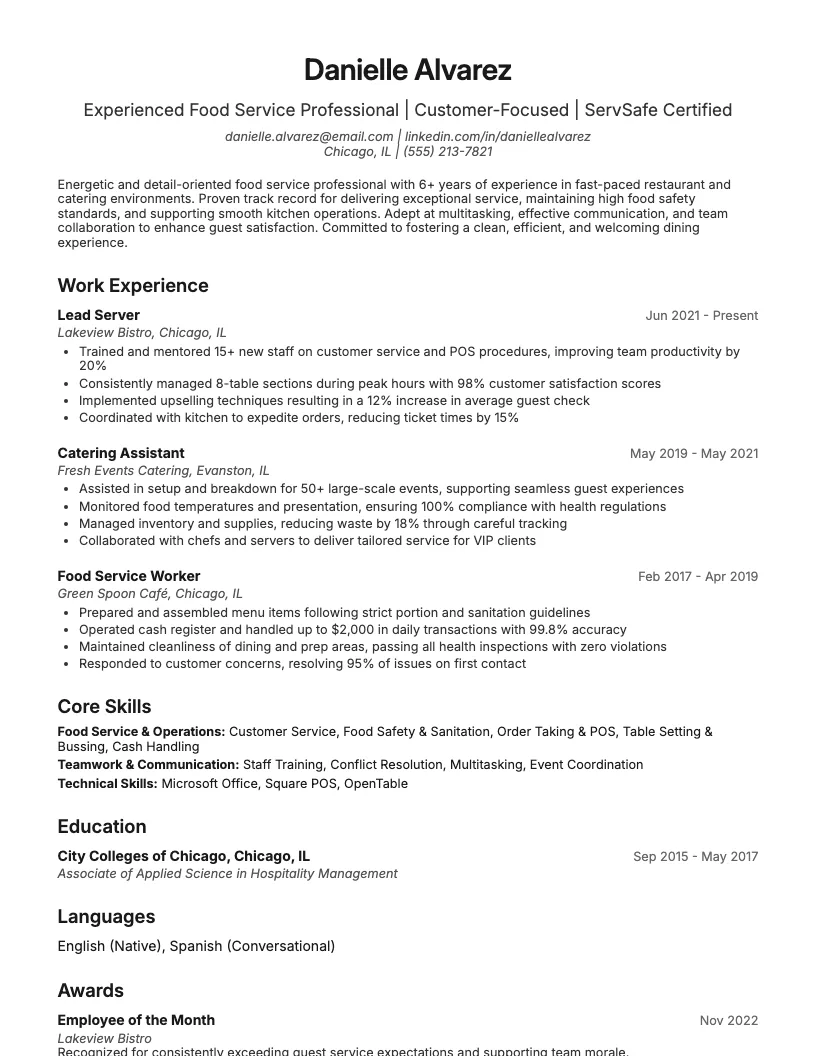
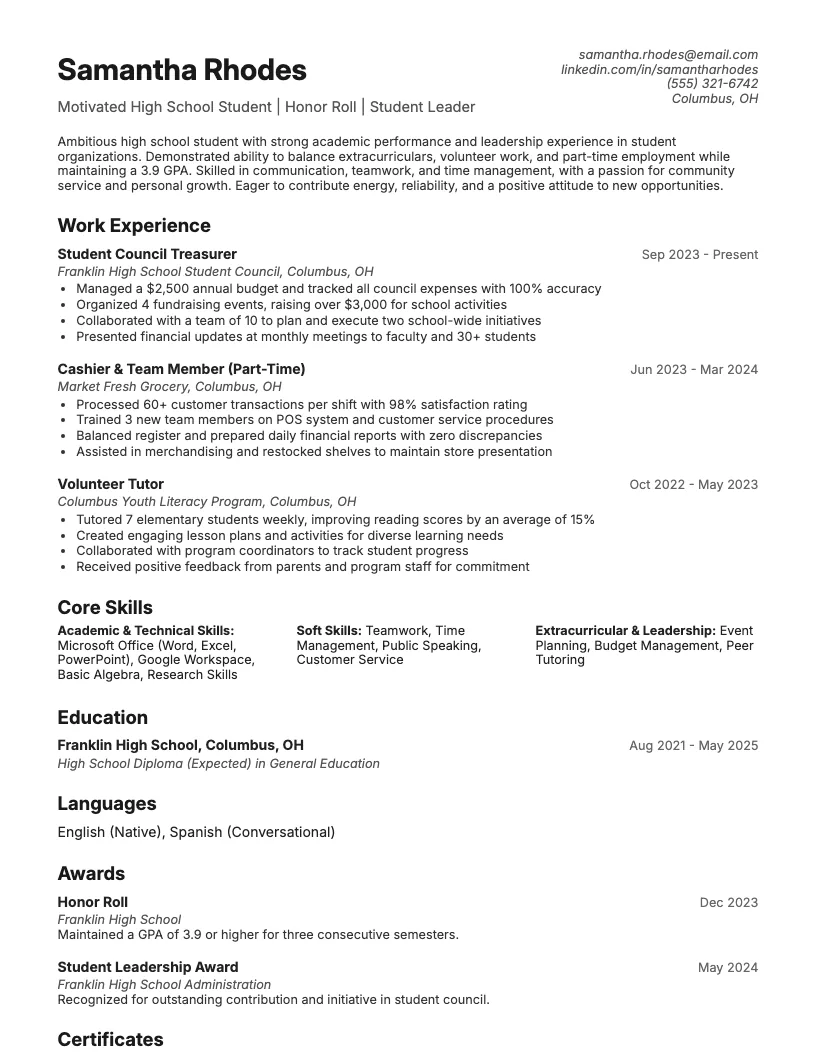
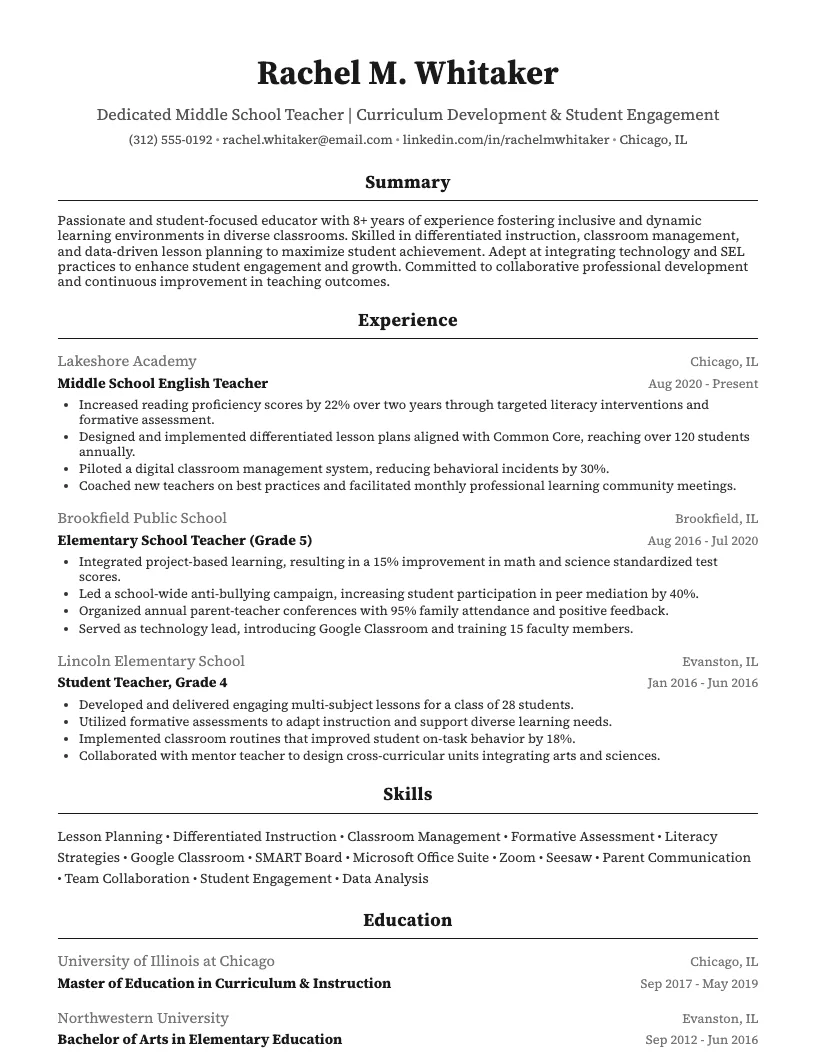
See these skills on a real resume
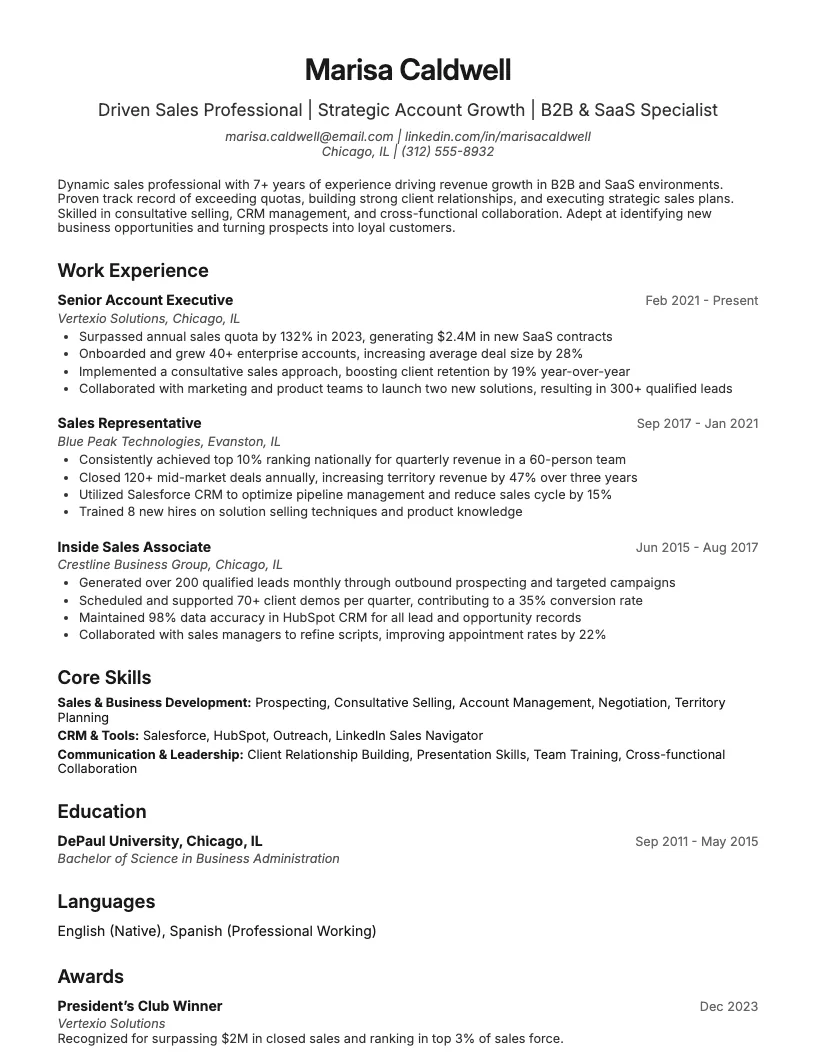
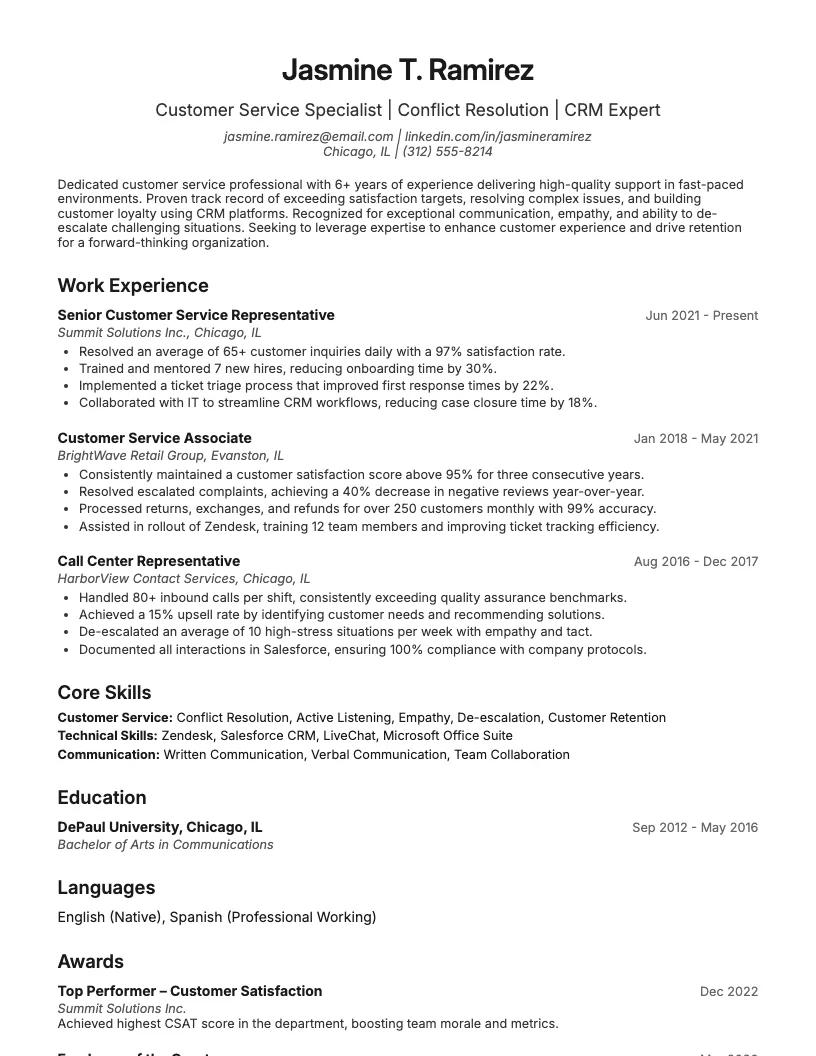
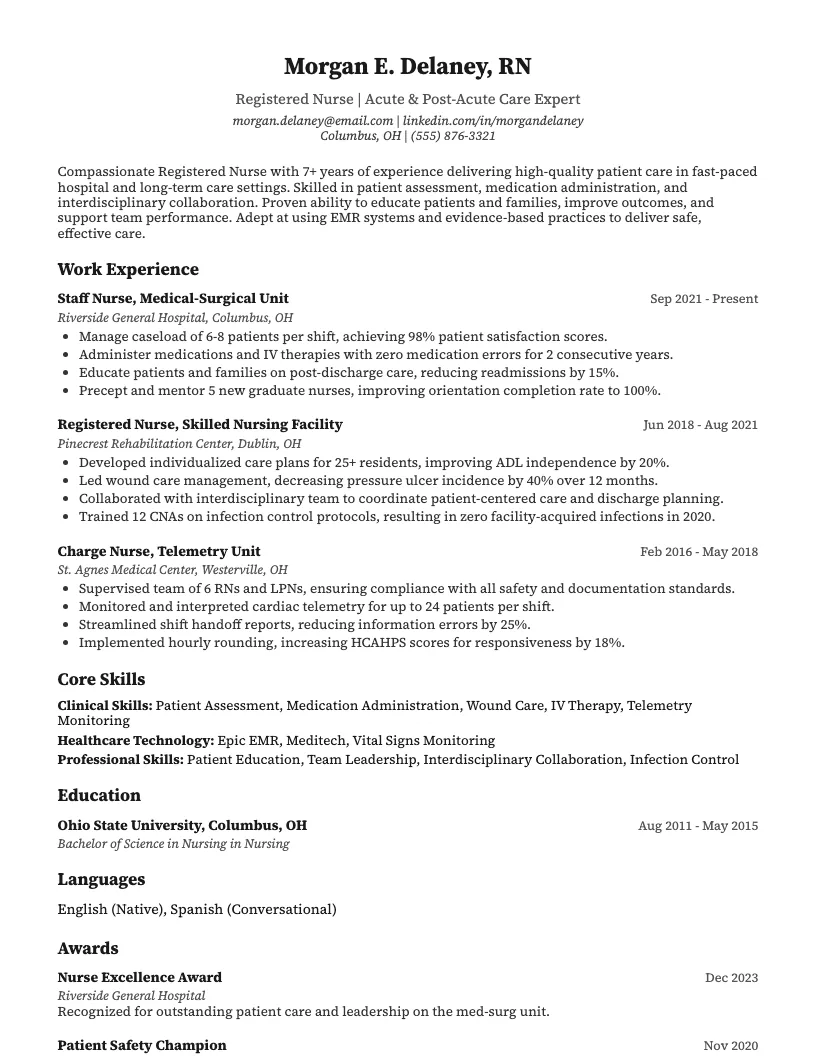
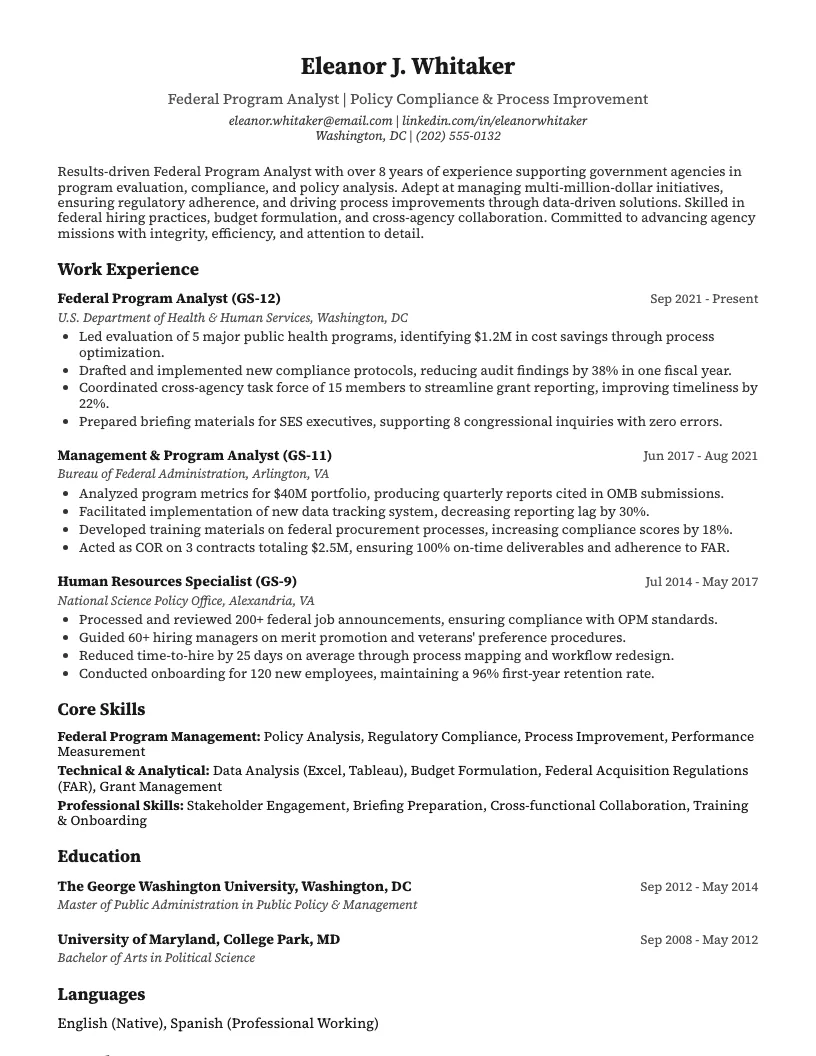
8 examplesStart from an example that already has them, and swap in your own.
Check your resume against the job you want
Scan your resume, see which skills and keywords the posting asks for that you are missing, and fix them before you apply.
Free to use • No credit card required