Business Development Resume Keywords: The Right 15-25 to Use
Which of the 15-25 business development resume keywords to use, how many per section (3-5 in your summary, 10-15 in skills), and the 80% match score to aim for.


Written by Dr. Priya Sharma
Career Development Expert & Resume Analyst
Updated August 2026
Reviewed by Sarah Chen
Is your resume ATS-friendly?
Drop your resume in and see which of these skills a scanner can actually read, and which ones the job you want is asking for that you have not listed.
PDF or DOCX. Max 2MB.
We never share your resume or use it to train a model.
In This Guide:
What are the business development resume keywords employers search for?
Business development postings pack in more jargon than almost any other sales role - partnerships, pipeline, GTM, ARR - and an ATS is matching your resume against that exact language. I've read hundreds of these, and the resumes that get filtered out almost always used a close synonym instead of the actual term.
"Built relationships" instead of "strategic partnerships." "Grew accounts" instead of "revenue growth."
Close enough for a person, not close enough for a scanner.
Partnership and alliance words
If the job touches partnerships at all, expect it to name the type: strategic partnerships, channel partnerships, technology partnerships, reseller agreements, joint ventures. Below that sit the verbs of actually running one - alliance management, partner onboarding, partner enablement, co-selling.
And below that, the paperwork words: partner recruitment, MOU and MSA agreements, revenue sharing. A BDM role lives or dies on partnership language, so don't just say you "worked with partners" - name the kind of partnership and what you did to it.
B2B sales and pipeline words
This is the engine-room vocabulary: lead generation, pipeline development, prospecting, cold outreach, territory management, account-based selling. Pair it with deal language - enterprise sales, mid-market, multi-year deals, recurring revenue - and process language - discovery calls, needs assessment, proposal development, deal closing.
If you've done the job, you've touched every one of these at some point; the work is remembering to write it down.
Market strategy and expansion words
Go-to-market strategy, market entry, product launch, channel strategy - these show you think beyond your own quota. Territory planning and geographic expansion signal you've helped a company grow into new ground, not just work the ground it already had.
Competitive positioning, market research, and win/loss analysis round it out. If your résumé only lists deals closed and skips this category entirely, it reads as a sales rep, not a business developer.
Revenue numbers and sales metrics
ARR, MRR, pipeline value, deal size, quota attainment, win rate, conversion rate, sales cycle length. For SaaS roles specifically, add ACV, CAC, and net revenue retention.
Nine times out of ten, the resume that gets the callback is the one with a number sitting right next to the word - "grew pipeline value 35%" beats "responsible for pipeline growth" every time. See which numbers to put next to each keyword for how to pick the right one for your situation.
People words: negotiation, relationships, leadership
Relationship building, C-suite engagement, stakeholder management, negotiation, deal structuring, objection handling, cross-functional collaboration, sales enablement. These are the words that get cut first when people run out of space, and it's a mistake - a posting that lists "negotiation" and "stakeholder management" is checking for them specifically, not assuming you have them because you closed deals.
CRM systems and sales tools by name
Name the actual product, not the category. Salesforce, HubSpot CRM, Pipedrive, Microsoft Dynamics, Zoho CRM.
Then the tools around the CRM: LinkedIn Sales Navigator, ZoomInfo, Outreach.io, SalesLoft, Apollo.io. Saying "CRM experience" when the posting says "Salesforce" is one of the most common near-misses I see, and it's an easy fix.
ResumeJudge will pull the exact tool names out of a job posting and check them against your resume, so you're not guessing which one matters.
Named sales methods: MEDDIC, BANT, Challenger, SPIN
Senior and enterprise roles often name a specific framework: MEDDIC, MEDDPICC, BANT, CHAMP, Challenger Sale, SPIN Selling, Sandler, account-based selling. If you were trained in one and actually used it, name it - don't fold it into "consultative selling" and hope it counts.
If you weren't trained in a named method, don't claim one; see which sales methods to skip until you've done them.
Which keywords should you pick from the job posting?
Which keywords should you pick from the job posting?

Every business development posting uses its own words for the same job. One company wants "strategic partnerships," another wants "channel development," a third just says "biz dev."
Copy theirs.
Step 1: Copy the posting and mark every skill it names
Paste the whole posting into a doc and underline every skill, tool, and qualification it names - not just the bullet list under "requirements." I've seen postings bury the real ask in a single line of the intro paragraph, like "experience negotiating enterprise contracts," while the requirements section stays generic.
Step 2: Count which terms it repeats
Whatever shows up more than once is the priority. A posting that says "strategic partnerships" five times and "Salesforce" three times is telling you exactly what the hiring manager cares about - put those two near the top of your skills section and work them into your summary.
Step 3: Cut anything you have not actually done
This is where I see people talk themselves into trouble. You found the posting's five favorite words, so you add all five - including "ARR growth" when you've never touched a SaaS deal.
Don't inflate a pipeline number or claim a CRM you've opened twice. If you get the interview, someone will ask you to walk through it, and a keyword you can't back up costs you more than one you left off.
Step 4: Write the term the way the posting writes it
If they wrote "business development representative," don't put "BDR" and expect credit for the same thing. Match their exact phrasing first, then add the spelled-out or abbreviated version alongside it so you catch both.
Step 5: Put the job title 'Business Development' on the resume
If your actual title was something else - "Partnerships Associate," "Sales Coordinator" - add "Business Development" somewhere on the page anyway, in your summary or a parenthetical next to the title. Screeners often search on the job title itself, and a resume that never says the words "business development" can get skipped even when the experience is a perfect match.
Once you've built this list by hand, run it against the posting again - ResumeJudge will scan both and show you anything from the posting you still missed, so you're not relying on your own read of a five-hundred-word job ad.
How many keywords should you put on a business development resume?
Where keyword counts go on the resume
| Location | How many | Notes |
|---|---|---|
| Whole resume | 15-25 | spread across summary, skills, bullets |
| Summary | 3-5 | years, deal type, one methodology |
| Skills list | 10-15 | grouped: sales, tools, methods |
15 to 25 across the whole resume
Here's the number I give people who ask: 15 to 25 keywords, spread across the whole page.
Not stuffed into one block. Spread through the summary, the skills list, and the bullets underneath each job.
That range covers the terms a business development posting usually repeats - partnership, pipeline, quota, CRM name, maybe a named sales method. Go much past 25 and you're not describing your experience anymore, you're padding it.
3 to 5 in the summary
Your summary gets 3 to 5. That's it.
A good one might name your years of experience, the size of pipeline or revenue you've handled, one methodology, and the type of deal you close - enterprise, channel, SaaS. Four keywords, one paragraph, done.
I see people try to cram ten keywords into three sentences up top and it reads like a list, not a person.
10 to 15 in the skills list
The skills section is where the bulk of your keywords live - 10 to 15 feels right for most business development resumes.
Group them instead of dumping them in one long row: sales terms together, CRM and tools together, methodology together. A recruiter scanning for "Salesforce" or "MEDDIC" finds it faster that way, and so does the scanner reading the page before a person does.
If you're not sure which of those actually belong on your resume, that's what the keyword list above is for.
Once you've got a draft list, running it against the actual posting is worth doing before you send anything - ResumeJudge will tell you exactly which of the posting's terms are still missing from your resume, rather than you guessing.
What keyword stuffing looks like and why it fails
Stuffing looks like this: "Business Development Manager with experience in business development, partnership development, and developing partnerships." Same word, three times, one sentence.
I've read hundreds of these, and the stuffed ones are easy to spot - they read fine to a scanner and terrible to a person. Nine times out of ten, the hiring manager reading it after the ATS pass just moved you to reject.
Where do these keywords go on the resume?
Where do these keywords go on the resume?
Same word, six different jobs to do. Where you put it changes whether it actually works.
Professional summary
Three to five keywords, right at the top, tied to a number.
Something like: "Business development professional with 5 years closing partnerships and driving revenue growth, including $2M+ in new pipeline last year." That's not a list of skills - it's a sentence a hiring manager reads in four seconds and knows what you do.
Skills section
This is the one place a list is fine - recruiters and scanners both expect it here. How many terms to put here, and how to group them, is covered in 10 to 15 in the skills list.
Work experience bullets
This is where keywords earn their keep. A skill listed at the top and never mentioned again reads as padding - I see it constantly, and it's the first thing that makes a resume feel thin.
Every keyword in your bullets needs a number or a named tool sitting next to it: leads generated, deals closed, revenue booked, the CRM you ran it through. "Managed client relationships" tells me nothing.
"Grew a portfolio of 12 accounts to 40+ using Salesforce to track the pipeline" tells me you actually did the job. More on building that sentence in writing a bullet that uses a keyword properly.
Projects
No full-time BD role yet? A project section carries real weight here.
A self-run lead generation effort - building a prospect list, running outreach, tracking replies in a spreadsheet - uses the same keywords as a job would: pipeline, outreach, conversion, lead generation. It just needs to be something you actually did, not a course description.
Achievements
If you've got standout numbers, don't bury them in your job bullets - pull them into their own line: hit 125% of quota for three straight quarters, grew a client base by 40%, closed a deal that moved the needle. A dedicated achievements line is what a reader's eye catches first on a page full of paragraphs.
Certifications and tools
HubSpot Sales, PRINCE2, CIM, APM - list what you actually hold, not what you're studying for. It's a small section, but for someone light on job history it's one more place a keyword can legitimately live.
Once the resume's built, run it against the actual posting rather than guessing - ResumeJudge checks your draft against the job description, tells you what's still missing from each section, and rewrites the wording to match, so you're not second-guessing which bullet needs fixing.
How do you write a bullet point that uses a keyword properly?
Here's the mistake I see most often: someone reads that "partnership development" is a keyword, so they write "Developed partnerships with technology companies." The word is there.
The bullet does nothing.
A resume screener isn't just counting words. Someone is going to read that line and decide if you can do the job.
The fix is always the same: name what you did, how you did it, and what happened because of it.
Weak vs strong: partnership development
Partnership development bullet
Developed partnerships with technology companies.
Built 15 strategic technology partnerships with B2B SaaS companies, generating $8M in co-selling pipeline and increasing ARR by 35% through integration partnerships and joint go-to-market campaigns.
Weak: "Developed partnerships with technology companies."
Strong: "Built 15 strategic technology partnerships with B2B SaaS companies, generating $8M in co-selling pipeline and increasing ARR by 35% through integration partnerships and joint go-to-market campaigns."
Same keyword. One tells me you did a task.
The other tells me the scale of it.
Weak vs strong: revenue growth
Weak: "Exceeded sales targets and grew revenue."
Strong: "Exceeded quota by 150% for 3 consecutive years, driving $12M in new ARR through enterprise sales and multi-year contracts with Fortune 500 clients."
Three years running, not one lucky quarter. That's the detail that makes a hiring manager believe it.
Weak vs strong: go-to-market strategy
Weak: "Helped launch new products and enter new markets."
Strong: "Led go-to-market strategy for 3 product launches, entering $50M+ in new market opportunities through channel partnerships and direct sales, hitting 110% of first-year revenue targets."
"Helped launch" could mean you sat in a meeting. "Led go-to-market strategy for 3 launches" can't mean that.
Weak vs strong: sales methodology
Weak: "Used sales frameworks to close deals."
Strong: "Applied MEDDIC to qualify and close 25+ enterprise deals averaging $500K in contract value, achieving a 65% win rate through structured discovery and economic buyer identification."
Naming the method only works if you back it with a result. MEDDIC alone is a buzzword.
MEDDIC plus a win rate is proof.
Weak vs strong: channel development
Weak: "Managed partner relationships and channel sales."
Strong: "Scaled a channel partnership program from 5 to 40 active resellers, driving $10M in partner-sourced revenue and 200% year-over-year growth."
The jump from 5 to 40 tells the story by itself. You don't need an adjective in front of it.
Action verb + keyword + how + result
If you want a formula that works across every bullet on this resume, it's this: action verb, then the keyword, then how you did it, then the result.
"Generated" pairs with leads, revenue, or pipeline. "Secured" pairs with clients or contracts.
"Negotiated" pairs with deals or pricing. Pick the verb that actually matches what you did, not the one that sounds most impressive.
I'd rather see one bullet built this way than five that just list skills. If you're not sure whether a bullet still reads as vague once you've rewritten it, run it and the job posting through ResumeJudge - it checks the wording against the posting and rewrites the weak lines for you instead of leaving you to guess.
Which numbers should you put next to each keyword?
Is your resume good enough?
Drop your resume in and see which of these skills a scanner can read, and which ones the job you want is asking for that you have not listed.
Upload your resumeFree. PDF or DOCX. We never share your resume or use it to train a model.
A keyword with no number attached is a claim nobody can check. I've read hundreds of business development resumes, and the ones that get callbacks pair every skill word with a figure that proves it.
Revenue closed and pipeline built
Start with the two numbers a hiring manager checks first: how much you closed, and how much pipeline you built to get there.
"Closed $90K in new business revenue" tells a very different story from "built a $2M pipeline that converted at 20%." Use both if you have them - closing shows you can finish, pipeline shows you can start.
Quota attainment and win rate
If you carried a number, say what percent of it you hit. "112% of annual quota" reads better than any adjective you could pick.
Win rate and conversion rate do the same job from a different angle - they show your close skills held up even when the deal size didn't.
Client and partner counts
Counts are the easiest metric to forget, and they're often the most impressive one you have.
"Secured 30+ new clients" or "grew a partner ecosystem to 15+ resellers" says more than "managed relationships" ever will. If you managed a book of business, say the size of it - "50+ client portfolio" beats "large portfolio" every time.
Growth percentages
A percentage only works next to something the reader can picture. "Grew accounts from 10 to 40+" is a stronger sentence than "grew accounts 300%," even though it's the same number, because the reader doesn't have to do math to believe you.
Use percentages for year-over-year growth, retention, and efficiency gains - "cut follow-up delays by 25%" or "improved retention 18% over 12 months" both work because they name a specific window of time.
ARR, MRR and deal size for SaaS roles
If you've worked in SaaS business development, these are the numbers that actually get read: ARR, MRR, average deal size, and customer acquisition cost.
A recruiter hiring for a SaaS role skims for ARR the way a recruiter hiring enterprise sales skims for deal size - give them the one they're looking for, not a generic "revenue" figure.
What to use when you cannot share exact revenue
Plenty of contracts forbid naming exact dollar figures, and that's fine - you still have three ways to prove the same result.
Use a percentage instead of a dollar amount ("grew regional revenue 35%" instead of naming the total). Use a range if your contract allows one ("$1M–$2M pipeline").
Or use rank and scale - "top 10% of the sales team" or "largest deal closed in company history" - since none of those require disclosing a single number.
Not sure which of these your bullets are actually missing? Running your resume against the job posting inside ResumeJudge will flag which of these metrics the posting expects and which of yours are still sitting there unquantified.
Do the keywords change for SaaS, enterprise, channel and startup roles?
Lead keywords by role type
| Role type | Lead keywords |
|---|---|
| SaaS | ARR, MRR, net revenue retention |
| Enterprise | Fortune 500 clients, multi-stakeholder sales, MEDDIC |
| Channel/partner | channel partnerships, reseller programs, VAR |
| Startup | 0-to-1 go-to-market, rapid iteration, pilot programs |
| Corporate | process discipline, cross-functional alignment |
| Agency/services | client retention, scope expansion, contract value |
Yes, and this is where I see the most generic resumes fail. Someone copies a business development template off the internet and sends the same one to a SaaS company, an enterprise account, and a channel team.
The words that would get them noticed are different in each case, and a recruiter who works one of these worlds spots a mismatch fast.
SaaS business development
Which revenue terms to lead with is covered under ARR, MRR and deal size for SaaS roles.
Add product-led growth, freemium-to-paid conversion, and usage-based pricing if you've touched any of them. On the partnerships side, technology partnerships, integration partners, and platform ecosystem carry more weight here than generic "strategic alliances" language.
Enterprise business development
Enterprise deals run long and involve a lot of people, so the resume needs to show you can handle that. Fortune 500 clients, complex sales cycles, and multi-stakeholder sales are the phrases that signal you've done this before.
I'd also put a named methodology here if you've genuinely run one: MEDDIC, MEDDPICC, or Challenger Sale, alongside deal sizes like $1M+ contracts. C-suite engagement is another one worth including if you've actually sold at that level.
Channel and partner business development
Channel roles live on a different vocabulary entirely: channel partnerships, reseller programs, VAR, and partner enablement. If you managed the partner relationship end to end, say so with partner recruitment, onboarding, and partner-led revenue.
Nine times out of ten, a channel resume that only says "built partnerships" gets skipped, because it doesn't tell the reader whether you managed distributors, resellers, or co-selling deals. Naming the type matters.
Startup business development
Startups want to see you can work without a playbook. Words like 0-to-1 go-to-market, rapid iteration, and pilot programs do that job.
A lighter tool stack is normal here too, so listing HubSpot or Apollo.io instead of a full enterprise CRM suite isn't a weakness.
Corporate business development
Corporate BD is the opposite pitch: process discipline, cross-functional alignment, and governance. If you drove multi-year deals or measurable partnership ROI inside a larger organization, that's the story this resume should tell, and Salesforce experience is close to expected.
Agency and services business development
Agency BD blends sales with account management, so client retention and scope expansion belong next to your pipeline numbers. Contract value and project-based partnership terms do more work here than SaaS metrics, since there's usually no recurring revenue to point to.
Once you've picked the right set for your world, running the resume against the actual posting is what catches the words you missed - ResumeJudge compares the two and tells you exactly which of these terms the listing wants that your resume doesn't have yet.
How are business development keywords different from account executive and SDR keywords?
I've reviewed enough of these resumes to know the mistake before I even read the job title: someone applies for a BDM role and the resume reads like an SDR resume with a different header. Same words, wrong job.
The three roles get lumped together because they all involve "sales," but the words a screener expects are different for each one.
Sales development representative
An SDR resume should be full of cold calling, lead qualification, BANT, SQLs (sales qualified leads), and email cadences. This is a volume-and-process job - the keywords should sound like it.
Account executive
An account executive resume needs quota attainment, contract negotiation, demo delivery, and closed-won deals. The job is closing and managing accounts, not finding them, so the language should center on the deal itself.
Business development manager
A BDM resume should lean on strategic partnerships, go-to-market strategy, channel development, alliance management, and co-selling. This is a strategy and expansion role, which I cover in more depth in market strategy and expansion words.
Partnerships manager and director of strategic partnerships
These titles sit close to a BDM but push further into relationship ownership: partnership development, alliance strategy, co-marketing, joint business planning. A director-level version of the title should also carry a leadership word or two - I get into how much weight those need in people words: negotiation, relationships, leadership.
Business development representative
This title confuses people because it sounds senior but usually functions like an SDR - outbound prospecting and lead generation, not partnerships. Nine times out of ten, a BDR resume should mirror the SDR list above, not the BDM one.
Words that make you look like the wrong role
The single biggest miss I see: someone applying for a BDM role keeps cold calling and lead qualification front and center from their old SDR job. To a screener, that reads as "prospecting," not "partnerships" - and it can push a resume toward the wrong req entirely.
The fix isn't rewriting your history, it's re-weighting it: pull the partnership and strategy language forward, and let the cold-calling detail sit lower or drop out. If you're not sure which version of your own experience the posting wants to see, running your resume against it directly will show you exactly which words are pulling you toward the wrong role - and rewrite the bullets to match the one you're actually applying for.
Which keywords work when you have no business development experience yet?
Which keywords work when you have no business development experience yet?
Nobody starts with a pipeline number to point to. That's fine - I've seen plenty of first business development resumes land interviews, and none of them faked experience they didn't have.
Internships and campus roles
An internship still counts, even a short one. Write down what you actually did: outreach, research, scheduling calls, updating a CRM, sitting in on a pitch.
Campus roles work the same way. Running a club's sponsorship drive or a society's membership push is business development - finding prospects, making the ask, closing something.
Use the words outreach, pipeline, prospect research if that's genuinely what you did.
A lead generation project you ran yourself
If you've got nothing paid to show, build a project and write it up properly. A common one: run a small B2B lead generation campaign on LinkedIn, pull a prospect list into a spreadsheet, send a batch of outreach emails, and report the results - how many replies, how many meetings booked.
That's a legitimate Projects entry, and it uses the real keywords: lead generation, prospect database, outreach, conversion rate. A number from a project you ran yourself beats a vague line about being "a people person."
Retail, hospitality and customer-facing jobs
I've seen more career switches launch from a retail or hospitality background than from anywhere else. Upselling is negotiation.
Handling a difficult customer is relationship management. Hitting a shift sales target is quota attainment, even if nobody called it that at the time.
Translate the job into business development language, but only translate what's true - don't claim you "managed accounts" if you rang up a till.
Certifications: HubSpot Sales, PRINCE2, CIM, APM
Four certifications carry real weight when your work history is thin: the HubSpot Sales Certification, PRINCE2, a CIM diploma, and APM project management. Each one tells a hiring manager you've put in the time to learn the fundamentals, even without a job title to prove it.
Put these in Certifications and tools, not buried in your skills list - a recruiter scanning fast should see them without hunting.
Keywords to skip until you have done them
Leave out quota attainment, enterprise accounts, territory management, and named methodologies like MEDDIC or Challenger if you've never worked inside them. The mistake I see most often at this stage is a resume that reads like a five-year veteran's, which just makes the thin experience section underneath it more obvious.
Before you send anything, run it against a real posting - ResumeJudge will show you exactly which of these you're safe to claim and which ones you should leave for next time.
How do you check the resume before you send it?
How do you check the resume before you send it?
Before you hit send, do one more pass. This is the step people skip because they're tired of looking at the thing, and it's the one that catches the mistakes a hiring manager actually notices.
Read the posting and your resume side by side
Open both windows next to each other. Go line by line through the posting and check: is this word on my resume, in some form?
I've seen candidates rewrite a whole resume around a job posting and still miss two or three terms, just because they never did this last check. Ten minutes, side by side, catches it.
Spell out abbreviations once: Customer Relationship Management (CRM)
Write the full term once, then use the short one. "Customer Relationship Management (CRM)" the first time, "CRM" after that.
Some scanners match on the abbreviation, some match on the full phrase, some match on both - you don't know which one is reading your resume, so cover both. This applies to any acronym in your tools list, not just CRM.
Keep keywords near the top of the page
Systems and recruiters both weight the top of the resume harder than the bottom. Your summary and the first bullet under your most recent role carry more than a line buried at the bottom of page one.
If a keyword only shows up near the bottom right now, that's usually a sign it belongs in the summary too.
Run it through a keyword checker
Don't just eyeball it - paste the resume and the posting into a checker and see what it flags as missing. It's faster than reading both twice, and it catches the gaps you've gone blind to after ten edits.
This is exactly the check ResumeJudge runs: it scores your resume against the posting, tells you what's missing, and rewrites the wording to match - you don't have to hunt for the gaps by hand.
What score to aim for
A score in the 70s built on three strong, specific bullets beats a stuffed 90 made of repeated keywords, because a person reads the resume right after the ATS pass. Chase the real gaps first, not the number.
Aim for 80% or higher on a match score. Sixty to eighty is workable but leaves you exposed; below sixty and I'd expect the resume to get filtered before a person ever opens it.
If you land below that mark, don't panic and stuff in every term you find - go back to how many keywords you actually need and add the real gaps, not everything at once.
Frequently Asked Questions
Should I list a sales method I only used once?
No - only claim a named methodology like MEDDIC or Challenger Sale if you can talk through how you ran it, because an interviewer who sees it on the resume will ask. If you used it briefly on one deal, describe the deal itself instead of naming the framework as a skill. Save the named methodologies for the ones you've actually carried start to finish.
Which CRM should I list if I have used three?
Lead with whichever CRM the job posting names, since that's the term the ATS and the hiring manager are both scanning for. List the other two after it if there's room. If the posting doesn't name one, put your most hands-on CRM first - interviewers sometimes ask you to walk through it.
Do I need to say ARR if the company was not SaaS?
No. ARR and MRR are subscription-revenue terms, and using them for a non-SaaS role signals you don't know what they mean. Use the revenue language that actually fits the deals you closed instead - contract value, deal size, or total pipeline generated.
Will an ATS reject my resume for missing one keyword?
Not usually - most ATS scoring works on your overall match to the posting, not a single missing term. Where it hurts you is missing several core keywords at once, which can push your match score low enough to get filtered out before a person sees it. ResumeJudge scans your resume against the actual posting and shows you exactly which keywords are missing, so you're not guessing at which ones matter.
Should I add a separate keywords section?
A short skills section is fine, but it should back up keywords you've already used in your bullets, not stand in for them. Both the ATS and the hiring manager give more weight to a keyword used in context, like "closed $2M in enterprise deals using Salesforce," than to the same word sitting alone in a list.
Can I use the same resume for every business development job?
No - a resume built for a SaaS business development role won't read right for an enterprise or channel role, because each posting weights different terms and different kinds of proof. ResumeJudge takes your resume and a specific posting and rewrites it against that posting's wording, so you're not sending the same generic version to every job.
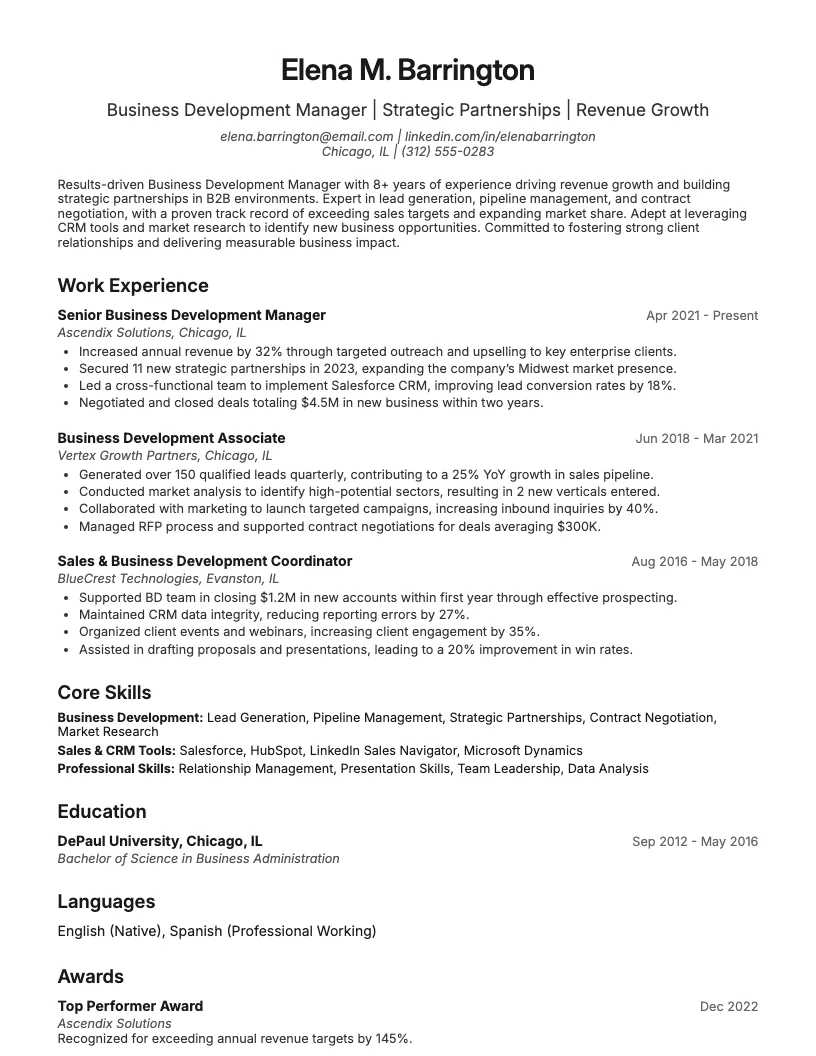
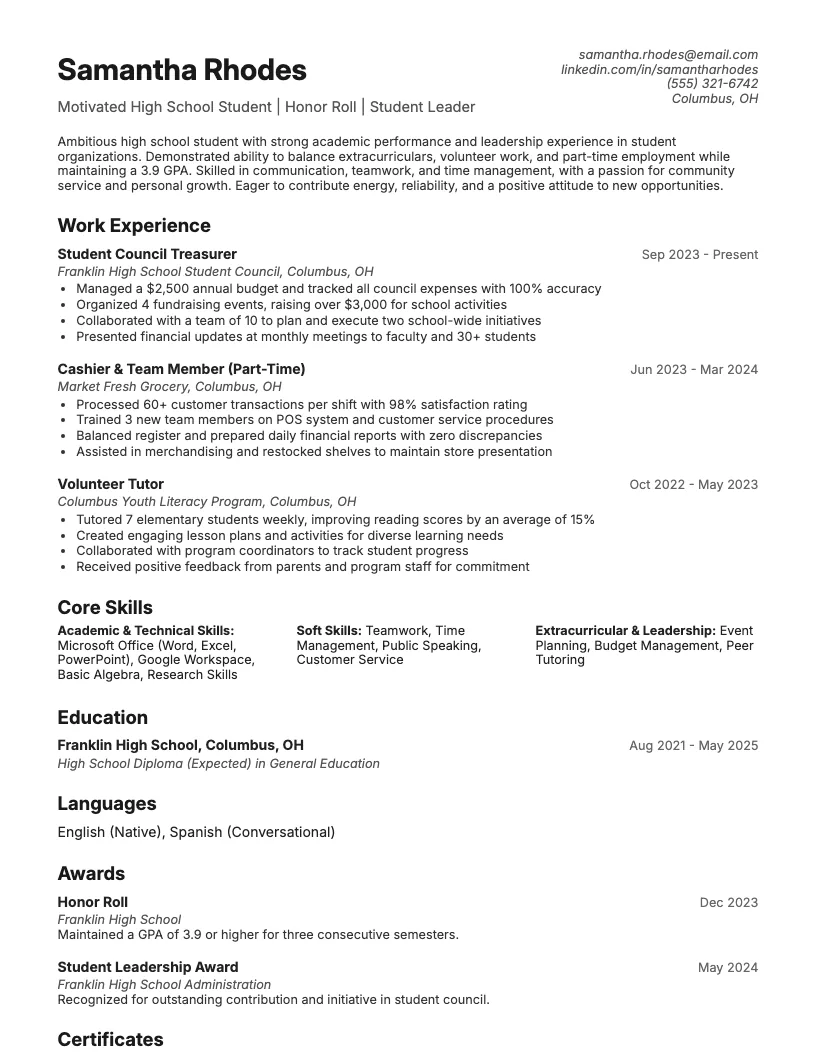
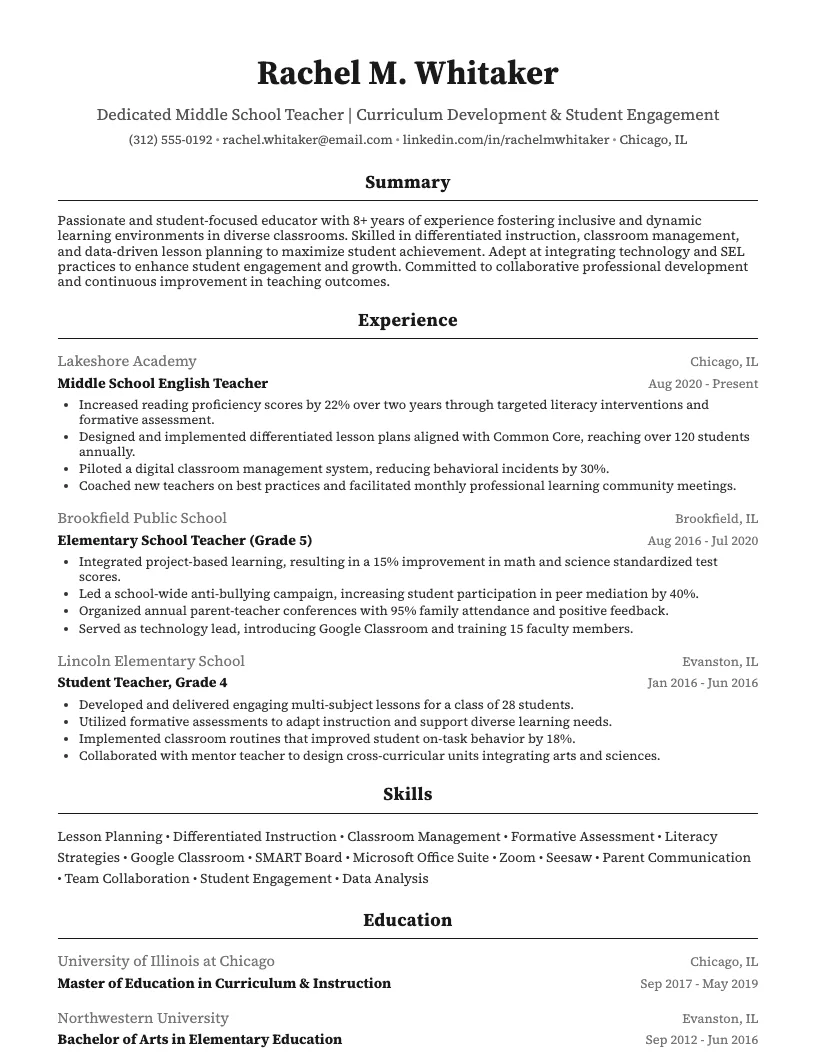
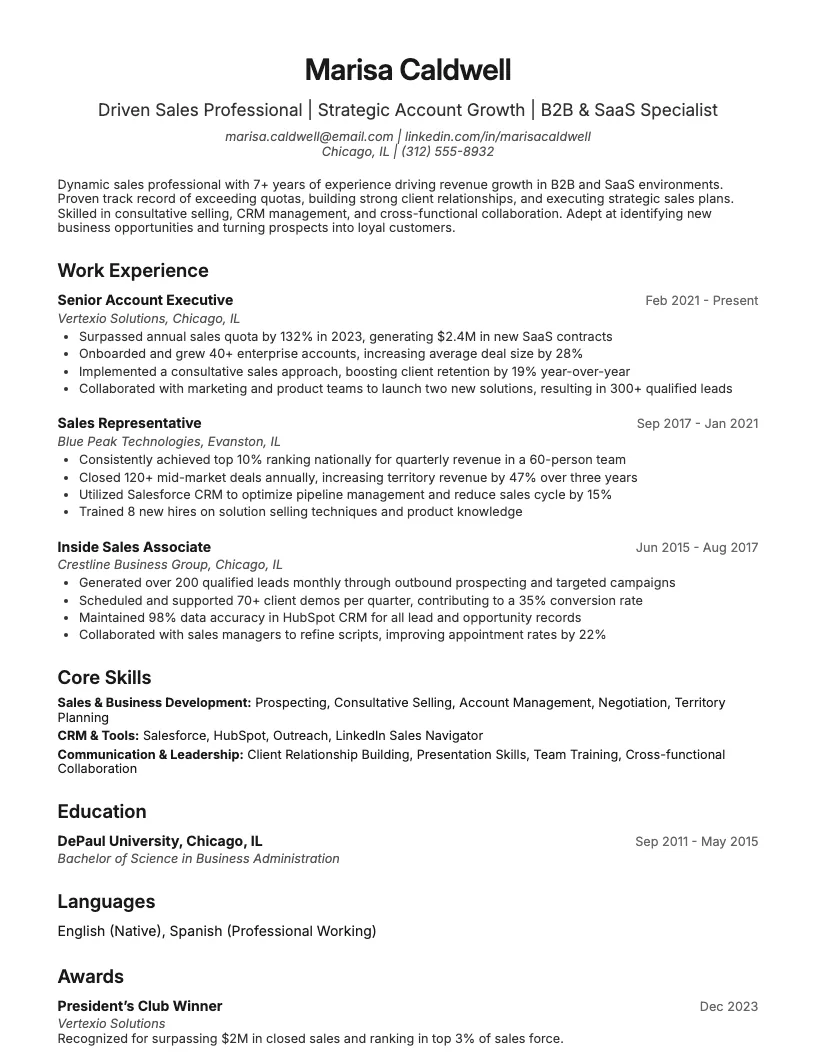
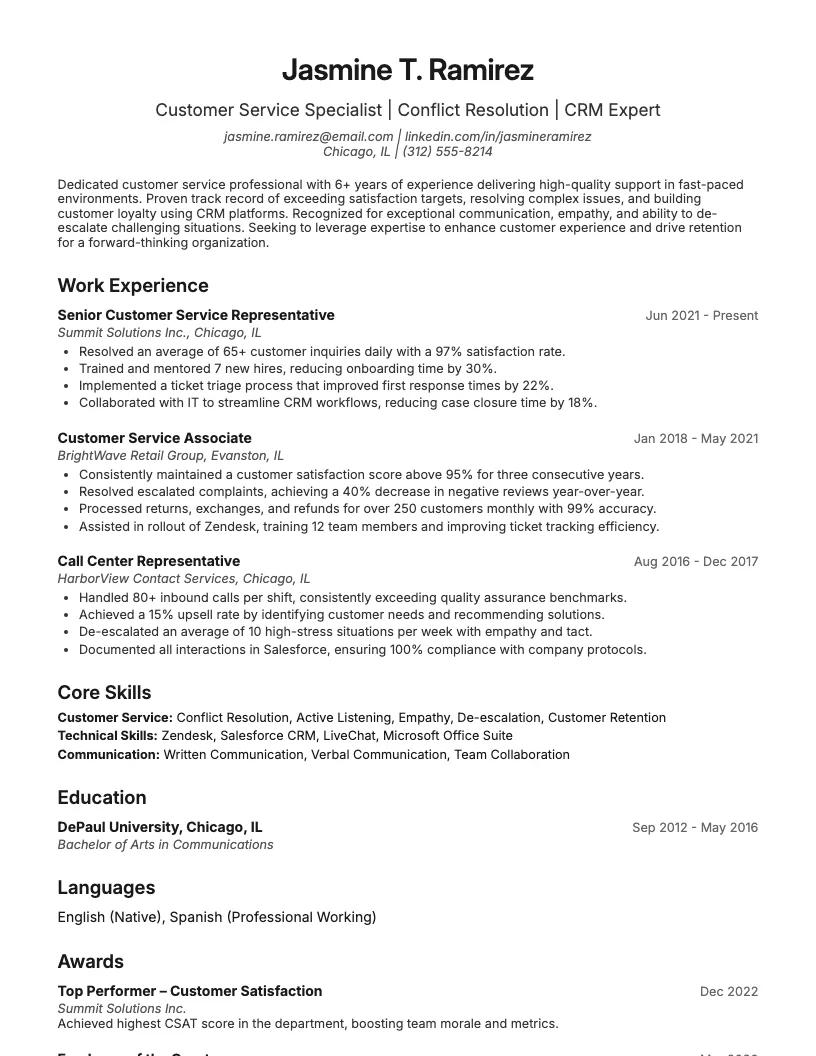
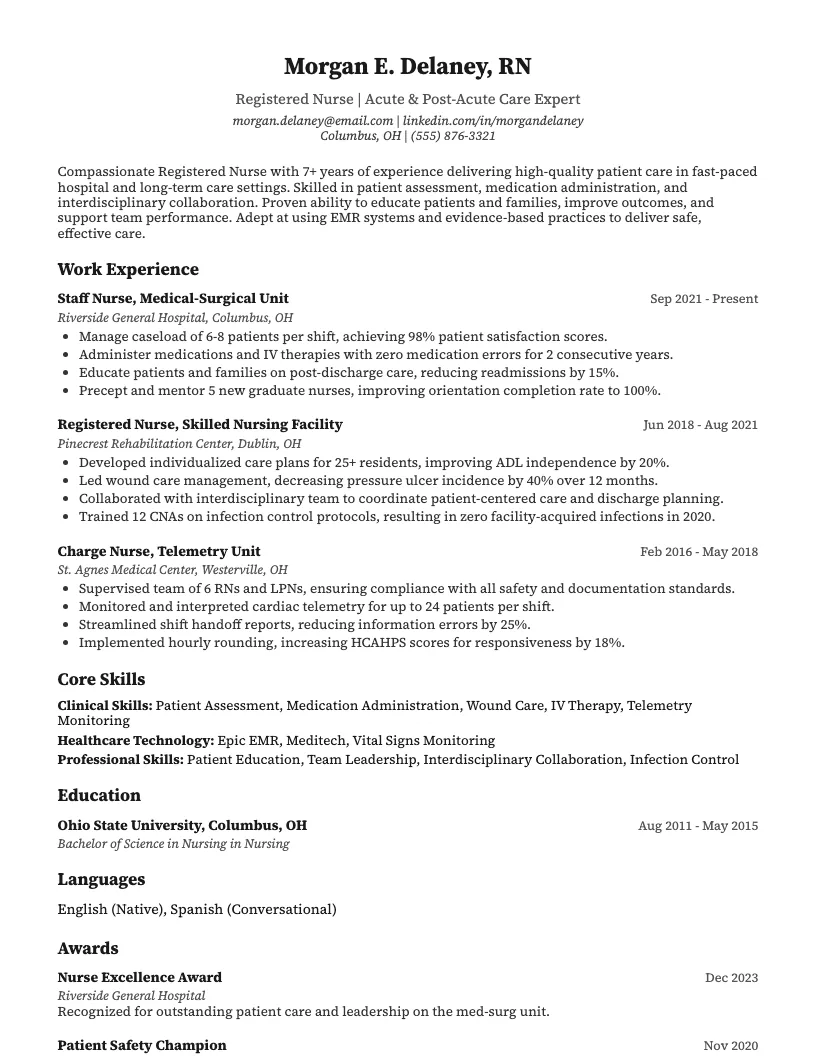
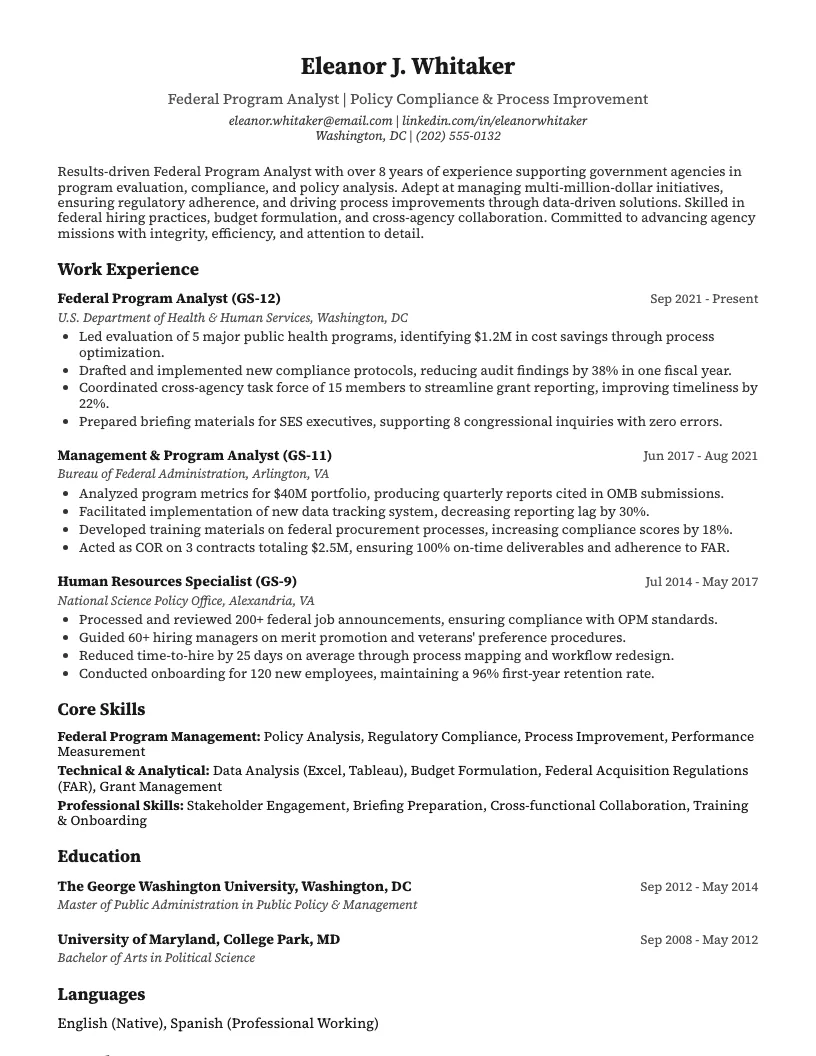
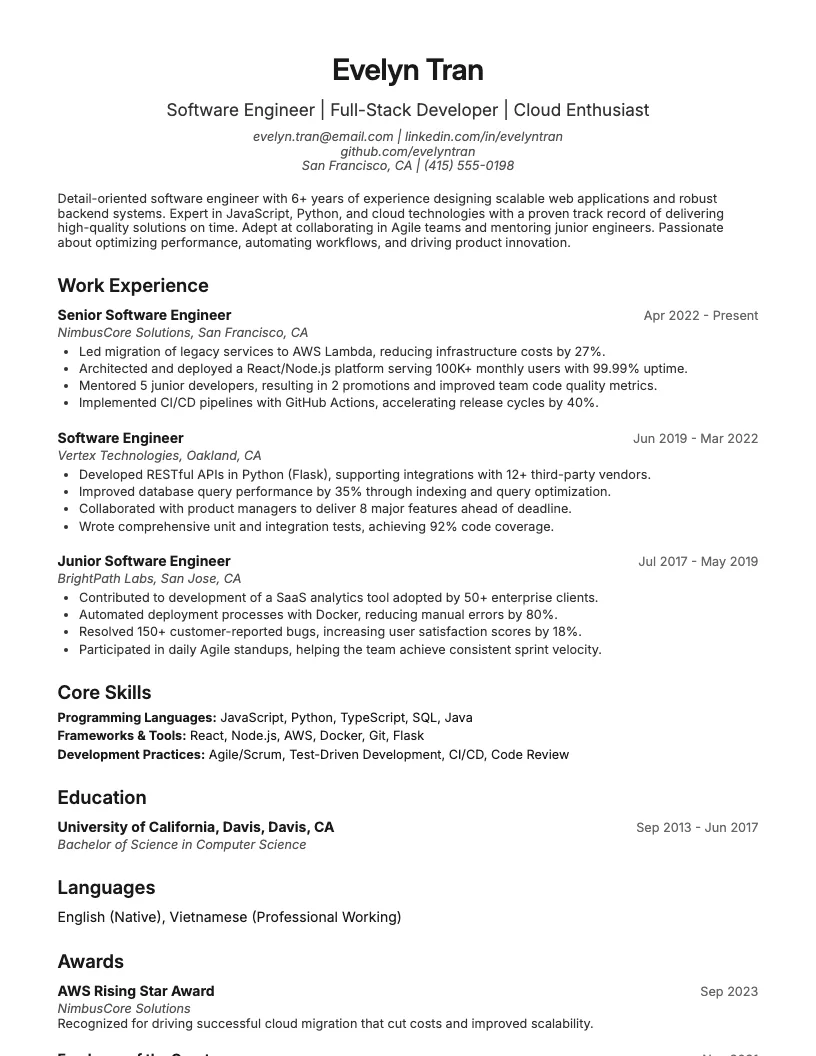
See these skills on a real resume
8 examplesStart from an example that already has them, and swap in your own.
Check your resume against the job you want
Scan your resume, see which skills and keywords the posting asks for that you are missing, and fix them before you apply.
Free to use • No credit card required