Accounts Receivable Resume Keywords: 8 Terms, 6 Places to Use Them
The 8 AR keyword buckets employers search for, which accounting systems to name, and exactly where each one goes on your resume so it actually gets read.


Written by Marcus Rodriguez
ATS Optimization Specialist & Career Coach
Updated August 2026
Reviewed by Dr. Priya Sharma
Is your resume ATS-friendly?
Drop your resume in and see which of these skills a scanner can actually read, and which ones the job you want is asking for that you have not listed.
PDF or DOCX. Max 2MB.
We never share your resume or use it to train a model.
In This Guide:
What are accounts receivable resume keywords?
They're the AR words a hiring manager and an ATS are both scanning for, and they're not the same as "accounting words" in general.
The words a job posting uses for AR work
Every AR posting is built around the order-to-cash cycle, whether it says so or not. Read enough of these and you start seeing the same handful of buckets repeat: how you bill, how you get paid, how you chase what's overdue, how you prove the books tie out, and what system you did it in.
Process words: invoicing, cash application, collections, reconciliation
Invoicing, cash application, collections, reconciliation - these are the verbs of the job, and I'd rather see one of them done well than five vague ones. A resume that says "processed payments" instead of "cash application" reads like someone who's never sat in the seat.
Number words: DSO, aging buckets, bad debt
DSO, aging buckets, bad debt provision - these aren't jargon for its own sake, they're how AR people measure whether they're any good. Nine times out of ten, a resume with none of these numbers on it gets read as junior, even when the person behind it isn't. More on which ones to actually use: which numbers should an AR resume show.
System words: SAP, NetSuite, QuickBooks
Name the system. SAP, NetSuite, QuickBooks, whatever ERP you actually touched - a posting that names one is telling you exactly what to put on the page.
Why 'called customers about payment' fails and 'B2B collections' passes
AR phrasing in a bullet
Called customers about overdue payments
Managed B2B collections on past-due accounts
"Called customers about payment" describes a task. "B2B collections" names a discipline.
The second one is what both the scanner and the hiring manager are actually searching for - if you're not sure your resume uses the right side of that line, running it against the posting will show you exactly where the wording still needs to change.
Which accounts receivable keywords do employers ask for most?
Which accounts receivable keywords do employers ask for most?

I've read hundreds of AR resumes, and the ones that get callbacks all hit the same eight buckets. Miss one that the posting cares about and you look like you've never done the job, even if you have.
Invoicing and billing
This is the base layer: invoicing, billing accuracy, credit memos, debit memos, and invoice verification. If the role touches complex or progress billing, or EDI invoicing, say so by name - generic "billing" doesn't cover it.
Cash application and payment posting
Cash application and payment posting show up in almost every AR posting I've seen. Get specific about how the money came in - lockbox processing, wire transfers, ACH, or Stripe and PayPal reconciliation - because that's the detail that separates a real answer from a filler line.
Collections and past due accounts
Collections splits by who you're chasing: commercial or B2B collections read differently than B2C. Pair it with past due accounts, aging reports, dunning letters, or payment plans, whichever ones you actually ran.
Account reconciliation and general ledger
Reconciliation and general ledger coding are the words that tell a hiring manager you understand where AR sits inside the books, not just the collections side of it.
AR aging and reporting
Aging reports and variance analysis belong here too, alongside whatever reporting cadence you owned - weekly, monthly, whatever it was.
Credit analysis and credit holds
Credit analysis, credit limits, credit holds, and risk assessment matter most for specialist and manager roles. Nine times out of ten, junior AR resumes skip this bucket entirely and it costs them.
Dispute and deduction resolution
Dispute resolution and deduction resolution are two of the most under-used AR keywords I see, even from people who do this daily. If a posting leans on this language and your bullets don't, ResumeJudge will catch the gap and rewrite the bullet in the posting's own words for you.
Month-end close
Month-end close, journal entries, and bad debt write-offs round out the set - mostly for roles that sit closer to accounting than pure collections.
Which accounting software should you name on an AR resume?
Which accounting software should you name on an AR resume?
"Accounting software" is the phrase I see on resumes most and the one that helps least. An ATS is matching on the actual product name, not the category, so name the system you touched.
SAP and Oracle
These show up on almost every mid-size and enterprise AR posting. If you've worked in either, say so by name in your skills section and in a bullet - "posted cash in SAP" beats "used accounting software" every time.
NetSuite
Common at growing companies that outgrew QuickBooks. Worth its own line if you've used it, since it's a different search term than SAP or Oracle to a recruiter scanning resumes.
QuickBooks and Xero
The two you'll see most on small-business and entry-level postings. Neither is impressive on its own, but leaving it off when the posting names it is a real gap.
Microsoft Dynamics 365
Less common than the others, so when a posting does ask for it, treat it as a must-have, not a nice-to-have.
FreshBooks and Zoho Books
Smaller-company tools. Include them only if that's genuinely what you used - they carry little weight beyond matching the exact posting.
Excel: VLOOKUP, XLOOKUP, pivot tables, macros
Excel is non-negotiable in AR, but "Excel" alone tells a recruiter nothing. Name what you actually do in it: VLOOKUP or XLOOKUP to match payments to invoices, pivot tables to build aging reports, macros if you've automated anything repetitive.
SQL, Power BI and Tableau
These separate a specialist from a clerk. If you can pull your own data or build your own dashboards, that's worth a line on its own - most AR resumes don't have it.
Only list what you have actually used
A posting might name one system you've never touched - that's a real gap, not a wording problem, and it's exactly what ResumeJudge will flag when you check your resume against the job description, before a recruiter finds it for you.
Which soft skills belong on an accounts receivable resume?
Which soft skills belong on an accounts receivable resume?
Most AR resumes list "communication skills" and stop there. That's the mistake I see most often - it's too vague to mean anything to a hiring manager or a scanner.
Name the skill in AR terms instead.
Negotiating payment plans
Don't write "worked with customers on payments." Write "negotiated payment plans" - it's the exact phrase a collections-heavy posting is looking for, and it says you can close an overdue account without burning the relationship.
Handling payment disputes
This is conflict resolution, but say it in AR words. If you've untangled short pays or deduction disputes, that belongs in a bullet, not just a skills line - see the dispute resolution bullet for how to phrase it.
Attention to detail
The resumes that get interviews connect this skill to a result - fewer reconciliation errors, cleaner aging reports. On its own, "detail-oriented" is filler.
Working with sales and customer service
AR doesn't sit in isolation. You're chasing sales for account details and looping in customer service on disputes, so cross-functional collaboration is a real, checkable skill - not a throwaway phrase.
Handling payment data confidentially
If you've touched card data, confidentiality ties straight to PCI compliance. Once your skills are named right, ResumeJudge can rewrite the wording against a specific posting so each one lands in the phrasing that posting actually uses.
How do you pull the right keywords out of a job posting?
How do you pull the right keywords out of a job posting?
I've read enough AR postings to tell you the keywords aren't hiding. They're just buried under paragraphs you're skimming past.
Step 1: Read the responsibilities and qualifications, not the intro
Skip the "who we are" paragraph at the top. That's marketing copy, not keywords.
The responsibilities and qualifications sections are where the actual AR language lives.
Step 2: Mark the AR phrases the posting repeats
If a posting says "cash application" twice and "collections" three times, that's not an accident.
Repetition is the posting telling you what it cares about most. Highlight those phrases before you touch your resume.
Step 3: Check each one against work you actually did
This is the step people skip, and listing a keyword you cannot back up is where that ends up.
Every phrase you marked needs a real match in your work history, or it doesn't go on the page.
Step 4: Copy the posting's wording, not your own version of it
If the posting says "AR aging" and your resume says "tracked overdue accounts," the ATS may not connect the two. Match the posting's exact words wherever your experience genuinely supports it.
ResumeJudge does this matching for you: feed it your resume and the posting, and it rewrites your bullets and skills section using the posting's own language instead of leaving you to guess where the gaps are.
Step 5: Use the exact job title from the posting
If they're hiring an "Accounts Receivable Specialist," use that exact title on your resume, not "AR Coordinator" or "Billing Associate," even if that's technically what you did.
Where do AR keywords go on your resume?
Where do AR keywords go on your resume?
Six spots, and each one wants a different kind of keyword.
Job title line
Keep it close to the posting's own title. If they wrote "Accounts Receivable Specialist," don't get creative and call yourself something else - match it, so the first line a scanner reads is the one it's looking for.
Summary: three to six themes from the posting
Three or four lines, naming three to six themes pulled straight from that specific posting - collections, cash application, month-end close, whatever they actually asked for. A summary that could sit on any resume is wasted space.
Skills section, grouped by category
Don't dump forty words into one line. Group them: Accounts Receivable (invoicing, cash application, payment posting), Reporting (AR aging, reconciliation), Tools (the systems you've used). Grouped skills read faster, for a person and for a scanner.
Experience bullets
This is where the same keywords get proven. If you claimed "cash application" in skills, a bullet needs to show you doing it, with a number attached. ResumeJudge will take your resume and the job posting and rewrite the bullets itself, putting the posting's own wording into the sections it actually belongs in.
Certifications and education
List an AR certification if you have one. If not, don't stretch a general accounting degree into an AR keyword - it doesn't fool anyone reading closely.
What belongs in skills and what belongs in a bullet
I've seen resumes list "collections" in skills and never back it up in a single bullet. Skills is the index; bullets are the proof. If you can't support a skill with a bullet, it doesn't belong in either place.
How do you write AR bullet points that use these keywords?
Is your resume good enough?
Drop your resume in and see which of these skills a scanner can read, and which ones the job you want is asking for that you have not listed.
Upload your resumeFree. PDF or DOCX. We never share your resume or use it to train a model.
Once you've picked your keywords, the bullet is where they either land or fall flat. I've read AR resumes where every keyword from the posting shows up in the skills section and nowhere else - that's the tell of a resume nobody actually wrote by hand.
Action verbs for AR work: posted, reconciled, resolved, recovered
Start each bullet with a verb that names the actual motion: posted, applied, reconciled, resolved, recovered, escalated, negotiated. Skip "responsible for" and "helped with" - they tell a hiring manager nothing about what you did.
Payment posting bullet
Payment posting bullet
Posted payments and applied them to customer accounts.
Posted an average of 200 customer payments daily and applied remittances to open invoices, keeping unapplied cash under 2% of total receipts.
"Posted an average of 200 customer payments daily and applied remittances to open invoices, keeping unapplied cash under 2% of total receipts." The volume number is what makes this one work.
AR aging bullet
"Prepared and reviewed the weekly AR aging report across 400+ active accounts, flagging past-due balances for collections follow-up." Name the account count if you tracked one - see which numbers to use if you're not sure which figure to lead with.
Collections bullet
"Managed a $1.2M past-due portfolio, negotiated payment plans, and recovered $150K in aged debt over six months." Nine times out of ten, the recovered-dollar figure is the single most persuasive number on an AR resume.
Dispute resolution bullet
"Investigated billing disputes and deduction claims, resolving 90% within 10 business days through cross-functional work with sales." A time-to-resolution number here beats a vague "handled disputes" every time.
Reconciliation bullet
"Completed monthly AR ledger reconciliations against the general ledger, clearing discrepancies before close." If you're not sure your wording actually mirrors the posting's, ResumeJudge will rewrite the bullet for you - it takes your resume and the job description together and puts the posting's own language into the right spot.
Billing accuracy bullet
"Processed $2M in monthly invoicing at 99.8% billing accuracy." Short, numeric, done - that's the whole formula.
Which numbers should an AR resume show?
AR numbers to put on your resume
| Metric | Example figure | What it shows |
|---|---|---|
| Days sales outstanding | 45 to 32 days | Collection speed, before and after |
| Portfolio value | $350M in annual billings | Scale of the job you handled |
| Aged debt recovered | $150K recovered | You closed accounts, not just chased them |
| Invoice volume | $2M in monthly billing | Pace of the work |
| Billing accuracy | 99.8% accuracy | Trusted with the numbers, not just processing them |
| Active accounts | 400+ accounts | Size of the book you managed |
Every AR resume I've reviewed has numbers somewhere. The ones that get an interview have the right numbers, tied to the words in the bullet points above.
Days sales outstanding, before and after
DSO is the one number every AR hiring manager reads first. Don't just report the current figure - show the move, like a drop from 45 days to 32, or a 24% cut in the collection cycle.
A before-and-after beats a single snapshot every time.
Dollar value of the portfolio you handled
Scale matters. Whether you managed $350M in annual billings or a $5M portfolio, name the figure.
It tells the reader the size of the job you're used to, before they read a single bullet.
Aged debt recovered
A specific dollar amount recovered from past-due accounts - $150k is a real example I've seen work - says more than "followed up on overdue balances." It proves you closed something, not just chased it.
Invoice or payment volume
Monthly billing volume, like $2M in progress billing, or weekly invoice counts, gives a reader a sense of pace. This is also where posting's exact phrasing matters most - if the job description says "high-volume invoicing," your number should sit right next to that phrase, not near a vaguer one.
That's the kind of match ResumeJudge checks for automatically when you run your resume against a posting, then rewrites the line so the wording lines up.
Billing accuracy rate
99.8% accuracy or a 35% drop in late payments - accuracy numbers separate someone who processes invoices from someone who's trusted with them.
Number of active accounts
400+ active accounts is a real figure worth naming. It shows you can handle a full book, not a handful of clients.
Team size, for manager roles
If you're applying for an AR manager or supervisor role, say how many people you led - "team of 10" reads very differently than no number at all.
How do the keywords change with the job you are applying for?
Same industry, different resume. The keywords that get an entry-level clerk hired aren't the ones that get a manager hired, and I see people reuse one resume across all of them.
Entry-level AR clerk
Keep it to the basics: invoicing, data entry, cash application, filing. No one expects DSO ownership from a first AR job, so don't force it in.
AR specialist
This is where the full vocabulary shows up - reconciliation, AR aging, dispute resolution, credit holds. Specialists are expected to touch every part of the cycle, and the resume should show it.
Collections specialist
Lean hard on numbers here - portfolio size, the DSO move, and dollars recovered, picked from which numbers should an AR resume show. That's the shape collections resumes need, not "called customers about late payments."
Billing coordinator
Accuracy and volume carry this one, plus discrepancies resolved with sales or customer service. Pull the billing volume and accuracy figures from which numbers should an AR resume show - they do more work than "made invoices."
AR manager or supervisor
Now it's leadership plus results: a team of ten, 98% team accuracy, DSO cut 15% in a quarter through a process you led. Pair the management word with the financial outcome in the same bullet.
Postings that lean on process work
Push invoicing, payment posting, reconciliation, and aging in both your skills section and your bullets - these postings are checking whether you know the cycle end to end.
Postings that lean on collections and disputes
Weight it toward dispute resolution and account follow-up, and write the bullets around customer communication, not just the accounting side.
Postings that lean on systems and reporting
Get the ERP name exactly right and name the reports you actually built. If you're not sure which of these three patterns a posting fits, paste it into ResumeJudge - it'll show you which bullets already match and rewrite the ones that don't.
How do AR keywords differ from accounts payable keywords?
AR words vs AP words
| Category | Example terms |
|---|---|
| AR-only | Collections, cash application, DSO, dunning letters, credit holds |
| AP-only | Vendor invoices, purchase orders, three-way match, payment runs |
| Shared by both | Reconciliation, month-end close, ERP systems, general ledger |
Money coming in versus money going out
AR and AP sit on opposite sides of the same ledger. One chases the money customers owe you, the other pays what you owe vendors.
I've reviewed a lot of resumes that blur the two, and it costs candidates interviews. A hiring manager scanning for a collections background doesn't want to see vendor payment terms in the first bullet.
Words that belong only to AR
Collections, cash application, dunning letters, DSO, and credit holds are AR words. If a posting uses any of those, it's an AR role, and your resume should answer with the same terms - not a softer version of them.
Words that belong only to AP
Vendor invoices, purchase orders, three-way match, and payment runs belong to AP. Those words won't help you on an AR resume, and using them signals you applied to the wrong posting by mistake.
Words both roles share
Reconciliation, month-end close, ERP systems like SAP or NetSuite, and general ledger work show up on both sides. List these without leaning on them - they prove you know the accounting cycle, not which side of it you worked.
What to do if you have done both
If your background covers both, don't try to prove it all on one resume. Pick the side the posting is hiring for and lead with those words.
ResumeJudge can scan your resume against that specific posting and tell you which set - AR or AP - it's actually asking for more of.
What keyword mistakes get AR resumes rejected?
I've read enough AR resumes to spot the same six mistakes over and over. Fix these and you're ahead of most applicants.
Listing a keyword you cannot back up
If you write "cash application" but never touched a lockbox or a remittance file, a follow-up question will expose you fast. Only add a phrase from pulling keywords out of a posting if you can describe the work behind it.
Generic finance words instead of AR words
Recruiters searching for this role type the AR words, not the generic finance ones, so swap generic terms for the specific ones AR postings actually use.
Leaving out a system the posting names
If the posting says SAP and you used SAP for three years, put SAP on the resume. Nine times out of ten, the resumes that stall on a system-heavy posting simply never named the system, even though the person had used it.
Repeating the same keyword in every bullet
Once is enough. Repeating "collections" in five bullets reads like stuffing, not experience, and it crowds out other terms the posting is actually asking for.
Putting AR terms in sections they do not belong in
Keywords belong in your summary, skills, and bullets - not wedged into an objective statement or a certifications line where they don't fit. See where AR keywords go for the right spot for each one.
Trusting a match score as a prediction
A high score means your wording lines up with the posting. It doesn't mean you'll pass the ATS, get an interview, or get hired - it's a checklist, not a guarantee. ResumeJudge will show you exactly which AR terms are missing and rewrite the resume around them, but the accuracy still has to be real: check every suggested phrase against what you actually did before it goes on the page.
Frequently Asked Questions
How many keywords should I put on an AR resume?
Aim for a dozen to twenty keywords pulled straight from the posting, not a list of every accounting term you know. Packing in extras you don't actually use just reads as filler, and it doesn't help if none of it matches the job you're applying for. ResumeJudge scans your resume against a posting and shows you which keywords are actually missing, so you're adding the ones that matter instead of guessing at a number.
Do I need to repeat a keyword for the ATS to count it?
No, one clear mention in the right section is enough for it to register. The keyword mistakes section above covers why repeating the same term in every bullet works against you.
Should I list collections if I do not want a phone-heavy job?
Yes, listing collections experience doesn't commit you to another phone-heavy role. Hiring managers read your job titles and the rest of your history for context, so a keyword on a resume isn't treated as a request for more of the same duties. Leaving it off can actually make your background look thinner than it is, since collections and dispute resolution show up in most AR postings.
Can I list a system I only used a few times?
Yes, but only if you can speak to it if asked, since an interviewer may test that claim. List it under skills rather than describing years of daily use you didn't have, and be ready to explain what you actually did with it. A system named honestly for brief but real use is still worth including, because ATS software matches on the name, not the hours behind it.
Do AR certifications like ARM or ARS help?
Yes, ARM and ARS signal formal training in collections and risk management, which can set you apart from candidates who only list software skills. They matter most for senior or specialized roles, where a company wants proof of expertise beyond on-the-job experience. For an entry-level or general AR role, real experience with the core keywords usually counts for more than the certification itself.
What if my job title was not 'accounts receivable'?
Your title doesn't have to match for your keywords to count. What matters is whether your day-to-day work covered AR tasks like invoicing, collections, or reconciliation, so pull those terms from your actual responsibilities and use them even if your official title was something like "Staff Accountant" or "Billing Specialist." A posting's requirements are based on the work, not the title on your last paycheck.
Does a higher keyword count get more interviews?
No, more keywords alone doesn't translate into more interviews. The keyword mistakes section above explains why a high match is not a prediction. Once your resume genuinely matches the posting, ResumeJudge can also write the cover letter for that posting and apply to jobs on your behalf with a resume tailored to each one, so the keyword work isn't the last step.
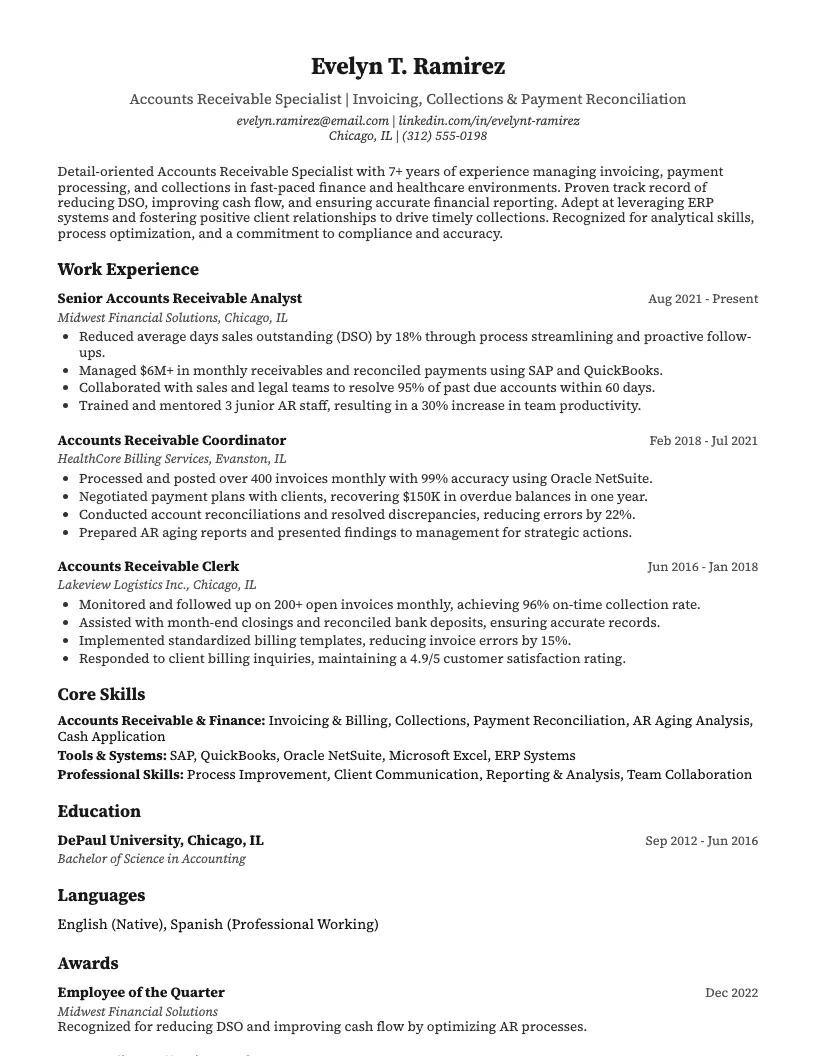
See these skills on a real resume
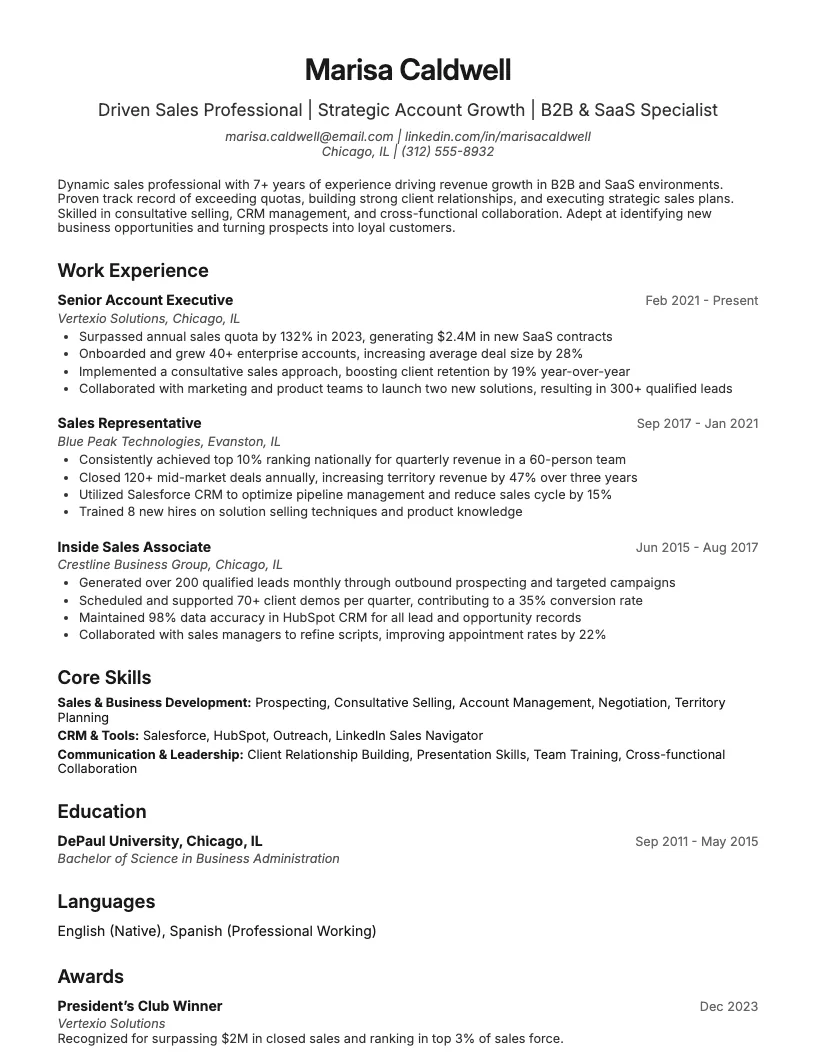
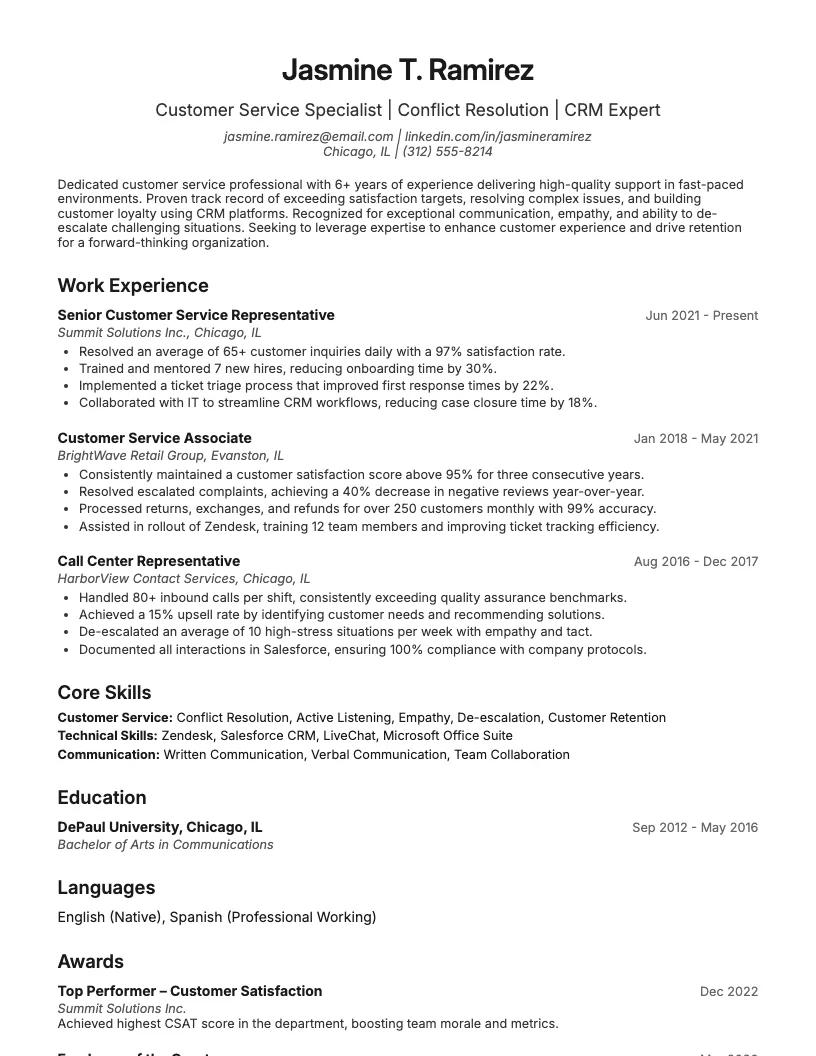
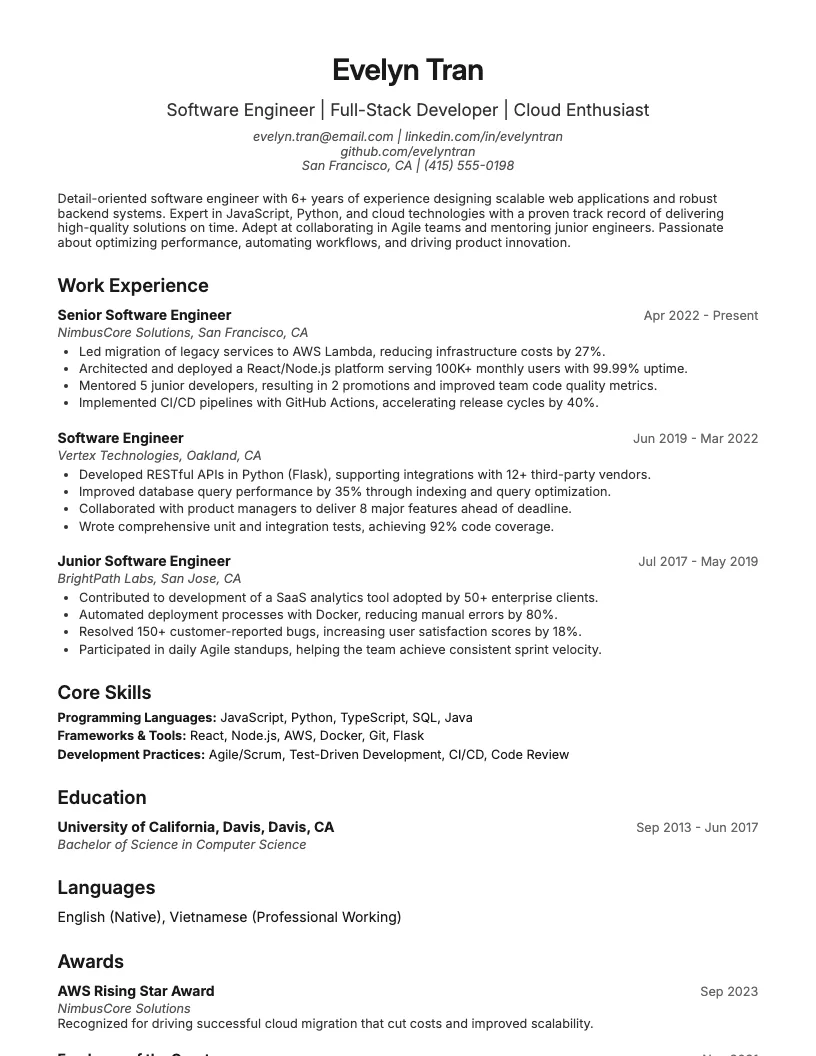
8 examplesStart from an example that already has them, and swap in your own.
Check your resume against the job you want
Scan your resume, see which skills and keywords the posting asks for that you are missing, and fix them before you apply.
Free to use • No credit card required