Accounting Keywords for Resume: 36 Terms, 11 Tools, 9 Roles
I've screened accounting resumes and pulled 36 keywords across 6 categories, the 11 software tools worth naming, and how to match them to 9 job titles.


Written by Marcus Rodriguez
ATS Optimization Specialist & Career Coach
Updated August 2026
Reviewed by Dr. Priya Sharma
Is your resume ATS-friendly?
Drop your resume in and see which of these skills a scanner can actually read, and which ones the job you want is asking for that you have not listed.
PDF or DOCX. Max 2MB.
We never share your resume or use it to train a model.
In This Guide:
What accounting keywords should you put on your resume?
I've screened enough accounting resumes to tell you the ones that get calls all use the same vocabulary the job posting uses. Not close - the same words.
Reporting terms: general ledger, accounts payable, accounts receivable, month-end closing, balance sheet, profit and loss statement
These are the words that prove you've actually done the job, not just studied it. If your resume never mentions the general ledger or a month-end close, a hiring manager assumes you haven't touched one.
Planning terms: budgeting, forecasting, variance analysis, cost-benefit analysis, capital budgeting, projections
This is the set that separates someone who records numbers from someone who's trusted to plan around them. If you've built a forecast or run a variance analysis, say so plainly - don't bury it under "assisted with."
Managing terms: reconciliations, payroll administration, asset management, cash flow management, inventory, billing
Day-to-day ownership words. Nine times out of ten, the resumes that list these get read as "can run the department," not just "can do the task."
Rules and compliance terms: GAAP, IFRS, FASB, Sarbanes-Oxley, SOX compliance, internal controls, due diligence
Public companies and anyone near an audit will scan for these specifically. Skip them and a SOX-heavy employer may not read further.
Tax terms: tax preparation, federal and state tax compliance, IRS regulations, Internal Revenue Code, transfer pricing
Only put these in if tax work is actually part of your background - they're specific enough that a mismatch is obvious in an interview.
Action verbs: reconciled, forecasted, audited, streamlined, budgeted, quantified
Pair each keyword with one of these instead of "responsible for." "Reconciled" and "streamlined" carry more weight than any adjective you could add.
Once you've pulled these in, check them against a real posting rather than guessing - ResumeJudge will scan your resume against any job description and tell you exactly which of these terms you're still missing before you hit submit.
What hard skills do accounting employers ask for?
What hard skills do accounting employers ask for?

I've read enough of these to tell you employers aren't looking for a personality. They're looking for proof you can do the technical work without supervision.
The exact words to write for each one are in the keyword list above - this section is what each skill is and why an employer checks for it.
GAAP and financial reporting standards
Every accounting posting assumes you know GAAP - the rules that keep financial statements consistent from one company to the next.
Account reconciliation and balancing
If you've closed a ledger or caught a discrepancy before it became a problem, that's the line a hiring manager is checking your resume against.
Financial statement preparation
Being able to read a balance sheet is one thing. Being able to build one, and explain what it says to someone who doesn't speak finance, is what actually gets you hired.
Data analysis and financial modeling
Most of this happens in Excel, building projections and budgets out of raw numbers. If you want to show exactly which formulas and tools recruiters expect here, software section covers that.
Tax preparation and filing
Filing taxes and knowing the tax code are two different skills, and postings usually want both spelled out.
Auditing and internal controls
Whether you're the one being audited or doing the auditing, employers want to see you understand controls - the checks that catch errors before they become fraud.
Payroll and accounts payable/receivable processing
AP, AR and payroll show up as separate line items in job postings more often than people expect.
The four formulas worth naming: current ratio, quick ratio, the accounting equation, EBITDA
Four formulas keep showing up in what employers expect you to know cold: the current ratio (current assets over current liabilities, for short-term solvency), the quick ratio (the same idea, minus assets you can't liquidate fast), the accounting equation (assets equal liabilities plus equity), and EBITDA (earnings before interest, taxes, depreciation, and amortization). You don't need to write these out on your resume - you need to be ready to talk through them in an interview.
Which accounting software should you list?
Which accounting software should you list?
Naming the actual tools you've used gets you past the scanner faster than any skill description will. I've reviewed enough accounting resumes to know the difference between someone who wrote "proficient in accounting software" and someone who named the platform - the second one gets the callback.
Excel: pivot tables, VLOOKUP and XLOOKUP
Don't just write "Excel." Every accountant claims Excel. Name the functions you actually use - pivot tables, VLOOKUP, XLOOKUP, financial modeling - because that's what separates someone who can build a report from someone who can only open a spreadsheet.
QuickBooks
The default for small and mid-size company accounting. If you've closed books or run payroll in QuickBooks, say so specifically.
Xero
Cloud-based, and increasingly common at smaller companies as a QuickBooks alternative. Worth naming if a posting mentions it - some teams are firmly in one camp or the other.
Sage
Covers accounting, payroll, and HR functions at a lot of small-to-medium businesses. List it if you've touched any of those modules.
SAP
This is where you shift from small-business tools to enterprise systems. SAP shows up constantly in corporate accounting and financial planning postings - if you've worked in it, it belongs near the top of your skills section.
Oracle Financials
The other major enterprise platform. Between SAP and Oracle, you're usually covering most large-company job descriptions.
NetSuite
Oracle's cloud ERP, and the one you see most at mid-size companies that have outgrown QuickBooks but aren't running SAP. Naming it tells a hiring manager which end of that range you've worked at.
Workday
Better known for HR and payroll, but its financial management module handles accounting too. If your close ran through Workday rather than a dedicated ledger, say which parts you worked in.
BlackLine
BlackLine is specialized reconciliation software - narrow, but if a posting names it, having it on your resume is close to a must.
Audit tools: ACL and IDEA
If you're an auditor, these two names carry weight that "audit software" doesn't.
Tableau, Power BI and SQL
Accounting is leaning harder into data analysis every year, and these three show up on postings that didn't ask for them five years ago. SQL especially - it signals you can pull your own data instead of waiting on someone else.
How to show your level with each one
Naming a software skill
Proficient in BlackLine
Reconciled accounts in BlackLine, cutting close time by 2 days
Don't just list the tool - attach what you did in it: "reconciled accounts in BlackLine," "built variance reports in Excel using pivot tables."
What soft skills belong on an accounting resume?
What soft skills belong on an accounting resume?
Soft skills are what get you from "qualified" to "hired" once two candidates both know GAAP. Here's the short list, and why each one matters more than people think.
Attention to detail
This is the one hiring managers name first, and for good reason. A wrong number on a financial statement or tax filing isn't a typo, it's a liability, so say where you caught errors before they became problems.
Communication with people who don't read financials
Nine times out of ten, the accountant who gets promoted is the one who can explain a budget variance to someone outside finance without the jargon. Put it on your resume as plainly as you'd say it in the room.
Analytical thinking
Pulling meaning out of raw numbers and spotting the pattern before it's a problem. That's a skill, not a personality trait, so back it with what you found.
Reliability under deadline
Month-end and tax season don't move for anyone. Employers are really asking "can I count on this person when it's tight," so show them a deadline you hit.
Adaptability as the rules change
FASB updates its rules regularly, and businesses shift faster than that. Show you've adjusted to a new standard or a new system instead of digging in on the old way.
Organization
Accountants manage a lot of documents, statements, and spreadsheets at once, and losing track of any of them is how mistakes happen. If you've built or kept a filing or reporting system running, that's worth a line.
Leadership for accounting manager roles
If you're aiming at accounting manager or controller, this is where you separate yourself. Taking charge of a close, holding a team accountable, making the final call on a judgment issue - that belongs here more than in work experience bullets.
How do you put accounting keywords into your resume?
How do you put accounting keywords into your resume?
Pull the keywords straight from the job posting
Don't work from memory. Open the posting and circle the terms it actually uses - GAAP, reconciliations, month-end close, whatever it names.
That's your list. Match the posting's own wording, since that's what a scanner and a hiring manager both check against.
Where to put them: skills section, summary, and work experience
Spread them across all three. The skills section is the obvious spot, but the summary should carry two or three of the biggest ones, and your bullets under work experience should show them in action, not just name them.
A keyword that only shows up once, in a list, reads thin next to one that shows up doing something.
A skills section that reads well
Skills section formatting
Skills: GAAP, hardworking, reconciliations, team player, ERP software
Technical Skills: GAAP, Reconciliations, ERP Software
Group technical and interpersonal separately - something like "Technical Skills: GAAP, Reconciliations, ERP Software" and then a shorter line for "Attention to Detail, Communication." I've seen hundreds of these, and the ones that group cleanly read faster than the ones that dump twenty terms into one line.
Work experience bullets with a number attached
A work experience bullet
Reconciled accounts under GAAP
Reconciled accounts for a $10M budget, cutting discrepancies 25%
Every keyword lands harder with a figure next to it. "Reconciled accounts under GAAP" is fine; "reconciled accounts for a $10M budget, cutting discrepancies 25%" is what gets remembered.
Certifications that count as keywords: CPA, CMA, CIA
A CPA, CMA, or CIA is itself a keyword, and it's proof, not a claim - it does more for you than any adjective on the page.
Only claim what you can talk about in an interview
The mistake I see most often is a resume full of terms the candidate can't back up in conversation. If you can't explain how you used it, leave it off. ResumeJudge will fix the wording against a posting for you, pulling in the exact terms it asks for without you having to guess which ones stretch the truth.
How many keywords is too many
Nine times out of ten, a resume packed with every term from the posting reads worse, not better. Pick your strongest ten to fifteen and let the bullets carry the rest.
Which accounting keywords fit your role?
Which keywords fit which accounting role
| Role | Keywords to lead with |
|---|---|
| Entry-level accountant | general ledger, pivot tables, GAAP |
| Staff accountant | month-end closing, AP/AR, ERP |
| Senior accountant | variance analysis, internal controls, audit support |
| AP/AR clerk | billing, collections, vendor reconciliation |
| Bookkeeper | QuickBooks, Xero, bank reconciliations |
| Auditor | SOX compliance, due diligence, ACL/IDEA |
| Tax accountant | tax preparation, IRS regulations, IRC |
| Cost/managerial accountant | cost-benefit analysis, budgeting, forecasting |
| Accounting manager/controller | leadership language, process ownership |
The keywords above are the full list. Which ones you actually use depends on the job title on the posting, so here's how I'd split them.
Entry-level accountant or recent graduate
Lead with reporting terms and Excel: general ledger, journal entries, account reconciliation, pivot tables, VLOOKUP. You don't have years of experience to lean on, so a keyword like GAAP or QuickBooks tells a recruiter you already speak the language.
Staff accountant
Month-end closing, reconciliations, accounts payable and receivable, and whichever ERP you've touched. This is the role where the reporting terms do the most work.
Senior accountant
Add variance analysis, internal controls, and audit support - you're expected to review other people's work now, not just produce your own.
Accounts payable and accounts receivable clerk
Billing, collections, vendor reconciliation, and whatever AP/AR module your software uses. Skip the tax and audit terms - they read as padding here.
Bookkeeper
QuickBooks or Xero, payroll administration, bank reconciliations. Small-business employers want software fluency more than GAAP citations.
Auditor
Internal controls, SOX compliance, due diligence, ACL or IDEA if you've used them.
Tax accountant
Tax preparation, federal and state compliance, Internal Revenue Code. I've seen candidates bury these under generic "accounting" bullets - don't, they're what gets you shortlisted.
Cost or managerial accountant
Cost-benefit analysis, budgeting, forecasting, variance analysis.
Accounting manager or controller
Everything above, plus leadership language - team size, process ownership. Pull the exact list a posting wants and ResumeJudge will tell you which of these you're missing before you apply.
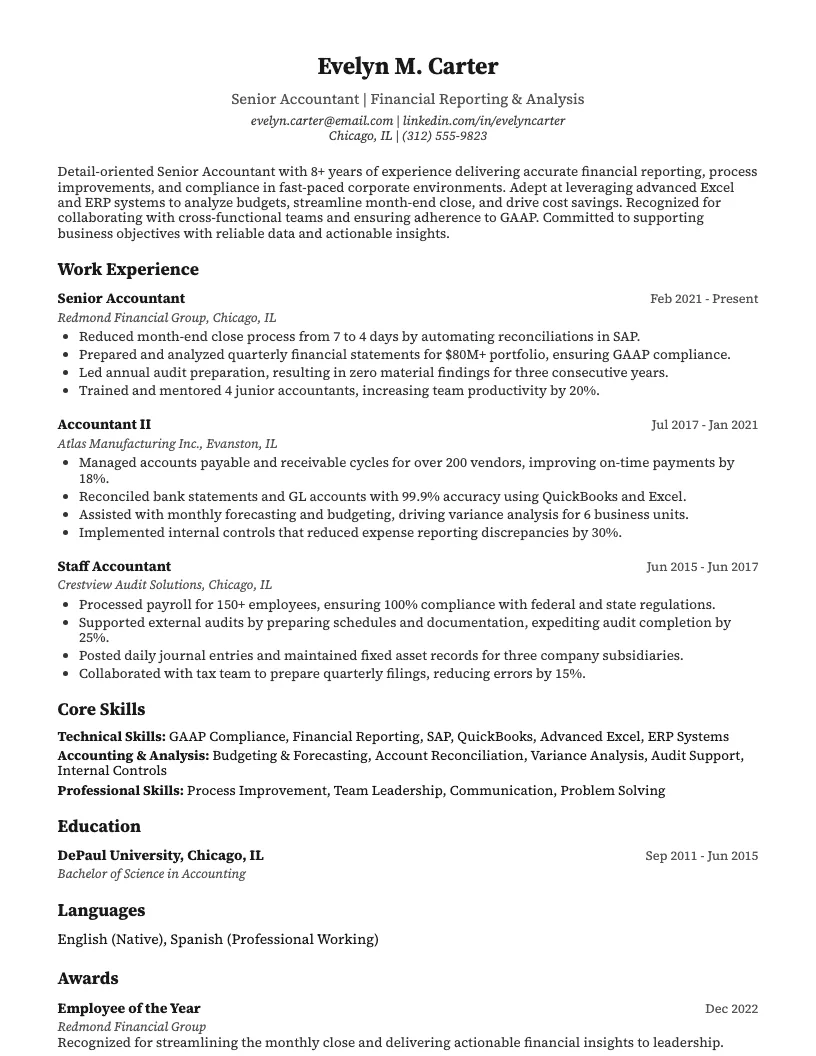
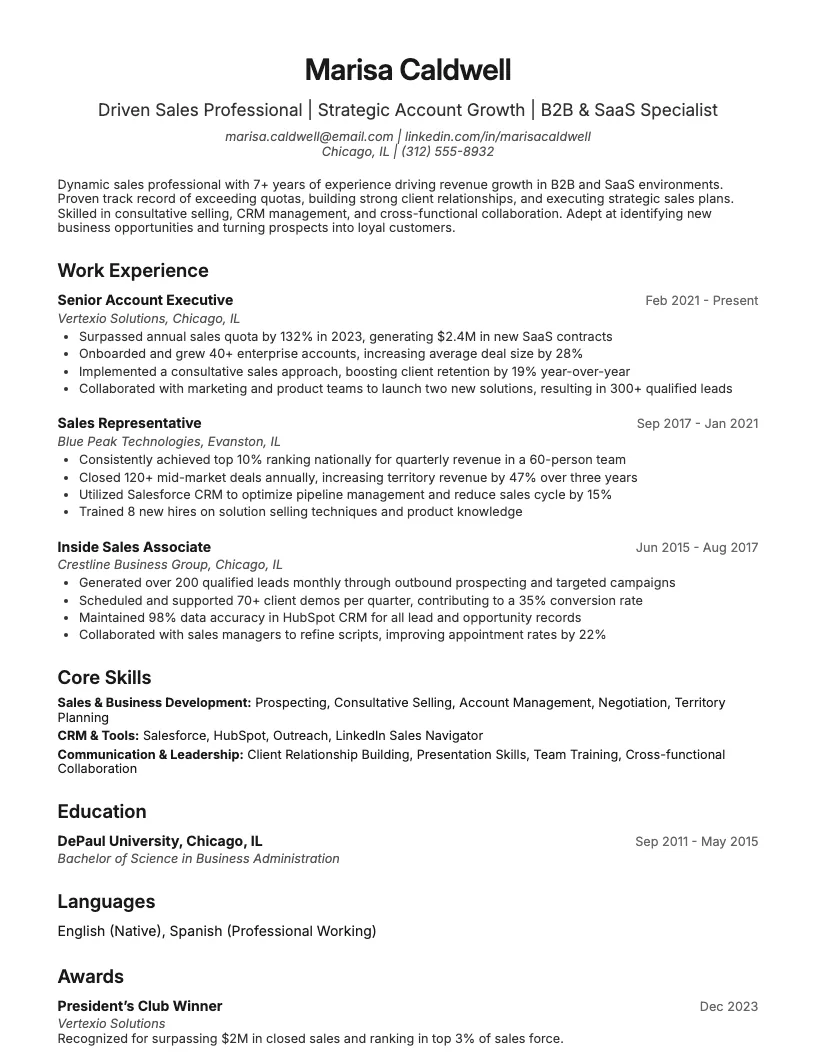
See these skills on a real resume
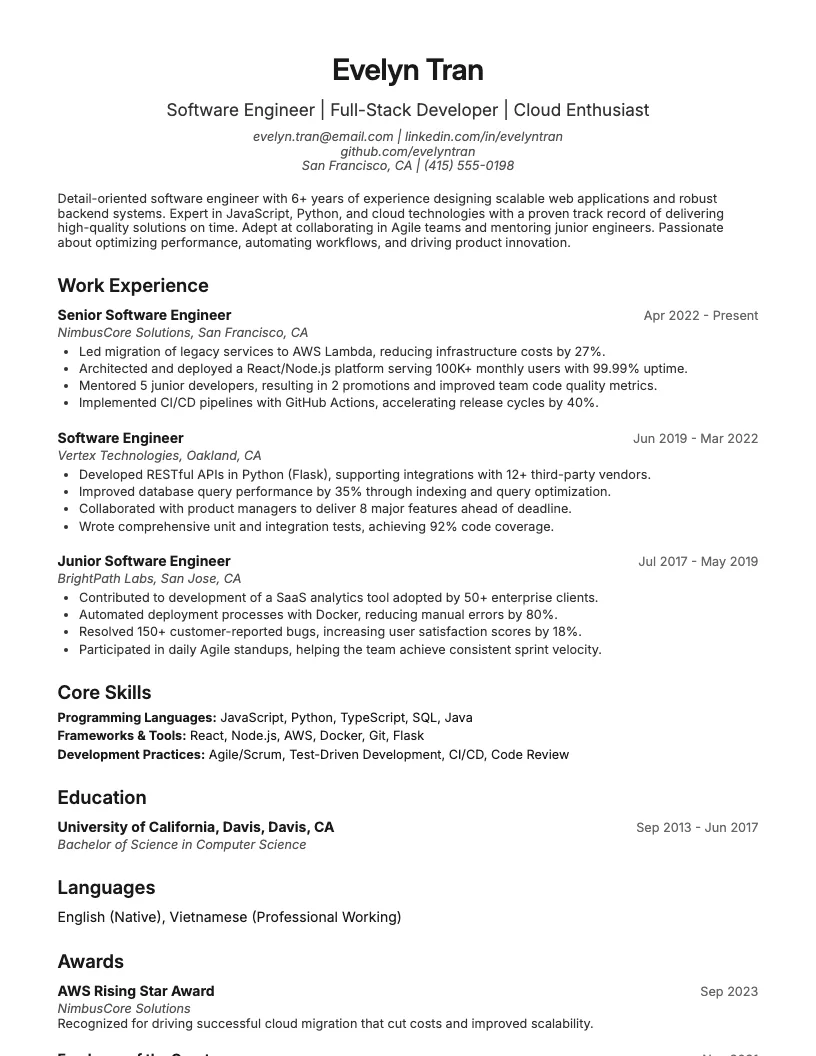
8 examplesStart from an example that already has them, and swap in your own.
Check your resume against the job you want
Scan your resume, see which skills and keywords the posting asks for that you are missing, and fix them before you apply.
Free to use • No credit card required