Account Executive Resume Keywords: 7 Mistakes That Get You Rejected
The exact ARR, MEDDIC, and CRM keywords account executives need, where to put them, and the 7 mistakes that get sales resumes rejected before you apply.


Written by Dr. Priya Sharma
Career Development Expert & Resume Analyst
Updated August 2026
Reviewed by Sarah Chen
Is your resume ATS-friendly?
Drop your resume in and see which of these skills a scanner can actually read, and which ones the job you want is asking for that you have not listed.
PDF or DOCX. Max 2MB.
We never share your resume or use it to train a model.
In This Guide:
What keywords does an account executive resume need?
What keywords does an account executive resume need?

I've read hundreds of AE resumes, and most list the same soft skill three different ways instead of the words a sales VP is actually scanning for. Here's what those words are.
Revenue words: ARR, MRR, ACV, TCV, bookings, net new logo
These are the words that say you carry a number, not just a title.
ARR and MRR if you sell SaaS, TCV if your deals span multiple years, bookings and net new logo if your world is pure new business.
Pick the ones that match how your company actually measured you, not the whole set.
Sales process words: full-cycle, prospecting, discovery, qualification, negotiation, closing
"Full-cycle" tells a recruiter you owned the deal from a cold list to a signed contract, no SDR or sales engineer doing the first half for you.
The mistake I see most often: someone writes "managed the sales process" instead of naming the stage. Say prospecting if you built your own pipeline, discovery if you ran the calls, negotiation and closing if you got to the signature.
Sales methodology words: MEDDIC, MEDDPICC, Challenger, SPIN, Sandler, solution selling
MEDDIC is close to the standard for enterprise sales resumes right now, and naming it tells a hiring manager you were trained to qualify a deal, not just chase one.
Challenger and SPIN work if you sold into competitive or consultative markets. Only name one you can actually walk through in an interview - more on that in what gets a resume rejected.
CRM and sales tools: Salesforce, HubSpot, Outreach, Salesloft, Gong, ZoomInfo, LinkedIn Sales Navigator, DocuSign
Every posting I've seen names its CRM by brand, and a resume that just says "CRM software" loses the exact match.
List the ones you've actually run: your CRM (Salesforce or HubSpot), your prospecting tools (Outreach, Salesloft, ZoomInfo, Sales Navigator), and DocuSign if contracts crossed your desk.
Relationship and account words: territory management, pipeline management, key account management, upsell, cross-sell
These show you managed a book, not just a deal. Territory management if you owned a region, key account management if you carried a short list of large clients, upsell and cross-sell if expansion revenue was part of your number - ResumeJudge can pull these straight from a posting and slot the exact ones missing into your bullets, instead of you guessing which apply.
Traits worth naming: self-starter, competitive, customer-focused
Sales postings lean on these three more than almost any other trait words. Use them sparingly, and only where a bullet backs them up - a trait with no evidence behind it reads as filler, not a strength.
How many of these to put on one resume
Enough to cover the categories above without turning your skills section into a word dump. The range I'd aim for is in how many keywords should I put on my resume.
Where do these keywords go on the resume?
Where do these keywords go on the resume?
Same word, six different jobs depending on where you put it. That's the part people miss.
The professional summary: segment, quota attainment, headline deal
Three sentences, front-loaded. Name your segment, your attainment percentage against the dollar target, and your single best deal.
"Account Executive with 5 years closing mid-market SaaS deals in HR tech. Generated $2.1M in new ARR in 2025 at 132% of quota."
That's the whole job in two lines, and it's what gets read before anything else does.
The skills and methodologies list
This is where the CRM names and the methodology names live - Salesforce, Gong, MEDDIC, Challenger. Don't stretch it past what you'd list in the keywords section above just to fill space.
Work experience bullets
This is where most of your keywords should actually sit, woven into the sentence, not sitting in a list. I'd rather see "ran full-cycle discovery through close on 22 mid-market accounts" than a bullet with no verb at all - see how to build that bullet.
Awards and recognition: President's Club, ranking, Rookie of the Year
Name the award and what it took to get it. "President's Club, top 10% of 80 reps" tells a hiring manager something.
"President's Club" alone doesn't.
Certifications: MEDDIC, Challenger, Sandler
List these if you've got them, but only if you can talk through the framework in an interview - see what gets a resume rejected.
The job title itself, written the way the posting writes it
If the posting says "Enterprise Account Executive" and your title was "Senior AE," match theirs. Nine times out of ten, ATS software weighs the title field heavily, and this is the one place where matching their exact wording matters more than staying literal.
ResumeJudge pulls the exact wording straight from the posting and rewrites your resume against it, so you're not guessing which version to use.
How do you write an account executive bullet that proves the number?
The AE resumes that get callbacks all do the same thing: a verb, then a number, then what the number was attached to and who it mattered to.
The pattern: verb, then number, then what and to whom
Start with an action verb, put a real figure right after it, then say what got sold and to what kind of buyer.
Skip that order and the reader has to hunt for the result. Follow it and the result is the first thing they see.
"Closed new business" → "32 deals totalling $1.4M in new ARR"
"Closed new business" tells me nothing. Thirty-two deals worth $1.4M in new ARR tells me exactly how big your deals are and how many you close in a year.
"Exceeded quota" → "138% of a $1.5M quota, ranked #1 of 18 AEs"
Proving quota attainment with a number
Exceeded quota
138% of a $1.5M quota, ranked #1 of 18 AEs
Anyone can write "exceeded quota" - it's the most overused claim on an AE resume, and hiring managers skip right past it. The percentage, the dollar target, and the ranking against your peers are what make it real.
"Managed enterprise accounts" → "30 accounts worth $8M, VP and C-suite relationships"
Naming the portfolio size and who you sold to signals seniority a job title alone can't.
"Generated pipeline" → "self-sourced 55% of a $1.8M pipeline"
This one number answers a question every sales manager asks in the interview anyway: can you hunt, or do you only work leads that land in your lap?
"Negotiated contracts" → "22 contracts at $185K average ACV, discounting cut from 20% to 12%"
The discount figure matters as much as the deal count - it shows you protect margin instead of just closing at any price.
Verbs that carry a sales result: generated, negotiated, closed, captured, expanded, exceeded
Reach for these six before anything softer. If you're not sure which of your bullets are still duties dressed up as achievements, ResumeJudge will flag the weak ones against the posting and rewrite them in this pattern for you.
Which numbers do sales hiring managers actually look for?
Is your resume good enough?
Drop your resume in and see which of these skills a scanner can read, and which ones the job you want is asking for that you have not listed.
Upload your resumeFree. PDF or DOCX. We never share your resume or use it to train a model.
Here's what they're actually scanning for.
Quota attainment as a percentage, with the dollar target
Give both numbers, always. The quota bullet shows how to write it.
Total revenue or ARR closed per year
This is the number that anchors everything else on the page. Put it in your summary and in the first bullet of your most recent role - see where these keywords go for how.
Average deal size and typical sales cycle length
These two together tell a manager what kind of seller you are. A $5K deal closed in two weeks and a $200K deal closed in nine months are different jobs, and your resume needs to say which one you did.
Number of stakeholders per deal
If you sold to a single buyer, say so. If you navigated procurement, legal, and a VP sponsor to get a deal signed, say that instead - it's the difference between transactional and enterprise selling, and enterprise hiring managers are specifically screening for it.
New business versus expansion and upsell
Don't let these blur together. A resume that just says "revenue" hides whether you're a hunter who opens new accounts or someone who grows existing ones - and those are different hires with different expectations.
Share of pipeline you sourced yourself
If marketing and SDRs handed you every lead, that's fine, but say so honestly. If you sourced a share of it yourself, put the percentage on the page - the pipeline bullet has the wording.
Ranking against your peers
Say where you finished and out of how many. It sits in the same bullet as your attainment, written like this.
Win rate and conversion
This is the metric I see missing most often, and it's a mistake - it shows discipline in a pipeline, not just luck on a couple of big deals.
Consecutive quarters or years at quota
One great year could be an outlier. Three years running says you can repeat it - pair it with any President's Club or ranking recognition you've earned.
If you want the exact wording to turn a metric into a bullet, that's the next section.
Not sure which of these your resume is missing? Run it against the actual posting - ResumeJudge will score the match and tell you exactly which numbers to add before you hit apply.
How do the keywords change by segment and industry?
Keywords by segment and industry
| Segment | Core keywords | What to name |
|---|---|---|
| Enterprise | RFP/RFI, procurement, C-suite selling | Number of stakeholders per deal |
| Mid-market | Deal size, cycle length | Where you sit between enterprise and SMB |
| SMB / inside sales | Call/email volume, deals per month | Cycle length in days |
| SaaS / tech | ARR/MRR, net new logo, churn, land and expand | Match the posting's exact term |
| Media / advertising | CPM/CPC, programmatic, media planning | Client-direct vs. agency |
| Healthcare / medical device | Regulatory, clinical language | Buyer type and any credentialing |
The same job title hides very different resumes, and the keywords are how you signal which one you actually did.
Enterprise: RFP/RFI, procurement, C-suite selling, strategic account planning, multi-stakeholder navigation
Enterprise deals run long and touch a lot of people, so your resume needs to prove you can navigate that, not just close.
Use RFP/RFI, procurement, C-suite selling, strategic account planning, and multi-stakeholder navigation. If your last deal had eight signers, say so.
Mid-market
Mid-market sits in between, and I see a lot of resumes that don't say which side they lean toward.
Name a deal size and cycle length instead. It tells a hiring manager more than the segment label does.
SMB and inside sales
SMB and inside sales run on volume: shorter cycles, more deals, higher activity numbers.
Lead with call and email volume, deals per month, and cycle length in days, not quarters.
SaaS and tech: ARR/MRR, net new logo, churn, land and expand, product-led growth
Most of these words are already covered under revenue words.
The mistake I see most often is a tech AE writing "sales growth" when the posting wants "net new ARR." Match its wording.
Digital media and advertising: CPM/CPC, programmatic, media planning, agency relations
Media sales has its own vocabulary too: CPM/CPC, programmatic, media planning, agency relations.
If you worked both client-direct and agency deals, say which, since the two read as different skill sets.
Healthcare and medical device
Healthcare and medical device selling adds a layer the other segments don't have: regulatory and clinical language.
Name the buyer, whether that's a hospital system, a physician group, or a distributor, and any compliance or credentialing you carry.
Government
Government sales runs on procurement cycles and contract vehicles most private-sector resumes never mention.
If you've worked a GSA schedule, an RFP process, or a multi-year contract award, name it plainly. Once you've picked the right words for your segment, run the resume against a real posting in that industry - ResumeJudge will tell you which of those words the posting actually expects and which ones you're missing.
How is an account executive resume different from an account manager or SDR resume?
Account executive vs. account manager vs. SDR
| Role | The job | Keywords that fit |
|---|---|---|
| Account Executive | Closes new business | Full-cycle, prospecting, new logo, negotiation |
| Account Manager | Keeps and grows existing clients | Retention, renewal rate, upsell, service |
| SDR / BDR | Books meetings, runs activity | Meetings booked, sequences, call volume |
I've read enough of these to spot the mix-up in the first two lines. An AE resume that reads like an account manager's is the fastest way to get passed over for a hunting role.
Account executive: closing new business
An AE closes. That's the whole job, and the resume has to sound like it: full-cycle deals, new logos, prospecting, negotiation, signed contracts.
Account manager: retention, service, renewals
An account manager keeps clients happy and renews them. Retention rate, renewal rate, upsell, service - good words on that resume, wrong words on an AE's.
SDR and BDR: meetings booked, activity volume
SDRs and BDRs live on activity: calls made, meetings booked, sequences run. Recruiters expect that language from them, not from someone applying to close deals.
Words that put you in the wrong pile
"Relationship building," "client support," "managed accounts" with no revenue attached - that's farmer language, and a hunter resume full of it reads as a mismatch, not a strength.
Showing the move from SDR to AE
If you're moving up from SDR or BDR, use clear titles with dates so the progression is obvious at a glance, then let the newest title carry deal size and quota, not meeting counts.
Showing the move from mid-market to enterprise
Moving into enterprise, lead with your biggest deals, your longest cycles, and the number of stakeholders you navigated - see which numbers hiring managers look for for the full list. Once you've picked the right words for the segment you're aiming at, ResumeJudge can rewrite your bullets against a specific posting so the resume actually reads like the AE that posting wants, not the one you used to be.
How do you find the keywords for the specific job you are applying to?
How do you find the keywords for the specific job you are applying to?
Read the posting and take its exact wording, not your synonym for it
Every list on this page is a starting point. The posting in front of you is the real answer.
Open it and pull out every noun and verb tied to the role: the segment, the methodology, the tools, the deal size. Then match your resume's wording to theirs, word for word.
Why the software will not match "prospecting" to "cold calling"
Most companies now run resumes through an applicant tracking system before a person ever opens one. It reads the job description, pulls out the keywords, and scores your resume against them.
Here's the part people miss: it's dumb. If the posting says "cold-calling" and your resume says "prospecting," the system doesn't know those are the same skill.
You need their word, not yours.
The match score you need before a human sees the resume
There's no single number that gets you through - each employer sets its own bar - so get the match as high as you can against the posting. The software isn't throwing your resume out on its own - it sorts and filters on criteria a recruiter sets, and a low match sinks you down a list that gets read from the top.
This is exactly the gap ResumeJudge closes - feed it your resume and the posting, and it scores the match and tells you which of the posting's own words are missing.
Keyword tools: Jobscan, SkillSyncer
Jobscan and SkillSyncer both do the same basic thing: you upload your resume and the job posting, and they show you what's missing.
They're worth using if you want a second opinion on which of the posting's words your resume is missing.
Repeating the keyword without stuffing it
A resume that repeats a phrase word-for-word can still miss if the posting uses two names for the same thing, like 'Salesforce' and 'SFDC'. Cover both once each rather than the same one three times.
Recruiters spend around 7.4 seconds on a first read. If a keyword shows up three times in one sentence, they notice, and it reads worse than if it wasn't there at all.
Say it once in your summary, once in a bullet where you actually did the thing. That's enough for both the software and the human.
File format and layout that the scanner can read
Keep the layout plain: no text boxes, no tables, no columns that scramble when the parser reads them top to bottom.
Word or PDF is fine as long as the file has real text in it - what trips a scanner is a scanned or image-only PDF with no text layer. ResumeJudge exports either format once the resume itself is fixed against the posting.
What gets an account executive resume rejected?
I've rejected hundreds of AE resumes in my head before finishing the first bullet, and it's almost always one of these seven things.
Listing duties instead of results
"Managed accounts, built relationships, closed deals" tells a hiring manager nothing they couldn't guess from the job title. Every bullet should read like a scoreboard, not a job description - see the bullet pattern if you're not sure how.
"Top performer" with no attainment percentage
Say the number. "138% of quota, ranked #1 of 18" beats "top performer" every time - the vague version makes me assume you're hiding a mediocre one.
"Responsible for", "results-driven", "team player"
These are filler, not keywords. Swap "responsible for" for the verb you actually did - led, closed, negotiated. Swap "results-driven" for the result. Swap "team player" for what you collaborated on and what it produced.
"Relationship building" with nothing behind it
Anyone can claim this. Show it: how many stakeholders, what level, what it turned into. A resume that names the number of accounts and the dollar value behind them proves relationship building without ever using the phrase.
Claiming MEDDIC when you cannot talk through it
I've watched candidates list a methodology they can't walk through in the interview, and it kills trust fast. Only name one you can explain deal by deal.
Not naming the segment or what you sold
Enterprise, mid-market, or SMB - say which. A resume that never names the segment or the product reads generic, and generic gets skipped.
Numbers you cannot defend in the interview
Every figure on the page has to survive a follow-up question. If you're not sure your numbers hold up against a real posting, run the resume through ResumeJudge first - it scores the resume against the job description and flags what's weak before a recruiter ever sees it.
Frequently Asked Questions
How many keywords should I put on my account executive resume?
Aim for 15 to 20 relevant keywords spread across the resume, not crammed into one list. That mix should cover core skills like CRM tools and pipeline management, plus segment terms like enterprise, mid-market, or SaaS. Go much past that and the resume starts to read as stuffed rather than as real experience.
Should I list my exact quota number?
Yes. A real figure like "$1.2M annual quota" or "120% attainment" carries far more weight than a vague claim about exceeding targets, and it signals the size of deals you actually handled. If you don't remember the exact number, a close estimate from memory or an old pay stub beats leaving it off entirely.
What do I write if I missed quota last year?
Don't lead with the miss - lead with what you built instead, like pipeline generated, new accounts landed, or a process you improved. Hiring managers know quota misses happen and care more about whether you kept moving the business forward. Save the honest context about your territory or the market for the interview, not the resume.
Do I need to name a sales methodology like MEDDIC?
Name one if you've actually used it - MEDDIC, MEDDPICC, Challenger, or Sandler are shorthand hiring managers recognize for how you run a deal. Only list a methodology you can talk through in an interview, since naming one you can't explain will hurt you more than help. If you've never trained in one formally, it's fine to leave it off.
Should I put keywords in a skills list or in my bullet points?
Both. A skills list gets the keyword in front of a fast scan, and repeating the important ones inside your bullet points backs them up with a result. A skills list proves you know a term; a bullet point proves you used it to get somewhere.
How long should an account executive resume be?
One page for most account executives, stretching to two only if you have eight or more years of experience across multiple roles. A one-page resume forces you to keep only your strongest deals and numbers, which is what a recruiter actually wants in a quick read.
Do the same keywords work on my LinkedIn profile?
Mostly, but not exactly. Your resume should be tailored keyword-for-keyword to each posting you apply to, while LinkedIn is more of a standing summary that can carry the terms common across your target roles. When you're applying to a specific job, ResumeJudge takes that posting and rewrites your resume against it directly, putting the right keywords in the right sections instead of you tailoring it by hand each time.
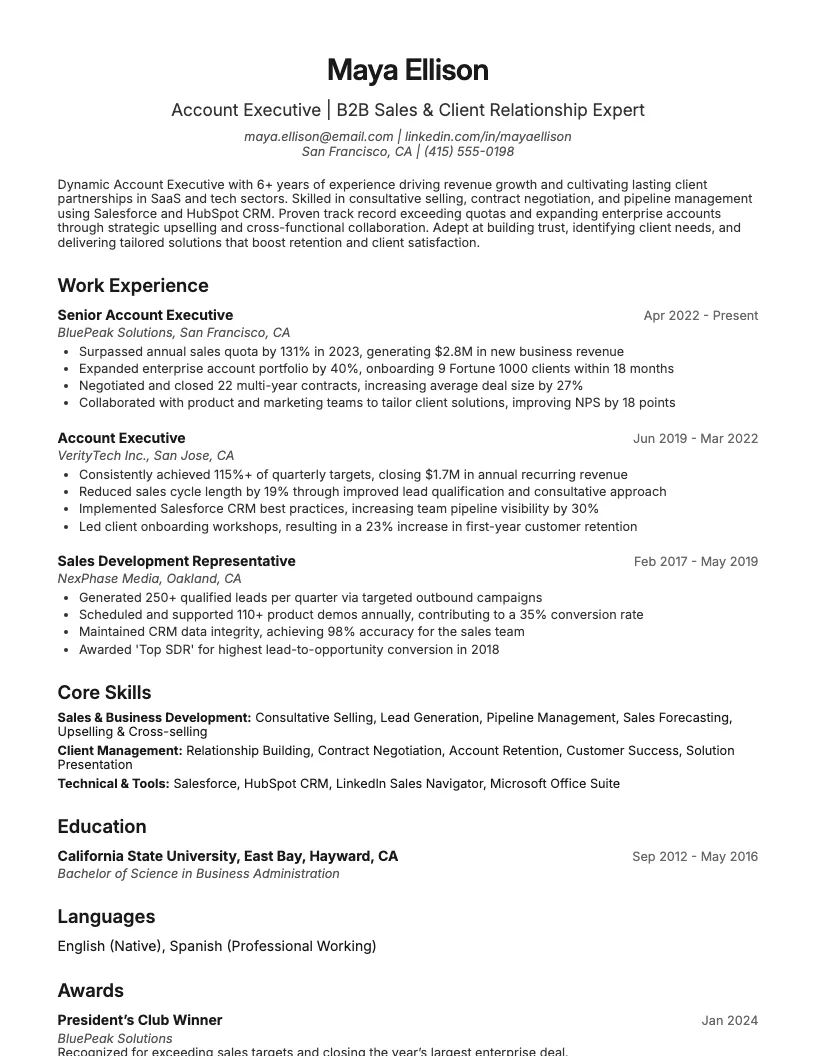
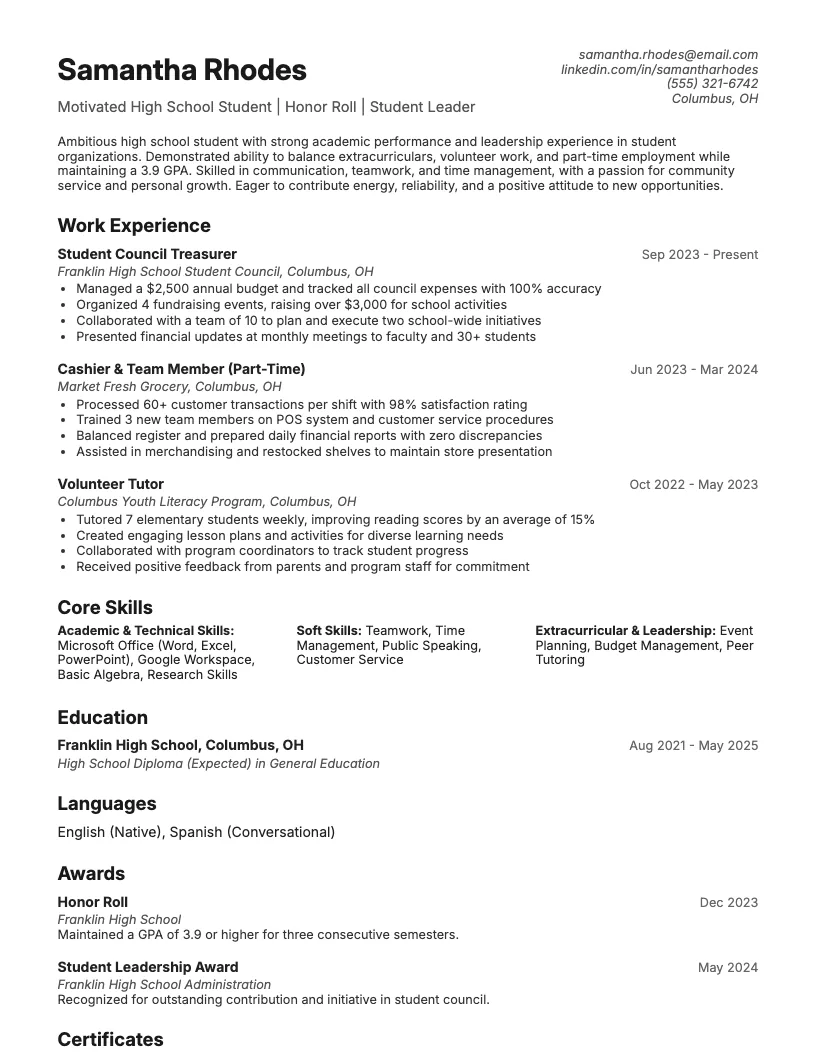
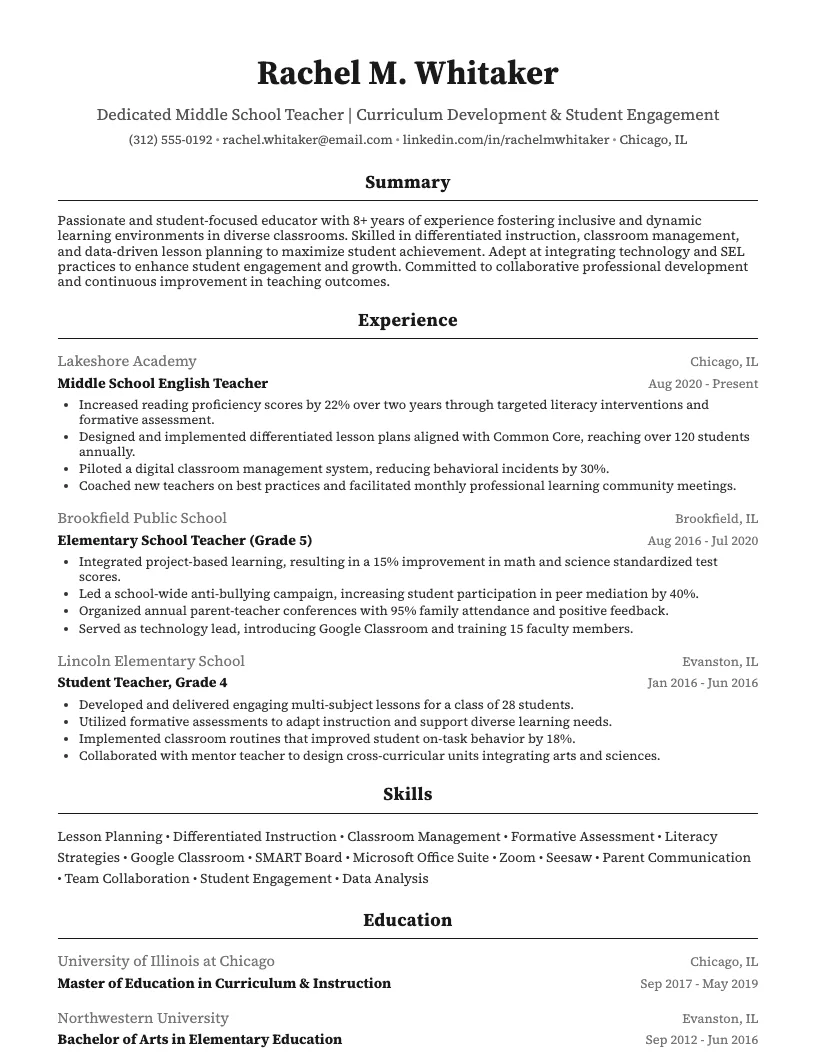
See these skills on a real resume
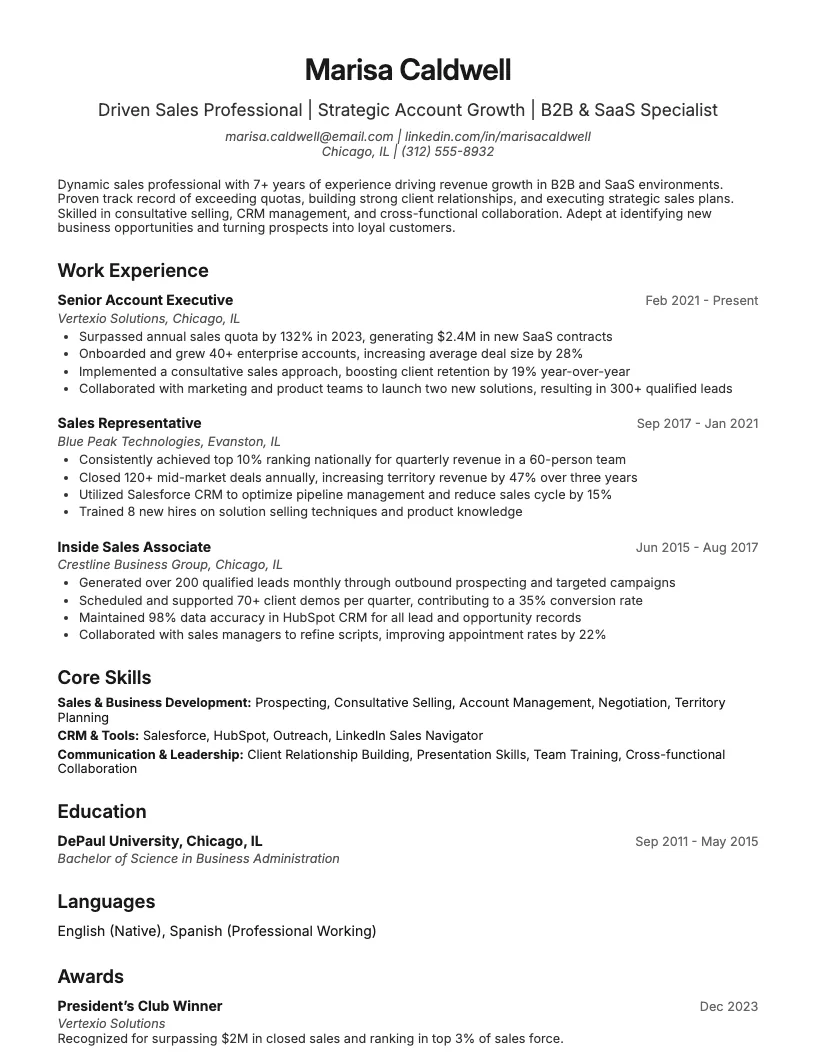
8 examplesStart from an example that already has them, and swap in your own.
Check your resume against the job you want
Scan your resume, see which skills and keywords the posting asks for that you are missing, and fix them before you apply.
Free to use • No credit card required