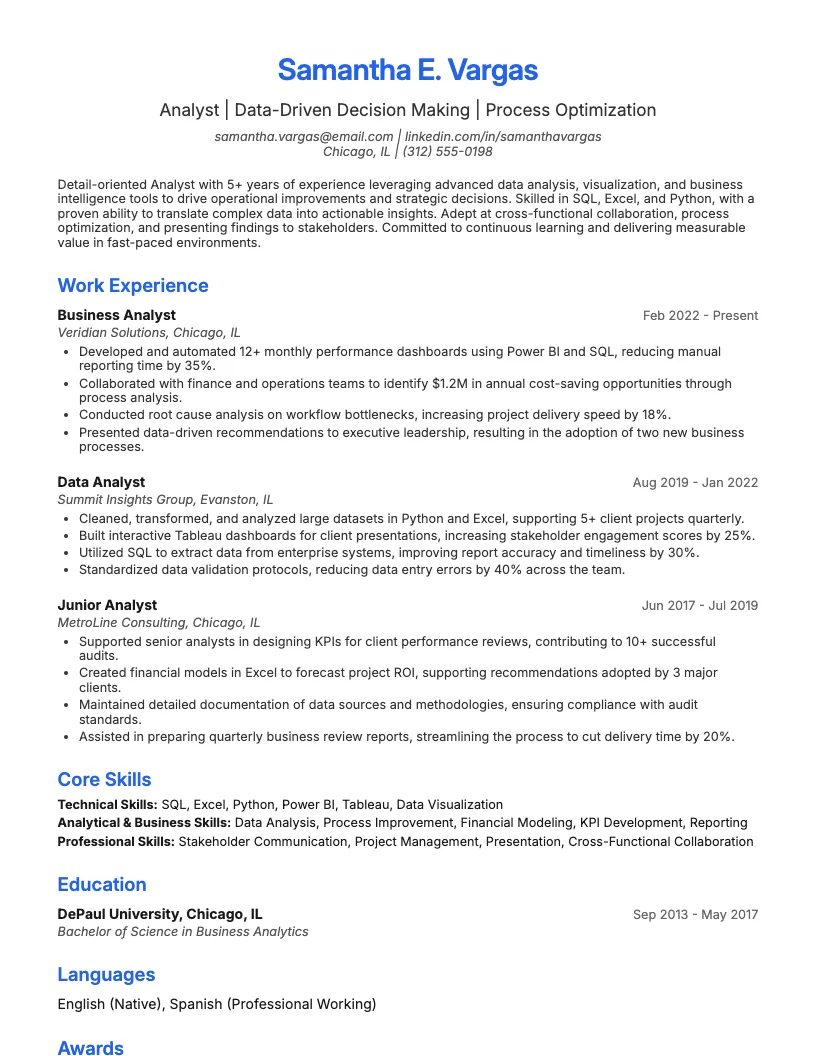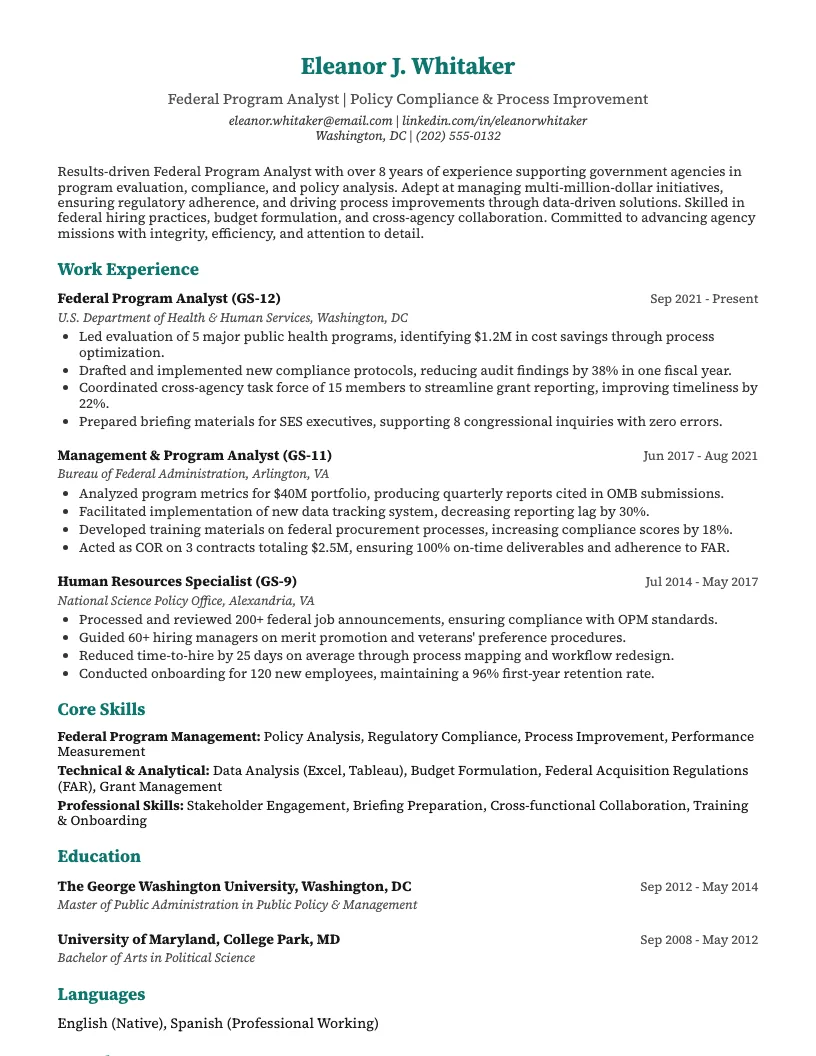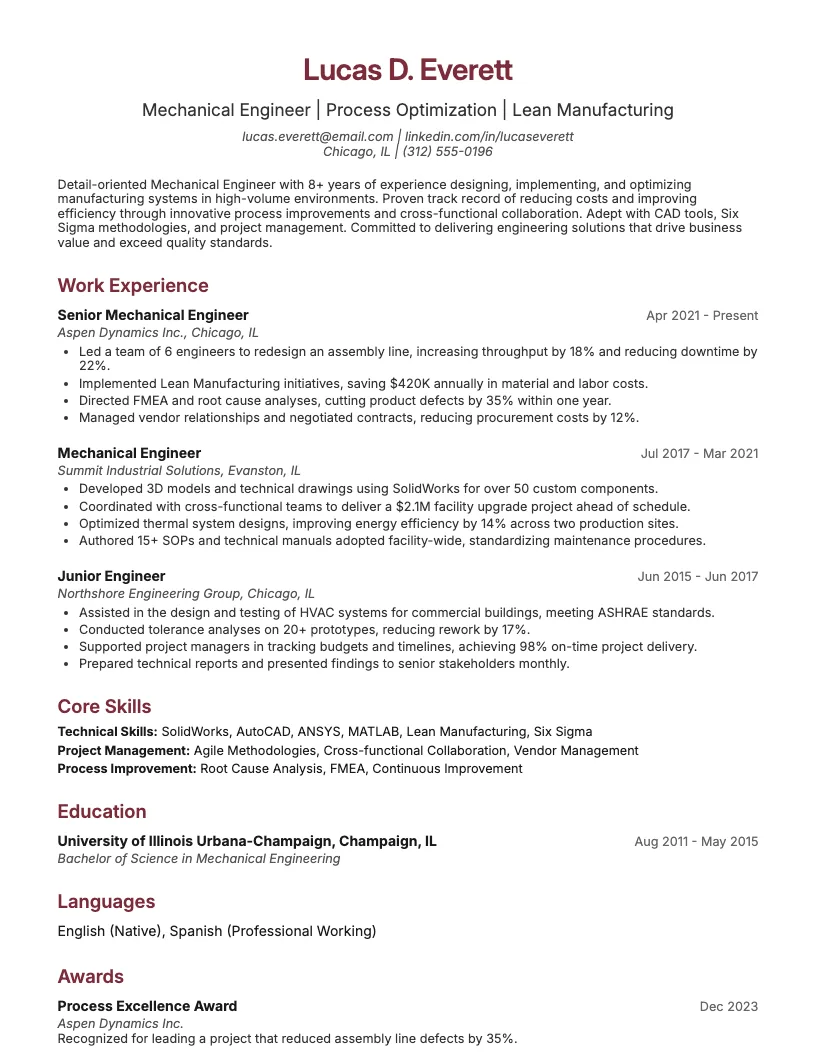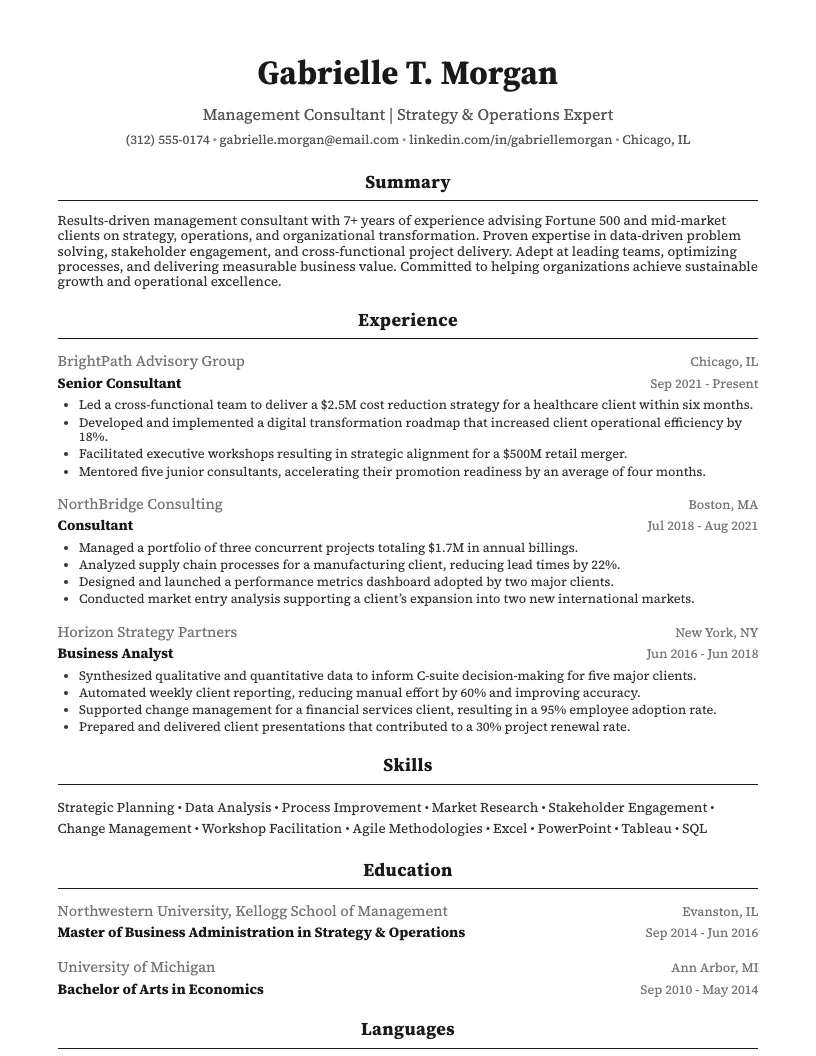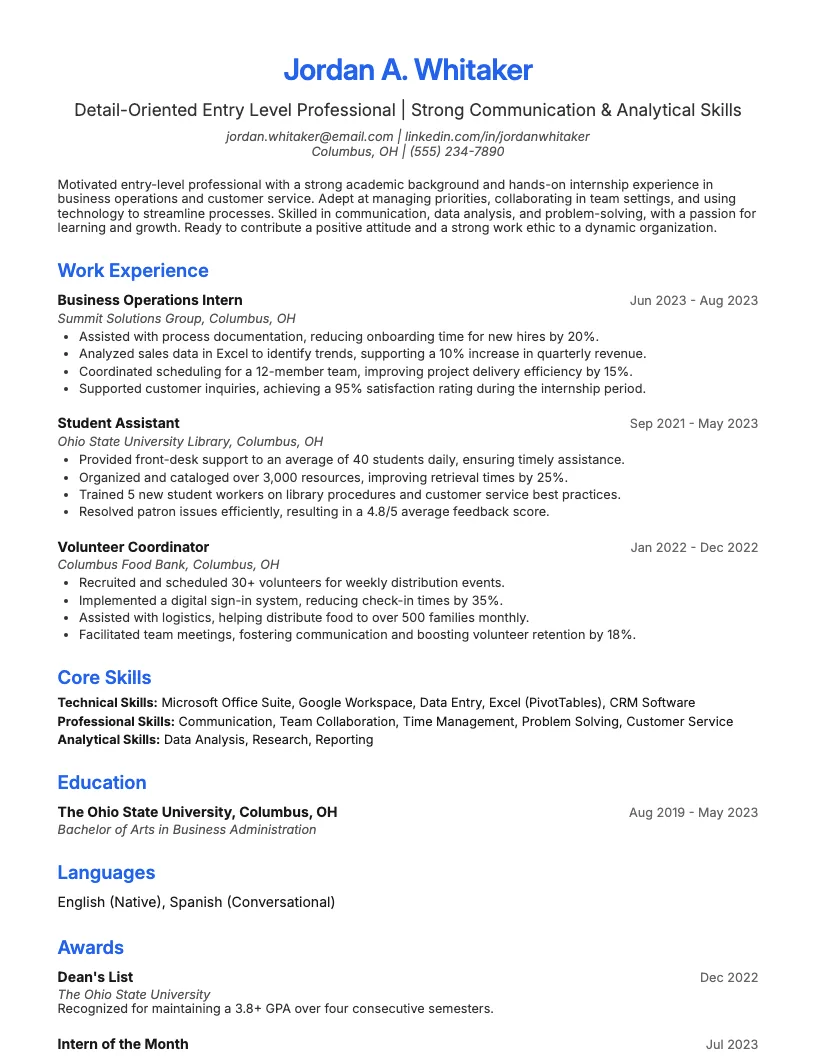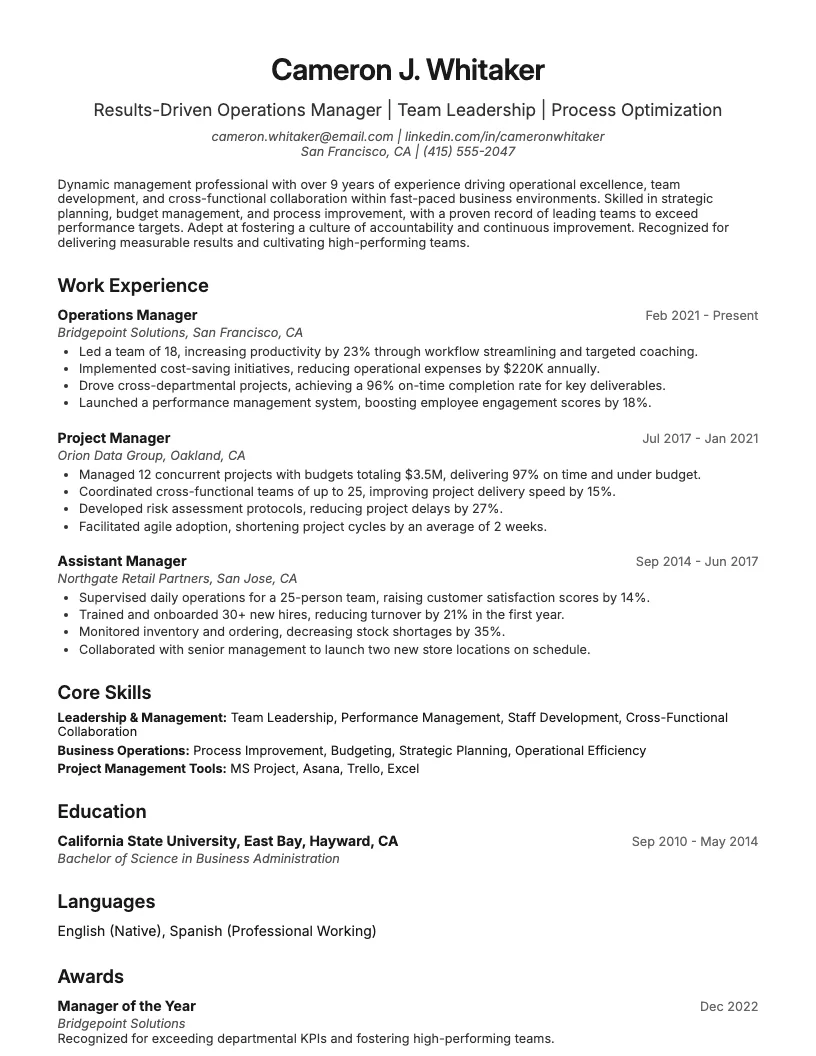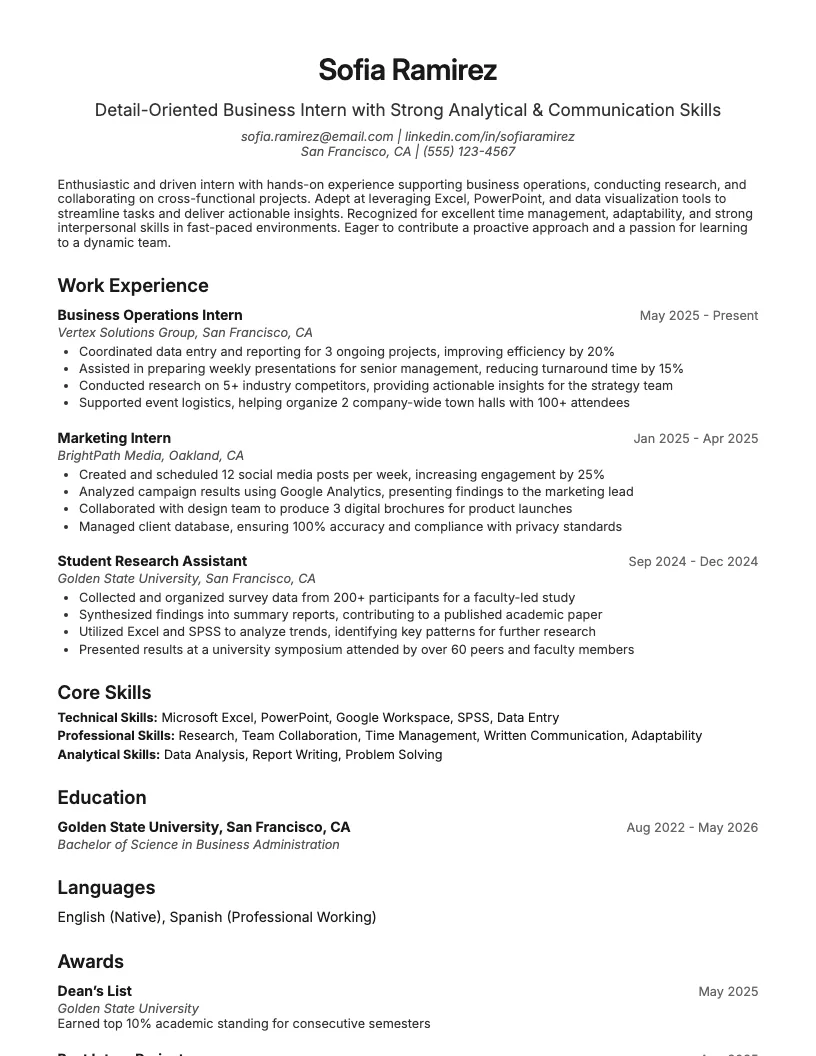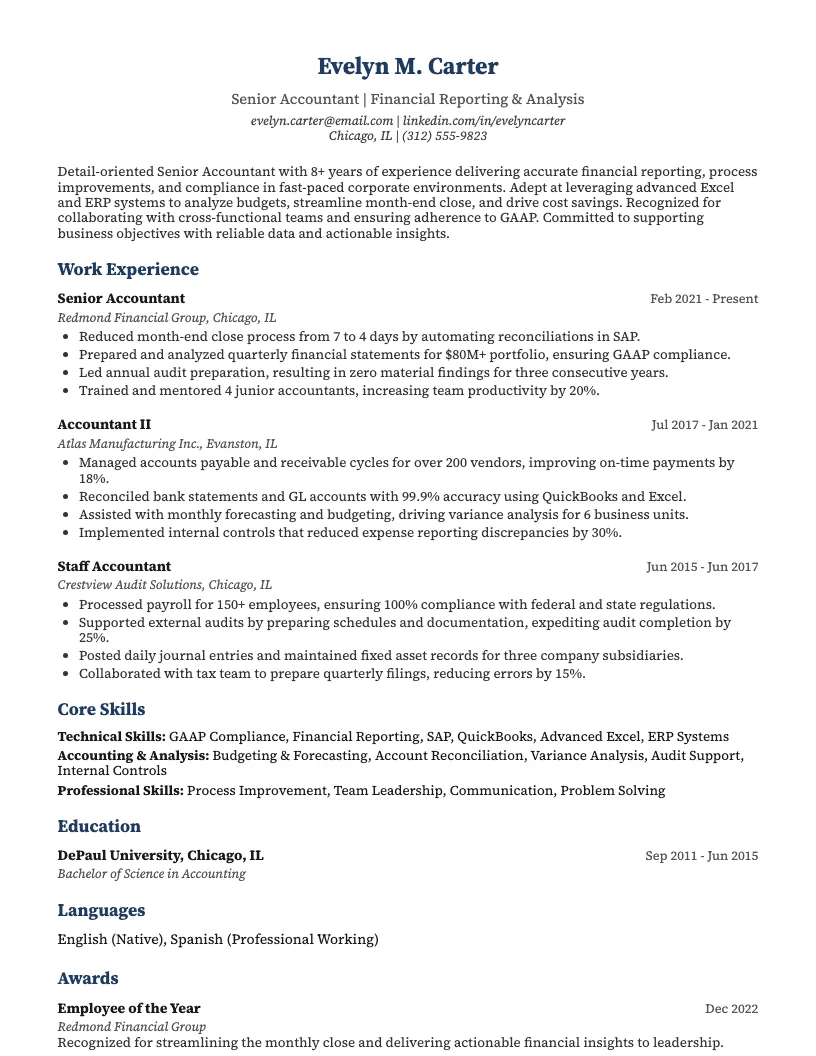
Systems Analyst Resume Example
See full guide on Systems Analyst resumes Click to enlarge
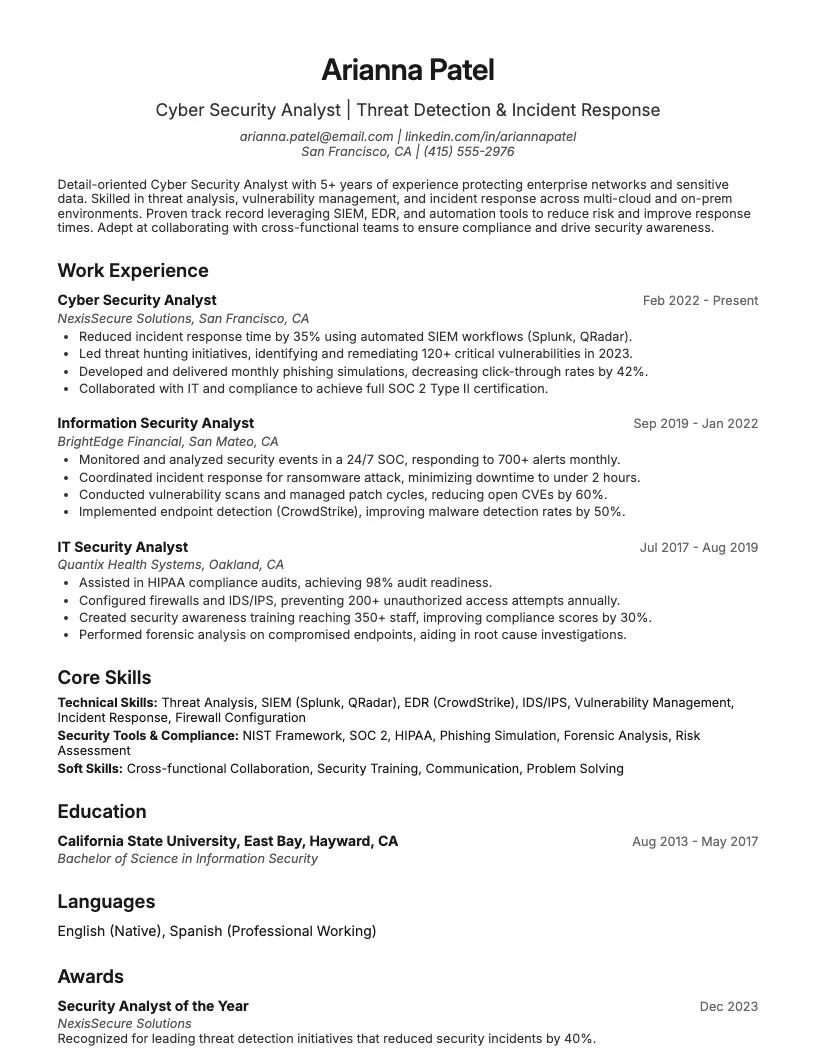 Click to preview

Get inspired by 50+ professional Cyber Security Analyst resume examples, each written by career experts and optimized to pass ATS scans. Pick a proven template, tailor it to your role, and download a polished resume in minutes.
Pick the specialization closest to your target role and start from a proven resume example.
Breaking into cyber security? I’ve got a resume example that shows what hiring managers actually look for in this fast-growing field.
You’ll see real achievements, technical skills, and industry certifications that help candidates land interviews. Use this as inspiration or tailor it to match your own background.
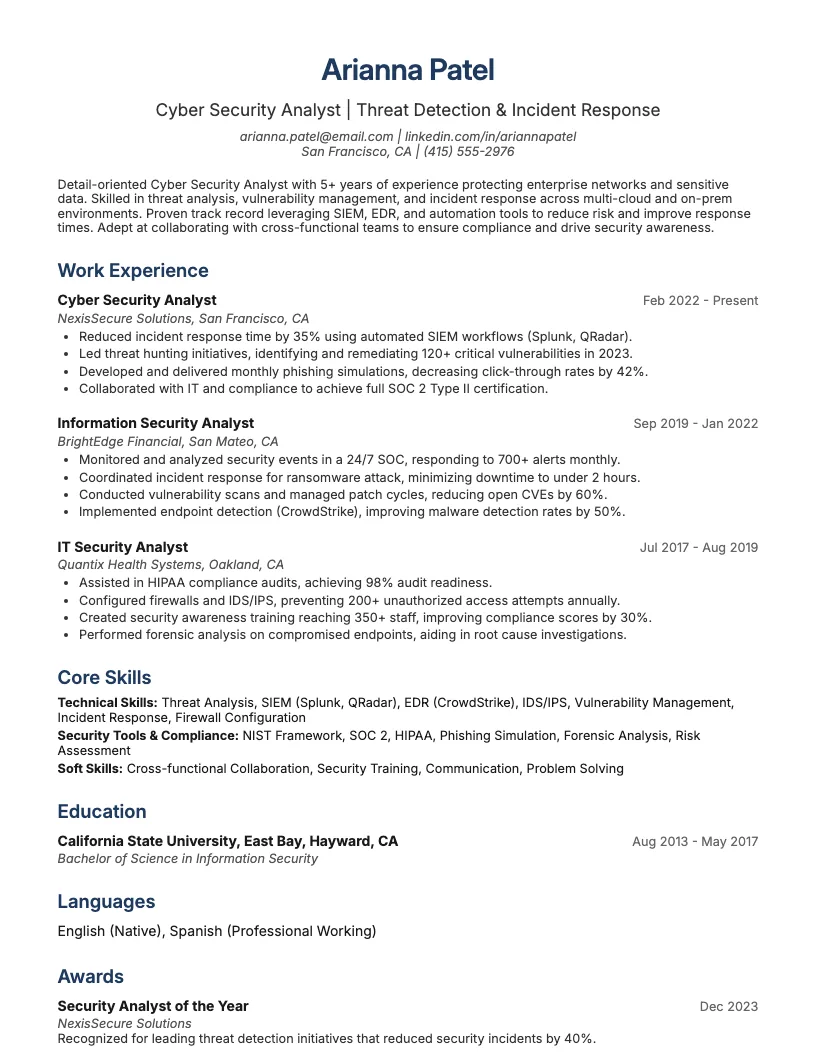
I want to show you what a strong cyber security analyst resume actually looks like. Here’s a real example, packed with the details recruiters look for.
The best resumes highlight technical skills, certifications, and hands-on experience. You’ll see clear sections for expertise, certifications, and achievements-this helps your profile stand out.
Focus on numbers. If you help reduce incidents by 20% or manage security for 500+ users, say so. Specifics like these make your impact obvious to employers.
There are a ton of cyber security analyst roles out there-everything from SOC analyst cover letter to threat intelligence specialist. Each one needs a slightly different resume focus.
If you’re targeting a junior role, show hands-on experience with basic tools. For more senior jobs, highlight project leadership and certifications like CISSP or CEH.
Your resume should reflect the unique skills each job description asks for. This helps recruiters spot your fit fast and boosts your chances of landing an interview.

Getting your resume format right can make a huge difference. A clean, organized layout helps recruiters spot your skills fast, especially in cyber security roles.
You want your resume to be easy to scan. Recruiters spend less than 7 seconds on each resume, so structure and format really matter here.
I’ll walk you through the best formats, design tips, and what information you need to include. Let’s make your experience stand out from the start.
I always recommend a reverse-chronological or hybrid resume format for cyber security analyst roles. These formats show off your recent experience and technical skills right up front.
You want to lead with your most recent work-especially projects from the last two or three years. This helps recruiters see you’re up-to-date with the latest threats and tech.
I like to group tools and certifications by function-like SIEM, EDR, or cloud security. This makes it easy for hiring managers to scan for what matters most in under 10 seconds.
Be sure to use clear dates for each experience. This helps show your career progression and how much time you’ve spent on key responsibilities.
I always stick with a one-page layout if I have less than 10 years in cyber security. Two pages work only if your experience is really extensive.
Use two columns to keep your technical skills and experience easy to scan. This helps recruiters spot key info in seconds. I keep my margins between 0.5"-1" for readability.
Pick a clean, professional font like Arial or Calibri, size 10-12 pt. Avoid fancy graphics or icons-these can confuse applicant tracking systems (ATS) and hide your skills.
A neutral color scheme with subtle accent hues looks professional. I like to use clear section headings and bullet points to organize content. This keeps everything readable and sharp.
I always put my full name, phone number, professional email, and LinkedIn at the very top. If you have a portfolio or GitHub, add those links too.
Skip your photo, full address, or age. Recruiters focus on skills and experience-not personal details. About 70% of hiring managers check LinkedIn, so keep it updated.
When saving your file, go with something straightforward like FirstName_LastName_CyberSecurityAnalyst.pdf. Use PDF format to keep your layout and fonts looking clean on any device.
You want your resume to highlight the right details. I always include a summary, work experience, skills, certifications, and education. These sections give a clear picture of your background.
You can also add relevant projects, especially if you’re newer or pivoting into cyber security. Use bullet points with numbers. This helps hiring managers see your real-world impact fast.
That’s the basic structure I recommend. Keeping things organized makes your strengths and achievements stand out, which is what really gets you noticed.
Your summary or objective is the first thing recruiters see. It’s short-usually three or four sentences-but it makes a big impact.
If you’re new to cyber security, a strong objective can highlight your goals and strengths. For those with experience, a summary lets you show off your top achievements fast.
Tailoring this section for each job is key. I always focus on years of experience, certifications, and any measurable results that back up my skills.
Next, I’ll walk you through how to craft a compelling summary or objective, and share examples for entry-level candidates.
Your summary or objective sits right at the top, so it’s your first impression. I always treat these few lines as my personal elevator pitch.
You want to mention your years of experience, key certifications, and one or two top achievements. This instantly shows recruiters you’re a solid fit.
Tailor every summary or objective for the company and job. Use keywords from the job posting-this helps you pass ATS filters and catch a recruiter’s attention fast.
If you’re just starting out, go with a resume objective. Focus on your certifications, transferable skills, and your genuine interest in cyber security.
Here’s a sample:
Recent IT graduate with CompTIA Security+ certification. I’m eager to apply strong analytical skills and hands-on project experience to help protect your company’s digital assets.
You can also mention any cybersecurity competitions or relevant coursework. This shows you’re proactive and passionate-even if you don’t have years of experience yet.
A short, direct objective works best. Stick to two or three sentences and use industry keywords to help your resume pass ATS scans.
Your experience section is where you show hiring managers your real impact as a cyber security analyst. It’s not just about listing tasks-it’s about results.
Focus on the tools you use, the problems you solve, and the numbers that prove your value. Every bullet should highlight your skills and contributions, not just your responsibilities.
I always start my experience section with my most recent role and work backward. This reverse-chronological approach helps recruiters see my current skills first.
Each entry should list your job title, company, location, and the dates you worked there. Keep it clear and easy to scan.
Focus on what you achieved, not just what you did. Swap out generic tasks for specific results-this shows real impact and highlights your value.
Use action verbs and mention the tools or frameworks you use, like Splunk or MITRE ATT&CK. This helps your resume stand out with recruiters and applicant tracking systems.
Remember, you want hiring managers to quickly spot your expertise in threat detection, incident response, or vulnerability management. Make every bullet count.
Numbers matter-a lot. When I write my experience bullets, I always show how much risk I’ve reduced or how fast I’ve responded, not just what I did.
You can point out metrics like MTTR (mean time to respond), number of vulnerabilities patched, or false-positive rates. This helps hiring managers understand your real impact.
Tools and frameworks also count. If you’ve rolled out CrowdStrike or mapped detections to MITRE ATT&CK, call it out. Quantifying scope-like 10,000 endpoints secured-makes your achievements pop.
You want your resume to show that you’re not just stuck in the same spot. I always highlight promotions, new responsibilities, or projects that prove I’ve grown.
If you’ve stepped up during an incident, led a cross-team project, or mentored junior analysts, call it out. These moments show you’re ready for the next level.
Numbers matter too. For example, “Promoted to Senior Analyst in 18 months after reducing incident response time by 30%.” This kind of detail really shows upward momentum.
When I update my resume, I always mirror the exact language from the job posting. If the ad says “EDR platforms” or names tools like CrowdStrike, I mention my hands-on experience with those.
You should highlight the scope and metrics the employer cares about. If the job talks about 50,000 endpoints or MTTR, I show numbers and results that match those expectations.
Don’t forget to call out frameworks and compliance needs like MITRE ATT&CK or NIST. Using their keywords helps your resume pass ATS filters and connects directly with what hiring managers want.
Doing this makes your achievements stand out. It shows you understand their environment-and you’re ready to jump in. That’s what gets your resume noticed.
Getting your skills section right is a game-changer. Employers look for up-to-date technical know-how and solid interpersonal strengths on every cyber security analyst resume.
I usually break skills down into “hard” and “soft.” Each plays a big part in landing interviews and passing ATS scans. Let’s dig into what matters most.
Let’s kick things off with the technical side. Cyber security analysts need a mix of hands-on tools, programming, and knowledge of security frameworks. It’s not just about listing buzzwords.
You want to show real expertise in areas like SIEM, EDR, cloud security, network protocols, and compliance standards. For example, Splunk, Microsoft Sentinel, or NIST CSF stand out on a resume.
I always suggest grouping your skills-network security, cloud tools, automation, and forensics. This helps recruiters and ATS systems spot your strengths fast and keeps your resume tidy.
You need more than just technical skills. Strong communication counts, especially when you’re explaining risks to non-technical teams. I always mention clear incident reporting and cross-team coordination.
Analytical thinking and decision-making under pressure are key. Employers look for people who can quickly spot threats and act fast. I add real examples to back up these claims.
You can also highlight mentoring, emotional intelligence, and organization. This shows you work well with others and can manage multiple priorities. Soft skills round out your profile and help you stand out.
I don’t just list skills-I show them in action. I drop keywords into my summary and each work experience bullet, always tied to a specific result.
You can include technical and soft skills in project descriptions or achievements. For example, mention how you used Splunk to reduce incident response times by 30%.
This helps recruiters see your value fast. Integrating skills throughout your resume, not in isolation, makes your expertise obvious and credible. That’s how you stand out.
Certifications often matter more than degrees for cyber security analyst roles. They show you have current, job-specific skills that hiring managers actually look for.
You want to keep your education section short and relevant. List your most recent or important degree, plus any key certifications right near the top.
Certifications signal real-world skills to hiring managers. You want to show you’re up-to-date on the latest security threats, tools, and frameworks-not just theory from college.
Some of the top ones I see everywhere: CISSP, CompTIA Security+, CEH, CySA+, GSEC, and OSCP. These pop up in over 70% of job postings.
If you’re new, start with CompTIA Security+ or CySA+. For experienced analysts, CISSP or OSCP really boost your credibility. Pick what matches your skill level.
I always recommend listing the full certification name, the issuer, and the year you earned it. This helps recruiters verify your credentials quickly and keeps things transparent.
I always keep my education section clear and compact. I list my most relevant degree, the school name, and graduation year-no fluff, just the key facts.
If you’re still in school, add your expected graduation date. Only include your GPA if it’s above 3.5 and you’re early in your career. This helps show strong academic performance.
Skip degrees that don’t match the cyber security field. If you picked up hands-on experience during your studies, use a bullet or two to highlight it. That rounds out your credentials nicely.
You want your resume to show you do more than just the basics. Extra sections can highlight what makes you different in cyber security.
Adding projects, awards, or freelance work proves your hands-on experience. These sections often help hiring managers see your real strengths right away.
I always add an Awards section if I’ve won any cybersecurity competitions or hackathons. This proves I can think fast and solve real problems under pressure.
You might also list Freelance Work or volunteering. Projects outside a full-time job show off hands-on skills. Employers value self-motivation and diverse experience.
Don’t forget about Languages if you speak more than one. In global teams, this helps you stand out-especially if you’re applying to multinational companies.
Writing a cyber security analyst resume means showing your technical skills and your impact. Recruiters only spend about 7 seconds on each resume, so every word counts.
You want your profile, experience, education, and skills sections to work together. I’ll walk you through what to highlight and how to keep things clear and relevant.
Your profile is your first impression. I always start with my title, years of experience, and a few standout skills. This helps recruiters see my fit right away.
Focus on what sets you apart. Mention unique tools or approaches, like SIEM platforms or cloud security. Align your profile with the roles you’re targeting for more impact.
Keep it short-five lines max. Use strong keywords from the job description. This boosts your chances with Applicant Tracking Systems and real people alike.
Focus on what you actually achieved in each role. Don’t just list your duties-show how your actions made a difference, like reducing incidents by 30% or detecting threats faster.
Use numbers and specifics. For example, say “Identified and remediated 50+ vulnerabilities in a Fortune 500 environment,” instead of just “monitored security.” This helps your impact stand out.
Highlight tools and methods you use-think SIEM, firewalls, or incident response. Employers want to see real, hands-on experience and measurable results in your bullet points.
You want to list your degree up front-usually a bachelor’s in cybersecurity, information technology, or computer science. If you have a master’s, definitely show it off.
Certifications matter a ton in this field. CISSP and CompTIA Security+ stand out for most employers. About 70% of job posts ask for at least one certification.
I always put the most recent or advanced credential first. This helps recruiters spot what matters fast and matches you to automated screening systems.
I always list my top technical skills, like SIEM tools, vulnerability assessment, and incident response. This helps applicant tracking systems (ATS) pick up my resume for the right roles.
You want your skills section to match the keywords in each job post. For example, if a job mentions SOC monitoring or risk analysis, make sure you highlight those skills—especially if you're applying for entry-level roles where a cover letter can help you stand out.
Don’t forget soft skills like problem-solving and attention to detail. These matter just as much as technical know-how. Wrapping up, a focused skills list strengthens your whole resume.
Cyber security offers so many career paths. I see roles ranging from analysts to engineers, each with different skills and certifications.
If you’re exploring your options, checking out other resume examples helps a lot. You can see what works for specific job titles in this fast-growing field.
There are a few key cyber security resume types that hiring managers see most often. Choosing the right type boosts your chances of landing interviews.
Some folks focus on technical skills with hands-on experience in scripting or automation. Others highlight incident response or compliance work. You want to show what you do best.
If you’re just starting out, I suggest you show off personal projects, lab work, or certifications in progress. This helps prove your passion and potential to employers.
If you’re eyeing information security analyst roles, your resume needs to stand out. There are over 150,000 jobs posted each year, so competition stays strong.
I always focus on results. Show how you help reduce risks, run audits, or respond to incidents. Numbers like "reduced threats by 40%" grab attention fast.
Tailor your resume with certifications like CISSP or CompTIA Security+. This helps you look credible and shows you’re serious about information security analyst work.
That wraps up the main cyber security resume types. Ready to tackle your next application? Use these examples as a guide and highlight what makes you unique.
Browse Cyber Security Analyst resume examples for related roles. Preview any example, open it in the builder, or read its full guide.
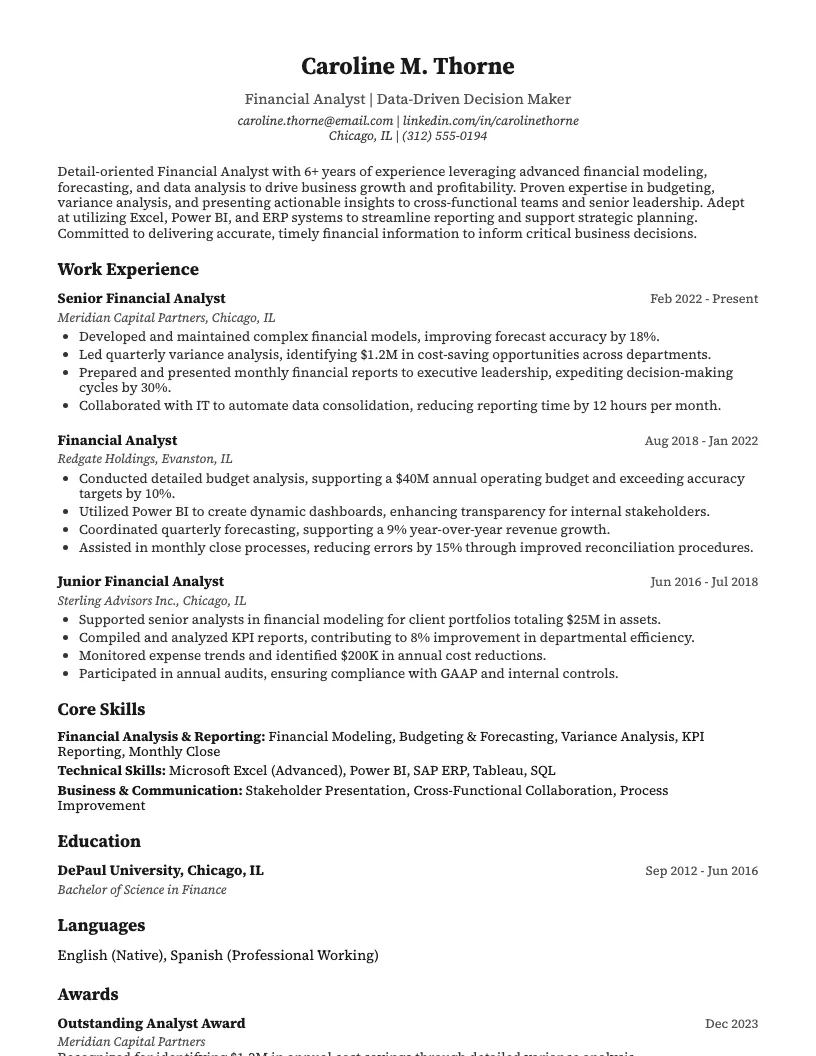
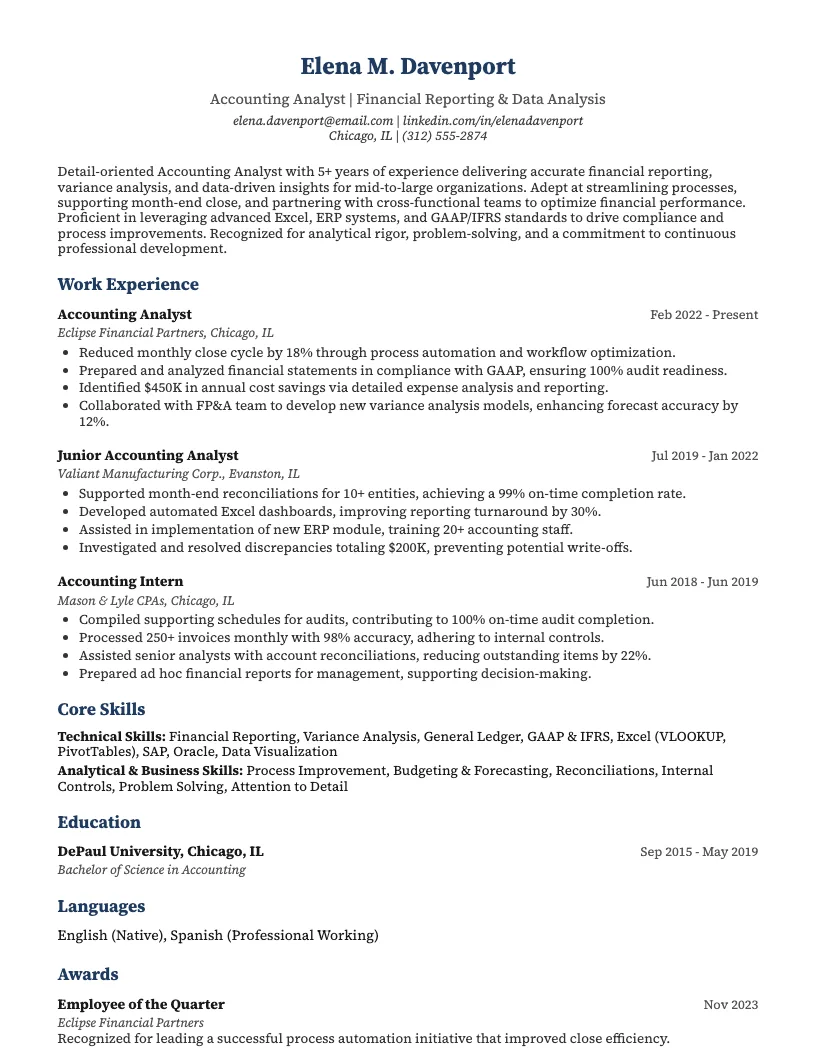
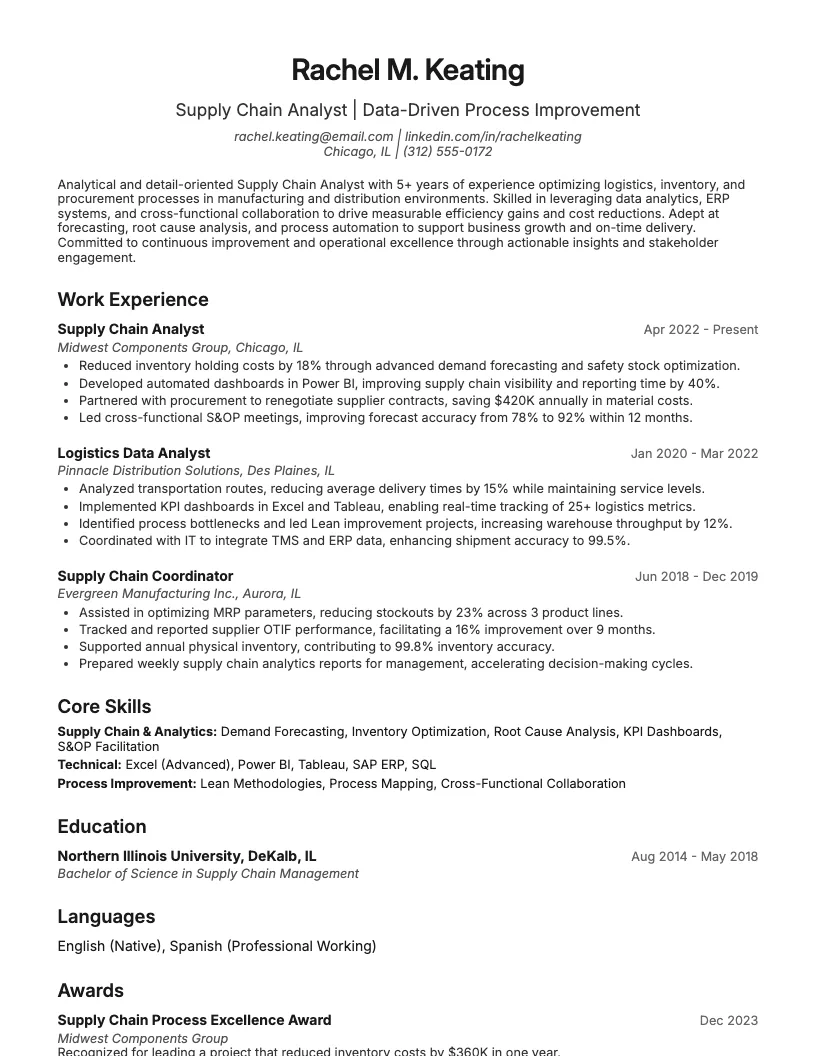
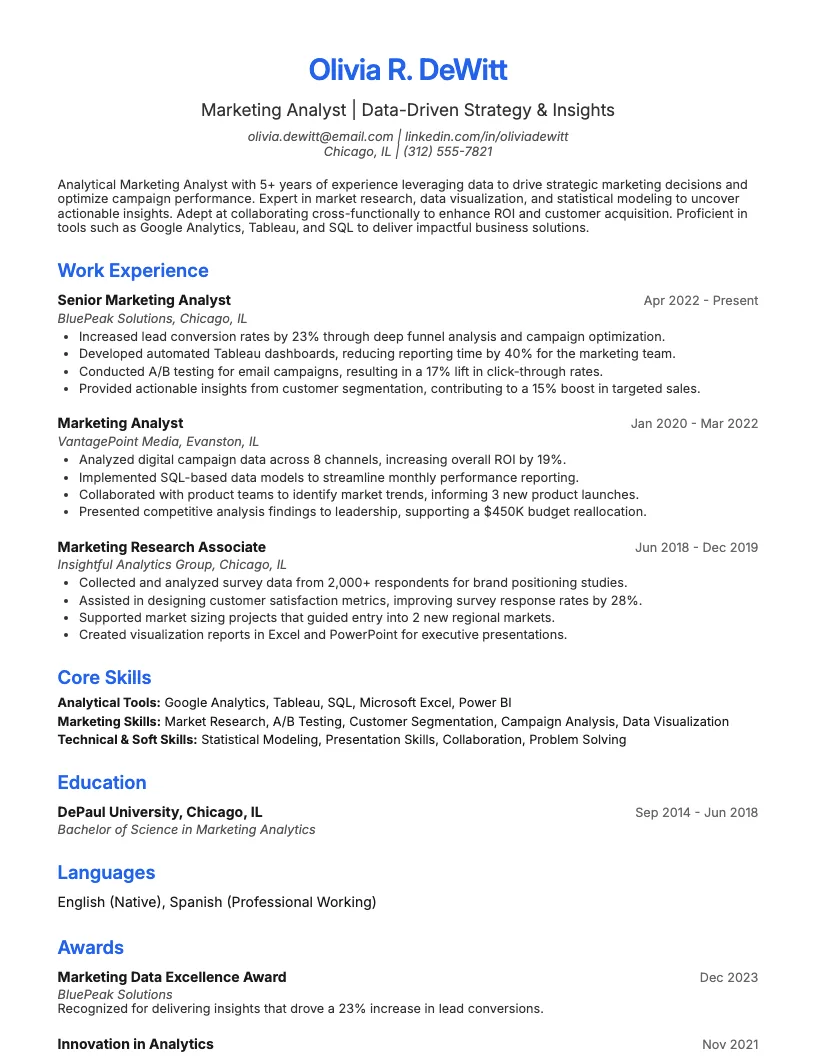
Click to enlarge Click to enlarge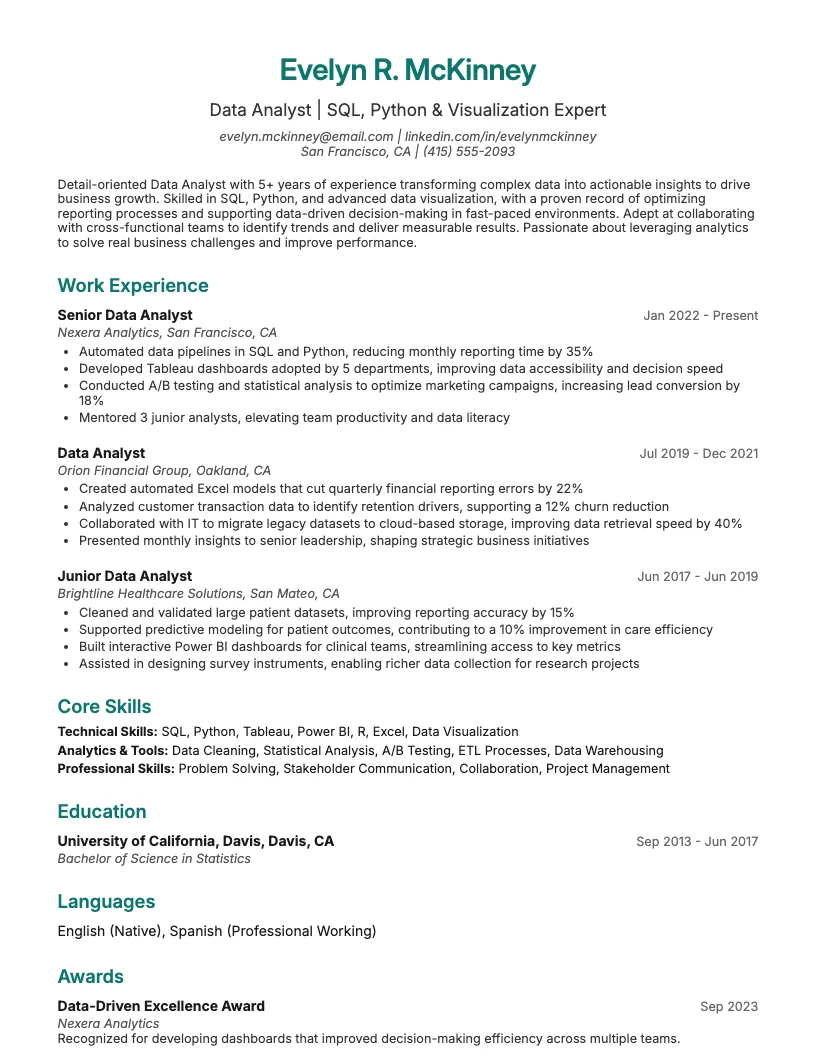 Click to enlarge
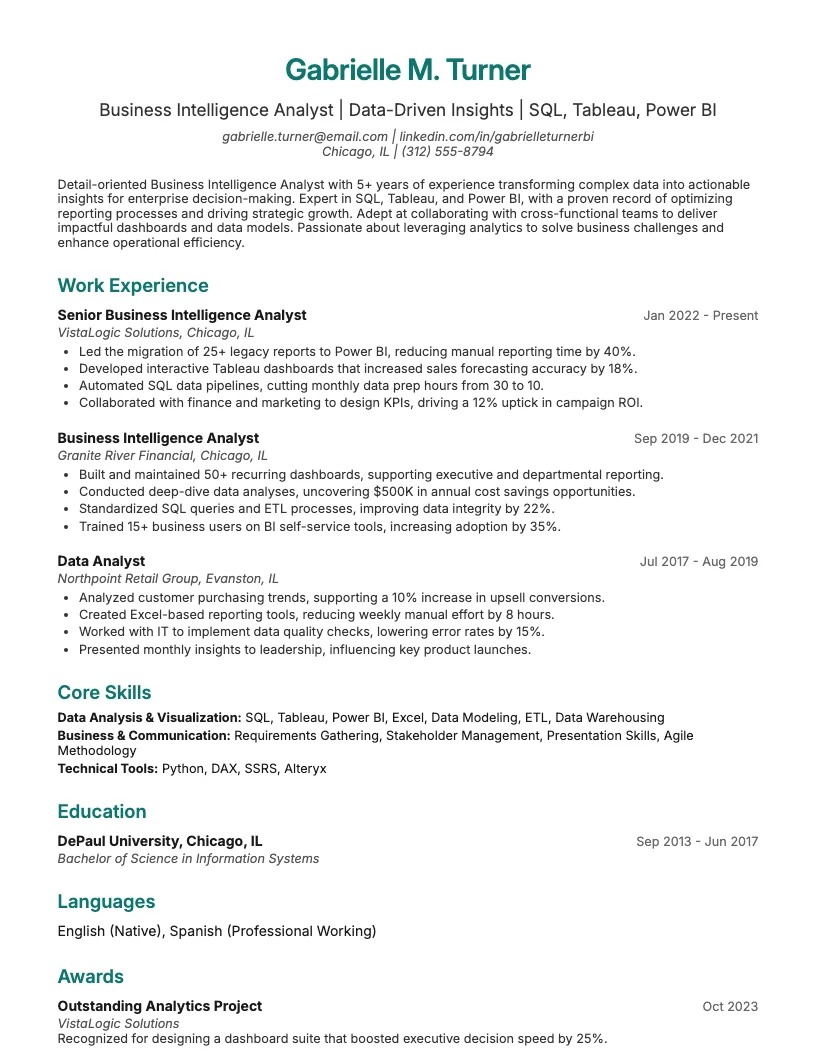 Click to enlarge
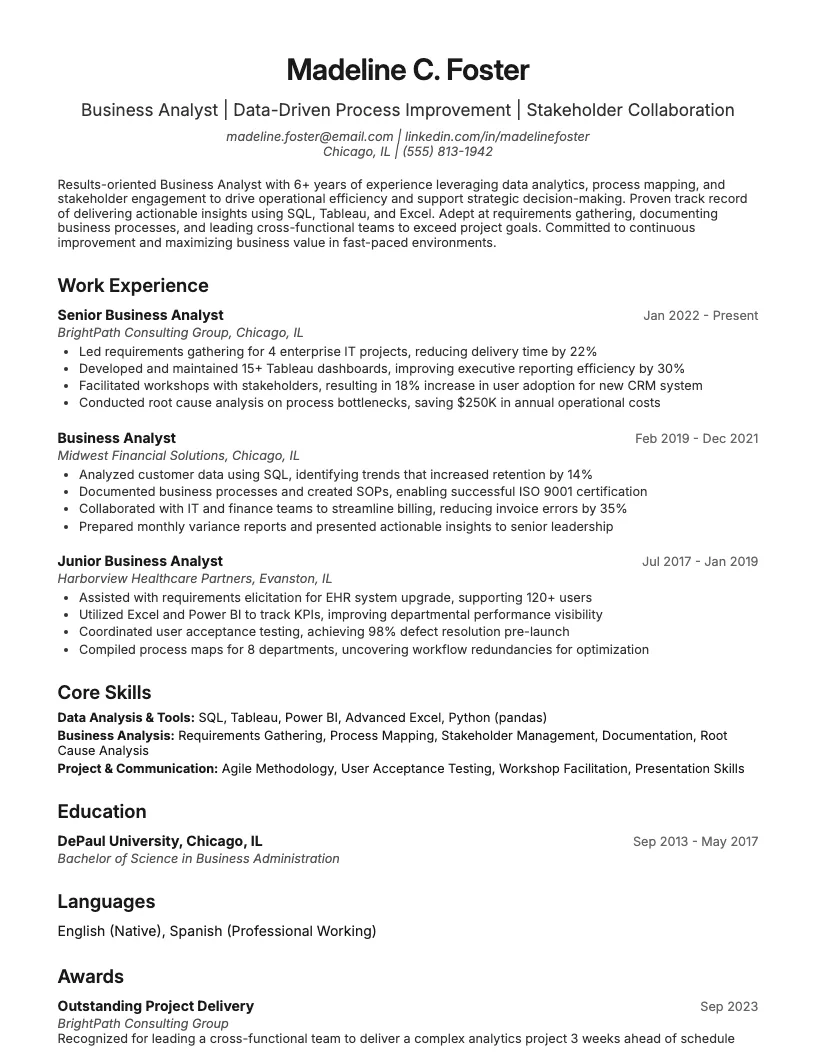 Click to enlarge
 Click to enlarge
 Click to enlarge
 Click to enlarge
 Click to enlarge
Common questions about Cyber Security Analyst resumes
A Cyber Security Analyst resume template is a pre-designed layout tailored for security professionals. It highlights key skills, certifications, and experience in threat analysis, incident response, and cybersecurity tools.
Yes, ResumeJudge’s templates are ATS-friendly, using clean formatting and standard headings. This ensures your resume passes automated screenings and reaches recruiters easily.
Use this template when applying to roles in IT security, finance, government, or healthcare. It’s ideal for jobs requiring skills in risk assessment, SOC operations, or compliance.
Absolutely! ResumeJudge lets you tailor sections, fonts, and content to match your experience and target job. Add certifications, specialized skills, or unique projects easily.
Cyber Security Analyst templates focus on technical skills, security certifications, and incident response experience. General templates may lack dedicated sections for tools like SIEM or EDR, which ResumeJudge includes.
Aim for a one-page resume if you have under 7 years of experience, or two pages for extensive experience. ResumeJudge helps you prioritize content to keep it concise and impactful.
Include a summary, technical skills, certifications, work experience, education, and relevant projects. ResumeJudge templates ensure all key sections are covered.
List certifications like CompTIA Security+, CISSP, or CEH prominently under a 'Certifications' section. ResumeJudge makes it easy to showcase these and boost your credibility.
Yes! ResumeJudge templates help entry-level applicants highlight coursework, labs, and internships. Career changers can showcase transferable IT or analytical skills.
Use a dedicated 'Technical Skills' section to list tools like Splunk, Wireshark, or CrowdStrike. ResumeJudge templates guide you to organize and present these for maximum impact.
Explore more professional resume examples to inspire your job search
Use our AI-powered resume builder to create a professional, ATS-friendly resume in minutes.
Free to use • No credit card required