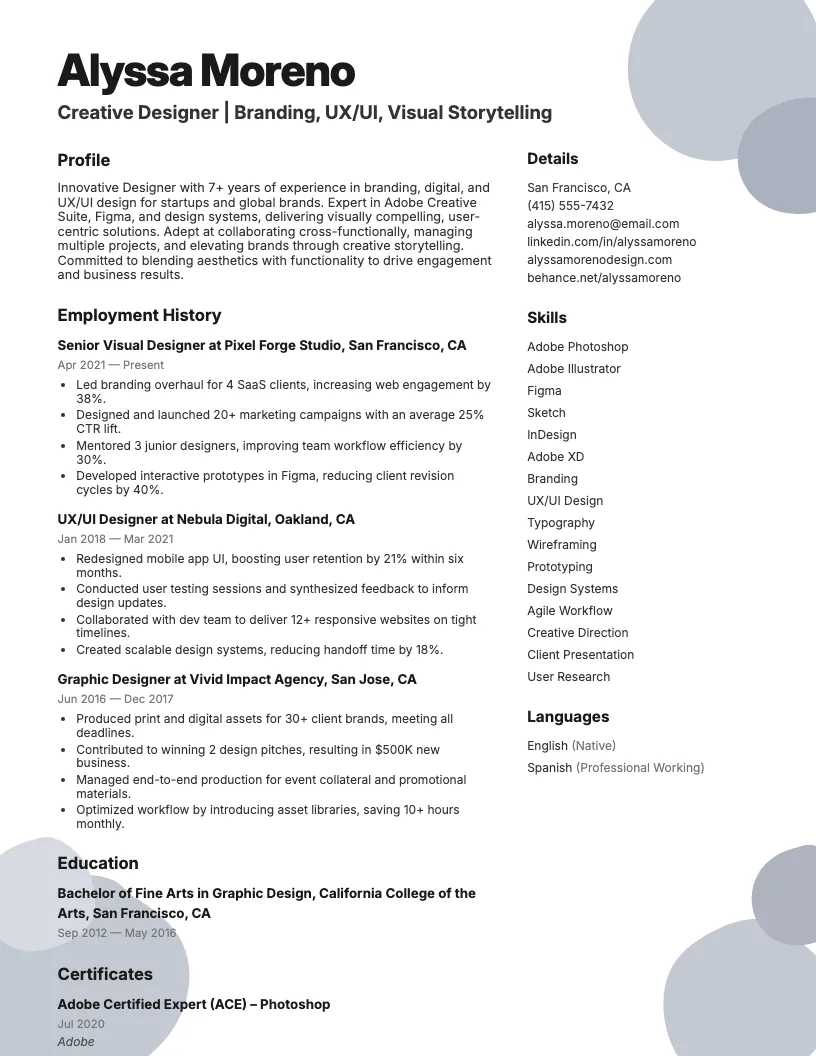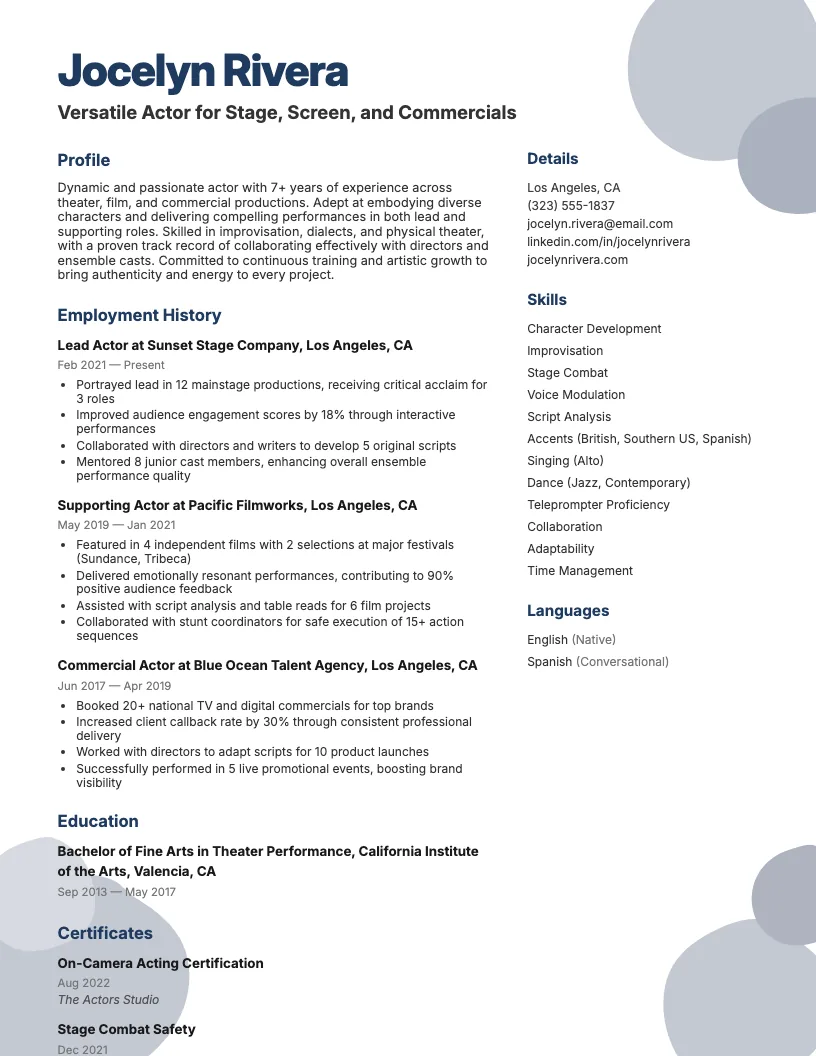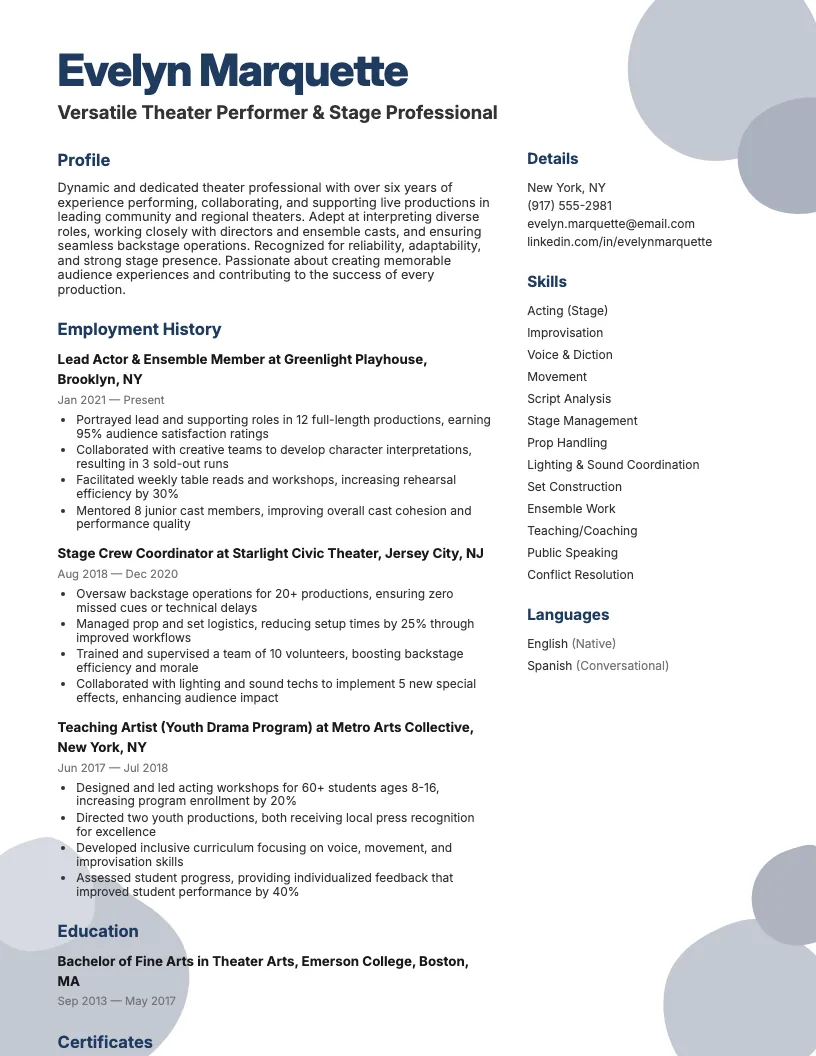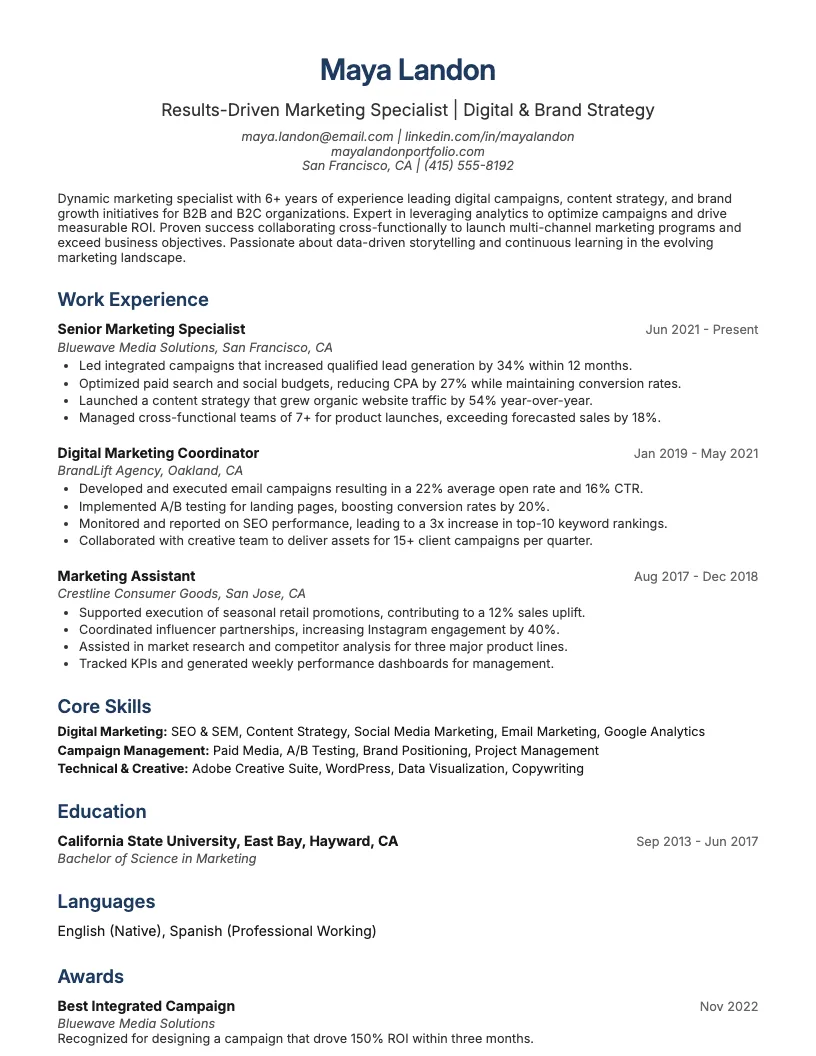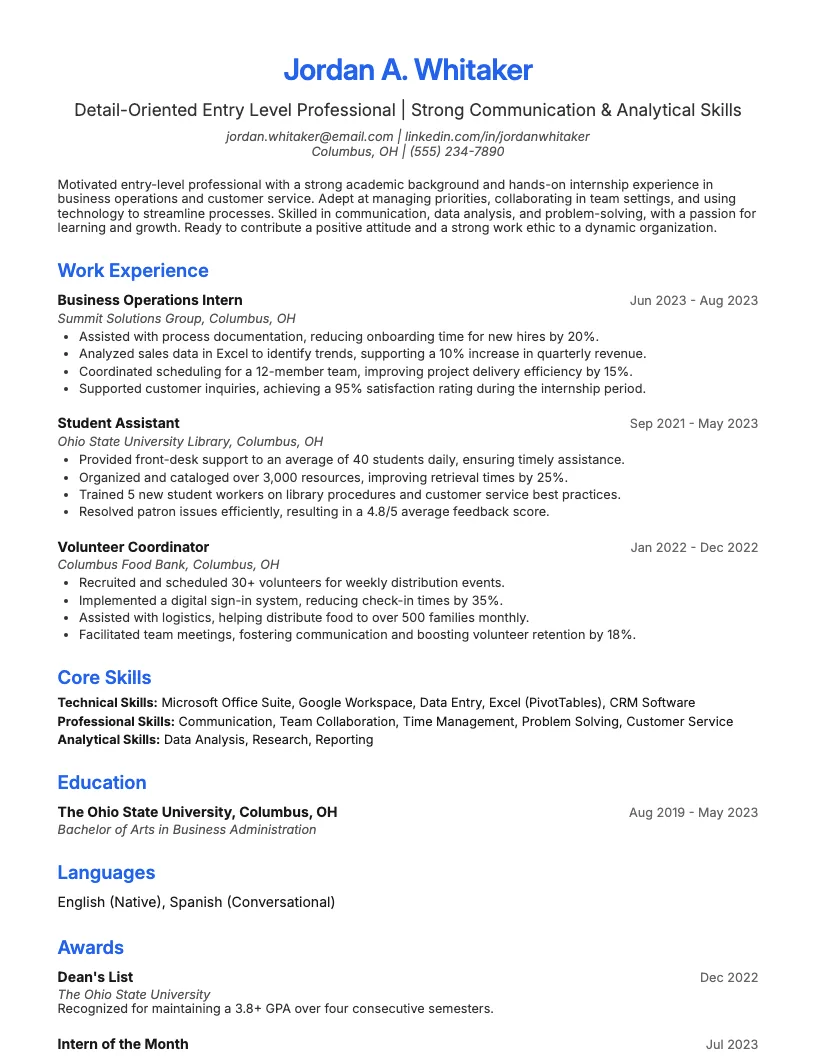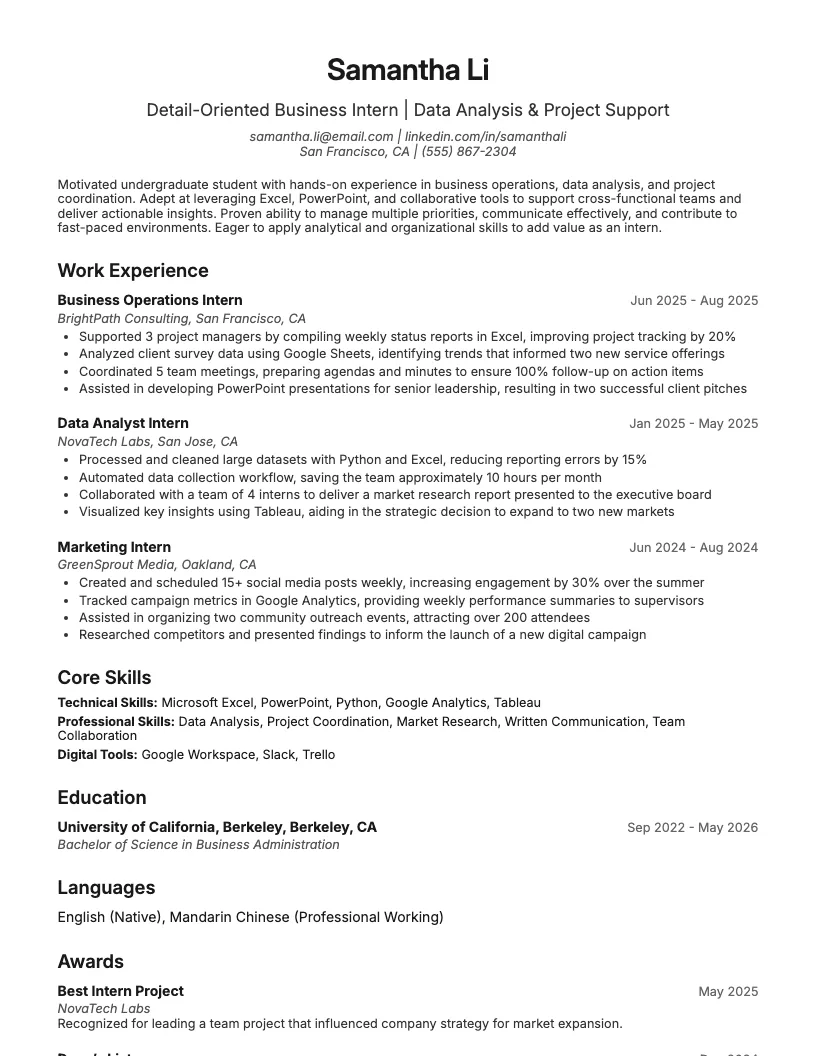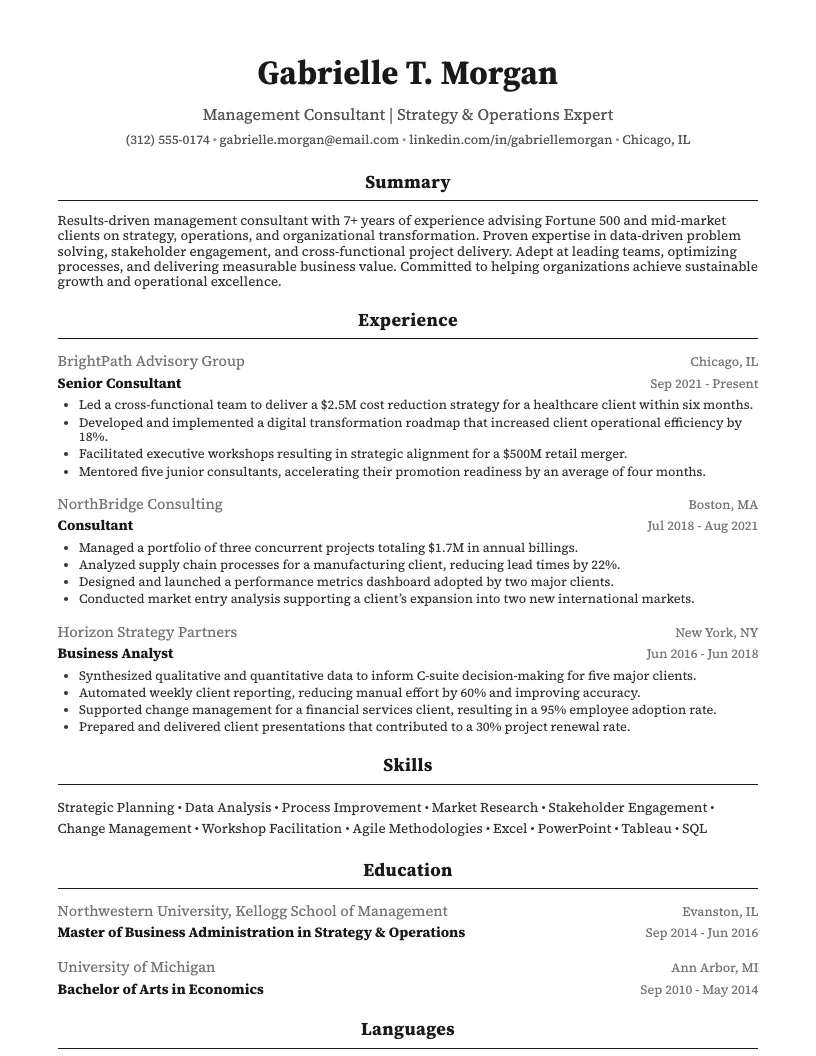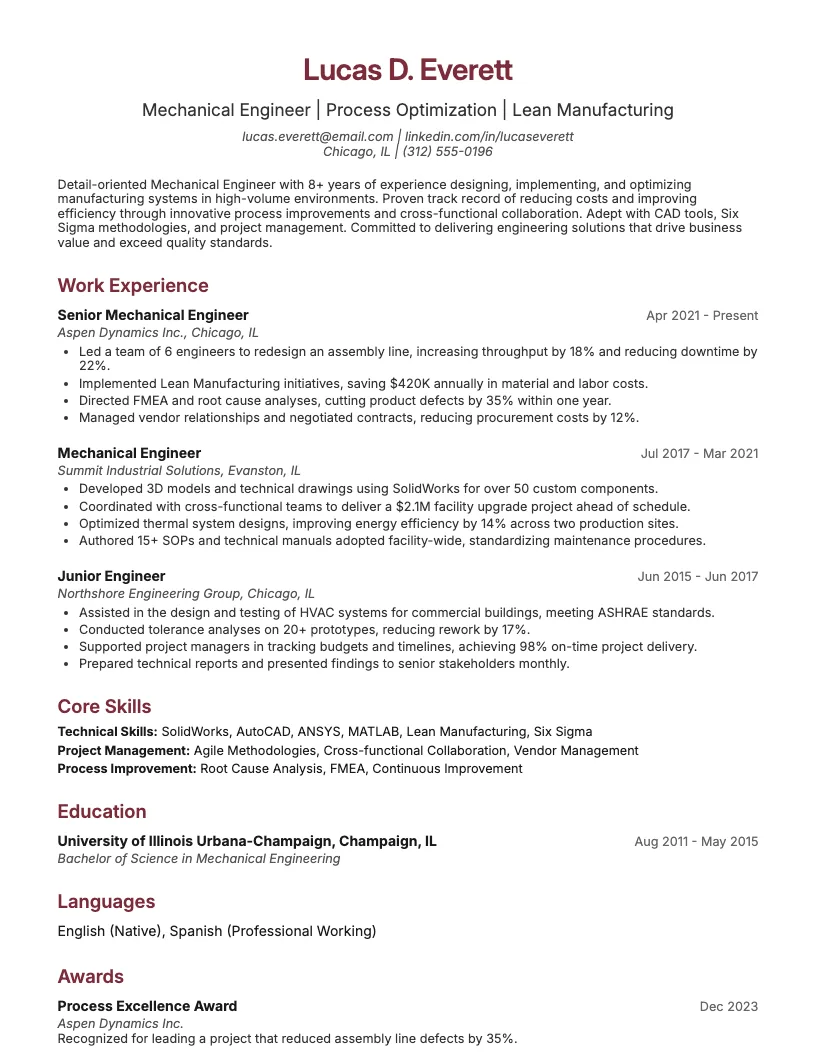
3D Motion Graphics Artist Resume Example
See full guide on 3D Motion Graphics Artist resumes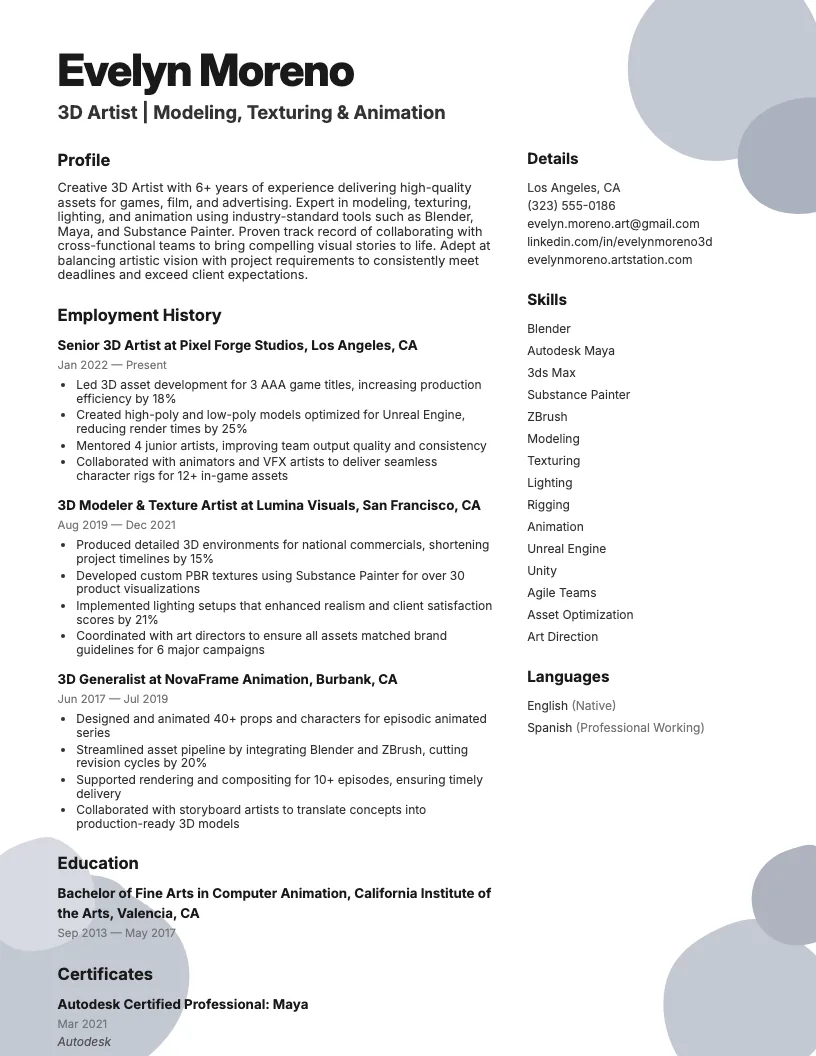 Click to enlarge
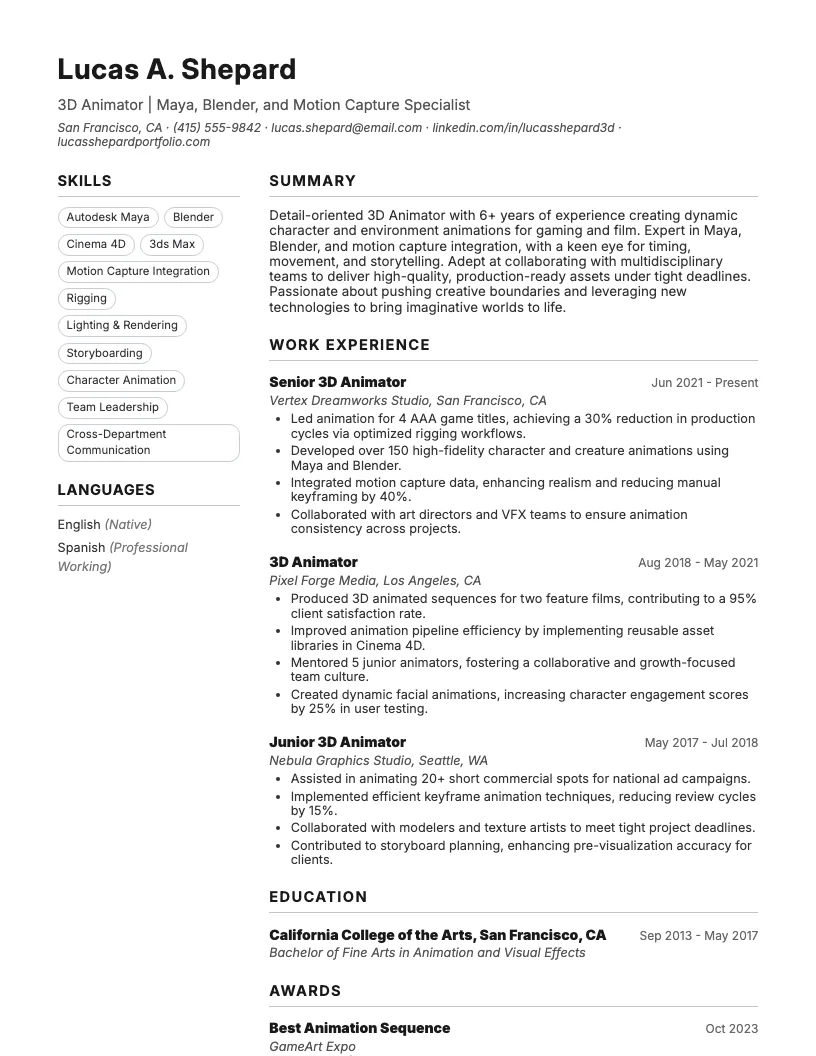 Click to preview

Get inspired by 58+ professional 3D Animator resume examples, each written by career experts and optimized to pass ATS scans. Pick a proven template, tailor it to your role, and download a polished resume in minutes.
Pick the specialization closest to your target role and start from a proven resume example.
3D animators design and animate characters, objects, or environments for movies, games, ads, and more. It’s not just about cartoons-lots of industries need this skill.
I model, texture, and animate digital assets using software like Maya or Blender. I focus on making things look realistic or stylized, depending on the project.
You need strong technical and artistic skills. Most 3D animators work in teams, often with tight deadlines and lots of feedback. Creativity and attention to detail matter every day.
3D animation jobs are growing fast. The U.S. Bureau of Labor Statistics says demand for animators and special effects artists is up 16% by 2030.
If you're considering this field, you can expect a median salary around $77,700. There's demand in film, gaming, advertising, and more, so plenty of options out there.

Writing a 3D animator resume means more than listing your skills. You want recruiters to see both your technical talent and your creative experience right away.
You need to pick the right format, show off your best work, and keep things clear. Every section counts if you want your resume to make it past the first glance.
I’m going to break down the layout, formatting tips, and the must-have sections. I’ll also share what studios and recruiters actually look for in a 3D animator resume.
Picking the right resume format is step one for 3D animators. I always recommend reverse-chronological order-recruiters and applicant tracking systems (ATS) both prefer it.
This format highlights your most recent projects and skills first. It makes it super easy for recruiters to follow your career path and see what you’ve achieved lately.
If you’re new to animation or have a non-linear work history, you can try a combination or functional format. These spotlight skills over experience, which can help if you’re just starting out.
You want your resume to look professional but stay easy to read. Stick to a clean design, use lots of white space, and avoid hard-to-read fonts.
I always recommend keeping color subtle-maybe just one accent shade. Too many graphics or wild fonts distract from your skills and make ATS systems glitch.
Keep your resume between one and two pages. If you have over ten years of experience, two pages are fine. Save your file as a PDF unless the employer says otherwise.
First off, every 3D animator resume needs a header with your contact info and a link to your portfolio. This helps recruiters get in touch fast and check your work.
Always include a summary or objective up top. Use 2-3 sentences to highlight your years of experience, specialties, and career goals—drawing inspiration from a 3D Animator Cover Letter Example can help you tailor this section for each job.
Your experience section shows off your technical skills and teamwork. List jobs in reverse-chronological order. Focus on relevant achievements, software, and project types, not just duties.
Don’t skip the skills section. List both technical skills, like Maya or Blender, and soft skills, like communication or problem-solving. Pick the ones that match the job description.
Finally, add education and certifications. Name your degree, school, and graduation year. If you have animation-specific certificates, like Autodesk Certified Professional, make them stand out.
Recruiters look for evidence of your animation skills-so always link a portfolio. I find that showing a range of styles and projects speaks louder than any job title.
Technical skills matter a lot. List specific software like Maya, Blender, or 3DS Max. If you know scripting or have experience with Adobe Creative Suite, mention those too.
Highlight your professional experience-especially if you’ve shipped projects or worked with tight deadlines. Numbers help here, like “completed 15+ animations for commercial clients.”
Don’t forget the basics. Recruiters like to see you understand animation principles-timing, motion, and anatomy for character work. Creative problem-solving is a bonus recruiters always mention.
Show off your attention to detail and ability to work in a team. These soft skills often make the difference between getting an interview or not.
Your summary or objective is the first thing recruiters notice. It’s your chance to give a snapshot of your skills, achievements, and goals in about 3-4 lines.
If you’ve got experience, a summary highlights your best work. If you’re new or switching fields, an objective shows your passion and fit for the role.
Getting this section right makes a big difference. Next, I’ll break down examples you can use or tweak for your own resume.
I always start my resume summary by highlighting years of experience and naming key software, like Maya or Blender. This shows hiring managers my technical strengths right away.
You can use your summary to mention big wins, like an industry award or a project that got over 500,000 views. This helps your application stand out.
For an objective, I focus on what I want to learn or where I want to grow. If you’re switching careers, say how your skills transfer to 3D animation.
There’s no need to write a novel-3-4 lines is enough. Just keep it specific, personal, and packed with results or your vision for the role.
This is where you show off your real-world skills. Recruiters want to see more than job titles-they look for impact, achievements, and the tools you use daily.
Highlight what you actually accomplished in each role. Use numbers and facts to back up your work. This is your chance to show results, not just responsibilities.
When I show off my 3D animator experience, I always use numbers. Completed 20+ projects? That’s way more convincing than just “worked on projects.”
You want to highlight things like project budgets, team sizes, or viewer stats. If your animation hits 100,000 views or wins two awards, recruiters notice.
There are lots of ways to quantify your impact. You can mention how much you reduced production time or improved client satisfaction. This helps your achievements stand out.
If you're starting out as a 3D animator with no formal experience, don't stress. I focus on a skills-based resume to show what I can actually do.
You can highlight transferable skills like teamwork, problem-solving, or software knowledge. Projects, school assignments, even personal animation work-these all count.
It's smart to use a strong objective statement, and pairing it with a tailored Animator Cover Letter Example can further boost your application. This helps recruiters see your motivation and unique strengths right away. Tailor it to each job you apply for.
Mention any specialized software you know, like Maya or Blender. Even if it's self-taught, it shows initiative and relevant skills studios love.
Just remember, everyone starts somewhere. Show what you bring to the table now and keep building from there.
When I put together a 3D animator resume, I focus on both technical and creative skills. Employers want to see a mix of software expertise and teamwork.
You want to list hard skills like Maya, Blender, or ZBrush, but don’t forget soft skills. Communication, adaptability, and attention to detail matter just as much in this field.
Tailoring your skills section to the job description helps you get past applicant tracking systems and straight to a hiring manager’s desk.
Education and certifications play a big role in landing 3D animator jobs. Most studios like to see a bachelor’s degree, but it’s not always required.
If you’ve got certifications in tools like Maya or Blender, definitely show them off. Recent certifications and ongoing courses show you’re staying current.
Awards, honors, and even projects from school or online courses can make you stand out. I always mention anything that highlights my skills or creativity.
I always recommend adding industry-recognized certifications like Autodesk Certified Professional or Unity Certified 3D Artist. These show you understand the tools studios want.
If you specialize in rendering, the V-Ray Certified Professional from Chaos Group is a strong choice. It demonstrates you know advanced lighting and rendering techniques that employers value.
Don’t forget about Blender Certification from Blender Foundation. It’s a solid way to prove your skills in open-source software, especially since Blender has over 3 million users worldwide.
Sometimes the basics just aren’t enough. If you want your 3D animator resume to stand out, extra sections can make a real difference.
Highlighting awards, major projects, or unique hobbies gives employers a fuller picture of who you are. These details often help you connect beyond your job skills.
You want a 3D animator resume that stands out, no matter your experience. I know it’s tough to show off technical skills and creativity in just one page.
I’ve put together resume examples for every stage-entry-level, mid-career, and expert. You’ll see what actually works for each experience level.
I see a lot of 3D animator resume examples that highlight both technical skills and creative projects. These resumes often show off portfolios, software expertise, and real animation results.
If you want your resume to stand out, you can add numbers-like “animated 12+ short films” or “improved rendering times by 30%.” This helps recruiters see your impact right away.
You don’t need to follow one template. There are 3d animator resume examples that use bold headers, clean designs, or even subtle color to show personality. Try a few styles and see what fits you best.
A strong 3D animator resume highlights both your technical skills and creative projects. Recruiters want to see real examples, so link to your portfolio whenever possible.
Customize your resume for each job. Tailoring your experience and skills to the job description helps you stand out, especially in competitive industries like animation.
Showcase results and details from past roles, even if they’re internships or freelance gigs. You can demonstrate value by listing project outcomes or client feedback.
Your resume layout should be easy to read. Use a clean design that lets your work and experience shine, making it simple for recruiters to find key info fast.
I always start by researching job descriptions. This helps me pick the right keywords and skills-like Maya, Blender, or Unity-so my resume matches what studios want.
You should add a direct link to your online portfolio. Studios and recruiters want to see your actual work, not just read about it. This makes your talents easier to access.
It’s smart to highlight any industry variety. 3D animation pops up in film, gaming, and advertising, and if you're targeting the gaming industry, reviewing a Game Animator Cover Letter Example can help tailor your application. Mentioning diverse projects, even internships, can show your range.
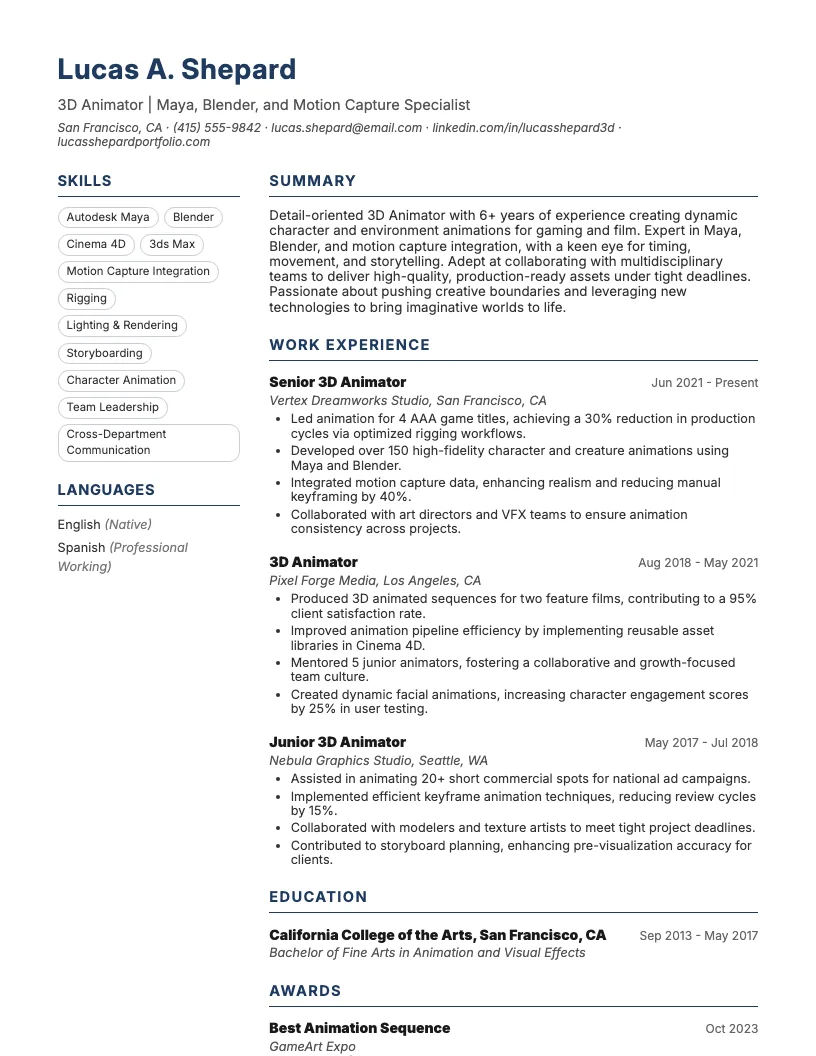
Browse 3D Animator resume examples for related roles. Preview any example, open it in the builder, or read its full guide.
Click to enlarge Click to enlarge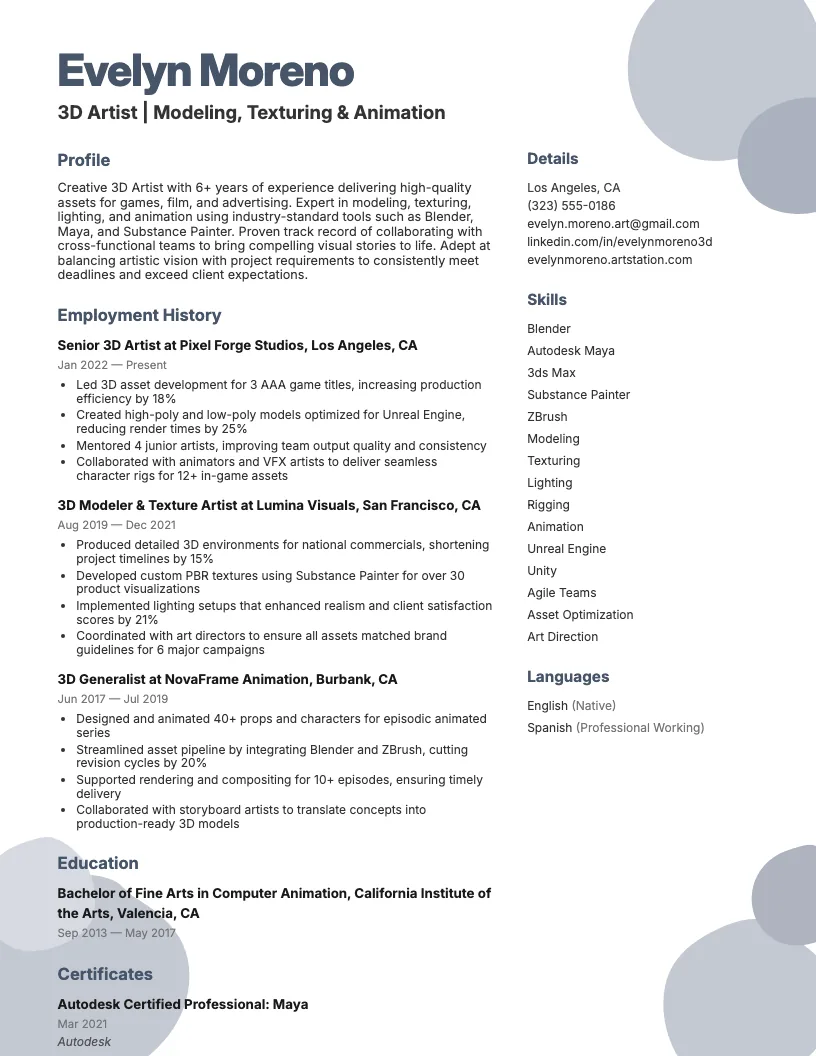 Click to enlarge Click to enlarge Click to enlarge Click to enlarge
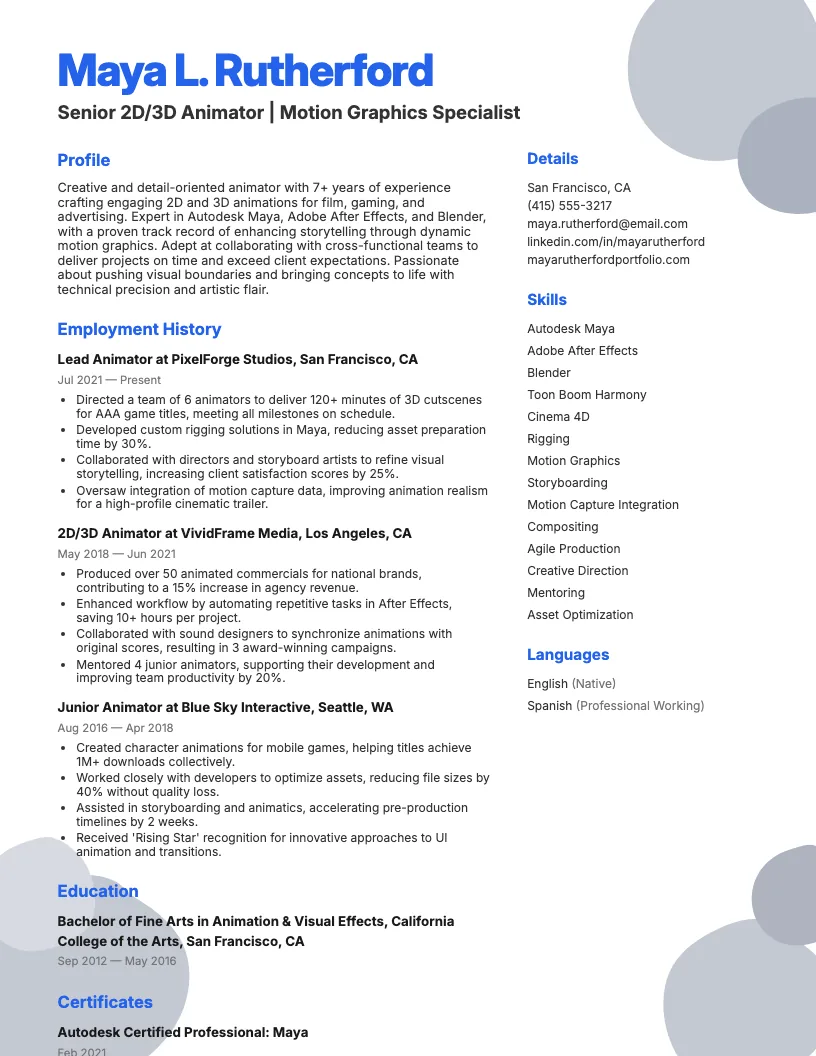 Click to enlarge
Common questions about 3D Animator resumes
A 3d animator resume template is a pre-designed layout tailored for showcasing animation skills, project experience, and software proficiency. It helps you present your creative work clearly to employers in animation, gaming, or film.
Many 3d animator resume templates, like those from ResumeJudge, are ATS-friendly, meaning they use simple formatting and keywords to ensure your resume passes automated screening systems used by studios and agencies.
Use a 3d animator resume template when applying to roles in film, gaming, advertising, or tech industries. It's ideal for showcasing portfolios and complex projects professionally-ResumeJudge makes this process simple.
Yes, you can easily customize most 3d animator resume templates to highlight your unique skills, software knowledge, and portfolio links. ResumeJudge offers templates that are fully editable for your needs.
3d animator templates focus on creative skills, animation software, and project showcases, unlike general resumes. ResumeJudge templates are designed to highlight both technical and artistic abilities needed in animation.
A 3d animator resume should typically be one page, two at most if you have extensive experience. ResumeJudge helps you condense your achievements and portfolio for a clear, impactful presentation.
Yes, most 3d animator templates, especially from ResumeJudge, include dedicated sections for portfolio links or project highlights. This lets recruiters quickly view your animation work.
Highlight skills like Maya, Blender, 3ds Max, or Cinema 4D. ResumeJudge templates have sections for software proficiency, helping you stand out to employers in animation and gaming.
Absolutely! 3d animator templates are great for freelancers pitching to studios or agencies. ResumeJudge lets you highlight client projects and freelance achievements effectively.
Yes, professional templates from ResumeJudge are formatted for global standards, making it easier to apply to studios or companies abroad. They ensure your skills are presented clearly to international recruiters.
Explore more professional resume examples to inspire your job search
Use our AI-powered resume builder to create a professional, ATS-friendly resume in minutes.
Free to use • No credit card required