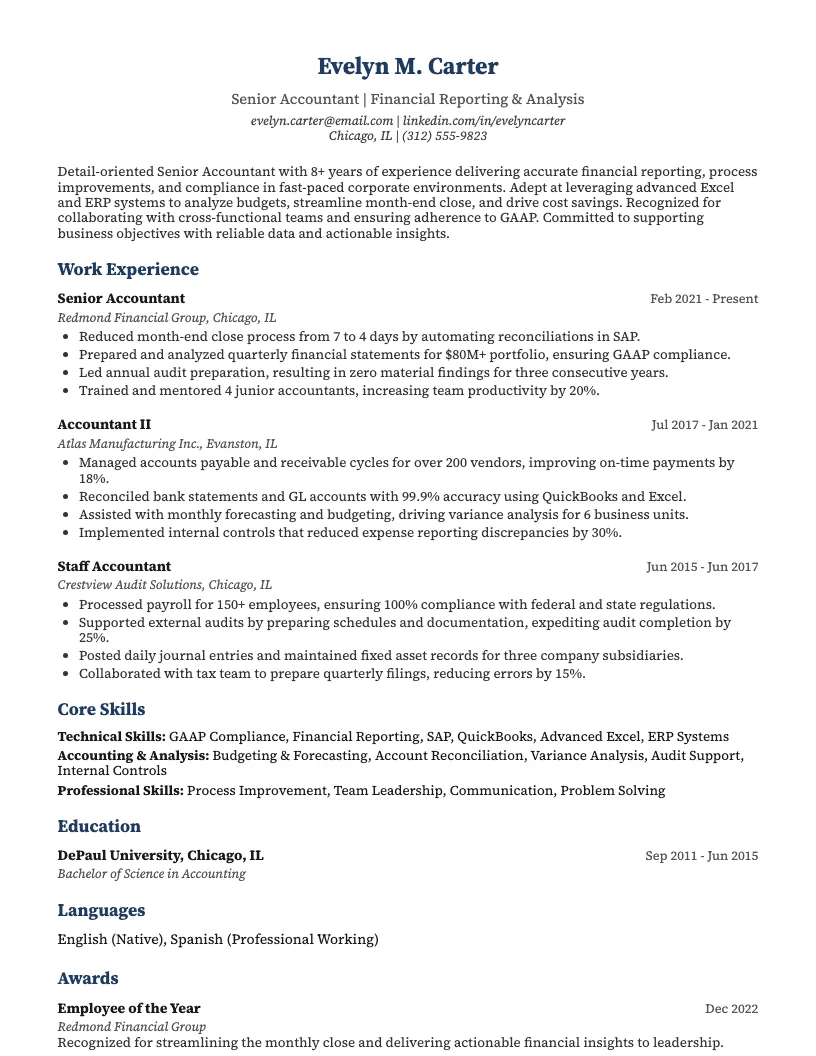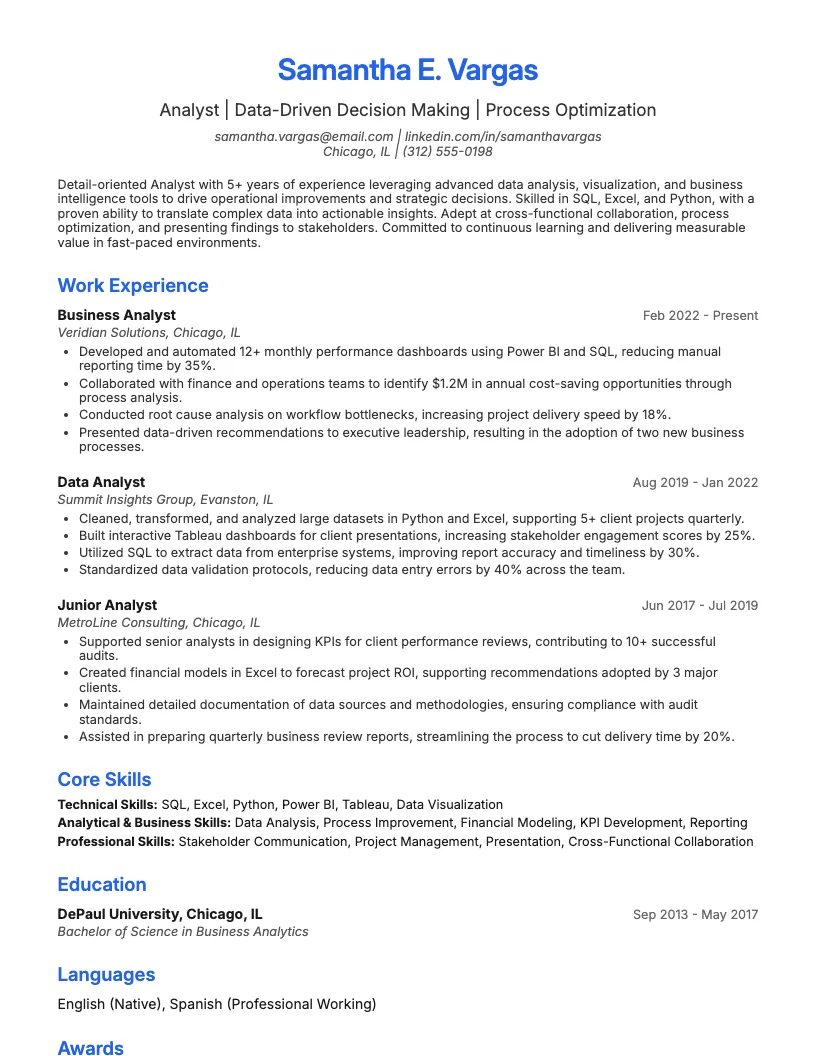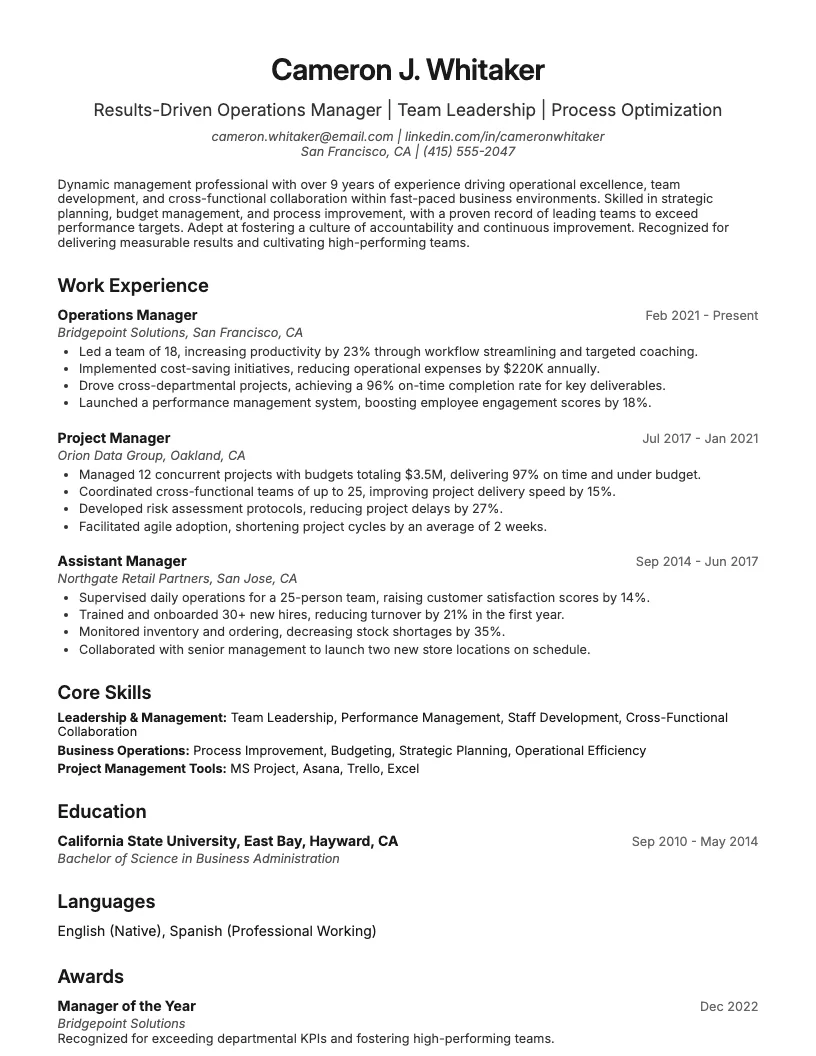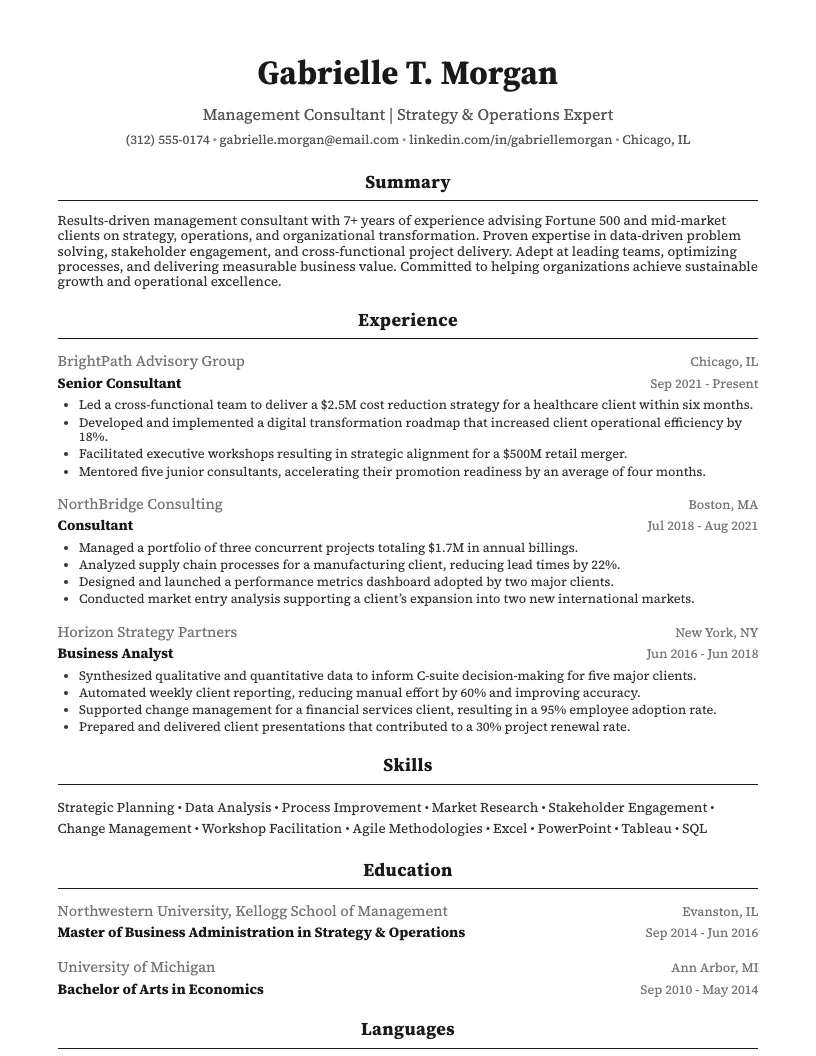
Accountant Resume Example
See full guide on Accountant resumes Click to enlarge
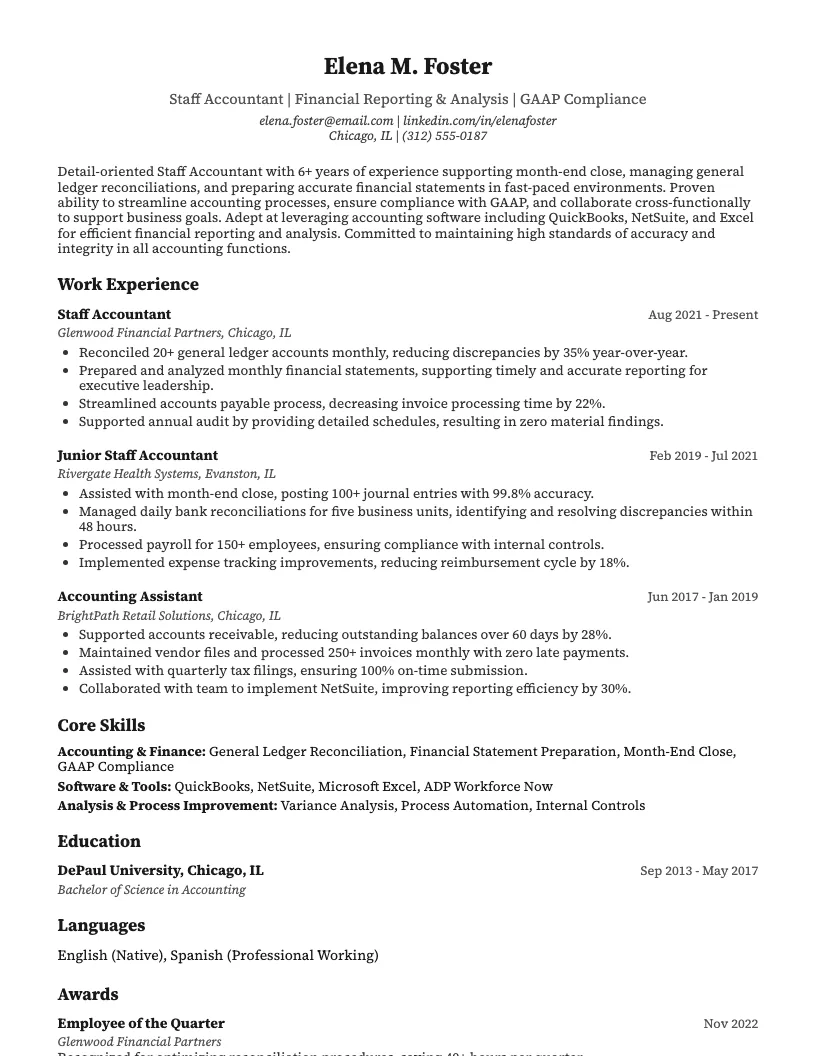 Click to preview

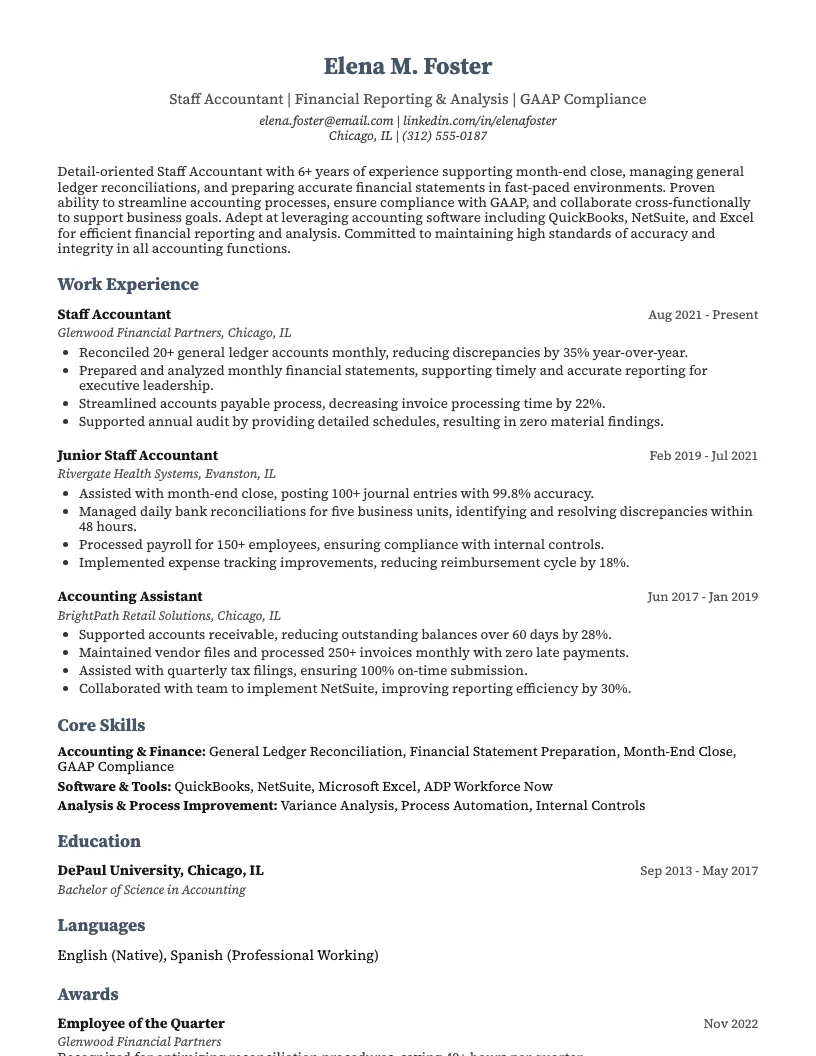
Get inspired by 62+ professional Staff Accountant resume examples, each written by career experts and optimized to pass ATS scans. Pick a proven template, tailor it to your role, and download a polished resume in minutes.
Pick the specialization closest to your target role and start from a proven resume example.
If you’re eyeing a staff accountant role, a strong resume helps you stand out. Employers want to see your experience with financial reporting, reconciliations, and compliance.
I’ve looked at what works for entry-level, mid-career, and senior accountants. Each stage brings different skills and responsibilities. Let’s break down what those resumes look like.
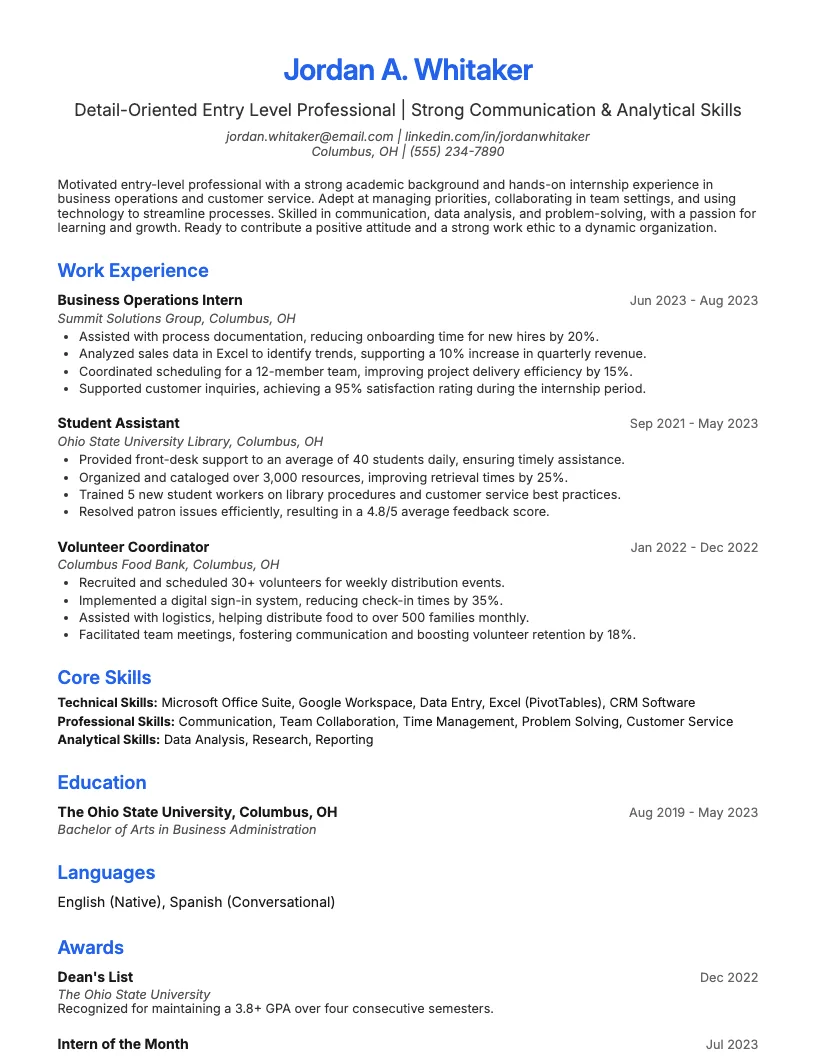
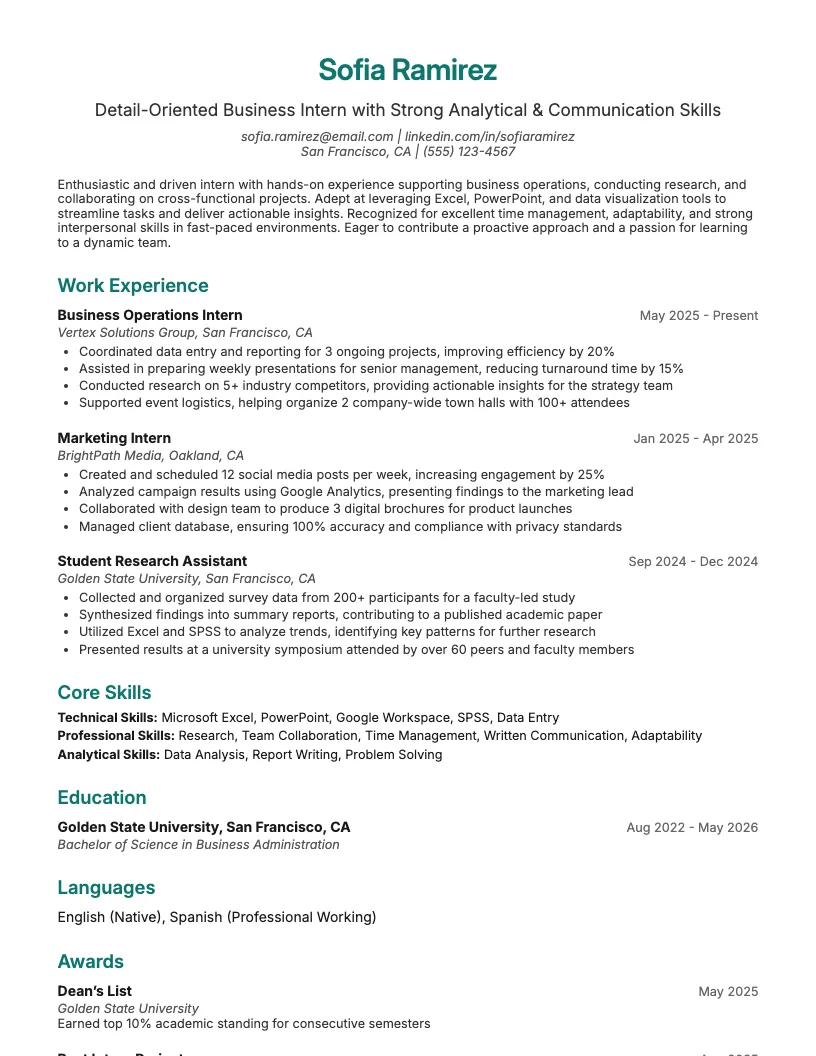
Starting out as a staff accountant? You want your resume to show off accuracy, attention to detail, and basic accounting skills. Employers look for fresh candidates who can handle numbers.
I always focus on highlighting internships, relevant coursework, and any experience with accounting software like Excel or QuickBooks. Even a part-time job managing invoices counts.
You don’t need years of experience. Instead, show you understand accounts payable, receivable, and basic reporting. Use numbers-like improving accuracy from 94% to 97%-to prove your impact.
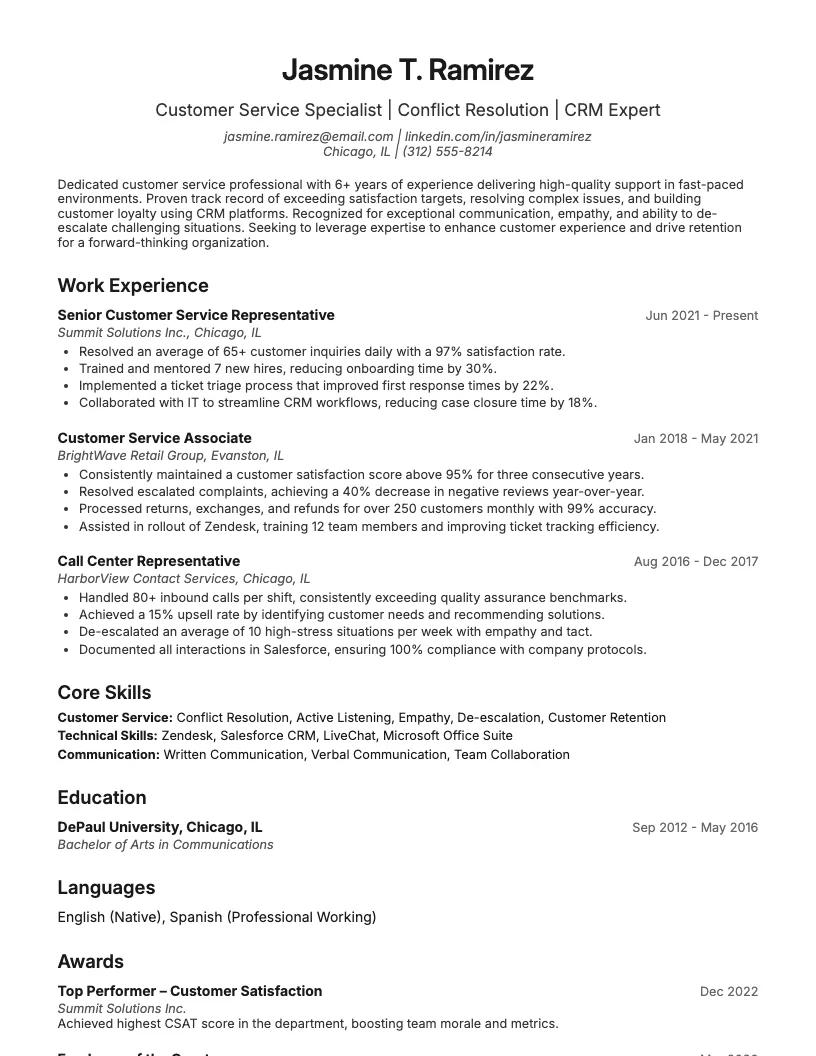
If you’ve got around 3-6 years in accounting, your resume should highlight more than just basic transaction processing. Show how you contribute to budgeting, forecasting, or process improvements.
I always include specific achievements-like raising accuracy rates or streamlining monthly closings. Concrete numbers, such as “improved reconciliation efficiency by 22%,” make your impact clear.
You want to show you handle complex tasks, mentor junior staff, and manage multiple priorities. Focus on your GAAP expertise, advanced Excel use, and any experience with ERP systems.
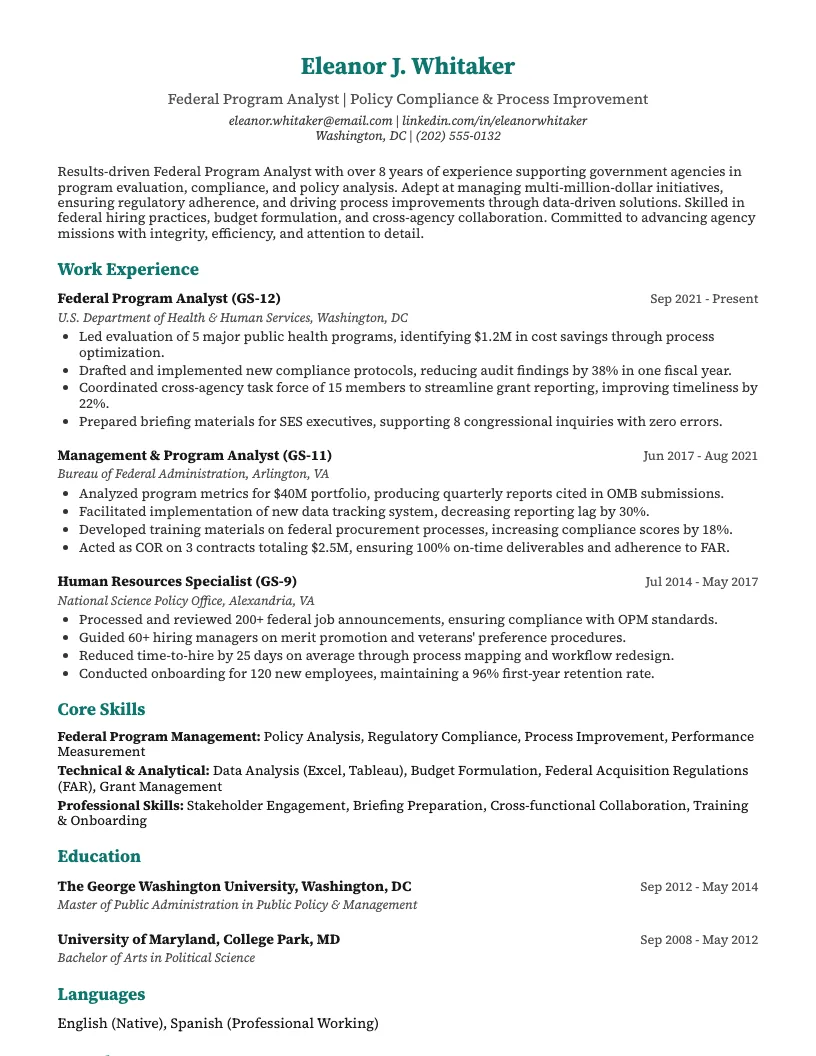
If you’ve got 7+ years in accounting, your resume should show leadership and expertise. I highlight my experience mentoring junior staff and managing month-end close for teams of 10+.
I focus on quantifiable achievements, like improving reconciliation accuracy by 15% or automating reporting processes. This helps demonstrate your impact and drive.
You want to show deep knowledge of GAAP, advanced Excel skills, and experience with ERP systems. Certifications like CPA or CMA help you stand out at this level.
A senior-level resume wraps up your story. It’s about showing that you’re not just capable-you lead, you solve problems, and you help the company grow.

Getting the right format for your staff accountant resume sets the tone for recruiters. Most hiring managers spend less than 7 seconds on a first scan.
You want a clean, organized style that highlights your experience and skills. Template choice, layout, and even file type matter more than you might think.
Next, I’ll break down which templates stand out and what details you need up top. This makes sure your resume looks professional and easy to read.
You want your staff accountant resume to look sharp and professional. Go for a clean layout with 1-inch margins and plenty of white space-this keeps everything easy to read.
Stick to simple fonts like Arial, Calibri, or Lato, sized between 10 and 12 points. Using two columns can help you fit more info without crowding the page.
Avoid flashy colors or graphics. Recruiters prefer resumes that highlight your skills and experience, not distracting design. A one-page resume is best if you have under 10 years in the field.
Start your resume with your full name, professional email, and a current phone number. I always include my LinkedIn URL if it’s up-to-date.
Skip the photo and stick to just the basics. This keeps things professional and avoids bias. Make sure your job title matches the position you’re applying for.
Save your resume as a PDF. This format keeps your layout clean and is accepted by over 90% of applicant tracking systems. Use a clear file name, like FirstName_LastName_StaffAccountant.pdf.
That’s pretty much it for nailing this section. Now your resume’s ready for the next step in the process.
A strong resume summary helps you stand out right away. This is where you highlight your top accounting achievements and skills in just a few sentences.
You want to grab the hiring manager’s attention fast. Focus on your years of experience, certifications, and results you’ve delivered. Keep it clear and relevant to the job.
Up next, I’ll walk you through how to craft a profile that makes your experience shine.
Start strong-mention your years of accounting experience and any industry certifications like CPA or CMA. This helps hiring managers see your credibility right away.
Highlight your biggest wins using numbers. I like to specify things like “reduced reconciliation time by 30%” or “managed monthly closings for $10M in revenue.”
Show some personality. If you thrive in fast-paced teams or enjoy streamlining processes, say so. Employers value soft skills just as much as technical expertise.
When you build your staff accountant resume, your experience section does most of the talking. Recruiters want to see real proof you can handle financial tasks.
Focus on results you achieve, not just your daily duties. Numbers, like saving $10,000 or increasing accuracy by 15%, make your impact clear.
Tailor your experience to each job description. That’s how you show you’re the right fit, whether you’re entry-level or have years in accounting.
Every job description lists specific skills and requirements. I always compare them to my own experience and highlight the most relevant tasks, tools, and results.
Read the posting carefully. Identify keywords-like “reconciliation,” “financial reporting,” or “QuickBooks.” Plug these straight into your resume where they match your background.
Focus on mirroring the language the employer uses. This helps automated systems and real people spot your fit right away. It’s a simple move, but it works.
I always try to back up my experience with hard numbers. Listing things like “processed 100+ invoices monthly” or “reduced errors by 15%” shows clear value.
You can highlight dollar amounts, percentages, or time saved. For example, “helped save $20,000 annually by improving reconciliation processes” packs more punch than a generic statement.
When you quantify your impact, recruiters notice. It’s not just about what you did. It’s about showing how your work actually made a difference.
You don’t need years of experience to make your resume stand out. Highlight relevant coursework, academic projects, or internships that use accounting principles.
I always list technical skills like QuickBooks, Excel, or any accounting software I’ve learned. Recruiters look for these keywords, especially for entry-level roles.
Include part-time jobs or volunteer work if you handled budgets, tracked expenses, or managed data. This shows you have practical, transferable skills-even if the job wasn’t in accounting.
Wrap up your experience section with a short objective statement. This tells employers exactly what you want and how your strengths fit their needs, and you can further reinforce your fit with a junior accountant cover letter.
Your education and certifications play a big role in landing a staff accountant job. Employers look for solid accounting knowledge and proof of technical skills.
Listing relevant degrees, coursework, and certifications shows you’re qualified. This section helps hiring managers see if your background matches what they want.
If you want to stand out, certifications matter. A Certified Public Accountant (CPA) is the gold standard-over 665,000 CPAs work in the U.S. right now.
You can also look at Certified Management Accountant (CMA) or Certified Internal Auditor (CIA) credentials. These show you’ve got skills in areas like cost control, financial planning, and risk management.
I always recommend adding certifications right after your degree. This helps employers see you’re keeping up with industry standards and investing in your career.
Getting hired as a staff accountant takes more than just knowing numbers. You need a mix of hard and soft skills to really stand out.
Employers look for candidates who handle financial data and software, but also work well with teams. Both skill sets matter when you want to move up.
If I’m applying for a staff accountant role, I always highlight my core technical skills. These show I can actually handle the real day-to-day accounting work.
You want to list things like Excel expertise, knowledge of GAAP, or experience with QuickBooks and SAP. Employers look for these because they’re directly tied to job performance.
Don’t forget to mention financial reporting, bank reconciliations, and tax preparation. If you process payroll for 100+ employees or manage month-end close, call that out-numbers matter.
I like to weave these skills into my resume summary and work experience. Using real examples-like “reduced audit errors by 30%”-makes your hard skills stand out even more.
You need more than just technical know-how. Strong communication skills help you explain financial data to non-accountants, which comes up in 85% of staff accountant roles.
I always mention attention to detail-errors cost real money. Employers value staff who spot mistakes quickly and keep everything compliant.
Teamwork and problem-solving matter, too. In my experience, accountants who collaborate and adapt can handle fast-paced deadlines and support big projects with ease.
When you highlight these soft skills, your resume stands out and shows you’re a well-rounded candidate. That’s what really gets you noticed.
You can really stand out by adding extra sections beyond the basics. These show off more of your skills and interests as a staff accountant.
Think about including things like professional memberships, language skills, or even hobbies. About 60% of hiring managers notice these details.
These sections help you show the full picture of your background. They’re a great way to highlight what makes you unique in the accounting field.
Building a strong staff accountant resume can feel tricky. I know the right approach makes a big difference in landing more interviews.
You want to highlight technical skills, attention to detail, and results. Recruiters look for candidates who can handle financial data, reporting, and compliance with accuracy.
Listing your top skills and proficiencies gives hiring managers a clear picture of what you offer. It also helps your resume pass through automated tracking systems.
I always highlight technical skills like Excel, QuickBooks, and SAP. These are in almost every staff accountant job description and help me stand out to hiring managers.
You want to mention account reconciliations, financial reporting, and general ledger maintenance. These show you understand core accounting functions and can handle daily responsibilities without much training.
Soft skills matter, too. I include things like attention to detail and time management. Employers value accountants who meet deadlines and catch errors before they become problems.
If you want to see how other accounting roles handle their resumes, you’re in the right spot. I’ve pulled together examples for a bunch of related jobs.
You can check out templates for everything from general accounting to more specialized roles. These samples show what works and what hiring managers expect right now.
If you’re eyeing an accounting role, you’ve got a ton of options. There are over 1.4 million accountants in the U.S., all working in different industries.
I always say, check out a few resume examples and an accountant cover letter before you start writing yours. This helps you see what skills and experience employers want to see.
You can find examples that fit entry-level, senior, or even specialized accounting jobs. Compare formats, bullet points, and layouts to figure out what works best for you.
If you’re looking for an accountant resume sample, I’ve got you covered. A strong accountant resume highlights your experience, certifications, and technical skills in a clear, concise format.
Use an accountant resume template to organize your work history, education, and achievements. This helps recruiters scan for details like CPA credentials, ERP software skills, or process improvements you’ve made.
Want your accountant resume to stand out? Quantify your impact-show how you reduced errors by 20% or closed monthly books three days faster. Keep everything easy to read and relevant to the role.
General accountant resume examples show versatile skills in bookkeeping, reconciliations, and reporting. I see hiring managers look for experience with accounting software like QuickBooks or SAP.
If you want your resume to stand out, highlight your accuracy, attention to detail, and experience handling monthly closes or journal entries. Use numbers-like “managed accounts for 50+ clients.”
A strong general accountant resume also covers compliance and internal controls. This helps show you know both day-to-day accounting and bigger-picture financial requirements.
If you’re eyeing a job as a property management accountant, your resume needs to highlight experience with lease accounting, rent payments, and financial reporting for multiple properties.
I recommend adding specific numbers-like managing budgets for over 50 units or reducing delinquency rates by 15%. This helps your property management accountant resume examples stand out.
Focus on software skills too. Mention Yardi, AppFolio, or MRI. Employers want proof you can handle complex reconciliations and monthly closings in property management environments.
If you’re eyeing a tax accountant role, you need a resume that highlights expertise in tax codes, compliance, and reporting. I always recommend including numbers-think reduced tax liability by 15%.
Tax accountant resume examples usually show strong skills in preparing returns, handling audits, and using software like QuickBooks or CCH. Employers like to see certifications, such as CPA or EA.
You want your resume to prove you can manage multiple deadlines during tax season. Mentioning how you handle high-volume filings or complex returns really helps you stand out.
Looking for staff accountant cover letter examples? I always say, a tailored cover letter increases your chances by up to 50%. It shows you understand the job requirements.
Highlight your accounting skills, attention to detail, and experience with tools like Excel or QuickBooks. You want to connect your achievements directly to the job description.
You can check out a variety of cover letter templates to see different formats and tones. This helps you find a style that matches your experience and personality.
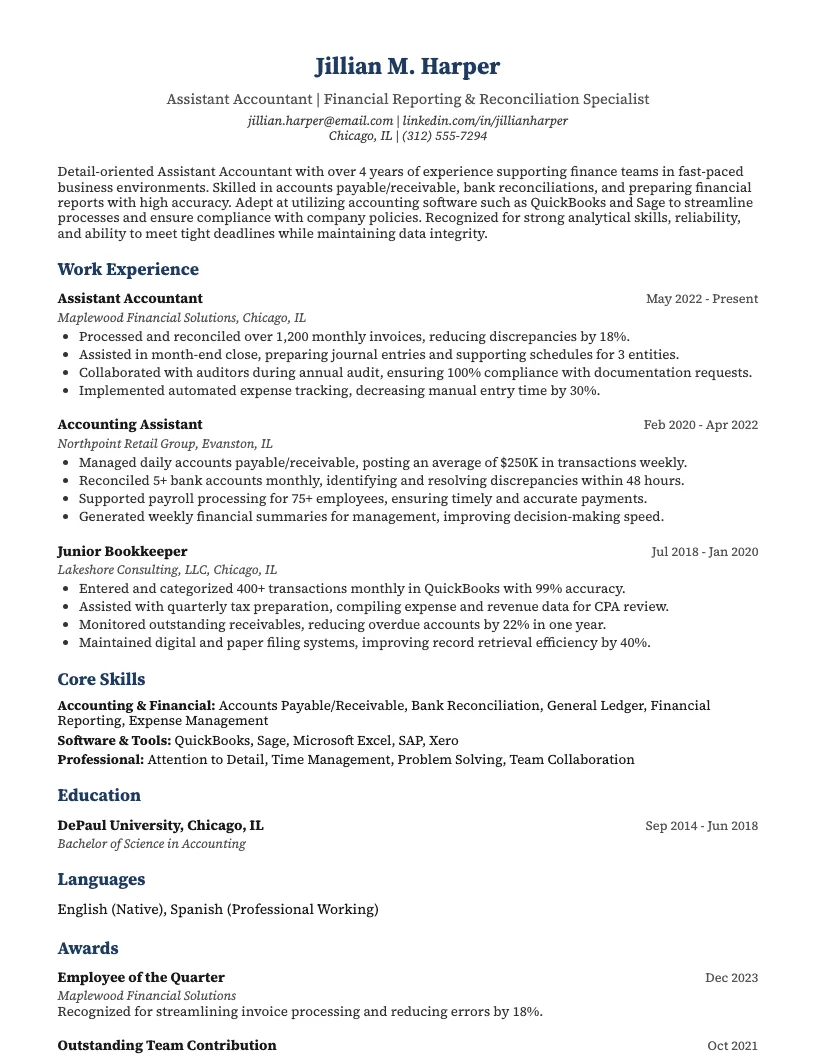
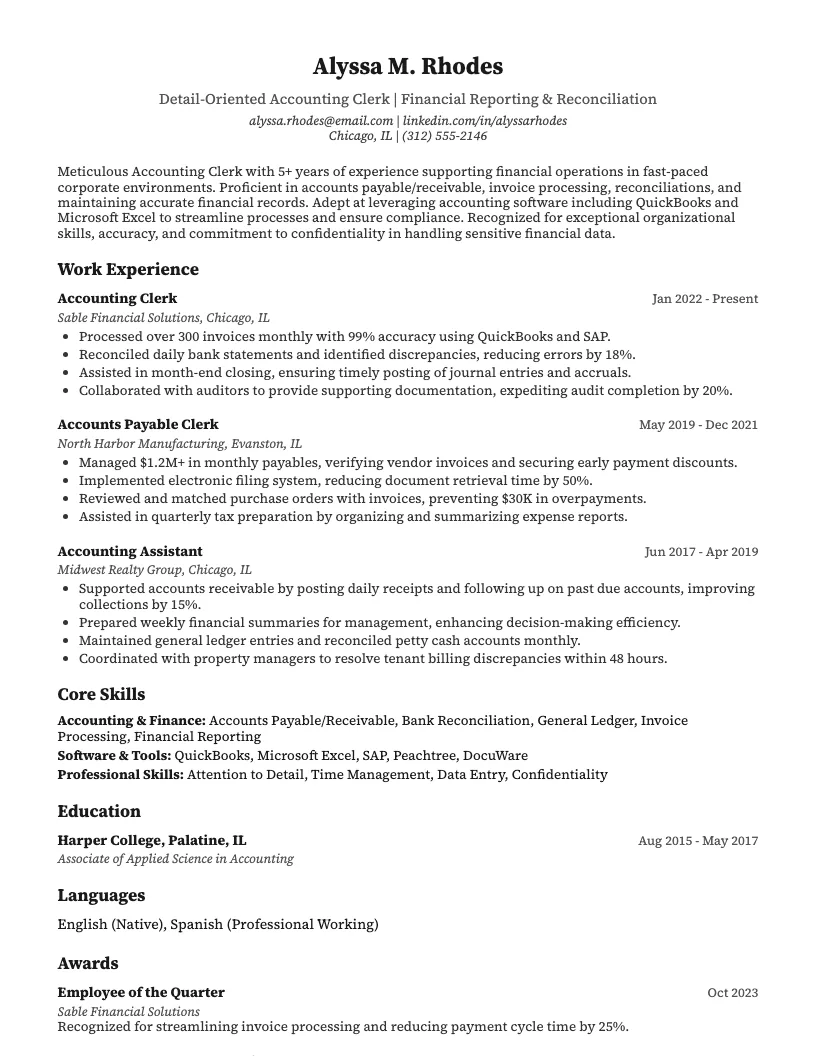
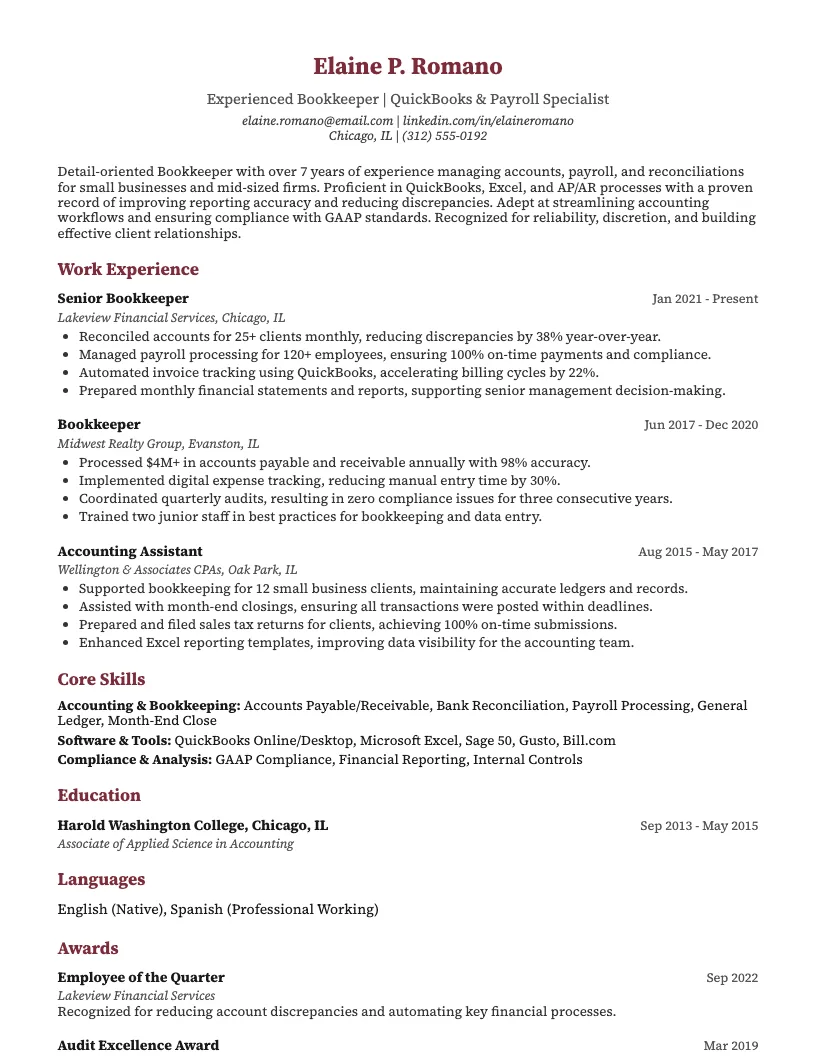
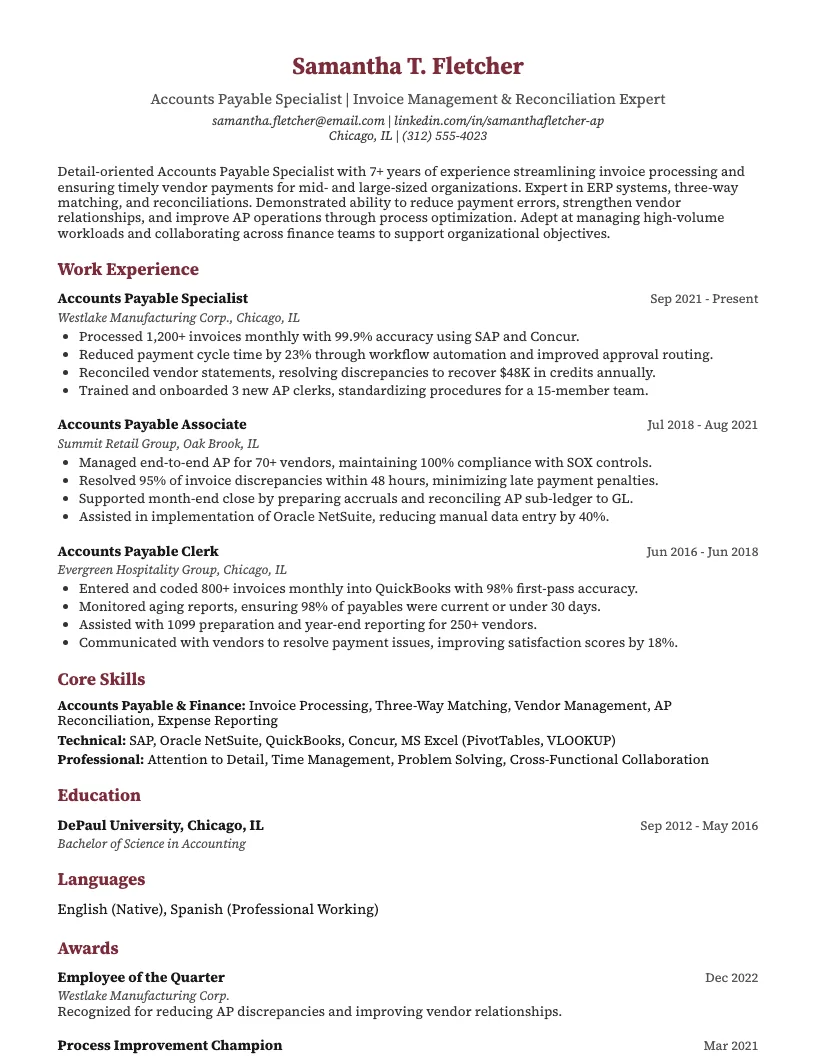
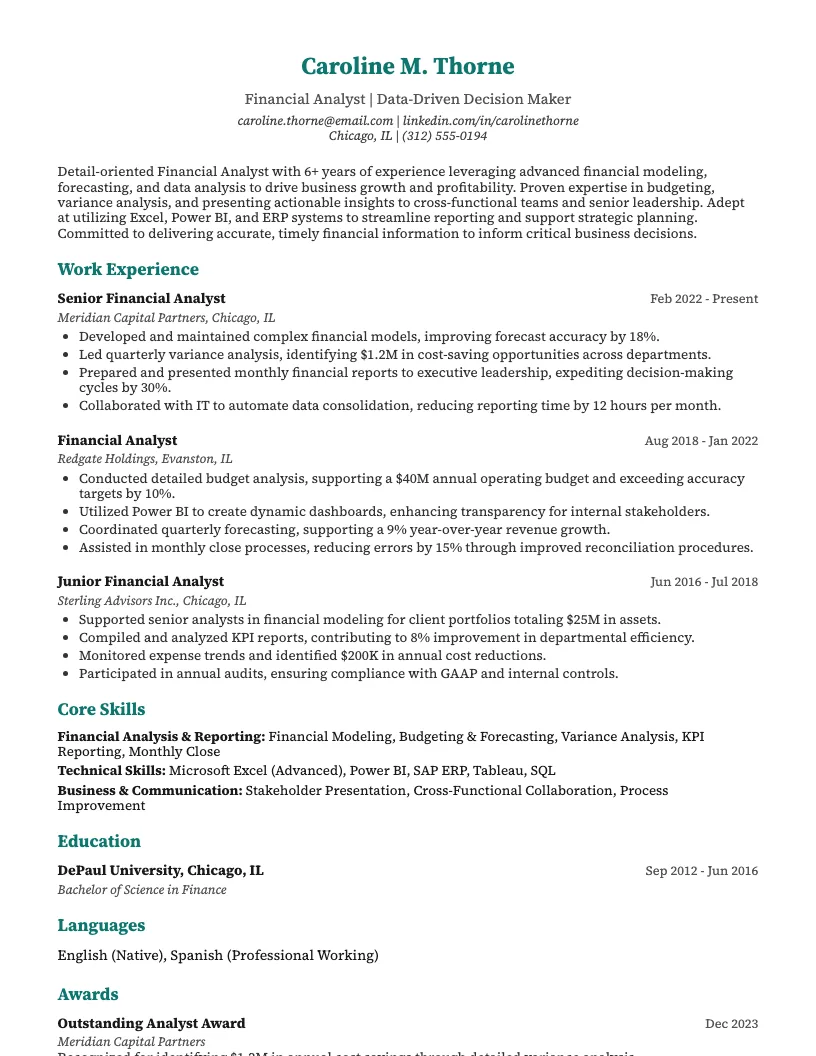
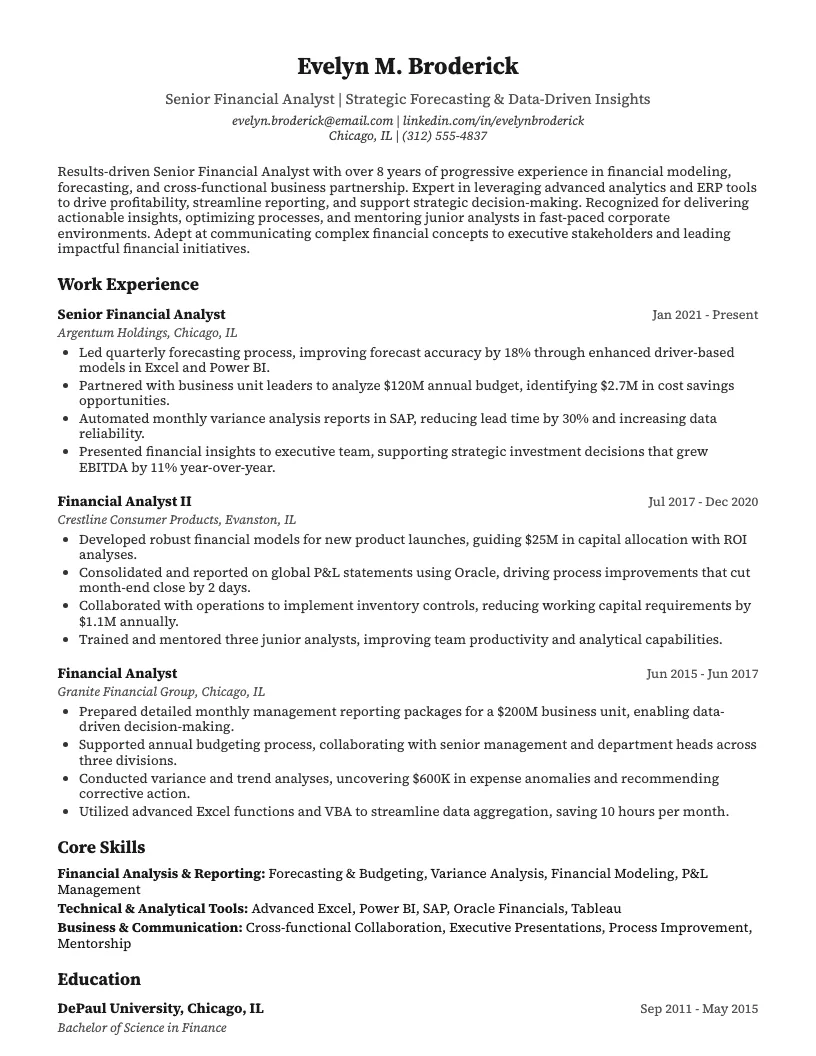
Browse Staff Accountant resume examples for related roles. Preview any example, open it in the builder, or read its full guide.
Click to enlarge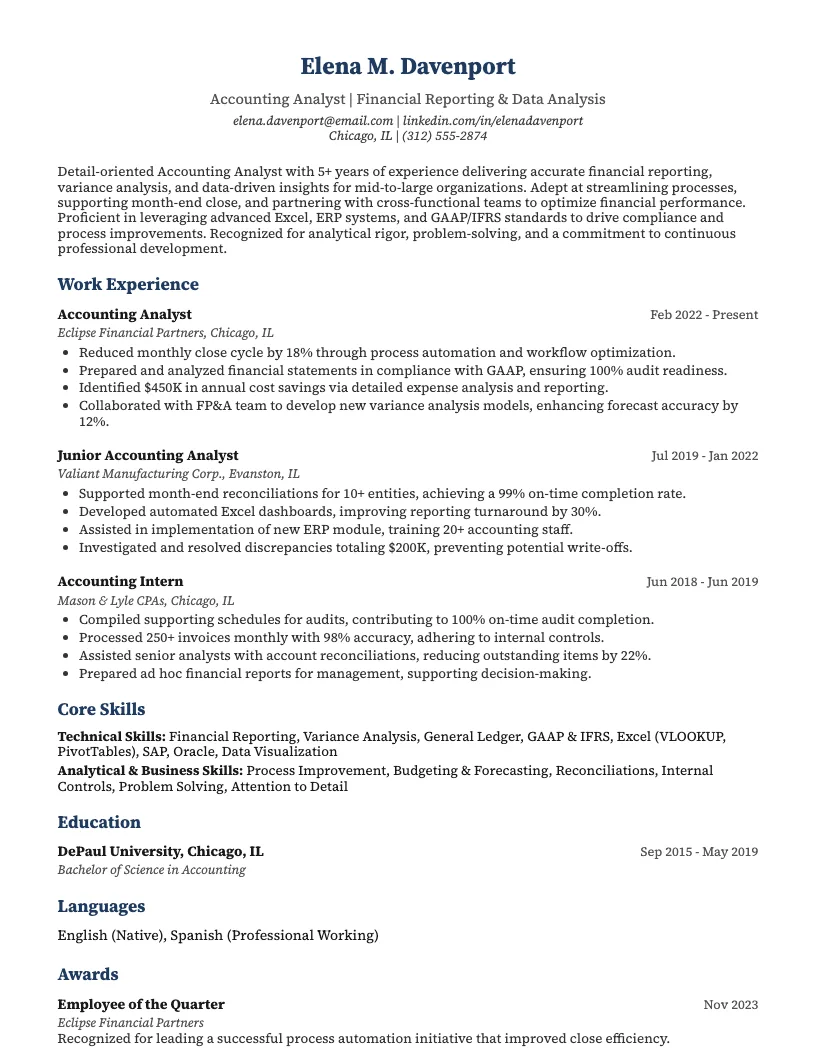 Click to enlarge
 Click to enlarge
 Click to enlarge
 Click to enlarge
 Click to enlarge Click to enlarge
 Click to enlarge
 Click to enlarge
Common questions about Staff Accountant resumes
A Staff Accountant resume template is a pre-formatted document tailored for accounting roles, making it easy to showcase your skills, experience, and certifications. ResumeJudge offers templates designed just for accounting professionals.
Yes, most Staff Accountant resume templates from ResumeJudge are ATS-friendly, ensuring your resume passes automated screening. Clean formatting and standard sections help your application reach hiring managers.
Use a Staff Accountant resume template when applying to accounting jobs in industries like finance, healthcare, or retail. ResumeJudge templates suit entry-level and experienced accountants alike.
Absolutely! ResumeJudge templates are fully customizable, so you can add your unique skills or certifications. Personalizing your template helps you stand out to employers.
Staff Accountant templates highlight accounting-specific skills like reconciliations and financial reporting. ResumeJudge designs templates to meet the needs of different professions, ensuring relevant keywords are included.
Ideally, a Staff Accountant resume should be one page, especially for those with under 10 years' experience. ResumeJudge templates help you organize content efficiently for a concise, professional look.
Yes, ResumeJudge offers templates suitable for both new graduates and seasoned staff accountants. You can highlight internships or advanced certifications depending on your experience.
Definitely! ResumeJudge templates include sections for certifications like CPA or CMA. This makes it easy to showcase your accounting credentials to employers.
Yes, ResumeJudge templates are ideal for remote or on-site accounting jobs. They let you highlight remote work experience, software skills, and adaptability.
A strong Staff Accountant resume should feature contact info, a summary, work history, education, skills, and certifications. ResumeJudge templates ensure you don't miss any key sections.
Explore more professional resume examples to inspire your job search
Use our AI-powered resume builder to create a professional, ATS-friendly resume in minutes.
Free to use • No credit card required