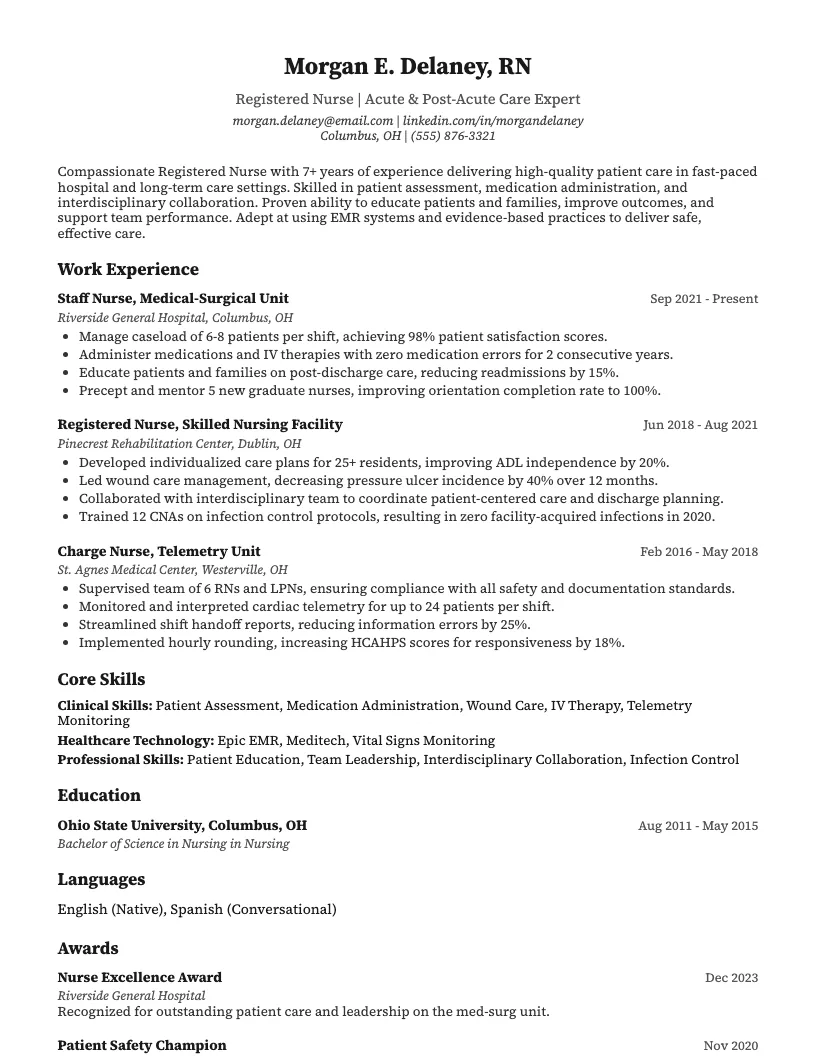
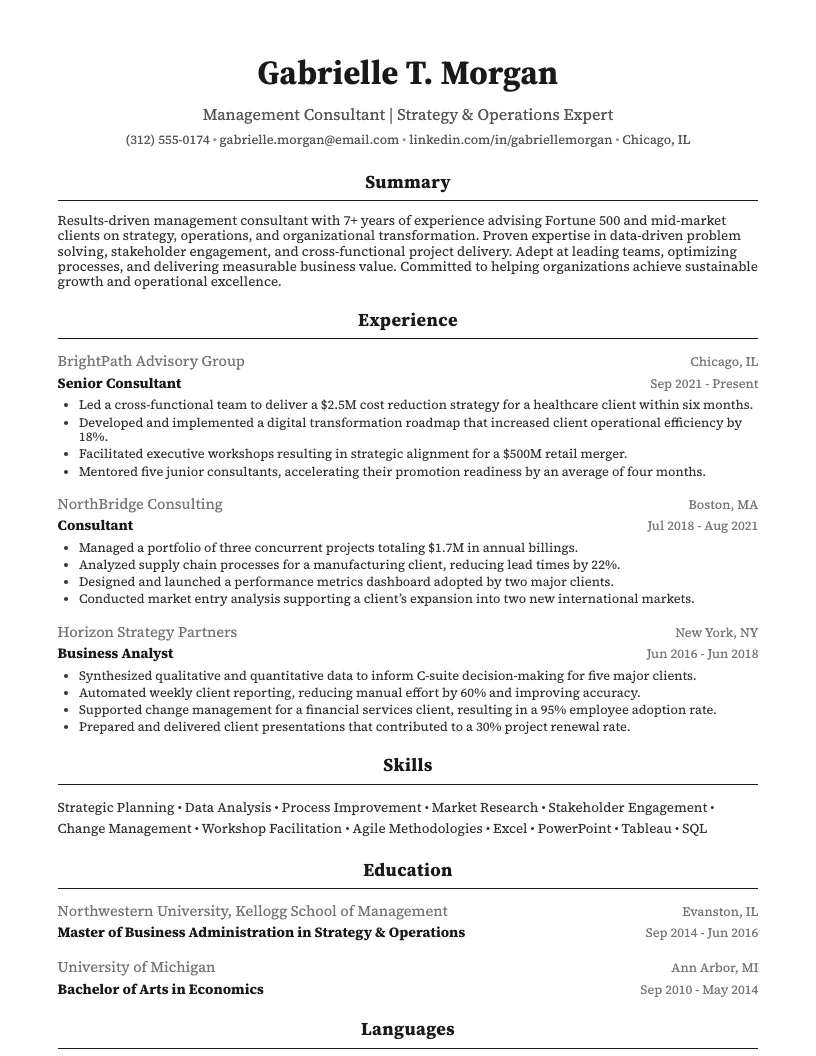
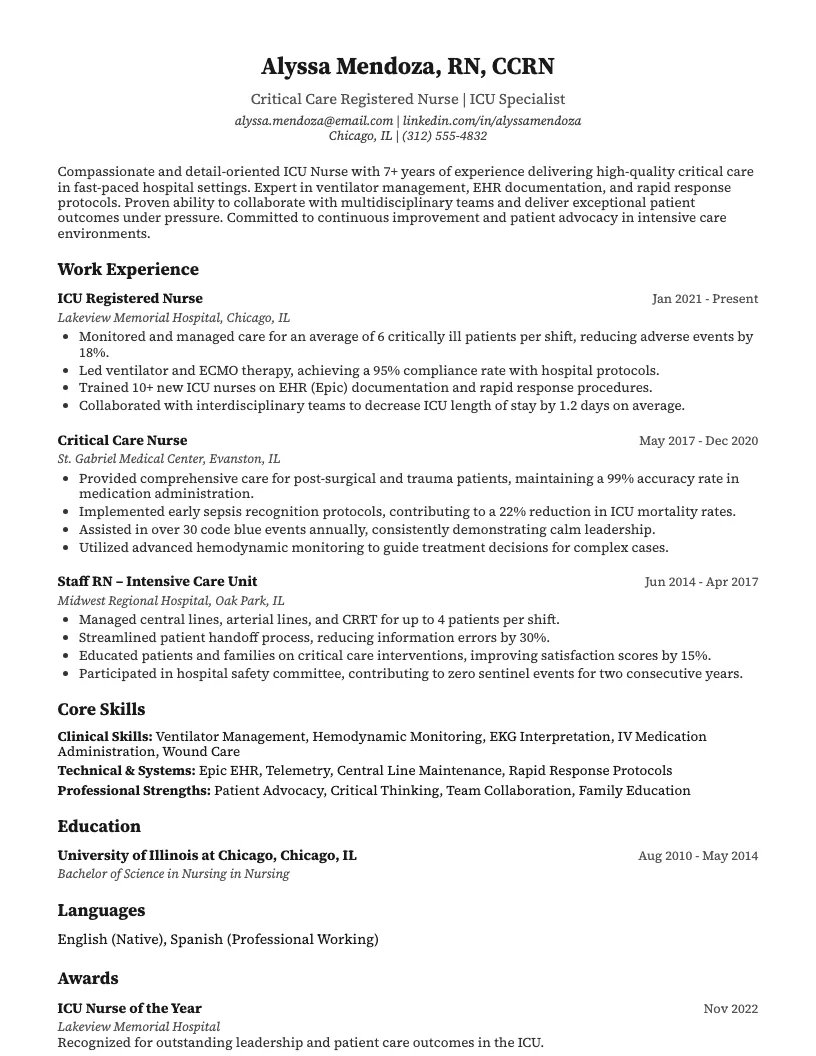
Critical Care Nurse Resume Example
See full guide on Critical Care Nurse resumes Click to enlarge
 Click to preview

Get inspired by 63+ professional Icu Nurse resume examples, each written by career experts and optimized to pass ATS scans. Pick a proven template, tailor it to your role, and download a polished resume in minutes.
Pick the specialization closest to your target role and start from a proven resume example.
Every ICU nurse brings different skills. Your resume needs to highlight your experience, specialty, and achievements in a way that stands out.
You’ll find examples here for every stage-new grads, experienced nurses, specialists, and leaders. I want you to see what works for your exact situation.
If you're just starting out in ICU nursing, your resume should focus on clinical rotations, certifications, and relevant skills. I always highlight hands-on experience from school.
You want to show initiative and adaptability. Mention any volunteer work, internships, or simulation labs. This helps prove you're ready for a fast-paced ICU environment.
Don’t worry if your job history is short. Emphasize teamwork, communication, and patient care skills. Hiring managers like new grads who can learn quickly and work well under pressure.
If you’ve got 3+ years in the ICU, your resume should highlight leadership, advanced skills, and clinical results. I always show measurable improvements, like reducing infections by 12%.
You want to list specific ICU protocols, advanced certifications, and how you mentor newer staff. This helps hiring managers see your impact and reliability in high-pressure situations.
Focus on collaborative care, big projects, and how you’ve shaped workflow or patient outcomes. Next, I’ll break down examples for specialty ICU roles if you want to target a specific unit.
If you focus on cardiac, neuro, or pediatric ICU nursing, your resume needs to show those skills. I always highlight certifications like CCRN, PALS, or NIHSS.
For specialty roles, I include outcomes-like supporting 100+ cardiac cases yearly or reducing neuro ICU complications by 12%. Stats like these give recruiters proof of impact.
Don’t forget to mention teamwork with specialists, advanced procedures, or using tech like ECMO—skills you can reinforce in a cover letter. This helps your resume stand out from general ICU applicants and leads into advanced practice roles.
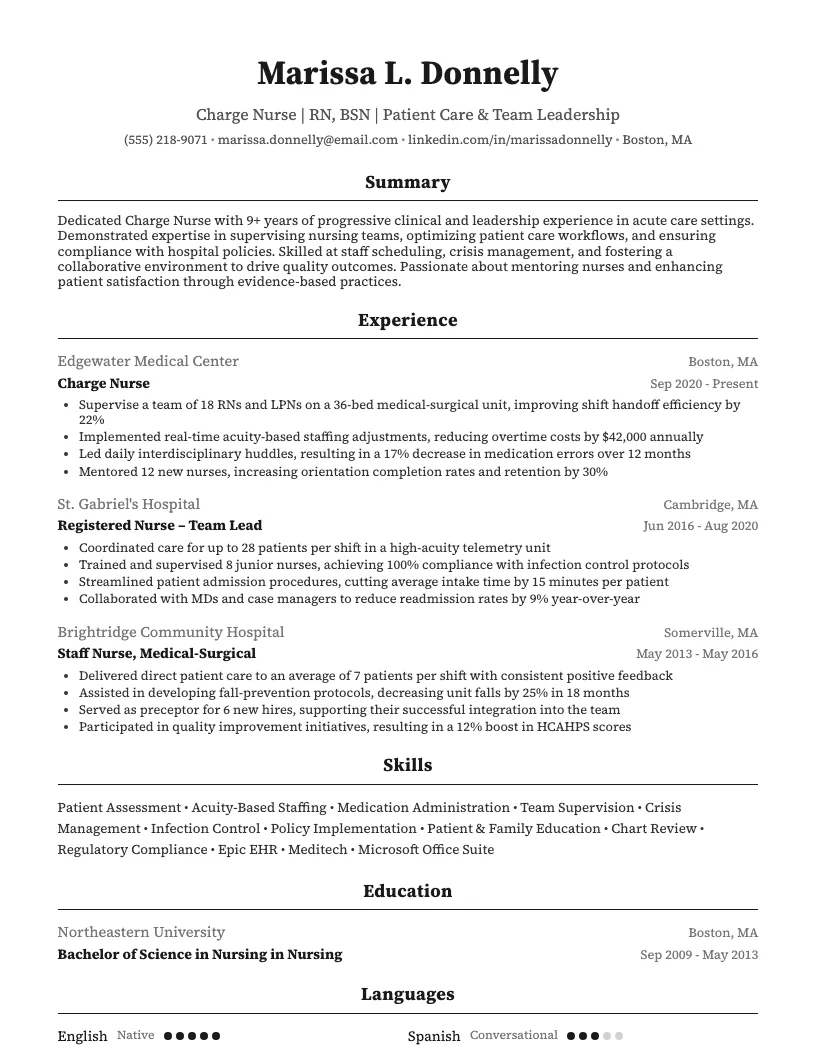
If you're aiming for charge nurse, ICU manager, or CNS positions, your resume needs to show leadership, program development, and advanced clinical skills.
Highlight certifications like CCRN, ACNP, or CNS. I always mention the number of staff I supervise or policies I implement-numbers like "15 direct reports" or "cut infection rates by 12%."
You want to show impact across the unit, not just patient care. This means project management, staff training, and proven outcomes-like improving team communication or workflow efficiency by specific percentages.
NICU nurse resume examples focus on experience with premature and critically ill newborns. I highlight skills like neonatal resuscitation, family support, and monitoring high-risk infants.
You want to show certifications like NRP and experience with ventilators or incubators. Employers look for teamwork, empathy, and precise charting because NICU care is detail-oriented.
A strong NICU nurse resume uses action verbs and shows measurable impact, like reducing infection rates or training new staff—qualities you can also emphasize in a cover letter. Tailoring your resume to NICU roles gets you noticed.
That wraps up the ICU nurse resume examples by specialty and experience. Use these templates to showcase your ICU skills and land your next role.

Choosing the right resume format matters a lot for ICU nurses. Recruiters and applicant tracking systems both care about how you present your experience.
I always tell nurses to focus on clarity and structure. A readable, straightforward template helps your qualifications stand out, not flashy visuals or colors.
There’s more than one way to organize your resume. Let’s break down which format works best for your specific situation and what essential sections you should include.
If you’re an ICU nurse with steady experience in critical care-think three or more years-the reverse-chronological format is your safest bet. It keeps your recent skills front and center.
You might want a functional format if you’re making a big career shift, like moving into nurse education or healthcare IT. This helps highlight transferable skills over job titles.
If you’ve got a lot of travel assignments or worked in several ICU specialties, a reverse-chronological layout still works best. Recruiters want to see your clinical journey-clear and simple.
I always make sure my resume starts with up-to-date contact information-name, phone, email, and LinkedIn. This makes it easy for recruiters to reach out quickly.
A strong professional summary comes next. I keep it to three or four lines, focusing on years of ICU experience, certifications like CCRN, and a measurable achievement.
You should also include a core competencies section. List skills like CRRT, IABP, or ECHMO. This helps your resume pass ATS filters and gets you noticed by clinical recruiters.
For clinical experience, use bullet points that highlight your impact. Whenever possible, quantify results-like reducing infection rates by 20% or mentoring five new nurses.
Don’t forget education and certifications. List degrees, RN licensure, and advanced credentials. This section confirms you meet all clinical requirements for ICU roles.
With these sections, your resume delivers the info recruiters care about most-fast and clear. Now you’re ready to choose the format that fits your story best.
If you want an ICU nurse job, your resume needs to stand out fast. Hiring teams spend less than 10 seconds on each one.
You need to show your clinical expertise and highlight your impact with real numbers. Every section should prove you handle high pressure and complex care.
I’ll walk you through writing a summary, sharing your experience, and showing your achievements. Let’s break down what truly matters for ICU nurse resumes.
Your resume summary is the first thing a recruiter sees. I always keep mine short-three to four lines max-so it’s easy to scan.
Start by naming your job title, certifications, and years of ICU experience. This helps hiring managers instantly understand your background.
Add two or three specialized skills-think ECMO or CRRT. Then, drop in a strong metric. For example, “manage care for 10+ critical patients per shift.”
Use keywords from the job description. This boosts your chances with both ATS and busy recruiters, so you get noticed right away.
When I write my ICU nurse experience, I always mirror the language and focus from the job description. This helps my resume stand out to both recruiters and ATS systems.
You want to highlight the types of patients and clinical situations you handle most-like trauma, neuro, or cardiac. Specifics show you actually know the work.
Name the equipment and EHRs you use, like Epic, Cerner, or ECMO. Matching their tech terms gets your resume noticed way faster.
Tailoring each bullet to the hospital’s priorities makes a real difference. It proves you’re ready to hit the ground running on day one.
Numbers speak volumes on an ICU nurse resume. I always try to include details like patient ratios, code response times, or infection reduction rates where possible.
You want to show results, not just tasks. For example, “Reduced central line infection rates by 25%” or “Cared for up to 3 ventilated patients per shift.” That’s concrete proof of your impact.
There are lots of ways to quantify your work: improved patient outcomes, training new hires, or leading quality initiatives. This helps recruiters see your value right away.
I start my experience section with my most recent role first. This keeps things easy to follow for recruiters.
Use clear job titles, unit names, and exact dates. This helps hiring managers quickly understand your background.
I keep my bullet points short and punchy. Each one shows a result or skill, not just tasks. I always include numbers where they fit.
If you held leadership roles, like charge nurse or preceptor, call those out. Recruiters notice extra responsibility fast.
Wrap up with a section that’s easy to skim. The right structure helps your ICU strengths stand out every single time.
If you want your ICU nurse resume to stand out, focus on skills that prove you’re ready for complex, high-pressure situations. Recruiters check for these first.
You need to show hands-on procedures, technical know-how, and advanced clinical skills. Soft skills also matter, but hard skills usually grab attention in critical care roles.
ICU recruiters look for hands-on experience with advanced procedures. I always highlight arterial lines, central venous pressure monitoring, and assisting with intubations on my resume.
You should list your expertise with ventilator modes, tracheostomy care, and managing CRRT or hemodialysis. These skills show you can handle complex, high-stakes scenarios.
If you’ve managed intracranial pressure monitors or placed central lines, mention it. Numbers help-state how often you perform these tasks, like “manage 12+ ventilators per shift.”
Knowing your way around ICU equipment is huge. I list specific devices-like Alaris infusion pumps, ECMO machines, and defibrillators-to show I handle high-stakes tech daily.
You want to mention interventions too. Think titration of vasoactive drips, IABP support, or managing complex ventilator settings. This proves you’re ready for the sickest patients.
I always highlight certifications like ACLS and experience with sepsis protocols. This helps recruiters see I meet the real clinical demands of modern ICUs.
Strong communication is crucial. I constantly coordinate with doctors, families, and other nurses-sometimes across three shifts. This keeps care seamless and errors to a minimum.
You need emotional intelligence to handle stressful situations. Recognizing a family’s anxiety or a colleague’s burnout helps everyone manage pressure and keeps patient care consistent.
Crisis management skills matter, too. I’ve handled rapid triage for up to 10 patients during critical incidents. Stay calm, act fast, and prioritize-these soft skills support every technical ability you list.
Round out your skills section with a few of these. Recruiters notice when you balance clinical expertise with the right attitude and interpersonal strengths.
When I write an ICU nurse resume, I always highlight my education and licenses first. Hospitals and recruiters want to see these details right away.
You need to show proof of your RN license, nursing degree, and any certifications. Recruiters and ATS systems look for these credentials before anything else.
You need an active RN license to work in any ICU. I always list my state, license number, and expiration date right up front-some hospitals actually check this first.
Critical Care Registered Nurse (CCRN) certification is a big plus. Nearly 16,000 nurses earn it each year, and it shows you really know your stuff in critical care.
If you have extra certs like Basic Life Support (BLS) or Advanced Cardiovascular Life Support (ACLS), mention them too. This helps you stand out and meet most hospital requirements.
Starting out as an ICU nurse with no direct experience can feel tough. Most hospitals want nurses with critical care backgrounds, but everyone has to start somewhere.
You don’t need years of ICU work to make your resume stand out. You can highlight your training, clinical rotations, and any relevant certifications you’ve earned.
It’s about showing you know the basics and that you’re passionate about critical care. I’ll walk you through practical tips for new grads and career changers next.
Focus on transferable skills from clinical rotations or past jobs-like teamwork, fast decision-making, and empathy. Employers value these just as much as direct ICU experience.
Highlight certifications like BLS or ACLS. If you’re still working on them, mention your expected completion date. This shows your commitment and preparation for critical care.
Use numbers whenever you can. For example, “Completed 600+ clinical hours” or “Managed patient loads of up to 5 per shift.” This gives your experience more impact.
AI and resume tools change how you apply for ICU nurse jobs. They help you quickly personalize your resume for each hospital or unit.
You don’t need to guess what employers want. These tools scan job descriptions and suggest updates, so your skills and experience match up perfectly.
Absolutely, AI can totally help you tailor your ICU nurse resume. I use AI to match my resume language to the exact requirements in the job description.
You just copy the job posting, feed it to the AI, and let it highlight the most relevant keywords. This helps you look like a perfect fit-fast.
AI doesn’t just save time; it also boosts your chances. Recruiters spend less than 7 seconds scanning each resume, so every word needs to count.
I use AI to quickly match my ICU nurse resume with job-specific keywords. This helps my application pass ATS filters and saves me hours every week.
You can instantly rephrase bullet points to mirror the employer’s language. AI tools also fix formatting errors, so your resume looks sharp and stays within two pages.
AI highlights gaps in your skills section or experience. This way, you don’t miss important details like specific devices or protocols the job posting wants. It’s all about working smarter, not harder.
You want your ICU nurse resume to show real results, not just a list of tasks. Recruiters look for concrete achievements, valid licenses, and clear clinical skills.
I always double-check that my experience matches what hospitals want. Using keywords from the job description boosts your resume’s chances of getting noticed.
Double-check that you’ve listed all required credentials like your RN license, BLS, and ACLS. Hospitals scan for these, so missing one can cost you the interview.
Scan for quantified achievements. If you managed ventilators for 12+ patients or trained 5+ new nurses, numbers make your impact clear to both recruiters and ATS software.
Look for relevant keywords from the job description. This helps your resume pass ATS filters and ensures your skills match what hiring managers actually want to see.
You’re not the only one looking for a standout ICU nurse resume. I see a lot of nurses search for related examples to spark ideas and compare details.
You might want to check other nursing resumes or healthcare career guides. These resources give you more options and help you see what works in this field.
If you’re aiming for an ICU nurse role, it helps to check out an ICU nurse cover letter as well as other nursing resume examples. I always suggest looking at different formats and specializations.
There are dozens of resume templates for jobs like Nurse Manager, Travel Nurse, and LPN. This gives you a sense of what skills and keywords to include.
You can compare your experience with others in nursing. This helps you spot gaps, highlight strengths, and tailor your resume for the job you want.
I always check out resume writing guides-they break down how to highlight ICU skills and certifications. This helps you stand out against hundreds of other applicants.
Professional associations like the AACN offer free webinars, networking events, and job boards. Over 130,000 nurses use AACN resources to advance their ICU careers.
You can also find resume templates, reference guides, and advice on picking the right resume fonts. These details are small, but they really polish your application.
That’s a quick rundown of resources that boost your chances in the ICU nurse job market. I hope you find something that fits your needs!
Browse Icu Nurse resume examples for related roles. Preview any example, open it in the builder, or read its full guide.
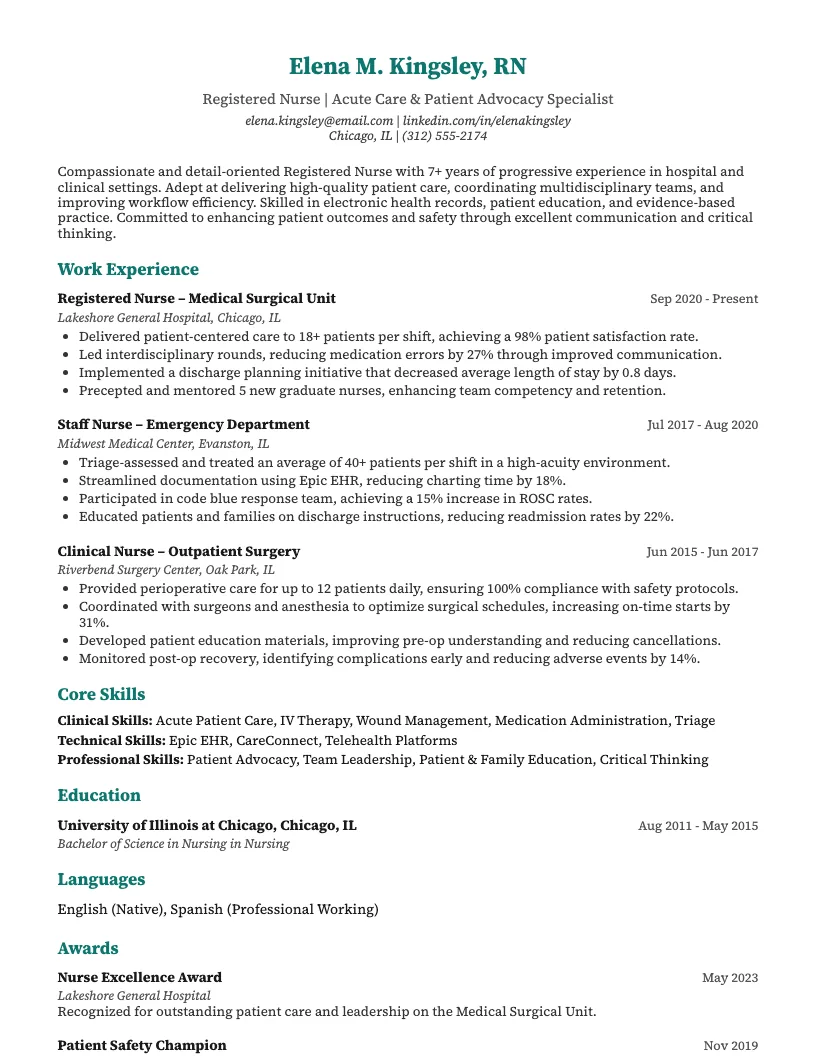
Click to enlarge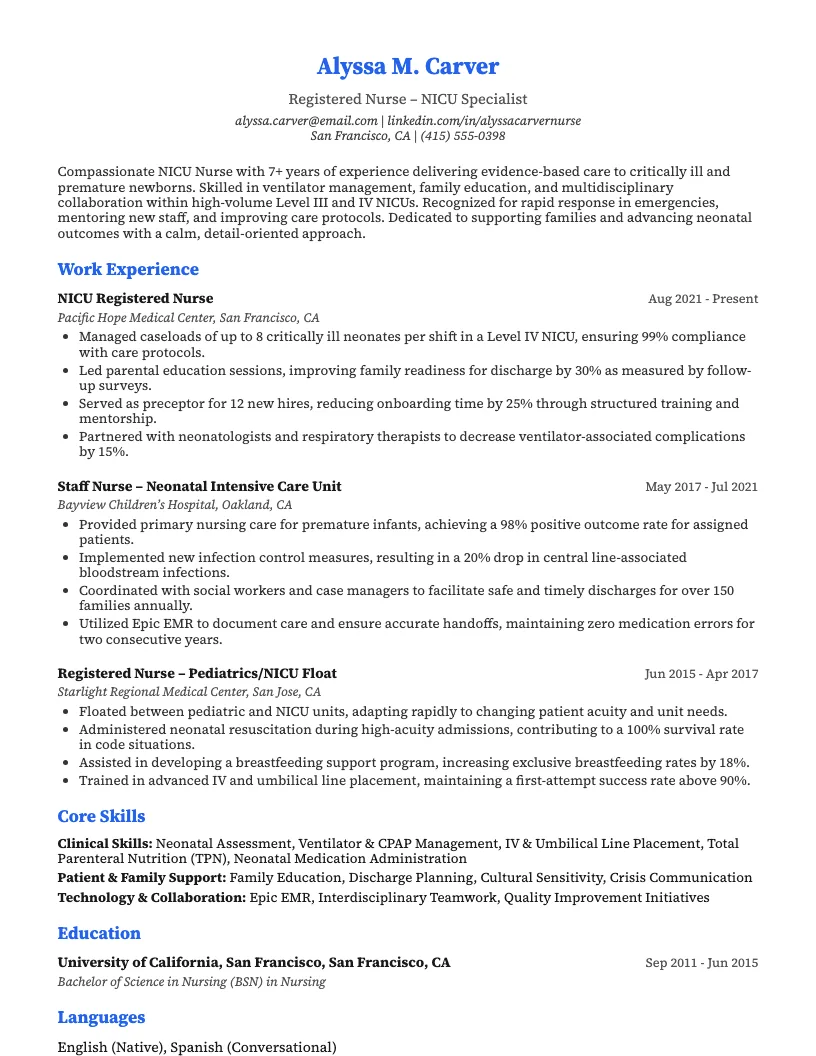 Click to enlarge
 Click to enlarge Click to enlarge Click to enlarge Click to enlarge Click to enlarge Click to enlarge Click to enlarge
Common questions about Icu Nurse resumes
An ICU nurse resume template is a pre-designed format tailored for intensive care nursing roles. It highlights clinical skills, certifications, and relevant ICU experience. ResumeJudge makes it easy to start with professional, proven layouts.
Yes, most ICU nurse resume templates from ResumeJudge are designed to be ATS-friendly. They use clean layouts and standard fonts to ensure your resume gets seen by recruiters and hiring systems.
Use an ICU nurse resume template when applying for critical care or intensive care unit positions in hospitals, trauma centers, or specialty clinics. ResumeJudge templates help you quickly target these jobs with the right emphasis.
Absolutely! You can personalize ICU nurse templates with your experience, certifications, and skills. ResumeJudge makes it easy to update sections, ensuring your resume fits each job you apply for.
ICU nurse templates focus on critical care skills, certifications like CCRN, and technical know-how specific to ICU settings. ResumeJudge distinguishes ICU resumes from general nurse templates with specialized sections and keywords.
Your ICU nurse resume should be one to two pages, highlighting your most relevant experience and skills. ResumeJudge helps you condense content effectively, so your key achievements stand out.
Highlight technical skills like ventilator management, EKG interpretation, and use of EHR systems. ResumeJudge guides you to showcase these along with soft skills like teamwork and critical thinking.
Yes, always list relevant certifications such as CCRN, ACLS, or BLS. ResumeJudge templates have dedicated sections so hiring managers can quickly see your qualifications.
Tailor your resume to each job by using keywords from the posting and quantifying achievements. ResumeJudge’s smart suggestions help you create bullet points that catch recruiters’ attention.
Yes, ICU nurse resume templates work for both experienced and entry-level candidates. ResumeJudge includes examples for new grads, so you can highlight clinical rotations and relevant skills.
Explore more professional resume examples to inspire your job search
Use our AI-powered resume builder to create a professional, ATS-friendly resume in minutes.
Free to use • No credit card required